• Following Us

  • Categories

  • Check out the Archives


  • Awards & Nominations

Star Trek: Enterprise – Shadows of P’Jem (Review)

Next year, Star Trek is fifty years old. We have some special stuff planned for that, but – in the meantime – we’re reviewing all of Star Trek: Enterprise this year as something of a prequel to that anniversary. This January, we’re doing the first season. Check back daily for the latest review.

Shadows of P’Jem is a wonderful episode. It is, in many respects, the first true post-9/11 episode of Star Trek: Enterprise, and it is a surprisingly thoughtful one at that.

In many respects, Enterprise has already established itself as Star Trek for the George W. Bush era. Archer is the franchise’s first white American male lead character since Kirk, and his contempt for politics and thirst for action mirrors the popular image of George W. Bush – a dynamic man with no time for questions or hesitation. Even little touches – like the fact that officers drink beer rather than champagne, or the anti-intellectual contempt that Archer and Trip feel towards Vulcans – suggest a Star Trek show that is very much in line with Bush’s America.

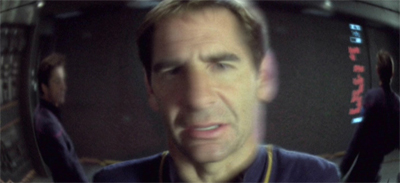
Shadows on Coridan...

Shadows on Coridan…

However, Shadows of P’Jem was among the first episodes written after the events of 9/11, and it’s an episode that seems quite thoughtful and introspective. The franchise has often used the Federation as a stand-in for American values and ideals. Shadows of P’Jem twists this idea on its head, offering the future Federation members as stand-ins for various facets of American foreign policy.

Shadows of P’Jem is a considerate and reflective look at what Walter Nugent termed “the habits of empire”, a look at the cost and consequences of imperialism in a post-colonial age, and how those issues tend to fester.
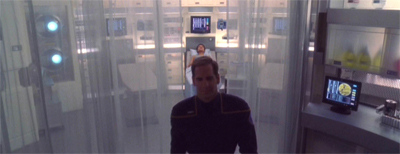
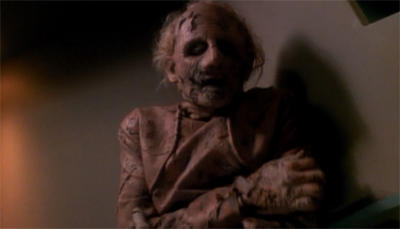
A night in sickbay...

A night in sickbay…

Continue reading

Star Trek: Enterprise – Silent Enemy (Review)

Next year, Star Trek is fifty years old. We have some special stuff planned for that, but – in the meantime – we’re reviewing all of Star Trek: Enterprise this year as something of a prequel to that anniversary. This January, we’re doing the first season. Check back daily for the latest review.

Silent Enemy is very much a game of two halves.

It’s an episode that suffers from the decision to incorporate two radically different plots into a single episode. In many respects, it’s a show that suffers from Star Trek: Enterprise‘s decidedly old-fashioned storytelling aesthetic: the sense that most hours of Star Trek need to have two plots running through them for pacing and structural reasons. This storytelling technique is a decidedly outdated approach to television, reflecting the narrative conservatism at play in the first season of the show.

We come in peace...

We come in peace…

Silent Enemy is built around two plots. The primary plot sees the ship coming into conflict with a bunch of strange predatory aliens who do not respond to attempts for contact, and who grow increasingly belligerent over the course of the episode. Archer and his crew find themselves facing an opponent far stronger and more aggressive than they are. It’s a pretty bleak, pretty heavy plotline. Inevitably, the show decided to pair it with something a bit more light-hearted, so we get Hoshi trying to figure out what Reed’s favourite food is that Chef can bake him a super-special birthday cake.

While the combination of plotlines isn’t the worst in the history of the franchise – the episode doesn’t feel like Frankenstein’s monster in the same way that Life Support does, for example – it’s still rather incongruous. Silent Enemy is an episode weakened by the decision to combine these two into a single story; the desire to offset the doom of the “Enterprise under siege” story with something a bit more easy-going and comedic.

Alien aliens...

Alien aliens…

Continue reading

Star Trek – Bread and Circuses (Review)

The first Star Trek pilot, The Cage, was produced in 1964. To celebrate its fiftieth anniversary, this December we are reviewing the second season of the original Star Trek show. You can check out our first season reviews here. Check back daily for the latest review.

Bread and Circuses is not subtle. Then again, that is the point.

There’s a lot of interesting stuff happening in Bread and Circuses, the fourteenth episode produced for the second season, but the last to air. There’s the idea of a world dominated by “a twentieth century Rome”, a rogue captain, a Prime Directive dilemma and a scathing indictment of modern television. Not only is it one of the last episodes with a “produced by Gene L. Coon” credit, it is also an episode co-written by Roddenberry and Coon. It is also the episode of Star Trek that endorses Christianity most explicitly and heavily.

"Wait, we're only getting it in black and white?"

“Wait, we’re only getting it in black and white?”

Bread and Circuses is a bold and audacious piece of television, full of venom and righteous anger, rich in satire and cynicism. It’s a plot so ridiculously over-stuffed with good ideas that viewers are liable to forgive the show’s somewhat cop-out ending where Kirk and his away team beam back to the Enterprise and continue on their merry way as though little has actually happened. Bread and Circuses feels like it uses every minute of its fifty-minute runtime wisely, balancing character with world-building.

It is probably a little bit too messy and disjointed to be labelled a dyed-in-the-wool classic, particularly when compared to the shows produced around it. Nevertheless, it is a decidedly ambitious piece of work, and one that demonstrates what Star Trek could do when it sets its mind to something.

When in Rome...

When in Rome…

Continue reading

Star Trek – The Deadly Years (Review)

The first Star Trek pilot, The Cage, was produced in 1964. To celebrate its fiftieth anniversary, this December we are reviewing the second season of the original Star Trek show. You can check out our first season reviews here. Check back daily for the latest review.

“Accelerated ageing” is one of those classic science-fiction tropes. It’s one of those stock element that can be easily baked into an episode – like “evil duplicate” or “body theft.” It instantly adds drama, gives the actors something to do, and offers a chance for the make-up team to work on something that might be considered a bit more prestigious than aliens. It pops up on shows as diverse as Stargate SG-1 and The X-Files.

Within the Star Trek franchise, the trope shows up a couple of times. The Deadly Years is the most obvious example, but it also shows up during the first two years of Star Trek: The Next Generation, when that show was trying hardest to channel its direct predecessor. Too Short a Season inverted the trope to give us “accelerated de-ageing”, while Unnatural Selection played it entirely straight.

A wrinkle in the timeline...

A wrinkle in the timeline…

The Deadly Years is an episode that doesn’t quite work as a cohesive whole, although if its populated with some intriguing moving parts. There is a sense that the writing staff are trying to plug perceived gaps in the story by throwing everything they have into the mix. Some of these are good ideas, some of these are already so familiar that they feel like Star Trek clichés at what marks the halfway point of the original production run.

There are several elements here that would arguably support their own episodes. On top of the idea of the crew ageing rapidly, we get the wonderful dramatic hook of Spock trying to prove Kirk unfit for command – a plot point that never feels like it gets enough focus. However, we also get another “incompetent/crazy/stupid senior official” plot heaped on top to provide a suitably dramatic climax to the episode. And the Romulans return, albeit as generic heavies. The Deadly Years is a mixed bag at best.

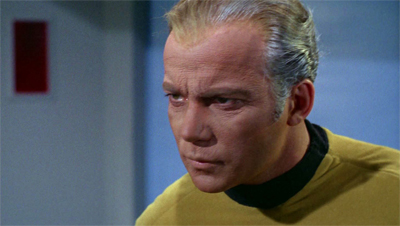
"She's... well, you get the idea..."

“She’s… well, you get the idea…”

Continue reading

Star Trek – Mirror, Mirror (Review)

The first Star Trek pilot, The Cage, was produced in 1964. To celebrate its fiftieth anniversary, this December we are reviewing the second season of the original Star Trek show. You can check out our first season reviews here. Check back daily for the latest review.

Mirror, Mirror is rightfully iconic.

It is a Star Trek episode that spawned sequels on Star Trek: Deep Space Nine and a prequel on Star Trek: Enterprise. It codified the whole idea of a “mirror universe” in popular culture, to the point where audiences readily accept the idea of an entire world populated with evil (and possibly sexy) counterparts to our characters. Shows as diverse as Doctor Who and South Park have played with the concept. Indeed, “evil alternate universe doppelganger has a goatee” is a recognisable trope.

... And that was the last time Koenig tried to upstage Shatner...

… And that was the last time Koenig tried to upstage Shatner…

There is a strange irony to all this. The mirror universe is an absurd concept for a number of reasons, and that absurdity is only heightened when it becomes more and more iconic. Turning the idea into a recognisable television cliché inevitably simplifies it. Although Mirror, Mirror is very camp – in the same way that a lot of classic Star Trek is camp – it is a story that has a lot of interesting and clever things to say. These tend to get sanded off through imitation and repetition. (For example, despite wearing the “evil goatee”, mirror!Spock is “a man of integrity.”)

And yet, behind the striking iconic production design and the admittedly absurd premise, Mirror, Mirror ranks as one of the best and most insightful scripts of classic Star Trek. It represents a cautionary tale and critical examination of some of the show’s core tendencies.

Bringing the pain...

Bringing the pain…

Continue reading

Star Trek: Deep Space Nine – The Die is Cast (Review)

This September and October, we’re taking a look at the jam-packed 1994 to 1995 season of Star Trek, including Star Trek: Deep Space Nine and Star Trek: Voyager. Check back daily for the latest review.

The Die is Cast is, like Improbable Cause before it, a wonderful piece of television.

As with most Star Trek: The Next Generation and Star Trek: Deep Space Nine two-parters, The Die is Cast maintains continuity and consistency with its predecessor, but it feels like a very different episode than Improbable Cause. After all, the curtain has been pulled back. The assassination attempt is no longer the driving force of the narrative (in fact, it’s barely referenced), with the plot focusing on Enabrain Tain’s pre-emptive strike against the Dominion.

A bruised ego...

A bruised ego…

It’s interesting that it falls to the Cardassians and the Romulans to drive the Dominion plot onwards. There’s been no real development of this long-form plot since Sisko and his crew escaped at the end of The Search, Part II. Episodes like The Abandoned and Heart of Stone have seen the crew encountering individual members of the Dominion, and shows like Visionary have had characters sitting around talking about them, but nothing has actually happened. It is mostly business as usual.

As such, the episode’s title feels beautifully appropriate – it’s the crossing of a threshold, a point from which there can be no return. Not just for Tain or the Cardassians, but the show itself.

Odo's sympathy for Garak runs dry...

Odo’s sympathy for Garak runs dry…

Continue reading

Star Trek: Deep Space Nine – Improbable Cause (Review)

This September and October, we’re taking a look at the jam-packed 1994 to 1995 season of Star Trek, including Star Trek: Deep Space Nine and Star Trek: Voyager. Check back daily for the latest review.

Improbable Cause is an episode that should be a mess. It was originally conceived as a sort-of-sequel to Second Skin, building off Garak’s murder of Entek in that episode. The idea was that Garak would face the consequences of that action, with the Obsidian Order planning an assassination attempt. However, the script was incredibly difficult to break. The resolution felt contrived and forced, closing the story out with Garak blackmailing is adversaries into compliance using a never-before-referenced isolinear rod felt overly convenient.

With the script not working, desperate action was taken. It was decided to extend Improbable Cause into a two-parter at the last minute, tying it into the proposed sequel to Defiant. The decision was made so late in the production schedule that it was impossible to pull the script back out of production. Even though Improbable Cause aired after Through the Looking Glass, it was produced beforehand. Writer René Echevarria re-wrote the last two acts of Improbable Cause with The Die is Cast screenwriter Ronald D. Moore in a frenzy, to tie both parts together.

Everything burns...

Everything burns…

This is the very definition of “production nightmare.” It recalls one of those stories that you hear about blockbuster movies that start shooting without a finished script, or directors being locked out of the editing suite. By all accounts, Improbable Cause should have been a trainwreck held together by duct tape and good thoughts. Instead, there’s a credible argument that Improbable Cause is the strongest episode of the third season. It’s certainly the strongest episode broadcast since Star Trek: Voyager came on the air.

And that’s down to one simple fact: every single aspect of Improbable Cause works extraordinarily well.

Odo has the scent...

Odo has the scent…

Continue reading

Star Trek: Deep Space Nine – Visionary (Review)

This September and October, we’re taking a look at the jam-packed 1994 to 1995 season of Star Trek, including Star Trek: Deep Space Nine and Star Trek: Voyager. Check back daily for the latest review.

Visionary confirms that “O’Brien must suffer” is to become an annual tradition on Star Trek: Deep Space Nine. The second season of the show had made a good start with episodes like Whispers and – to a lesser extent – Armageddon Game, but Visionary confirms that this will really be O’Brien’s niche in the ensemble from this point on. Visionary sees O’Brien randomly jumping forward through time, inevitably glimpsing some horrible tragedy that must be avoided. (Boy, it sure is lucky that he started jumping at this point, isn’t it?)

Visionary should feel contrived and convenient, hinging on a pretty flimsy plot hook. That said, the episode ultimately works quite well, even if it doesn’t stand out as a classic piece of Star Trek. Watching Visionary, there’s very much a sense that Visionary only really works as well as it does because Deep Space Nine has built up a larger mythology of characters and long-form plotting that can support what might otherwise be a fairly flimsy premise.

"Why the hell doesn't this ever happen to Julian?!"

“Why the hell doesn’t this ever happen to Julian?!”

Continue reading

Star Trek: Deep Space Nine (Malibu Comics) – Blood and Honour (Review)

The September and October, we’re taking a look at the jam-packed 1994 to 1995 season of Star Trek, including Star Trek: Deep Space Nine and Star Trek: Voyager. Check back daily for the latest review.

Whatever is to be done about the Romulans?

In space, all warriors are cold warriors...

In space, all warriors are cold warriors…

Continue reading

Star Trek: Voyager – Eye of the Needle (Review)

This September and October, we’re taking a look at the jam-packed 1994 to 1995 season of Star Trek, including Star Trek: Deep Space Nine and Star Trek: Voyager. Check back daily for the latest review.

Eye of the Needle really should be a bigger deal than it is.

Looking at the basic premise of Star Trek: Voyager, a story like Eye of the Needle should be an “event.” It should, at the very least, be a mid-season finalé. Ideally, the episode would serve as the season finalé, bringing a sense of closure to year of adventuring by our crew, suggesting that there is some measure of hope for them. Perhaps home is not as far away as it might seem.

"Hm. You appear to have beamed me up in my pyjamas..."

“Hm. You appear to have beamed me up in my pyjamas…”

Voyager is a show about a ship stranded on the far side of the galaxy. The crew are isolated from friends and family. The return journey will take seventy years. It is quite possible that this will be a generational voyage. The Voyager crew will return home to a world that has changed without them. It’s heartbreaking even to think about.

So the ship’s first chance to get home should be something to get excited about. It should be cause for celebration; it should feel like a lifeline dangling just within the reach of our characters. There should be a sense that this sort of think might only happen once, and everybody best be prepared for it. Instead, it happens six episodes into the season, and the audience spends forty-five minutes waiting for the other shoe to drop.

Thoughtful Janeway pose #452...

Thoughtful Janeway pose #452…

Continue reading