• Following Us

  • Categories

  • Check out the Archives


  • Awards & Nominations

Non-Review Review: Mr. Turner

Mike Leigh’s Mr. Turner is a stunningly beautiful naturalistic period piece. It is a little messy and unfocused, indulgent and uneven, but such is life itself. Covering the life of J.M.W. Turner, Leigh takes an expansive look at the life of one of Britain’s most distinctive and influential painters. Mr. Turner is perhaps a little over-long and meandering, and occasionally just a little bit too sly for its own good, but it does feature a charmingly larger-than-life performance from Timothy Spall and fantastic cinematography from Dick Pope.

Portrait of the artist as Timothy Spall...

Portrait of the artist as Timothy Spall…

Continue reading

Non-Review Review: ’71

Harrowing. Claustrophobic. Intense.

’71 is a powerhouse experience. Charting one night in Belfast for a young soldier separated from his regiment, there is a constant sense of dread pushing in from the edge of the frame. As one might expect for a movie set off the Falls Road in seventies Belfast, ’71 is paranoid and unsettled. It is a movie that constantly pushes the viewer to the very edge of their seat, offering an uncomfortable glimpse into something that would seem excessively brutal were it not anchored in historical fact.

71d

Continue reading

Star Trek: Voyager – Phage (Review)

This September and October, we’re taking a look at the jam-packed 1994 to 1995 season of Star Trek, including Star Trek: Deep Space Nine and Star Trek: Voyager. Check back daily for the latest review.

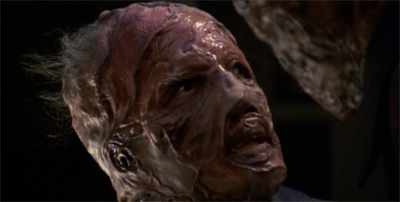
Phage is far from perfect. It is very far from perfect. However, there’s something rather endearing about this cheesy B-movie throwback written by Brannon Braga from a pitch by Timothy DeHass and first draft by Skye Dent. The Vidiians are probably the most memorably and effective aliens from the first three seasons of Star Trek: Voyager, feeling like they could have wandered into the show from some trashy late-night horror movie on another channel.

There’s a pulpy quality to the episode that makes it more enjoyable than many of the surrounding Voyager episodes, albeit one undermined by some of the more awkward resonances in the script.

The Vidiians survive by the skin of their teeth...

The Vidiians survive by the skin of their teeth…

Continue reading

Non-Review Review: Magic in the Moonlight

Attending a Woody Allen movie can often feel like playing low-stakes roulette. An extraordinarily prolific director with an incredible body of work behind him, Allen seems capable of churning out films that run the gamut from joyless and pedestrian to magical and exceptional. Woody Allen movies are like trains; if you don’t like this one, there will inevitably be another along in a year or so. However, it feels strange that his fiftieth feature should land so near the middle of the pack.

Magic in the Moonlight is an enjoyable Woody Allen comedy. It lacks a mesmerising central performance like Blue Jasmine or the sheer charm of Midnight in Paris, but it is a well-made and enjoyable excursion. There is charm and wit to it, and it never drags too heavily. However, there is very little truly exceptional about it. Magic in the Moonlight is more of a parlour trick than a how-stopping illusion; delightful and diverting, but feeling a little too unrefined to be truly memorable.

magicinthemoonlight4

Continue reading

Star Trek: Voyager – Caretaker (Review)

This September and October, we’re taking a look at the jam-packed 1994 to 1995 season of Star Trek, including Star Trek: Deep Space Nine and Star Trek: Voyager. Check back daily for the latest review.

So, Star Trek: Voyager.

Where do we begin? Voyager is probably the most divisive and controversial of the Star Trek spin-offs, the one that carries a lot of the blame for the franchise’s decline and decay in the mid to late nineties. It is the series that connects the tail end of the success story that was Star Trek: The Next Generation to the start of the dying gasp that was Star Trek: Enterprise. This spin-off had the misfortune to launch at the height of a revived franchise’s popularity and to finish as public interest waned.

Feels like going home...

Feels like going home…

Star Trek: Voyager felt like an act of hubris. It was positioned by Paramount to be the studio’s highest-profile television show. It was a feature of the television landscape, finally allowing Paramount the chance to leverage its own television network – a plan delayed since the late seventies, but deemed feasible in the mid-nineties. UPN branded itself “the first network of the new century”, a rather arrogant declaration. Caretaker was the first thing broadcast on UPN in early 1995, débuting to an audience of more than 21 million. However, Voyager would never reach those figures again.

Despite that success, things fell apart quickly. None of the shows that aired on UPN’s second night received a second season. The only shows to limp on to renewal from the network’s rocky first year were Voyager, The Sentinel and Moesha. Of these meagre freshmen hits. Voyager lasted the longest, with one more season to its name than Moesha. Over the summer of 1995, it was identified by The Los Angeles Times as the network’s “star survivor”, and the show upon which all of the network’s hopes rested. By 2000, five years later, the network had run up a debt of $800,000.
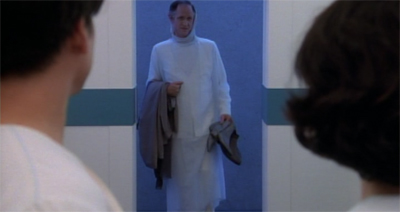
"I hope you don't mind, our tailors measured you while you were unconscious. It's all part of a standard probe."

“I hope you don’t mind, our tailors measured you while you were unconscious. It’s all part of a standard probe.”

That’s a lot of pressure for any television series to bear. Following (and, in the eyes of many, replacing) an illustrious predecessor, supporting the weight of a new television network, pushing into the future while remaining anchored to the past, it’s no wonder that Star Trek: Voyager wound up the confused mess that it became. Indeed, one can recognise many of the problems that would haunt the show through to its final season tied up in this pilot episode.

Continue reading

Non-Review Review: A Walk Among the Tombstones

A Walk Among the Tombstones is an oddly nostalgic serial killer film.

The movie is an adaptation of Lawrence Block’s novel of the same name. Block originally published A Walk Among the Tombstones in 1992, around the time that pop culture’s fascination with serial killers was building to a crescendo. Thomas Harris had released Red Dragon and The Silence of the Lambs to universal acclaim. Jonathan Demme’s film adaptation of The Silence of the Lambs had managed to sweep the Oscars, despite the handicap of a February 1991 release.

Dead letters...

Dead letters…

Scott Frank’s feature film adaptation moves the action forward to 1999, towards the tail end of pop culture’s interest in serial killers. Morgan Freeman’s career in serial killer films offers perhaps the best illustration of the state of the genre. By this point, Freeman had already moved on from 1995’s stylish se7en towards 1997’s efficient Kiss the Girls and was on the cusp of 2001’s unnecessary Along Came a Spider. The serial killer’s stock was falling, and the serial killer would soon be replaced by another bogeyman.

This shift in the story’s setting makes it feel like A Walk Among the Tombstones is a funeral ode towards the serial killer.

Lives are on the line...

Lives are on the line…

Continue reading

Non-Review Review: Noble

Christina Noble has done a lot of good in the world. She has helped 700,000 street children in Vietnam and Mongolia. She has devoted her life to charity pursuits. Travelling to Ho Chi Minh City in 1989, she made it her mission to help those who could not help themselves. She has done a phenomenal job of raising awareness and of improving the standard and quality of life of children who would otherwise be neglected or exploited. She is affectionately known as “Mama Tina” by the children she helps.

There is probably a great movie to be made about the life and times of Christina Noble. Sadly, Noble is not it.

noble3

Continue reading

Non-Review Review: The Equaliser

Appropriately enough for a movie featuring a climax that might be dubbed “Die Hard at the Home Depot”, The Equaliser does exactly what it says on the tin.

The revenge thriller is a tried-and-tested storytelling model. Similarly “the unstoppable killing machine relapses” is a pretty effective stock plot element. There is very little surprising to be found in The Equaliser. There’s never any real doubt about our hero. There’s never a twist that can’t be seen coming a mile away. Appropriately enough, given our hero’s fixation on time-keeping, everything in The Equaliser is constructed like clockwork. There is minimal clutter, no extraneous element. It works right out of the box.

When all you have is a hammer...

When all you have is a hammer…

And yet, despite that, it largely works. For all that one can follow instructions, watch-making is an artform. The Equaliser may not be an exceptional example of the form, but it is a fine demonstration of just how much technical skill counts in putting something like this together. Denzel Washington may be the most likeable leading man of his generation. Even when he is attacking mobsters with corkscrews or suffocating adversaries in their cars, there’s something strangely charming about him.

It helps that director Antoine Fuqua goes all in on The Equaliser. There are no half-measures here. The Equaliser doesn’t just hit the necessary beats. It smashes them.

Tears in the rain...

Tears in the rain…

Continue reading

Star Trek: Deep Space Nine – Meridian (Review)

The September and October, we’re taking a look at the jam-packed 1994 to 1995 season of Star Trek, including Star Trek: Deep Space Nine and Star Trek: Voyager. Check back daily for the latest review.

Meridian is, to be frank, an absolutely abominable episode of Star Trek: Deep Space Nine. As a series, Deep Space Nine never really had a concentrated run of bad episodes, like the first and second seasons of Star Trek: The Next Generation or the second season of Star Trek: Enterprise or the third season of the original Star Trek. The first two seasons of Deep Space Nine might not be spectacular, but they are competently produced television – while there are a few scattered stinkers to be found, the bulk of the show comprises of mediocre and solid stories.

Instead, Deep Space Nine tended to pepper its weakest episodes throughout its run, perhaps a firm reminder that the show was never an entirely serialised experience. This wasn’t one story pushing forward, despite the presence of arcs and character development; Deep Space Nine was still prone to the pratfalls of episodic television. In this case, the pratfall was the necessity of churning out filler on a tight schedule and hoping to meet a deadline while pumping out two dozen episodes a year.

So we get unforgivably shoddy episodes like The Emperor’s New Cloak or Profit and Loss or Let He Who Is Without Sin mixed in with Deep Space Nine at the height of its form. The third season of Deep Space Nine lacks the highs of the later seasons, but that doesn’t mean it lacks the lows. Meridian stands out as the weakest episode of the season, and a serious competitor for one of the worst episodes of the show.

It appears that the toxic smell of the script is suffocating Terry Farrell...

It appears that the toxic smell of the script is suffocating Terry Farrell…

Continue reading

Non-Review Review: A Most Wanted Man

For better or worse, A Most Wanted Man is going to be overshadowed by the passing of its lead actor. Philip Seymour Hoffman was a giant, a performer with a wonderful gift for bringing flawed and real characters to life, and A Most Wanted Man serves as his last leading role in a major motion picture. It is impossible to talk about A Most Wanted Man without talking about Philip Seymour Hoffman’s performance, and that’s not necessarily a bad thing.

It is a great performance, one that reminds the audience of why they loved Hoffman in the first place – Günther Bachmann is the sort of flawed human being that Hoffman played so well, given a great deal of depth by the late actor.

What's on the table?

What’s on the table?

Continue reading