• Following Us

  • Categories

  • Check out the Archives


  • Awards & Nominations

Non-Review Review: The Suicide Squad

The Suicide Squad is a stunning piece of blockbuster cinema.

There’s an understandable urge to treat The Suicide Squad as something of an outlier, particularly in the modern wave of big superhero blockbusters. After all, this is an R-rated blockbuster about a bunch of super-villains populated largely be characters that few people will recognise, let alone care about, and which exists in something of a strange continuity limbo away from the rest of the shared continuity. It is darkly funny, bitterly bleak, and decidedly uninterested in things like brand synergy. It is a sequel to a maligned film from a director now best known for his work with a rival studio and a rival property.

Squad goals.

Looked at from a certain angle, The Suicide Squad must seem as alien as the monster that rampages through the film’s third act – a space oddity that fell to Earth. However, this just makes it all the more remarkable that writer and director James Gunn has managed to fashion all of this into a thrilling and spectacular piece of blockbuster cinema that understands the appeal and the potential of the superhero genre without forsaking its own distinct perspective and while delivering on everything that a well-made populist blockbuster should.

There are very few superhero movies that are put together like The Suicide Squad. That’s their problem.

Continue reading

Non-Review Review: Stillwater

Stillwater is effectively three different movies bundled together. Each of those three movies have their own merits and their own weaknesses, but none of them really work when bundled together.

Stillwater stars Matt Damon as Bill Baker, a demolition worker from the eponymous town in Oklahoma. His daughter Allison is five years into a nine-year sentence in Marseilles, having been found guilty of a sensational crime involving the death of her roommate. Even half a decade later, Allison still protests her innocence and Bill tries to maintain some connection with his previously estranged daughter. However, the past is pulled into the present when a potential new lead opens up.

Damon’s demons.

Stillwater is directed by Tom McCarthy, who won the Best Original Screenplay Oscar (and was nominated for the Best Director Oscar) for his work on Spotlight. McCarthy has kept relatively busy since winning the award, collaborating on the script for Christopher Robin and doing uncredited rewrites on The Nutcracker and the Four Realms. However, Stillwater still feels likes something of a long-awaited return from McCarthy as a prestige filmmaker. Stillwater is built around a central movie star, deals with weighty issues, and even (faintly) echoes the very public spectacle of the Amanda Knox trial.

However, the film never coheres into a compelling narrative. It is disjointed and uneven, bouncing clumsily between tones and struggling to anchor itself as it switches freely between genres. Stillwater doesn’t run quite as deep as it needs to.

An American in Marseilles.

Continue reading

Non-Review Review: Jungle Cruise

Jungle Cruise is a throwback to a throwback to a throwback.

Jungle Cruise is inspired by the eponymous theme park ride, a surprisingly common occurrence in the age of intellectual-property-derived blockbusters, and an approach that has led to films like Pirates of the Caribbean: Curse of the Black Pearl and The Haunted Mansion. However, because even narrative-driven theme park rides don’t necessarily provide enough story to sustain a feature-length film, Jungle Cruise positions itself as a very deliberate homage to movies like The Mummy, and traces that lineage back to classic eighties adventures like King Solomon’s Mines, Romancing the Stone and Raiders of the Lost Ark.

Cruise Control.

There’s an undeniable charm in this. After all, that adventure movie template can trace its roots back to movies like The African Queen and even into classic screwball comedies. It is a narrative framework that lends itself to charismatic movie star performances, and so it makes sense that Jungle Cruise features two genuinely engaging movie stars at its core: Dwayne Johnson and Emily Blunt. Jungle Cruise is at its strongest when it is willing to trust its leads to do what they do best, to be fun and charming while having exotic adventures together.

Unfortunately, Jungle Cruise feels too beholden to the conventions of modern blockbuster storytelling to lean into its stronger elements. Instead, those aspects of the films are constantly at war with the demands and the limitations of a modern spectacle-driven blockbuster. At times, Jungle Cruise feels more like a faded map promising a path to precious treasure. The broad outline is clear, but the richer detail has been lost to time.

Continue reading

Non-Review Review: The Sparks Brothers

The Sparks Brothers is a fan’s love letter. As the tagline helpfully summarises, it is a documentary about “your favourite band’s favourite band.”

Virtually everybody who appears on camera in The Sparks Brothers appears to rave about the eponymous siblings, Russ and Ron Mael, whose career has spanned more than half a century. There is a lot of joy and enthusiasm on display, even within fairly standard talking head sequences. Mike Myers takes a moment to playfully joke about how carefully the documentary team is getting is mole in focus, while the only character who has anything particularly negative or dismissive of the band is an animated Neil Tennant in a recollection from one of the band’s long-term associates.

An interesting framing…

This makes sense. The Sparks Brothers is a documentary from director Edgar Wright, a self-acknowledged fan of the band. Wright is careful never to crowd out or overwhelm his subjects, but he also takes advantage of his position as director to indulge his own fannish enthusiasm for the unlikely pop group. The Sparks Brothers is a surprisingly long documentary, running to two hours and twenty minutes. At least part of this is down to the fact that Wright takes great care to ensure that absolutely everybody gets a chance to have their say on what makes this “unusual duo from the seventies” such a monument

The Sparks Brothers is indulgent to a fault, but it’s also enthusiastic and excited. The energy of the assembled panel radiates through the screen, giving the documentary an infectious joie de vivre. The result is perhaps a little overlong and a little hagiological, but it is carried by a genuine sense of overdue celebration.

Oh, brother!

Continue reading

New Escapist Video! “Space Jam: A New Legacy – Review”

I’m thrilled to be launching movie reviews on The Escapist. Over the coming weeks and months, I will be joining a set of contributors in adding these reviews to the channel. For the moment, I’m honoured to contribute a three-minute film review of Space Jam: A New Legacy, which is releasing theatrically and on HBO Max this weekend.

Non-Review Review: Fear Street Part Three – 1666

If Fear Street Part One – 1994 and Fear Street Part Two – 1978 didn’t make it clear enough, Fear Street Part Three – 1666 confirms that the trilogy is more of a miniseries than a set of films.

To be fair, this was quite clear from the outset. The films feature a large branching cast, with many actors carrying over from one installment to another. The continuity between the individual films is so tight that the two later installments each open with an extended “previously on…” segment. Fear Street Part Three – 1666 carries this idea to its logical conclusion, effectively functioning as a two-part season finale. It opens with an hour set in the past and then jumps forward for a forty-minute coda designed to close the book (if not literally) on the events from Fear Street Part One – 1994.

A sight for sore (or missing) eyes…

There’s not necessarily anything wrong with this. After all, there’s arguably not a huge difference between the structure of these three films and something like the Red Riding trilogy. More to the point, it demonstrates how porous the gap between various media has become. Demon Slayer: Mugen Train, the highest grossing movie of 2020, is really just a six-episode bridging arc between two seasons of the manga. Hamilton is both one of the best movies of all-time according to the Internet Movie Database and an Emmy nominee. Even the Marvel Cinematic Universe is arguably as much television as cinema.

As such, it’s hard to judge Fear Street Part Three – 1666 entirely on its own merits.

Tying it all up.

Continue reading

New Escapist Video! “A Marvelous Escape” – Loki – “For All Time. Always.”

With a slew of Marvel Studios productions coming to Disney+ over the next six months, The Escapist has launched a weekly show discussing these series

This week, I join KC Nwosu and Amy Campbell to talk about the sixth and final episode of Loki, streaming on Disney+.

Non-Review Review: Space Jam – A New Legacy

Space Jam: A New Legacy is content to be content.

Continue reading

Non-Review Review: Fear Street Part Two – 1978

Fear Street Part Two: 1978 sets itself a more modest goal than Fear Street Part One: 1994.

Part of that is simply the luxury of being the second part of a larger series. Fear Street Part Two: 1978 has appreciably less table-setting to do than Fear Street Part One: 1994, as the earlier film did a lot of the hard work in terms of establishing rules and building a framework for the trilogy’s internal mythology. While Fear Street Part Two: 1978 obviously builds on the foundations established by Fear Street Part One: 1994, it also has the luxury of working within an established template that saves it the bother of having to unload a lot of exposition very quickly while also serving as a self-contained slasher tribute.

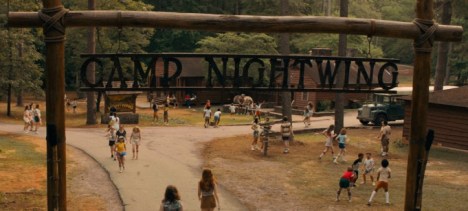
Camp Fear.

Part of it is also because Fear Street Part Two: 1978 is referencing a much less ambitious and self-aware set of movies. Fear Street Part One: 1994 was drawing from a pool of self-aware nineties horror movies like Scream, Urban Legends and I Know What You Did Last Summer, movies made by filmmakers who had grown up watching classic slasher movies on video cassettes and wanted to put their own self-aware spin on the genre and its conventions. So Fear Street Part One: 1994 was a self-aware riff on self-aware riffs on the genre. In contrast, Fear Street Part Two: 1978 draws from a purer sort of slasher movie.

These two factors mean that Fear Street Part Two: 1978 feels a lot less busy and cluttered than Fear Street Part One: 1994, if appreciably less ambitious. More than that, with a lot of the mythology building out of the way, Fear Street Part Two: 1978 is able to use its own narrative real estate to deepen and develop the core themes of the trilogy, foregrounding its big ideas with a little more finesse than the previous entry. The result is a movie that is perhaps less energised and less dynamic than its predecessor, but also a lot more comfortable and assured in what it is doing.

Sister, sister.

Continue reading

New Escapist Video! “Black Widow – Review”

I’m thrilled to be launching movie reviews on The Escapist. Over the coming weeks and months, I will be joining a set of contributors in adding these reviews to the channel. For the moment, I’m honoured to contribute a three-minute film review of Black Widow, which is releasing theatrically and on Disney+ Premier Access this weekend.