• Following Us

  • Categories

  • Check out the Archives


  • Awards & Nominations

Non-Review Review: Get Out

This film was seen as part of the Audi Dublin International Film Festival 2017.

Get Out is a fantastic horror comedy from Jordan Peele.

The premise of Get Out is relatively straightforward, with Rose taking her African American boyfriend Chris home to meet her wealthy white parents. What follows is essentially a twenty-first century horror movie twist on Guess Who’s Coming to Dinner?, in which Chris finds himself growing increasingly uncomfortable in the presence of Rose’s very liberal parents. There is an awkward unease to his visit with the family, beneath all the welcoming smiles and the mannered politeness.

Terrorvision.

Terrorvision.

Get Out is a brilliantly wry and ironic piece of film-making, building a very traditional horror movie around a very intangible discomfort. After all, racism is not always something that can be cleanly defined and measured, often reflected in implications and patterns more than individual statements and actions. Get Out masterfully plays on this tension of something so horrifying being rendered so ethereal, most notably through its repeated (effective) use of scare chords and horror angles making normal social interactions especially uncomfortable.

Get Out is a promising directorial debut from veteran comedian Jordan Peele, one that skilfully uses the flexibility and surrealism of conventional horror beats to build a well-observed and uncanny piece of social commentary.

Couldn't be Keener.

Couldn’t be Keener.

Continue reading

Star Trek – The Savage Curtain (Review)

This July and August, we’re celebrating the release of Star Trek Beyond by taking a look back at the third season of the original Star Trek. Check back every Monday, Wednesday and Friday for the latest update.

Gene Roddenberry returns to Star Trek, to put the show to rest.

Two of the final three episodes of this third season originated with Roddenberry, putting paid to the idea that the veteran executive producer was entirely absent from the year. Roddenberry had departed the show at the start of the season, after issuing NBC with an ultimatum regarding the scheduling of his series. He had moved out of the Star Trek production offices and across the lot to develop his own projects. The standard narrative of the third season suggests that Roddenberry was no longer around to keep the show on the rails.

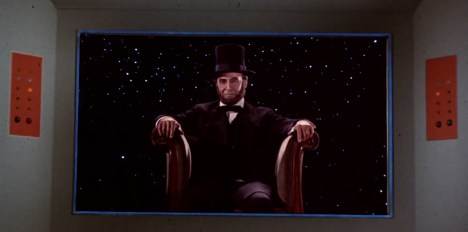
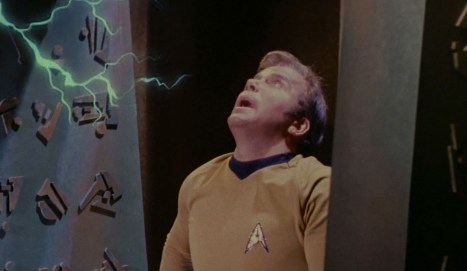
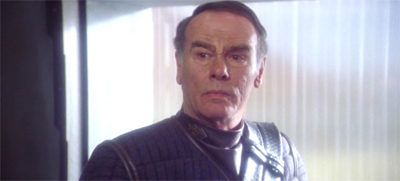
Holy space!Lincoln...!

Holy space!Lincoln…!

This is untrue, in a number of respects. Roddenberry was involved in the production of the third season, just not as actively as he had been. He was responsible for commissioning and championing a number of early third season episodes inherited by Fred Freiberger, including Elaan of Troyius and The Paradise Syndrome. He had even used his remaining leverage to shamelessly try to shoehorn merchandise into Spock’s Brain and Is There in Truth No Beauty? He was also drawing an executive producer salary and nabbed two late-season production slots.

Of course, this argument also relies on the assumption that Roddenberry understood Star Trek better than anybody else. Roddenberry had created Star Trek, but he was not the singular vision behind it. Writers like Dorothy Fontana and producers like Gene L. Coon were as responsible for shaping the show as Roddenberry in many respects. Roddenberry might have talked a good game, but he was also a producer who believed that The Omega Glory would have made a good pilot for the show.

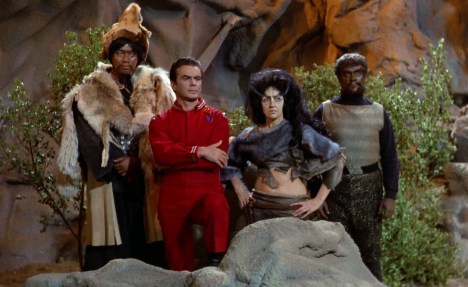
Legion of Doom!

Legion of Doom!

If anything, there is something faintly damning about Gene Roddenberry’s triumphant return to the series at the end of its third year. Neither The Savage Curtain nor Turnabout Intruder are good episodes. In fact, the best thing that can be said about Roddenberry’s two final contributions is that The Savage Curtain probably isn’t quite as bad as And the Children Shall Lead or The Way to Eden. Still, both episodes feel regressive and awkward. Roddenberry’s writing is a reminder of just how far the show had come in the care of other producers.

However, at least The Savage Curtain is memorable.

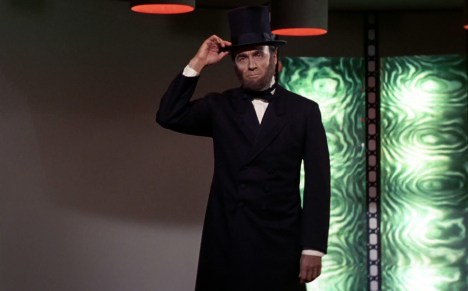
Topping it all off.

Topping it all off.

Continue reading

Star Trek – Plato’s Stepchildren (Review)

This July and August, we’re celebrating the release of Star Trek Beyond by taking a look back at the third season of the original Star Trek. Check back every Monday, Wednesday and Friday for the latest update.

Another third season episode. Another iconic episode.

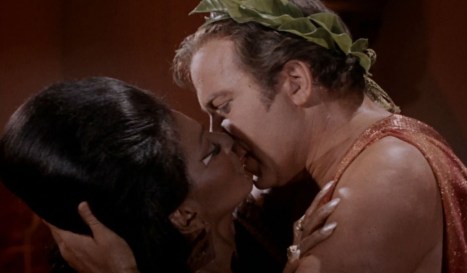
As with a lot of third season episodes, Plato’s Stepchildren is easily reduced to a selection of imagery and iconography. It is one of the episodes most likely to be cited as an “important” moment in the cultural evolution of Star Trek, full of clips that are likely to pop up on documentaries covering the history of television. Plato’s Stepchildren is an episode that has permeated popular culture, in large part due to a singular and memorable image that ultimately has very little to do with what the story is actually about.

"A kiss can be even deadlier, if you mean it."

“A kiss can be even deadlier, if you mean it.”

There is something frustrating about this. It feels inappropriate that Plato’s Stepchildren should have become such an important part of the history and the mythology of Star Trek. Not only is Plato’s Stepchildren offensive in ways that deliberately and brutally cut against the imagery that is so lauded, it is also a terrible piece of television in its own right. As with a lot of the third season of Star Trek, it seems like the mythology of the show is brushing up against the quality of the show itself.

Plato’s Stepchildren is memorable and important, but it is all boring and offensive. It encapsulates a lot of the third season, all in all.

"I can see you."

“I can see you.”

Continue reading

Star Trek – The Paradise Syndrome (Review)

This July and August, we’re celebrating the release of Star Trek Beyond by taking a look back at the third season of the original Star Trek. Check back every Monday, Wednesday and Friday for the latest update.

As with Elaan of Troyius, it feels like The Paradise Syndrome casts an awfully long shadow for such a simply awful episode.

Much like Elaan of Troyius before it, The Paradise Syndrome marks out what will become a particular subgenre of Star Trek episode. To be fair, Elaan of Troyius had a much greater influence; it demonstrated that the basic “Enterprise ferries diplomats” plot from Journey to Babel was something that could be repeated, throwing a healthy helping of “our hero falls for an alien princess” into the mix. In contrast, the basic template defined by The Paradise Syndrome is a lot more specific.

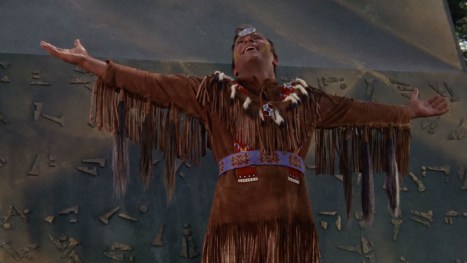
Going Native American.

Going Native American.

The Paradise Syndrome effectively posits a “what if…?”, wondering what might happen if Kirk gave up adventuring to settle down into a more mundane existence. It is an idea that Star Trek: The Next Generation would revisit to much greater effect in The Inner Light. It is also the basic template employed by Workforce, Part I and Workforce, Part II during the final season of Star Trek: Voyager. It is very rare to point to Voyager and argue that it executed an idea much better than the original Star Trek, but this is perhaps the exception that proves the rule.

The Paradise Syndrome is also (and unavoidably) a clumsy racist misfire of an episode.

"That'll teach me to hope that the next episode will be better."

“That’ll teach me to hope that the next episode will be better.”

Continue reading

Star Trek: Enterprise – Storm Front, Part II (Review)

This May, we’re taking a look at the fourth (and final) season of Star Trek: Enterprise. Check back daily for the latest review.

Storm Front, Part I and Storm Front, Part II arrive at a transitory time for Star Trek: Enterprise.

The fourth season was almost certain to be the end of the show, with Brannon Braga stepping back from the writers’ room to allow Manny Coto the chance to the take the reins. Coto would use the opportunity to more firmly connect the show to its franchise roots, constructing a final season that would serve as something of a bridge between this prequel series and the rest of the canon. However, there was just one problem. Coto inherited a cliffhanger from Zero Hour, the third season finale that stranded Archer in the past with some evil!alien!space!Nazis.

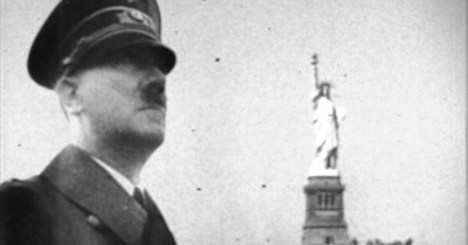
Into the sunset...

Into the sunset…

Although the fourth season of Enterprise is widely praised by the few fans who remained watching until the bitter end, Storm Front, Part I and Storm Front, Part II are often overlooked in discussions of the season. Much like These Are the Voyages… at the very end of the season, the opening two-parter is largely treated as a story foisted upon an incoming executive producer that does not reflect his own plans or desires for the season ahead. There is typically a sense of obligation to discussions of the two-parter as little more than a speed bump into the season.

This is a shame. Storm Front, Part I and Storm Front, Part II were both written by Manny Coto. Although the producer inherited the basic premise and the brief from his direct predecessors, how Coto chose to approach the material is quite insightful and informative. In that respect, Storm Front, Part I and Storm Front, Part II might be seen as an introduction to the Manny Coto era before it properly begins in Home.

"It's been a long road, gettin' from there to here... It's been a long time, but my time is finally near..."

“It’s been a long road, gettin’ from there to here…
It’s been a long time, but my time is finally near…”

Continue reading

Non-Review Review: Zootropolis (aka Zootopia)

This film was seen as part of the Audi Dublin International Film Festival 2016.

Zootropolis is a solidly entertaining family film that strains under the weight of its core premise.

There is a great idea in here, a detective film set in an anthropomorphised world featuring a rabbit and fox who must team up to solve a number of mysterious disappearances. Along the way, writers Jared Bush and Phil Johnston fashion the story into an allegory rich with social commentary about race and class issues in American cities. It helps that the script is light on its feet and packed with enough fast gags that it breezes along without ever getting stuck in the same place for too long.

zootopia4

However, this becomes a problem in and of itself. There is a sense that Zootropolis struggles to do too much in the space afforded to it. The plot covers quite a lot of ground as our plucky heroes embark on their investigation, including extended (and overt) riffs on pop culture standards like The Godfather and Breaking Bad. There are points at which it feels like Zootropolis might be a much stronger film if it slowed down a bit, instead of hopping from one set-up to the next in the style of its rabbit protagonist.

Zootropolis largely works, but it never comes together in the way that the best Disney outings do. There are points at which Zootropolis feels more like a turducken than a chimera.

zootopia5

Continue reading

Millennium – Human Essence (Review)

This July, we’re taking a trip back in time to review the sixth season of The X-Files and the third (and final) season of Millennium.

Human Essence is the second (and final) script from Michael Duggan. It is also, notably, the first episode of the third season not to credit Duggan as an “executive producer” before the final credits.

Human Essence is a terrible episode of television. However, it is interesting to note that it is mostly terrible in ways that generic television can be terrible. The third season of Millennium is often terrible because of decisions or realities imposed by or resulting from creative decisions relating to the show itself. In the case of something like Through a Glass Darkly, the terribleness results from a perfect storm of vices associated with Millennium as a show. The Innocents and Exegesis are hobbled by choices made about the direction of the show.

Here there be monsters...

Here there be monsters…

Human Essence is terrible in a much more generic way. It would be a terrible episode of just about any television show. One of the problems with the episode is that it feels like it could easily be a terrible episode of just about any television show. With some light revisions, Human Essence could easily become a terrible episode of The X-Files or a terrible episode of Law & Order. Change the character names, tweak the dialogue a little. It wouldn’t take more than some light scrubbing to remove any hint of Millennium from the script.

However, it would take significantly more scrubbing to get the smell of crap off the script.

Yeah. We're hip.

Yeah. We’re hip.

Continue reading

The X-Files – El Mundo Gira (Review)

This February and March, we’re taking a trip back in time to review the fourth season of The X-Files and the first season of Millennium.

The X-Files is a show that sometimes has difficulties when it comes to portraying minorities.

There are lots of episodes that offer insightful and thoughtful explorations of isolated subcultures, without veering into offensive stereotypes or awkward cliché. Fresh Bones and Hell Money are two examples of the kinds of stories that do offer those sorts of interesting and respectful depictions of minorities. In contrast, the show can sometimes seem a little close-minded and xenophobic. Excelsis Dei, Teso Dos Bichos and Teliko are episodes with somewhat questionable depictions of other cultures.

Illegal aliens.

Illegal aliens.

Writer John Shiban likes his horror tropes. He adores the classic horror movie trappings, and revels in a very old-school approach to scary stories. Unfortunately, the horror genre has an unfortunate history of exploitation and racism when it comes to the portrayal of “the other.” The easiest way to make something scary and unknown is to make it foreign, suggesting that the outside world is filled with horrors and monstrosities. Shiban would hit on this trashy exploitation vibe repeatedly during his tenure on The X-Files.

El Mundo Gira is very much a companion piece to Shiban’s other stories about foreign monsters – the indigenous cat-people of Teso Dos Bichos and the butt-dwelling Indian fakir of Badlaa. It is a not a story set in the world of Mexican-American immigrants; it is a story set in a clumsy stereotypical depiction of the world of Mexican-American immigrants, as channelled through unfortunate racial stereotypes.

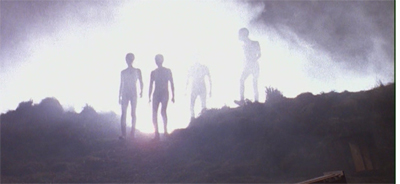
Green haze...

Green haze…

Continue reading

Star Trek: Enterprise – Detained (Review)

Next year, Star Trek is fifty years old. We have some special stuff planned for that, but – in the meantime – we’re reviewing all of Star Trek: Enterprise this year as something of a prequel to that anniversary. This January, we’re doing the first season. Check back daily for the latest review.

Detained is well-meaning, if a little clumsy and awkward.

It is a rather conscious effort to do a “message show” in the grand tradition of the Star Trek franchise, using the show’s science-fiction premise to offer a commentary on current events. Detained is very clearly structured as a response to the 9/11 attacks, even if Archer only explicitly references the internment of Japanese Americans at Manzanar. Detained is full of interesting ideas, and its heart is in the right place, but the execution feels decidedly rushed and haphazard. Detained works much better as a two-line moral than it does as a forty-five minute episode of television.

You can't call him Al...

You can’t call him Al…

Continue reading

Star Trek: Enterprise – Breaking the Ice (Review)

Next year, Star Trek is fifty years old. We have some special stuff planned for that, but – in the meantime – we’re reviewing all of Star Trek: Enterprise this year as something of a prequel to that anniversary. This January, we’re doing the first season. Check back daily for the latest review.

Breaking the Ice is the first episode of the first season of Star Trek: Enterprise not to reserve a “story by” credit for Rick Berman and Brannon Braga. (Although – in the To Boldly Go documentary – Braga has suggested that at least some of the episode came from his own ideas.)

It is instead credited solely to the writing team of Maria & Andre Jacquemetton. A husband-and-wife writing team, the duo have a long history of writing for television. Before they worked on Enterprise, their credits included Baywatch Nights. However, they are probably more notable for the work that they did after Enterprise, working as executive producers and writers on Mad Men. The duo have won WGA awards for their contributions to Mad Men and been nominated for Emmys.
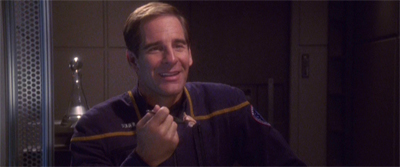
Guess who's coming to dinner...

Guess who’s coming to dinner…

It is very easy to take the pedigree of the writers on Star Trek for granted. After all, Ronald D. Moore went from a Star Trek: The Next Generation fan with a spec script to the showrunner on the rebooted Battlestar Galactica. Bryan Fuller went from a workhorse on the Star Trek: Voyager staff to a television auteur with work on Dead Like Me, Pushing Up Daisies and Hannibal. Brannon Braga has been prolific since his departure from the franchise, while Ira Steven Behr and René Echevarria have worked consistently in genre television.

It is tempting to claim that Enterprise was something of a formative experience for the Jacquemettons, but that would be disingenuous. Despite writing the show’s first script without a credit to Berman and Braga, the duo were not around long enough to make an impression on the show. They departed at the end of the first season, along with most of the writing staff. Indeed, the most significant influence that Enterprise had on their career was probably the fact that they used to discuss the idea for Mad Men with creator Matt Weiner while they were working on this show.
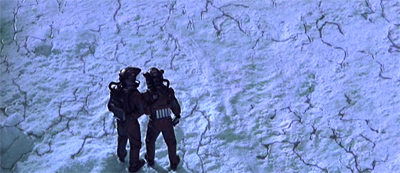
They're cracking up out there...

They’re cracking up out there…

Still, while hardly a demonstration that Jacquemettons were a creative force to be reckoned with, Breaking the Ice is a solid little episode. It ranks as the strongest episode of Enterprise since the pilot. In many respects, it recalls the Prime Factors/State of Flux duology from the first season of Voyager. It is a flawed episode that has no shortage of ambition, offering a taste of what could make its show unique in the Star Trek pantheon.

It is an episode that celebrates everything that makes Enterprise unique as compared to the other Star Trek shows, taking a great deal of pleasure in things that the audience had come to take for granted in the franchise. It’s a quiet character piece, where what little plot exists is pushed very much to the background, and which offers a much more nuanced view of human/Vulcan relations than Strange New World or The Andorian Incident.

Those Vulcans are cold so-and-sos...

Those Vulcans are cold so-and-sos…

Continue reading