• Following Us

  • Categories

  • Check out the Archives


  • Awards & Nominations

Star Trek: Deep Space Nine – Family Business (Review)

This September and October, we’re taking a look at the jam-packed 1994 to 1995 season of Star Trek, including Star Trek: Deep Space Nine and Star Trek: Voyager. Check back daily for the latest review.

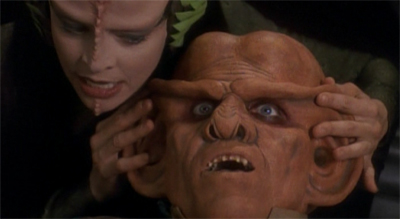
Family Business is surprisingly good, standing as one of the strongest Ferengi-centric episodes produced during the run of Star Trek: Deep Space Nine. This is largely down to how Family Business treats its central characters. While still broadly played as a farce, Family Business is rooted in character. Like House of Quark (and unlike Prophet Motive), the episode takes care to treat its characters with a great deal of respect.

This isn’t an episode constructed around stock comedy tropes and trying to get the audience to laugh at one-note caricatures. Instead, it’s an episode firmly built around exploring Quark as a character in his own right. Family Business makes the decision to treat Quark (and its other Ferengi characters) with respect, and it’s a decision that ultimately pays dividends.

Naked ambition...

Naked ambition…

Continue reading

Star Trek: Deep Space Nine – Prophet Motive (Review)

This September and October, we’re taking a look at the jam-packed 1994 to 1995 season of Star Trek, including Star Trek: Deep Space Nine and Star Trek: Voyager. Check back daily for the latest review.

Now that Star Trek: Voyager is on the air, there’s a sense that Star Trek: Deep Space Nine can be more relaxed. The show was undeniably contrarian during the short period when it was the only Star Trek on the air, presenting a series of uncompromisingly cynical episodes to assure viewers that it would not be trying to fill the void left by Star Trek: The Next Generation. At the same time, there’s also a sense that show was acutely aware of it potentially wider audience watching during that window.

During that first half of the season, a new adversary was pushed to the fore, the show did a story about Klingons and featured three guest stars from The Next Generation – although not necessarily the guest stars anybody would have chosen. More than that, though, the show seemed to consciously avoid its more controversial types of episodes. Even by the show’s third year, it had become clear that certain “types” of episodes appeared a few times a year – a couple of “old favourites” for the writing team to fall back on while constructing a twenty-six episode season.

'Ear me out 'ere...

‘Ear me out ‘ere…

As such, it’s telling that the most divisive parts of any Deep Space Nine season were pushed into the second half of the season.  So Ira Steven Behr and Robert Hewitt Wolfe’s two Ferengi-centric scripts came after Voyager had premiered. Sure, Quark got to be the focus of the season’s third episode, House of Quark, but he shared that with the popular Klingons. The season’s two big Bajoran plot lines (Life Support and Shakaar) were positioned towards the end of the year.

Prophet Motive feels like the kind of Star Trek episode that could only be produced on Deep Space Nine as part of Ira Steven Behr’s unique vision for the show. It’s the kind of weird script that the show seemed to get away with by virtue of being “the other Star Trek on television.” That doesn’t mean that it’s particularly good, mind you, just that it’s distinctly a Deep Space Nine story.

Quark is a by-the-book Ferengi...

Quark is a by-the-book Ferengi…

Continue reading

Star Trek: Deep Space Nine (Malibu Comics) – The Rules of Diplomacy (Review/Retrospective)

The September and October, we’re taking a look at the jam-packed 1994 to 1995 season of Star Trek, including Star Trek: Deep Space Nine and Star Trek: Voyager. Check back daily for the latest review.

One of the more interesting aspects of Star Trek: Deep Space Nine is the way that the cast actively involved themselves in the mythology of the show. Armin Shimerman originally pitched The 34th Rule as an episode of the show, along with Eric A. Sitwell and David R. George III. Andrew Robinson published A Stitch in Time, a novel based on notes he had been making about Garak during the production of the series. Even J.G. Hertzler co-wrote the Left Hand of Destiny duology.

Of course, this was not a unique occurrence. Walter Koenig had written an episode of Star Trek: The Animated Series, an issue of Marvel’s on-going Star Trek comic and even The Machiavellian Principle, a play performed at the Ultimate Fantasy convention. John DeLancie had co-written The Gift, a story published in DC’s Star Trek: The Next Generation comics. Ethan Phillips and Robert Picardo would lend their names to tie-in Star Trek: Voyager books.

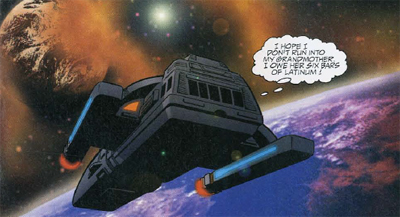
However, it seems reasonable to observe that the supporting cast on Deep Space Nine were particularly interested in fleshing out and developing their characters. So it seems appropriate that Aron Eisenberg should co-write The Rules of Diplomacy, a special about Nog earning some credits before shipping off to Starfleet Academy.

You can't go home again...

You can’t go home again…

Continue reading

Star Trek: Deep Space Nine – Meridian (Review)

The September and October, we’re taking a look at the jam-packed 1994 to 1995 season of Star Trek, including Star Trek: Deep Space Nine and Star Trek: Voyager. Check back daily for the latest review.

Meridian is, to be frank, an absolutely abominable episode of Star Trek: Deep Space Nine. As a series, Deep Space Nine never really had a concentrated run of bad episodes, like the first and second seasons of Star Trek: The Next Generation or the second season of Star Trek: Enterprise or the third season of the original Star Trek. The first two seasons of Deep Space Nine might not be spectacular, but they are competently produced television – while there are a few scattered stinkers to be found, the bulk of the show comprises of mediocre and solid stories.

Instead, Deep Space Nine tended to pepper its weakest episodes throughout its run, perhaps a firm reminder that the show was never an entirely serialised experience. This wasn’t one story pushing forward, despite the presence of arcs and character development; Deep Space Nine was still prone to the pratfalls of episodic television. In this case, the pratfall was the necessity of churning out filler on a tight schedule and hoping to meet a deadline while pumping out two dozen episodes a year.

So we get unforgivably shoddy episodes like The Emperor’s New Cloak or Profit and Loss or Let He Who Is Without Sin mixed in with Deep Space Nine at the height of its form. The third season of Deep Space Nine lacks the highs of the later seasons, but that doesn’t mean it lacks the lows. Meridian stands out as the weakest episode of the season, and a serious competitor for one of the worst episodes of the show.

It appears that the toxic smell of the script is suffocating Terry Farrell...

It appears that the toxic smell of the script is suffocating Terry Farrell…

Continue reading

Star Trek: Deep Space Nine – The Jem’Hadar (Review)

Star Trek: Deep Space Nine is twenty years old this year. To celebrate, I’m taking a look at the first and second seasons. Check back daily for the latest review or retrospective.

In terms of sheer quality of execution, The Jem’Hadar is probably the weakest of Star Trek: Deep Space Nine‘s season finalés. It lacks the gut punch of A Call to Arms, the shock twist of Broken Link, the atmosphere of The Adversary or even the timeliness of In the Hands of the Prophets. It is, at its most basic level, a story about a disastrous first contact that occurs during a father-son bonding trip that goes horribly wrong, ending with precious little actually advanced.

However, in terms of conceptual ideas, The Jem’Hadar is a game-changer. It is the cornerstone upon which Deep Space Nine would construct its most iconic narrative arc. It caps off two years of trying to develop the Ferengi as more than one-note jokes. It’s a bold statement about the freedom that Deep Space Nine would enjoy with Star Trek: The Next Generation retiring from the airwaves. It cemented the notion that Deep Space Nine never really dealt in two-part episodes to bridge seasons.

For Deep Space Nine, season finalés did not exist simply as pieces of Lego designed to snugly fit those other pieces at the start of the following season, crafting some illusion of continuity flow between two different seasons of television. Instead, cliffhangers on Deep Space Nine changed the rules, shook up the status quo, and teased the changing face of things to come.

A Jem?

A Jem?

Continue reading

Star Trek: Deep Space Nine – The Alternate (Review)

Star Trek: Deep Space Nine is twenty years old this year. To celebrate, I’m taking a look at the first and second seasons. Check back daily for the latest review or retrospective.

Well, at least the second season of Star Trek: Deep Space Nine is experimental. It might not always pay-off, but there’s a clear sense that the show is trying new things, bending various genres to make them fit within the broad outline of a Star Trek show. Necessary Evil was a fascinating attempt to construct a noir episode, while Rivals was a less-than-successful sit-com in space. The Alternate is very much doing “Star Trek as monster movie”, which is surprisingly fun.

To be fair, it’s not a subgenre new to the franchise. Indeed, the first episode of the original show to air, The Man Trap, was essentially a monster horror in space. Still, The Alternate feels a bit more sinister and dark than  anything that Star Trek: The Next Generation might attempt. (Schisms probably comes closest, but – even then – there’s no sense that the monsters are stalking the starship. They have to abduct their victims to experiment on them.)

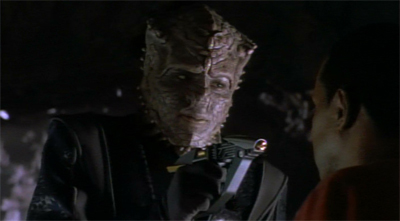
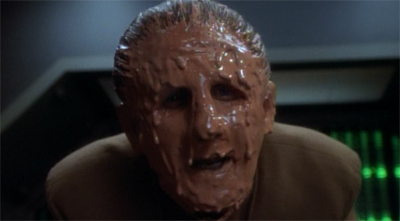
More than that, though, The Alternate is also a fascinating exploration of Odo as a character, looking at the relationship that Odo has with his co-workers and how that is rooted in his relationship with the man who claims to be his “father.”

Melting! Melting! Oh what a world!

Melting! Melting! Oh what a world!

Continue reading

Star Trek: Deep Space Nine – Rivals (Review)

Star Trek: Deep Space Nine is twenty years old this year. To celebrate, I’m taking a look at the first and second seasons. Check back daily for the latest review or retrospective.

Rivals doesn’t work. However, while the second season has produced a string of noble failures, Rivals fails for a very simple reason. It’s a comedy episode without any comedy. It’s a guest-star focused episode which centres on a hopelessly miscast Chris Sarandon. Sarandon is an Oscar-nominated actor, and he should be something of a casting coup for the show. This second season has already featured Louise Fletcher, Frank Langella and John Glover – so it seems fair to acknowledge that the casting people were on a bit of a roll.

However, due to a reheated script and Sarandon’s lack of interest or engagement, Rivals winds up feeling stale. There is potential here, but it’s squandered as the writers forget the first rule of a good comedy episode. They forgot to bring the laughs.

I feel a similar way...

I feel a similar way…

Continue reading

Star Trek: Deep Space Nine – Necessary Evil (Review)

Star Trek: Deep Space Nine is twenty years old this year. To celebrate, I’m taking a look at the first season. Check back daily for the latest review or retrospective.

Commence Station Security log. Stardate 47282.5. At the request of Commander Sisko, I will hereafter be recording a daily log of law enforcement affairs. The reason for this exercise is beyond my comprehension, except perhaps that humans have a compulsion to keep records and lists and files. So many, in fact, that they have to invent new ways to store them microscopically, otherwise their records would overrun all known civilisation. My own very adequate memory not being good enough for Starfleet, I am pleased to put my voice to this official record of this day. Everything’s under control. End log.

Necessary Evil continues to deliver on the promise of “things you can’t do anywhere but Star Trek: Deep Space Nine that Michael Piller made at the start of the show’s second season. It’s a genuinely ambitious piece of Star Trek, all the stronger for the fact that it’s idea that could go horribly and spectacularly wrong. Movies like Blade Runner demonstrated that it is possible to blend the aesthetics of science-fiction and film noir, but it seems like a mix that would sit rather uncomfortably in the bright utopian future of Star Trek.

However, Deep Space Nine was never afraid to experiment with its format. This wasn’t always successful, but it did give the show a unique flavour. And when it did work, as it does here, it offered something new and exciting to the franchise’s playbook.

Time for a Changeling...

Time for a Changeling…

Continue reading

Star Trek: Deep Space Nine – Rules of Acquisition (Review)

Star Trek: Deep Space Nine is twenty years old this year. To celebrate, I’m taking a look at the first season. Check back daily for the latest review or retrospective.

The Nagus was a surprising high-point of the first season of Star Trek: Deep Space Nine. It represented a conscious effort to rehabilitate and reappraise the Ferengi, the aliens introduced as potentially major adversaries in the first season of Star Trek: The Next Generation, only to wind up as mostly unfunny comic relief. The Nagus dared to suggest that the Ferengi might not be the monsters the Federation considers them to be, suggesting that their culture – while different – was no less worthy of respect or consideration than that of the Klingons.

Rules of Acquisition is a clear follow-up, right down to the way that it includes Grand Nagus Zek. However, it’s nowhere near as charming and successful as The Nagus, because it feels like it’s just treading water. It teases potential developments down the line, but the story seems locked in a familiar holding pattern – right down to the rather convenient ending that inevitably sees Quark snatching defeat from the jaws of victory.

It’s not quite a bad episode, certainly not on the scale of the colossal misfire that was Melora, but it’s also not a particularly good one.

Nothing to see here...

Nothing to see here…

Continue reading

Star Trek: Deep Space Nine – Melora (Review)

Star Trek: Deep Space Nine is twenty years old this year. To celebrate, I’m taking a look at the first season. Check back daily for the latest review or retrospective.

It’s hard to believe, based on what we’ve witnessed so far, but one day viewers will be able to think “oh, a Bashir episode!” without an involuntary shudder. There will come a time when the writing staff figure out how to write a Bashir-centric episode. In fact, they’ll even revisit this central premise in the show’s final season, in a way that is much less creepy because at least it acknowledges the creepiness. However, we’re a long way from that.

It’s not that Bashir is a bad character. In fact, I’m very fond of him. I think that this version of the character works very well as part of an ensemble, or even teamed up with another major character to carry a story. However, I don’t think that the show has quite figured out how to tell a Bashir-centric story yet. Most notably because – like The Passenger before it – Melora isn’t really about Bashir. At least not in a way that isn’t creepy and disturbing and unnerving.

Instead, Bashir is mostly a vehicle for the guest character of the week, who lends the episode her name and serves as the focal point of some incredibly condescending and patronising writing which doesn’t make the optimistic future of Star Trek look particularly bright.

Floating in a most peculiar way...

Floating in a most peculiar way…

Continue reading