• Following Us

  • Categories

  • Check out the Archives


  • Awards & Nominations

Star Trek: Deep Space Nine – In the Cards (Review)

In the Cards is the perfect penultimate episode to a sensational season of television.

One of the more common observations about Star Trek: Deep Space Nine is that it is the most dour and serious of the Star Trek series. It is the grim and cynical series of the bunch, with many commentators insisting that the series rejects the franchise’s humanist utopia in favour of brutality and nihilism. This criticism is entirely understandable. The series is literally and thematically darker than Star Trek: The Next Generation or Star Trek: Voyager. Even at this point, it is about to embark upon a two-year-long war arc, the longest in the franchise.
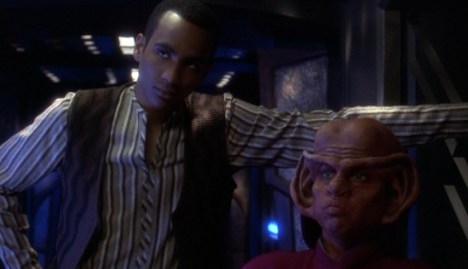
Jake and the Ferengi Man.

Jake and the Ferengi Man.

However, this is also a very reductive reading of Deep Space Nine. The series is more willing to criticise and interrogate the foundations of the Star Trek universe than any of its siblings, but it remains generally positive about the human condition. Governments and power structures should be treated with suspicion, but individuals are generally decent. Positioned right before the beginning of an epic franchise-shattering war, In the Cards is the perfect example of this philosophy. In the Cards elegantly captures the warmth and optimism of Deep Space Nine.

Deep Space Nine is fundamentally the story of a diverse and multicultural community formed of countless disparate people drawn together by fate or chance. In the Cards is a story about how happiness functions in that community, how the bonds between people can make all the difference even as the universe falls into chaos around them. It is also very funny.

Pod person.

Pod person.

Continue reading

Star Trek: Deep Space Nine – The Quickening (Review)

This February and March (and a little bit of April), we’re taking a look at the 1995 to 1996 season of Star Trek, including Star Trek: Deep Space Nine and Star Trek: Voyager. Check back daily for the latest review.

Somehow, it happened. Star Trek: Deep Space Nine went from a show that could barely produce one good Bashir episode in a season to a series that could crank out three great Bashir episodes within the same production year.

The fourth season of Deep Space Nine is a fantastic season of television, even allowing for the episodes that don’t quite work (Sons of Mogh, Rules of Engagement) and those that fall completely apart (Shattered Mirror, The Muse). There any number of ways of measuring this success: the ease with which Worf has been integrated into the ensemble; the very high average quality of the individual episodes; the skill with which the production team navigated the introduction of the Klingon plot threads at the suggestion of the studio.

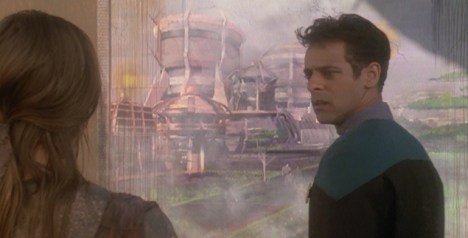
Paradise lost.

Paradise lost.

These are all perfect valid barometres of the season’s success. As is the most obvious indicator: the season is fun to watch and largely holds up on rewatch. However, the simple fact that Deep Space Nine could produce three great centring around Julian Bashir over the course of a single season speaks to how far the production team had come. After all, the studio had repeatedly asked the staff to write Bashir out of the show, convinced that fans were not responding to the station’s chief medical officer.

The Quickening is the third and final “good Bashir episode” of the fourth season, and it demonstrates just how important Bashir is to the fabric and framework of Deep Space Nine. Bashir represents Deep Space Nine‘s esoteric utopianism.

Bashir determination...

Bashir determination…

Continue reading

Star Trek: Enterprise – The Council (Review)

Next year, Star Trek is fifty years old. We have some special stuff planned for that, but – in the meantime – we’re reviewing all of Star Trek: Enterprise this year as something of a prequel to that anniversary. This August, we’re doing the third season. Check back daily for the latest review.

From a technical standpoint, The Council is the third last episode of the third season. From an arc-based standpoint, the third season Xindi arc is not completely resolved until the events of Home three episodes into the fourth season. However, there is an argument to be made that The Council represents the logical conclusion of the third season arc. Sure, Countdown and Zero Hour provide a suitably bombastic resolution to the year-long story, but The Council is the story that really resolves the central conflict driving the season.

After twenty-one episodes of moral ambiguity and ethical compromise, The Council exists to assure viewers that Star Trek: Enterprise has not forgotten the optimistic humanism that has guided the franchise. The Council confirms what most even-handed fans had probably deduced from The Expanse and what had been rendered explicit in The Shipment. The third season was never about getting away from the core utopian values associated with the Star Trek franchise; instead, it was about an attempt to get back to those hopeful ideals.

"I told you not to interrupt me when I'm working on my tan!"

“I told you not to interrupt me when I’m working on my tan!”

As the name implies, The Council is a rather talky script; it is certainly the most talky script between this point and the end of the third season. The episode’s plot finds Archer making his case to the Xindi Council, appealing for a peaceful resolution to the escalating crisis. Archer puts aside his anger and his thirst for retribution, in the hope of finding common ground that might accommodate both sides without resort to warfare or attempted genocide. Naturally, Archer is not entirely successful; the season needs an action climax. However, he is close enough.

Much like The Forgotten, it turns out that The Council is a script about moving beyond grief and hatred towards reconciliation and understanding. It affirms that the third season of Enterprise is (and was always) following a very traditional Star Trek arc.

"Et tu, Dolim?"

“Et tu, Dolim?”

Continue reading

Star Trek: Enterprise – E² (Review)

Next year, Star Trek is fifty years old. We have some special stuff planned for that, but – in the meantime – we’re reviewing all of Star Trek: Enterprise this year as something of a prequel to that anniversary. This August, we’re doing the third season. Check back daily for the latest review.

Conventional wisdom treats as a bump in the road between The Forgotten and The Council, an episode that could easily be skipped on a marathon rewatch of the season. The argument suggests that the episode ultimately provides little meaningful information and advances the season’s over-arching plot by inches. The most critical of fans will consider an episode that saps the momentum out of the final run of the third season, preventing a clear home run between Azati Prime and Zero Hour.

This is certainly true from a plot-driven perspective. It would be easy enough to trim from the twenty-four episode season order without anybody batting an eyelid. At least Shran gets to make a cameo appearance in Zero Hour, while Lorian fades into discontinuity and non-existence. Like so many time travel stories, the final act of conveniently erases itself from existence. This just reinforces the sense that nothing that happened actually mattered in the grand scheme of things.

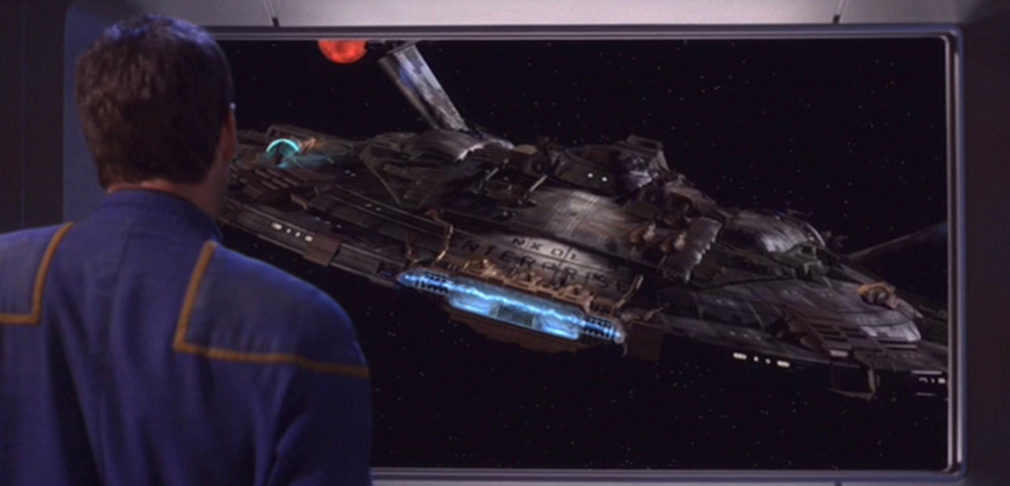
It's like looking in a mirror...

It’s like looking in a mirror…

This is another example of the complications that tend to come with serialised storytelling. The conventional way of telling a long-form story is to drive it via plot – to have a clear path along which the characters might advance with a number of clear markers along the way. In the case of the third season of Star Trek: Enterprise, the launch of the Xindi weapon is an obvious marker; it is a plot point which the show must address before the end of the season. As such, the show’s serialisation is typically measured by whether it moves the crew in relation to that plot point.

doesn’t move the crew appreciably closer to that plot point. There is a miniature hurdle for the crew to overcome (getting into the subspace corridor to make the meeting with Degra), but it is very clearly just window-dressing on a plot that is very clearly more interested in the time-travel dynamics of having the Enterprise crew meet their descendants. The same narrative ground could have been covered by having Degra accompany Archer to the Xindi Council at the end of The Forgotten.

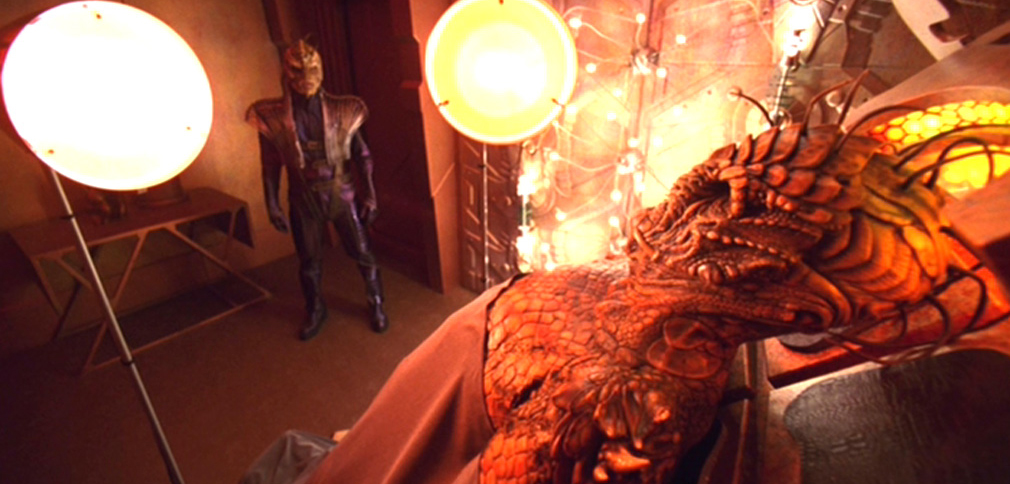
He's all ears...

He’s all ears…

However, plot is not the only thing important to long-form storytelling. Theme and character are just as important, as The Forgotten demonstrated. The biggest problem with is that it is a plot-driven episode of television that advances the season’s thematic and character arcs, but with a story that is disconnected from the season as a whole. Which is a shame, because the thematic and character dynamics are fascinating. This is the perfect point at which to confront Archer with the idea of legacy and consequence; to ask what kind of future might lie ahead.

As with a lot of the scripts for the third season, feels like a meditation on Enterprise‘s relationship with the rest of the franchise and where it stands at this point in its run.

"Worf and Dax neve rhad to put up with crap like this."

“Worf and Dax neve rhad to put up with crap like this.”

Continue reading

Millennium – Exegesis (Review)

This July, we’re taking a trip back in time to review the sixth season of The X-Files and the third (and final) season of Millennium.

It is odd to think of The Innocents and Exegesis as a two parter, despite the explicit “to be continued” that bridges the two episodes.

The Innocents is very much a straightforward procedural episode, with Frank rejoining the FBI and investigating a string of mysterious occurrences that are all connected. As Frank tries to pull himself back together after the death of his wife, various parties insist that he is more lost than ever before. There is a sense that Frank needs to work though what happened to him, regardless of the doubts expressed by his embittered father-in-law or his friendly supervisor at the FBI. Of course others doubt him, and of course he works through those doubts.

"I can see it all clearly..."

“I can see it all clearly…”

It is very much a standard “lead character gets his life back together” story, complete with obligatory sequence where Frank demonstrates he has made his peace with the loss of Catherine by using his story as emotional leverage to ply a confession (or, at least, an explanation) from a person of interest in the on-going investigation. The Innocents is a very banal and paint-by-numbers episode of television. Underneath all those biohazard warnings and eerie blue-eyed siblings, there is a strong procedural element to The Innocents. It feels trite and coy.

At the very least, Exegesis is more unique. It feels like an episode of Millennium, rather than some generic dime-a-dozen procedural. This is likely down to the fact that The Innocents was written by Michael Duggan and Exegesis was written by Chip Johannessen. Michael Duggan was a writer who had a lot of experience on procedurals (Law & Order and C-16: FBI), but who had no prior experience writing Millennium. Hired to run the show in its third year, he would only write two scripts for the show before departing seven episodes into the season.

Go fly a kite...

Go fly a kite…

In contrast, Chip Johannessen had helped to define Millennium’s identity in its first year. In fact, with a group of nearly identical female sisters working towards a mysterious goal (based on vague prophecy), Exegesis owes a great deal to Johannessen’s earlier script Force Majeure. While it does illustrate how Exegesis feels like a more traditional Millennium episode than The Innocents, it is not a comparison that does Exegesis any favours. Force Majeure was one of the best episodes the show ever produced; Exegesis is… not.

As with The Innocents, Exegesis is handicapped by a lot of the clumsy production decisions made at the start of the third season. It feels curiously disconnected from what came before; it plays a little too much like a reheated leftover from The X-Files; a lot of the nuance and development given to Peter Watts and the Millennium Group over the second season is washed away. Nevertheless, it does have a clearer sense of purpose and energy than The Innocents. It feels like Johannessen knows what he wants to say, even if the show is still tripping over itself.

Welcome back, Frank.

Welcome back, Frank.

Continue reading

Space: Above and Beyond – The River of Stars (Review)

This November (and a little of December), we’re taking a trip back in time to review the third season of The X-Files and the first (and only) season of Space: Above and Beyond.

And so this is Christmas.

On the face of it, doing a Christmas episode of Space: Above and Beyond seems absurd. Space: Above and Beyond is a show about a grim and relentless future war, where human lives are sacrificed in a long and brutal slog. It is very hard to reconcile that with the traditional structure of a Christmas story, which typically draws together a family so that they might celebrate the possibility of “peace on Earth” and “goodwill to all men.”

Homecoming...

Homecoming…

And yet, the episode works in spite of this contrast – or, perhaps, because of it. The River of Stars opens with a monologue narrated by Wang that helps to set the mood for the next forty-five minutes, documenting the well-known Christmas truces that took place during the First World War. Although these spontaneous demonstrations of good will and trust were by no means unique, those temporary reprieves served as a reminder of the humanity that often seemed lost amid the pain and the bloodshed.

If any show could use a charming feel-good story about the possibility of peace on Earth and goodwill towards other people, Space: Above and Beyond might be it.

Staring at the stars...

Staring at the stars…

Continue reading

Non-Review Review: Interstellar

Interestingly, Christopher Nolan seems to have generated a reputation as a rather detached director. Common wisdom around Nolan’s films suggest that the film-maker is perhaps too cold and clinical in his approach to the material; that his films lack warmth or humour. This reputation is probably a result of the director’s fascination with non-linear storytelling. After all, The Dark Knight is his only straight-arrow-from-beginning-to-end film.

Probably also due to the narrative contortions and distortions of films like Memento or The Prestige, Nolan is generally presented as a film-maker who constructs visual puzzle-boxes. His films are frequently treated as riddles to be solved. Consider the discussion of narrative “plot holes” in The Dark Knight Rises that fixates on how Bruce Wayne got around back to Gotham, or the discussion on the mechanics of the final shot of Inception. This approaches to his work tend to divorce the viewer from his films.

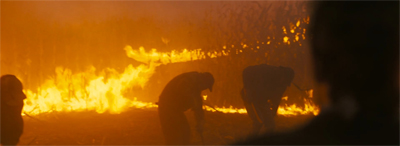
Everything burns...

Everything burns…

Interstellar will likely be Nolan’s most polarising film to date, replacing The Prestige or The Dark Knight Rises. The film offers an extended two-and-a-half hour rebuttal to accusations that Nolan is detached or distant. Much has been made about the attention to detail on Interstellar. The physics on the movie were so exact and precise that physicist Kip Thorne actually made theoretical advances while working on the film.

However, at the same time, one character posits love as a force more powerful than gravity or time. Interstellar might be precise and meticulous, but it is not a film that lacks for an emotional core; it is not a movie that lacks for warmth. Interstellar feels like a conscious attempt to cast off the image of a cynical and cold film-maker.

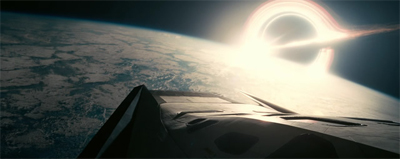
Out of this world...

Out of this world…

Continue reading

Mark Waid, Chris Samnee, Paolo Rivera et al’s Run on Daredevil (Vol. 3) (Review/Retrospective)

This April, to celebrate the release of The Amazing Spider-Man 2, we are taking a look at some classic and modern comics featuring Spider-Man (and friends). Check back daily for the latest review.

Daredevil had been one of the most consistently reliable books at a major comic book publisher over the last decade or so. Under creative teams from Kevin Smith to David Mack to Brian Michael Bendis to Ed Brubaker, the gritty street level superhero has enduring a whole host of twists and shifts that have made the book a compelling read. Indeed, the only real problem with the run was that Andy Diggle couldn’t quite stick the landing and so we ended up closing out that incredibly run with a bland and generic crossover like Shadowland.

Still, Daredevil remains an exciting book – a comic that affords the writers and artists a bit more freedom than they’d enjoy working on a more high-profile or major character. When Spider-Man’s identity was revealed by J. Michael Straczynski during Civil War, the publisher almost immediately hit a reset button in the form of One More Day to tidy up everything. When Brian Michael Bendis revealed Matthew Murdock’s secret identity to the world, there was no attempt to stuff the genie back in the bottle. That radical shift remained in play for the rest of Ed Brubaker and Andy Diggle’s run, casting a shadow over Mark Waid’s as well.

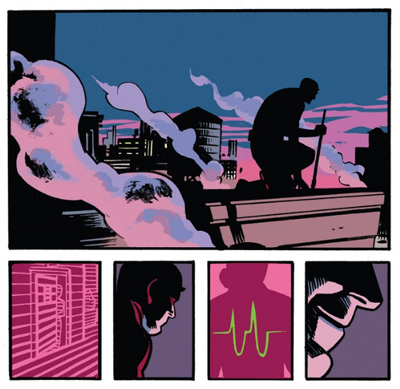
The big smoke...

The big smoke…

However, reading Andy Diggle’s Daredevil, it’s easy to get a sense that the character was suffocating under the influence of Frank Miller. Frank Miller and Klaus Jansen enjoyed a character-defining run in the mid-eighties. For Miller, it paved the way to The Dark Knight Returns, and it really shook the foundations of the superhero genre. Suddenly superheroes weren’t infallible; suddenly fights could get genuinely dirty; suddenly dressing up in a silly costume to fight crime was treated as something that might be deemed a little eccentric.

This had a dramatic impact across the superhero genre. At the same time, however, it really defined the character of Daredevil. In his year years, Daredevil often seemed like a cheap knock-off of Spider-Man; an imitation of a far more popular hero. With the work of Frank Miller, Matthew Murdock become more conflicted and more complex. He became a hero who could make mistakes, a hero who didn’t have the best judgement, a hero who could fail. This pushed the character of Daredevil more towards gritty urban crime and film noir conventions, and further away from superhero conventions.

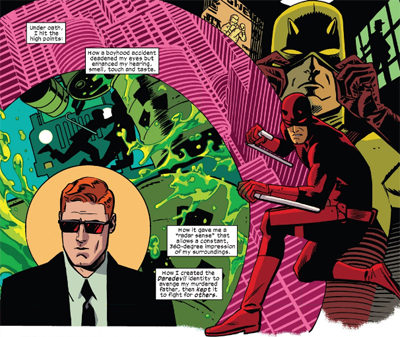
Radar love...

Radar love…

Decades after Born Again, writers are still drawing on that iconic take on Matthew Murdock. The Kingpin is still considered one of the – if not the – greatest foe of the Man Without Fear. Kevin Smith killed off Karen Page, the character who betrayed Matthew Murdock in Born Again. Brian Michael Bendis wrote a story featuring the character who planted the bomb in Born Again, two decades after that story was published. Miller cast a long shadow over the character. One of the (many) problems with Andy Diggle’s Daredevil was the way that it demonstrating that riffing on Frank Miller was getting old.

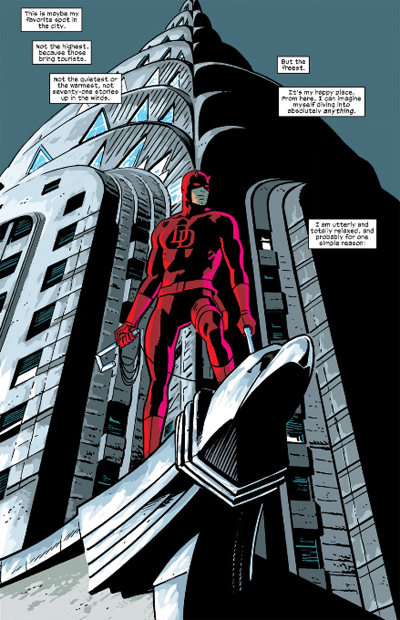
And so, Mark Waid’s run on Daredevil is absolutely fascinating. It’s a clear departure from the grounded urban realism that came to define the character, often feeling like an attempt to reconnect with the character’s Silver Age roots. Brought to life by some of the best artists in the business, the run just pops off the page. At the same time, Waid doesn’t ignore or avoid or overlook what has come before. He just seems to realise that there are other ways of approaching the character.

On top of the world...

On top of the world…

Continue reading

Pixar and the Weight of Expectation…

Well, it probably had to happen. I know it’s probably not statistically impossible, just highly improbable – but I guess that I always knew (deep down) that Pixar’s batting average was too good to last. I mean, I (at the very least) really like all of their films, and I genuinely love the majority of them. And that fact is borne out by the Rotten Tomatoes ratings of the various films. The vast majority rank in the 90% to 100% range, something any studio would kill for: Toy Story (100%), A Bug’s Life (91%), Toy Story 2 (100%), Monsters Inc (95%), Finding Nemo (98%), The Incredibles (97%), Ratatouille (96%), Wall-E (96%), Up (98%), Toy Story 3 (99%). Even the single film that ranks lowest, the only one not in the range, still had mostly positive reviews, Cars with 74%. However, Cars 2 looks to have bucked that winning trend, with reviews that not only fall far short of Pixar’s impressive average, but is actually pretty negative.

I can’t help but feel more than a little bit sad.

Do Pixar need to get in gear?

Continue reading

Superman & Relevance: (Yet) More Thoughts on Snyder’s Superman…

March is Superman month here at the m0vie blog, what with the release of the animated adaptation of Grant Morrison’s superb All-Star Superman. We’ll be reviewing a Superman-related book/story arc every Wednesday this month, so check on back – and we might have a surprise or two along the way.

Dear Hollywood,

I am a movie fan. I am not an American. I didn’t read too many comic books as a child, and those I did never featured Superman. I say this as a means of introducing myself. I’ve been somewhat frustrated that you have been consistently unable to produce a good Superman film since Richard Donner was unceremoniously booted off the set of Superman II over 30 years ago. I know you’re working on a new film, so I thought I’d pen this open letter.

I’m sure David S. Goyer is a great writer, and look forward to his screenplay. After all, I appreciate his work on Nolan’s Batman Begins trilogy and his work with James Robinson on Starman (plus he helped kickstart this whole “superhero movie” business with Blade). Still, I can’t help but be a little concerned about this new Superman reboot you have to produce by the end of next year, lest the rights revert to the creators of the character.

Anyway, I want to talk to you about the relevance of Superman, as I’m sure it’s something you’ve talked about quite a lot, and perhaps it’s something you’re still concerned about.

Continue reading