• Following Us

  • Categories

  • Check out the Archives


  • Awards & Nominations

Doctor Who: The Doctor’s Daughter (Review)

To celebrate the fiftieth anniversary of the longest-running science-fiction show in the world, I’ll be taking weekly looks at some of my own personal favourite stories and arcs, from the old and new series, with a view to encapsulating the sublime, the clever and the fiendishly odd of the BBC’s Doctor Who.

The Doctor’s Daughter originally aired in 2008.

Not what you’d call a natural parent, are you?

They stole a tissue sample at gunpoint and processed it. It’s not what I call natural parenting.

Rubbish. My friend Nerys fathered twins with a turkey baster. Don’t bother her.

You can’t extrapolate a relationship from a biological accident.

Er, Child Support Agency can.

– Donna and the Doctor discussing parenting

The Doctor’s Daughter is the weakest script of the fourth season. It’s just a mess of high concepts and ideas and in-jokes mashed together and then cut down to fit into a forty-five minute time slot. It’s a fundamentally flawed episode that has some meritorious elements, but a whole host of other ingredients that just fall flat. It’s the speed bump in the fourth season of the show, Russell T. Davies’ final season of Doctor Who, which had started out of the gate so very strong.

I suppose the real positive of The Doctor’s Daughter is that it doesn’t cause too much damage as it stumbles.

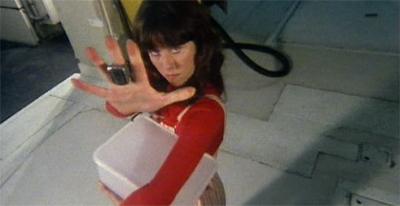
The ball's in his court...

The ball’s in his court…

Continue reading

Doctor Who: The Green Death (Review)

To celebrate the fiftieth anniversary of the longest-running science-fiction show in the world, I’ll be taking weekly looks at some of my own personal favourite stories and arcs, from the old and new series, with a view to encapsulating the sublime, the clever and the fiendishly odd of the BBC’s Doctor Who.

The Green Death originally aired in 1973.

Where are you off to?

To pack a suitcase.

Oh, good. Give me a couple of minutes and we’ll be off.

Off? Off where?

Well, Metebelis III, of course.

I’m not going to Metebelis III.

Why? Where are you thinking of going to?

Well, South Wales, of course. Llanfairfach.

– the Doctor and Jo discuss travel plans… why would you want to go to Metebels III when you can visit South Wales?

The Green Death is a great example of the Jon Pertwee era. It offers a pretty solid showcase of the best of the era, along with the glaring structural and thematic weaknesses that the show never really tackled head-on. It’s a great yarn, an affectionate run-around. There is a reason, after all, that the overgrown maggots have managed to wedge themselves in British popular consciousness. There’s a conscious sense that The Green Death is a season finalé, in the biggest and boldest terms possible.

In an era where television wasn’t really structured in that way, you can trace a pretty clear line between The Green Death and the big epic series finalés of the Russell T. Davies era of Doctor Who.

And the Beatz go on...

And the Beatz go on…

Continue reading

Doctor Who: Army of Ghosts (Review)

To celebrate the fiftieth anniversary of the longest-running science-fiction show in the world, I’ll be taking weekly looks at some of my own personal favourite stories and arcs, from the old and new series, with a view to encapsulating the sublime, the clever and the fiendishly odd of the BBC’s Doctor Who.

Army of Ghosts originally aired in 2006.

How long are you going to stay with me?

Forever.

– the Doctor and Rose tempt fate

It’s only logical that anybody diving head-first into a fifty-year-old television show is going to have an opinion that radically diverges from the fandom consensus on a couple of stories. So, for example, I’ll concede that I like The Talons of Weng-Chiang, but less than most. However, the biggest divide – and the point on which I feel furthest from consensus – comes with Army of Ghosts and Doomsday, Russell T. Davies’ massive farewell to Rose Tyler, the companion he introduced all the way back in Rose. It’s generally acknowledged as one of the high points of Davies’ tenure and one of the truly great Tenth Doctor stories.

I am far from convinced.

The cracks are starting to show...

The cracks are starting to show…

Continue reading

Doctor Who: The Hand of Fear (Review)

To celebrate the fiftieth anniversary of the longest-running science-fiction show in the world, I’ll be taking weekly looks at some of my own personal favourite stories and arcs, from the old and new series, with a view to encapsulating the sublime, the clever and the fiendishly odd of the BBC’s Doctor Who.

The Hand of Fear originally aired in 1976.

Come on, where are we?

We’re in a quarry.

Yes, I know we’re in a quarry, but where?

Well, how do I know? I don’t know all the quarries that–

– the Doctor and Sarah Jane get a bit meta

The Hand of Fear is odd, because it’s the end of an era – but it’s not the end of the era for the rather obvious reason that it bids farewell to one of the franchise’s best-loved companion character. The Hand of Fear is best known as the final story to feature Sarah Jane Smith. Indeed, the DVD comes with a helpful sticker informing any potential purchasers of the story’s significance.

However, watching The Hand of Fear with the benefit of hindsight, it isn’t Sarah Jane’s departure that is the most striking part of the show.

Keep it handy...

Keep it handy…

Continue reading

Doctor Who: Dragonfire (Review)

To celebrate the fiftieth anniversary of the longest-running science-fiction show in the world, I’ll be taking weekly looks at some of my own personal favourite stories and arcs, from the old and new series, with a view to encapsulating the sublime, the clever and the fiendishly odd of the BBC’s Doctor Who.

Dragonfire originally aired in 1987.

You’re going to go looking for the dragon?

Absolutely.

Oh, cool. Can I come too?

– Ace introduces herself to the Doctor smoothly

Dragonfire is better than Delta and the Bannermen, which is certainly damning with faint praise. Like the rest of Sylvester McCoy’s first season, Dragonfire suffers because of a gap between concept and execution. There is a wealth of good ideas here, but Dragonfire can’t seem to develop any of them to the point where they stand out. Of this troubled first season, it’s perhaps the serial where the conflict between the show’s old-fashioned production and more modern writing are thrown into sharpest contrast. Dragonfire looks like it wants to be a classic Doctor Who episode, even though it’s written like anything but.

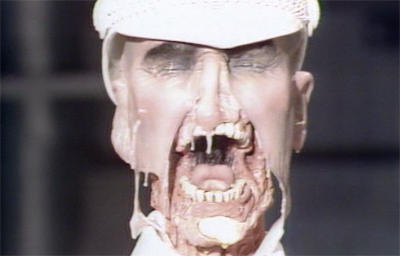
"I'm melting!"

“I’m melting!”

Continue reading

Doctor Who: Delta and the Bannermen (Review)

To celebrate the fiftieth anniversary of the longest-running science-fiction show in the world, I’ll be taking weekly looks at some of my own personal favourite stories and arcs, from the old and new series, with a view to encapsulating the sublime, the clever and the fiendishly odd of the BBC’s Doctor Who.

Delta and the Bannermen originally aired in 1987.

Hey, this doesn’t look like Disneyland.

No, well, according to my reckoning, it seems to be somewhere in, er, Wales.

– Murray and the Doctor get in touch with the “real fifties”

Delta and the Bannermen is quite terrible. That said, it’s not terrible in the same way that, say, Timelash or Attack of the Cybermen or The Twin Dilemma is terrible. It doesn’t offer a demonstration of everything intrinsically wrong with this era of the show, and the frustration isn’t compounded by the sense that nobody producing the show seems interested in watching it and maybe learning from their mistakes.

While that is certainly a promising thing from the perspective of the show, it doesn’t really do the viewer that much good when they are watching it.

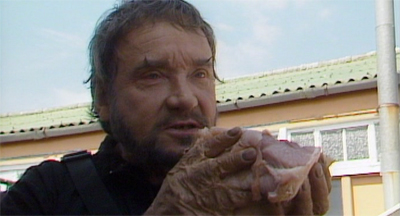
Large ham, incoming!

Large ham, incoming!

Continue reading

Doctor Who: Paradise Towers (Review)

To celebrate the fiftieth anniversary of the longest-running science-fiction show in the world, I’ll be taking weekly looks at some of my own personal favourite stories and arcs, from the old and new series, with a view to encapsulating the sublime, the clever and the fiendishly odd of the BBC’s Doctor Who.

Paradise Towers originally aired in 1987.

Oh, I see. It’s some sort of robotic cleaner with automotive bicurval scraping blades. Impressive workmanship.

You don’t understand.

No, I don’t, but I intend to.

– the Doctor and the Deputy Chief Caretaker

Paradise Towers is brilliant. It’s crazy, it’s overstated, it’s an hour too long and it suffers from the fact that nobody really knows what they’re doing, but there’s a sense of genius at work here. Script editor Andrew Cartmel took over at the start of the season, with no scripts. Time and the Rani came from John Nathan Turner’s reliable Pip and Jane Baker, so Paradise Towers is the first script where Cartmel has been allowed to make his mark.

And it’s precisely what the show needed. The execution is significantly flawed, the pacing is all wrong and there’s a sense that not everybody between the script and the camera realised what was going on, but it has a distinct energy to it. Time and the Rani was essentially Doctor Who struggling to keep its head above water. Paradise Towers sees the show diving right into the eighties.

"... where the grass is green and the girls are pretty..."

“… where the grass is green and the girls are pretty…”

Continue reading

Doctor Who: Time and the Rani (Review)

To celebrate the fiftieth anniversary of the longest-running science-fiction show in the world, I’ll be taking weekly looks at some of my own personal favourite stories and arcs, from the old and new series, with a view to encapsulating the sublime, the clever and the fiendishly odd of the BBC’s Doctor Who.

Time and the Rani originally aired in 1987.

Right, that all seems quite clear. Just three small points. Where am I? Who am I? And who are you?

– the Doctor

A Doctor’s first story is always difficult. Even if it’s not as explicit as it was in Power of the Daleks, the new actor his constantly fighting against the weight of expectation, trying to cast off the spectre of their predecessor and make the show their own. There’s also a sense that the production team is trying to reinvent the show around their new lead. It’s transitional, and it’s not too difficult to see how the task could be daunting.

If that’s a typical first story, imagine how frustrating Time and the Rani must have been at the time. Hastily cobbled together in a rush, coming out of a season that had been a spectacular failure and with the shadow of cancellation looming heavy, there’s a lot of pressure on Time and the Rani. It is a story that is routinely trashed and mocked, and perhaps deservedly so. However, I must concede, it’s not as bad as it could have been and I’d be very reluctant to rank it among the worst Doctor Who serials of all time.

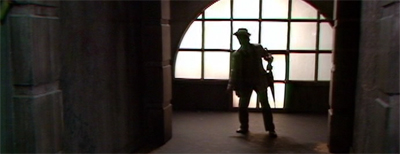
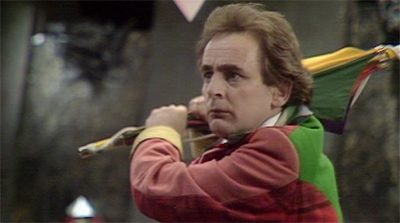
He's got an umbrella and he's not afraid to use it!

He’s got an umbrella and he’s not afraid to use it!

Continue reading

Doctor Who – The Shakespeare Code (Review)

To celebrate the fiftieth anniversary of the longest-running science-fiction show in the world, I’ll be taking weekly looks at some of my own personal favourite stories and arcs, from the old and new series, with a view to encapsulating the sublime, the clever and the fiendishly odd of the BBC’s Doctor Who.

The Shakespeare Code originally aired in 2007.

Goodnight, Doctor.

Nighty night, Shakespeare.

– talk about your British icons

The Shakespeare Code is the third season’s opening trip into British nostalgia, a celebrity historical where the Doctor journeys back in time to meet a famous character and to deal with alien menaces masquerading as something altogether more sinister. This time, the Doctor and Martha travel back to meet William Shakespeare. It’s a little on the nose, but perhaps that’s not a bad thing. After all, teaming the Doctor up with Queen Victoria in Tooth and Claw did seem a little cynical when the show opened with a gag at the expense of Margaret Thatcher.

The rather safe and occasionally quite “postcard-y” portrayal of British history aside, The Shakespeare Code is more interesting as a rather novel form of arc-building for the show. “Saxon” was the arc word for the show’s third season, but restricted to those episodes set in the present. However, The Shakespeare Code winds up offering major thematic foreshadowing of the season ahead.

Where there's a Will...

Where there’s a Will…

Continue reading

Doctor Who: The Reign of Terror (Review)

To celebrate the fiftieth anniversary of the longest-running science-fiction show in the world, I’ll be taking weekly looks at some of my own personal favourite stories and arcs, from the old and new series, with a view to encapsulating the sublime, the clever and the fiendishly odd of the BBC’s Doctor Who.

The Reign of Terror originally aired in 1964.

Hush, child. Say your goodbyes and remember, we shall be leaving almost immediately

– the Doctor, about two minutes into the first part of a six parter

The Reign of Terror represents a fairly disappointing conclusion to a reasonably solid first season of Doctor Who. I won’t argue that the show’s first year can be ranked among the finest in the fifty-year history of the show, but I do think that the stories generally did quite a decent job of introducing the characters and concepts and setting them up so that they could support a lot more. It’s interesting to compare the title character introduced in An Unearthly Child to the version presented in The Sensorites.

While The Sensorites is still a story far too long and far too generic for its own good, it still feels like it solidifies a version of the character who – broadly speaking – resembles the Doctor we know and love. While I’d argue the Doctor was only absolutely solidified as a hero in The Dalek Invasion of Earth, there’s a very clear through-line from An Unearthly Child to The Sensorites which charts the evolution of the character. The Sensorites would make a decent (if unspectacular) place to end the first season.

Unfortunately, the first season continues on for one more episode. The Reign of Terror is just as over-long and just as padded out as The Sensorites, but it suffers because it feels like a massive step backwards in a season that has been very clearly moving forwards.

An animated sort...

An animated sort…

Continue reading