• Following Us

  • Categories

  • Check out the Archives


  • Awards & Nominations

Doctor Who: Dark Water (Review)

I presume you have stairs?

I’m not a Dalek.

Dark Water is downright provocative in places, and rather ingenious.

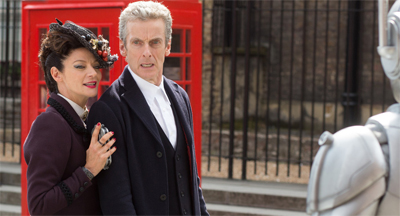
On the surface, Dark Water is the first part of a season-ending two-parter building to the return of two very obvious pieces of Doctor Who continuity. In doing so, it cleverly demonstrates one of the most obvious issues with the two-part structure in contemporary Doctor Who. The episode spends forty-five minutes building to a game-changing cliffhanger that is quite easy to figure out ahead of time. (Not least because the BBC’s publicity department loves Cybermen.) As such, the typical first part of a two-parter ends where the Doctor Who story actually begins.
doctorwho-darkwater9

However, there’s something far shrewder happening beneath the surface. While Dark Water spends most of its runtime affectionately mocking the inevitability of the two revelations at the climax, it is very in keeping with the aesthetic of the Moffat era around it; it is much more interested in the intimate than the epic. The climax beautifully subverts the classic Davies era “global invasion” cliffhanger by dismissing the Doctor as “another mad Scot” while the public look on bemused at the six Cybermen wandering down from St. Paul’s Cathedral.

In contrast, the juicy parts of Dark Water are those defined by the personal relationships at play. For all the iconic visuals and soaring music, the episode doesn’t close on the Cybermen or the Master; it closes on Danny and the reflection of the young child he killed. The episode’s big dramatic beat is that final conversation between Danny and Clara. The reveal that Missy is really the Master is obvious, but it is more interesting for her re-contextualising her relationship with the Doctor as that of a spurned and abandoned lover. It’s all personal.

doctorwho-darkwater13 Continue reading

Non-Review Review: The Imitation Game

The Imitation Game is a solid and effective bio-pic elevated by a sharp script from Graham Moore, tight direction from Morten Tyldum and a superb central performance from Benedict Cumberbatch. There are points where the film seems to over-simplify its protagonist, trying to reduce his fascination with computers to a series of Freudian quirks, but the movie is held together by witty dialogue and a mesmerising turn from its lead actor.

theimitationgame

Continue reading

Minor Miracles: Supporting Characters & The Lesson of Hannibal Lecter

“Less is more.” Or so we’re often told at least. It generally seems to be used in a polite way to limit our exposure to things we don’t like. However, I can’t help but wonder if it is true of supporting characters. After all, those interesting side characters in movies that happen to capture our imaginations with a relatively minor roles. Indeed, I reckon that I could probably name more supporting characters I took a shine to, rather than iconic lead characters. While we undoubtedly relish every moment they appear on-screen, and perhaps lament that we only get so limited an exposure to them, I can’t help but wonder of that somewhat restricted presence might be precisely what makes them so appealing in the first place.

Bloody brilliant…

Continue reading

The “Meta” Mystery Approach…

I’ve always been fascinated by mysteries in fiction. That said, I will concede I’ve never really been particularly good at picking up on the hints within the work itself designed to point towards a particular perpetrator. I haven’t necessarily got the skills to pick up on what tiny little detail mentioned in dialogue or the tiniest little action that supports a particular conclusion – it’s just not how my mind works. Instead, perhaps as a direct result of watching far too many movies, I find it more relevent to look at factors outside the fictional world where the mystery is set in order to reach a conclusion – I’m more likely to identify the culprit by reference to the film itself than the clues on hand.

Continue reading

Non-Review Review: The Usual Suspects

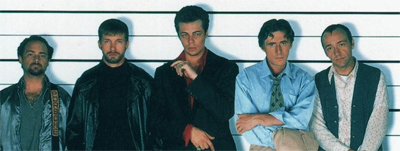
Wow. Neo-noir is a very tough genre to pull off. It really is. Think of how many dodgy movies you’ve seen about drug dealers and bent cops in the last year alone (I’ve even seen one this weekend). When it works, it works magically. It seems like the mid-nineties was the era for producing any number of classic modern noir-style tales. There’s Copland, L.A. Confidential and – of course – the movie that arguably started the whole trend. We’re looking at you, The Usual Suspects

Calvin Klein models just aren't trying anymore...

Calvin Klein models just aren't trying anymore...

Continue reading