This film was seen as part of the Jameson Dublin International Film Festival 2014.
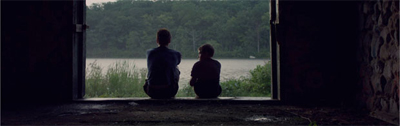
Kids these days, am I right?Hide Your Smiling Faces feels like an eighty-eight minute extended catalogue of various fears and insecurities about the children growing up in today’s world. Following the tragic death of a young boy, Hide Your Smiling Faces focuses its attention on the young kid’s closest friend and that friend’s older brother – exploring their different emotional reactions to the loss. Writer and director Daniel Patrick Carbone adopts a naturalistic approach to dialogue, trying to lend Hide Your Smiling Faces an authenticity or realism.
Unfortunately, the film is simply too dull for its own good, mistaking inertia for pensiveness and inactivity for pensiveness. It seems like Hide Your Smiling Faces spends most of its runtime trying to convince the audience – and itself – that less is more. Sadly, sometimes less is less.
This film was seen as part of the Jameson Dublin International Film Festival 2014.
Mystery Road is mostly atmosphere. Its plot is fairly standard neo-noir drugs thriller fare; its characters are pretty stock. However, Ivan Sen’s Australian thriller has a palpable sense of dread and anxiety that seems to press down on the film. There’s a slow boil pressure cooker at the heart of the film, which rather brilliantly taps into standard film noir storytelling conventions and translates them effortlessly to the Outback.
The obvious comparison for Need for Speed is to suggest that the movie feels like a video game. After all, the film is an adaptation of EA’s successful car racing video game franchise, porting the adventure to the big screen. However, that doesn’t quite cover Scott Waugh’s Need for Speed. Instead, his car racing adventure feels almost like a cartoon for most of its runtime, adopting a much lighter tone and more careful visual style than the Fast & Furious series which also invites comparisons.
This cartoonish quality is endearing at points, with certain racing sequences and chases feeling almost like a live-action version of Wacky Races, but it means that the movie struggles to shift gears. Attempts to get the audience to invest in a standard central plotline about redemption and justice are hard to balance against the decidedly over-the-top atmosphere of the rest of the film. There are points where Need for Speed needs to convince us to care about its characters, but it can’t make them seem real – no matter how hard it tries.
It is almost immediately apparent that 300: Rise of an Empire was not directed by Zack Snyder. Snyder is credited on the inter-quel’s screenplay, but Rise of an Empire is directed by Noam Murro. Murro’s only other feature-length directorial credit is the forgotten indie movie Smart People, which would hardly make a case for Murro as an obvious choice to succeed Snyder in the director’s chair.
300 was a lavish and rich (and surprisingly shrewd) visual feast – packed with iconic imagery and memorable mosaics, treating it’s muscle-bound stars as props for epic spectacle while casting a knowing look out at the audience. Rise of an Empire feels like an attempt at imitation rather than innovation – with a sense that Murro isn’t bold enough to put his own stamp on the film, instead trying to channel one of the most unique voices currently working in action movies.
At its best, Non-Stop evokes one of those mid-nineties high-tension high-altitude thrillers – movies about various crises unfolding on a plane, with a questionable hero wading in to help save the day. There’s a decidedly pulpy aspect to Non-Stop, as the film revels in the absurdity of its set-up and the contrived planning of the movie’s would-be skyjacker/ransomer. Those looking for a tightly-plotted thriller that withstands any level of critical thought would be best served to look elsewhere, but that’s entirely the point. Non-Stop basks in its minute-to-minute thrills, which it delivers with just enough consistency to maintain momentum.
The movie runs into problems though. Running to almost two hours, it’s impossible for the film to maintain the necessary level of tension for such an extended period. One sense that twenty minutes might have easily been trimmed from the film and tightened up the pacing a bit – after all, it’s not as if the plot hangs together particularly tightly as is. Non-Stop also runs into difficulties when it is forced to confront the fact that it is not – despite its best intentions – a hijacking movie from the mid-nineties. For better or worse, Non-Stop is set in the wake on 9/11, and the movie’s attempts to acknowledge that can’t help but feel a little forced.
Non-Stop is hardly an exceptional little thriller, but Neeson anchors it well and the movie often feels like an affectionately pulpy throwback to much more exciting skyjacking films.
This film was seen as part of the Jameson Dublin International Film Festival 2014.
The Grand Seduction is nowhere near as cynical as it needs to be, and nowhere near as cynical as it thinks that it is. The story of a small Canadian town harbour in desperate need of a doctor in order to win a lucrative contract from a nebulous oil corporation, The Grand Seduction sets itself up as a vicious satire of these sorts of communities. Trying desperately to convince a visiting doctor to stay in their small community, the locals fashion themselves an endearingly quaint façade, manipulating their guest to get what they want.
This film was seen as part of the Jameson Dublin International Film Festival 2014.
On the surface of it, The Stag feels like an Irish version of The Hangover; a “lads going wild before the wedding” comedy that thrives on men behaving badly and even features the bride’s brother as a reluctant invitee and breakout character. Of course, there are any number of differences – substituting the wilds of rural Ireland for the glitzy glamour of Vegas, the decision to make the groom a main character more than a plot device, the nature of the breakout character’s anti-social personality – but The Stag essentially takes a tried and true comedy template and runs with it.
I’m always glad to support Irish film here, so I thought I’d pass on the details of the premiere of Mark O’Connor’s new film, Stalker. The director’s third feature film, with a cast including John Connors (King of The Travellers), Barry Keoghan (Between the Canals, Stay) and Peter Coonan (Love/Hate), the movie is premiering this Wednesday, February 26th at 7pm in Movies @ Dundrum. Tickets are reportedly selling fast, but are available on-line here.
There will be a Q and A with cast after the film. Stalker came second in Galway Film Festival and won the Underground Film Festival 2013. The trailer is below.
This film was seen as part of the Jameson Dublin International Film Festival 2014.
Lock a character in a tight space for an extended period of time, crank up the pressure, watch the results. It’s a tried and true method of generating compelling drama – albeit one that depends on a wide range of variables. Films like Phone Booth and Buried demonstrate – to varying degrees of success – the appeal of such a format. If you can get a good actor in a tight space for an extended period of time and crush them, the results are inevitably fascinating.
At the same time, it’s a very delicate cocktail. The set-up has to be convincing, the script has to be tight without being contrived, the direction needs to be spot on, the performance needs to be perfectly modulated. Steven Knight’s sophomoric feature-length film manages to maintain this fine balance for Locke‘s eighty-five minute runtime. Essentially an hour-and-a-half locked in a car with Tom Hardy, Locke is a powerhouse of a feature, an utterly compelling and heartrending watch.
This film was seen as part of the Jameson Dublin International Film Festival 2014.
The Double calls to mind a very old school of BBC television production. In fact, it’s not too difficult to imagine The Double as an artefact from the BBC archives, a piece of eighties low-key dystopian science-fiction existential horror, like a slightly more polished (and colourised) companion piece to their 1954 production of 1984. By translating Dostoyevsky’s story from late nineteenth century Russia to a vision of the future from eighties Britain, writer and director Richard Ayoade has crafted a wonderfully unnerving psychological black comedy.
















 the m0vie blog