• Following Us

  • Categories

  • Check out the Archives


  • Awards & Nominations

Star Trek: The Next Generation – A Matter of Honour (Review)

This January and February, we’ll be finishing up our look at the second season of Star Trek: The Next Generation and moving on to the third year of the show, both recently and lovingly remastered for high definition. Check back daily for the latest review.

The second season of Star Trek: The Next Generation might be a bit rough around the edges (among other places), but there’s still a sense that the show is trying to improve itself, struggling to find its own voice. Most of the first season seemed content to offer a pale imitation of the classic Star Trek show, ignoring the fact that a lot had changed in the two decades since Kirk and Spock took to the air.

A Matter of Honour is an example of The Next Generation engaging the late eighties instead of trying to evoke the lost spirit of the sixties. Taking the “Klingons as Communists” metaphor as far as it could logically go, and serving as a companion piece to Star Trek VI: The Undiscovered Country, A Matter of Honour is a tale of deep space détente.

Guess who's going to dinner where?

Guess who’s going to dinner where?

Continue reading

Star Trek: The Next Generation – Unnatural Selection (Review)

This January and February, we’ll be finishing up our look at the second season of Star Trek: The Next Generation and moving on to the third year of the show, both recently and lovingly remastered for high definition. Check back daily for the latest review.

It’s really strange that this is our first Pulaski-centred episode. It’s even stranger that it’s the shows only Pulaski-centred episode, given she’s a new character being inserted into an established ensemble. It’s even stranger-er that the episode doesn’t really seem to have much to say about Pulaski apart from the fact that she is the show’s new doctor – and she’s a bit of an idiot. Which is not necessarily what you want when you’re trying to endear a new character to the audience.

Then again, Unnatural Selection is a pretty good indicator of where Star Trek: The Next Generation is right now. The show hasn’t quite figured out that it’s a good idea to anchor character-centric stories in the character upon which that intended to centre. It’s one of the most successful aspects of Michael Piller’s approach, and part of what really revitalised the writing in the show’s third season. As it stands, Unnatural Selection seems to be a story about medical stuff, so it gets to focus on Pulaski. Who is really just sort of there.

I can see this getting old fast...

I can see this getting old fast…

Continue reading

Star Trek: The Next Generation – Dark Mirror by Diane Duane (Review)

Star Trek: Deep Space Nine is twenty years old this year. To celebrate, I’m taking a look at the first and second seasons. Check back daily for the latest review or retrospective.

We’ll be supplementing our coverage of the episodes with some additional materials – mainly novels and comics and films. This is one such entry.

Dark Mirror was released a few mere months before Crossover was broadcast – one of those moments of pop culture synergy where it turns out that two different individuals can have the same idea, but with infinitely different nuance or emphasis. Indeed, the timing syncs up so well that Crossover actually aired between the hardcover and soft cover printings of Dark Mirror, suggesting that a return to the mirror universe was something of an inevitability for Star Trek, in one form or another.

Duane’s approach to the mirror universe is markedly different to that of writers Michael Piller and Peter Allan Fields, with both Dark Mirror and Crossover taking the ending of Mirror, Mirror and running with it in opposite directions. Piller and Fields used the aftermath of Kirk’s meddling as a means to explore the consequences of interference in a culture that Kirk didn’t quite understand – a mechanism to explore the way that the original Star Trek didn’t seem to grasp moral relativity, and to explore political complexities outside Kirk’s value system.

In contrast, Dark Mirror is a more philosophical meditation on the nature of good and evil, a more metaphysical exploration of a fictional world built around the concept of selfishness and strength, and how such a universe would have to work on different physical laws than that of Star Trek: The Next Generation.

tng-darkmirror

Continue reading

Star Trek: Deep Space Nine – Crossover (Review)

Star Trek: Deep Space Nine is twenty years old this year. To celebrate, I’m taking a look at the first and second seasons. Check back daily for the latest review or retrospective.

At the time, Crossover must have seemed like a very odd choice for a late-second-season episode of Star Trek: Deep Space Nine. Of course, the mirror universe episodes would become a quasi-annual occurrence on the show, similar to the “O’Brien must suffer” adventures. However, in May 1994, it must have seemed like a really strange choice to do an entire episode as a sequel to a much-loved second-season installment of the original Star Trek.

Still, Crossover remains the strongest of Deep Space Nine‘s mirror universe episodes, most notably because it treats the rather absurd premise with a certain amount of weight and integrity, but also because it feels so delightfully weird.

Half the cast has been waiting two years to do that...

Half the cast has been waiting two years to do that…

Continue reading

Star Trek: Deep Space Nine – The Maquis, Part II (Review)

Star Trek: Deep Space Nine is twenty years old this year. To celebrate, I’m taking a look at the first and second seasons. Check back daily for the latest review or retrospective.

Oddly enough, for an episode designed to serve as a launching pad for Star Trek: Voyager, The Maquis, Part II really feels like the point where Star Trek: Deep Space Nine becomes Ira Steven Behr’s show. Deep Space Nine had been created by Michael Piller and Rick Berman. While Berman oversaw the franchise as a whole, Piller had been a guiding influence during the first two seasons of Deep Space Nine. However, his attention would wander to both Voyager and the pending films based on the Star Trek: The Next Generation film franchise.

As a result, producer Ira Steven Behr would be left in the driving seat of Deep Space Nine. Behr had some experience with the franchise. he was part of the wonderful writers’ room responsible for the massive upswing in the quality of The Next Generation, but left after a year on that show – describing it as “the Connecticut of Star Trek.” Years later, he was aggressively pursued by Piller to work on Deep Space Nine, where Piller felt his philosophy might be more at home.

The Maquis, Part II is far from Behr’s first writing credit on the show, and it’s certainly not the first time his influence has been felt. It is, however, the point at which it feels like Behr’s creative vision is firmly cemented the show’s outlook. Piller would move further away over the course of the next year, and Behr’s influence would grow even stronger, but this is the point where Behr’s vision of Deep Space Nine really takes hold.

Burning bridges...

Burning bridges…

Continue reading

Star Trek: Deep Space Nine – The Maquis: Soldier of Peace (Review)

Star Trek: Deep Space Nine is twenty years old this year. To celebrate, I’m taking a look at the first and second seasons. Check back daily for the latest review or retrospective.

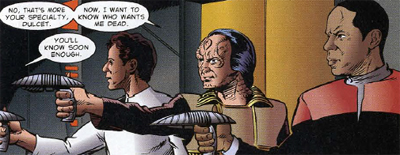
We’ll be supplementing our coverage of the episodes with some additional materials – mainly novels and comics and films. This is one such entry.

The Maquis: Soldier of Peace is a rather interesting little miniseries, produced while Malibu comics held the rights to Star Trek: Deep Space Nine spin-off comics in the early nineties. Malibu owned the rights to the earliest comics, publishing just over thirty issues of the main Deep Space Nine title between August 1993 and December 1995. Due to Paramount’s desire to exploit the license as much as possible, Malibu only had access to the Deep Space Nine rights, and not to Star Trek: The Next Generation or the original Star Trek.

Malibu would eventually be bought by Marvel, allowing the company to briefly publish Star Trek comics related to all on-going series. However, the company managed to generate an impressive amount of content in the time that it held the rights. Cynics would suggest that company was trying to cash in on the comics boom of the nineties, trying all manner of gimmicks, including one-shots and even a “celebrity” prestige series featuring stories written by Mark Lenard or Aron Eisenberg.

As such, these comics offer an interesting snapshot of where Deep Space Nine was at this point in its history.

The three amigos...

The three amigos…

Continue reading

Star Trek: Deep Space Nine – Playing God (Review)

Star Trek: Deep Space Nine is twenty years old this year. To celebrate, I’m taking a look at the first and second seasons. Check back daily for the latest review or retrospective.

Playing God is – structurally – quite similar to Shadowplay. The episode follows the same basic format. We have three plots running concurrently. One of these plots is a science-fiction plot while the other two are centred around character development. What’s interesting about Playing God is that the script essentially changes the priority of these plot threads. In Shadowplay, the central plot concerned the science-fiction mystery in the Gamma Quadrant, while here the ethical quandary is pushed firmly to the background. (Much to the chagrin of writer Jim Trombetta.)

Instead, Playing God brings the character plotline to the front, giving us the first Dax-centric episode firmly based around Jadzia rather than the symbiote inside of her.

Quark smells a rat... er... I mean vole...

Quark smells a rat… er… I mean vole…

Continue reading

Star Trek: Deep Space Nine – Rivals (Review)

Star Trek: Deep Space Nine is twenty years old this year. To celebrate, I’m taking a look at the first and second seasons. Check back daily for the latest review or retrospective.

Rivals doesn’t work. However, while the second season has produced a string of noble failures, Rivals fails for a very simple reason. It’s a comedy episode without any comedy. It’s a guest-star focused episode which centres on a hopelessly miscast Chris Sarandon. Sarandon is an Oscar-nominated actor, and he should be something of a casting coup for the show. This second season has already featured Louise Fletcher, Frank Langella and John Glover – so it seems fair to acknowledge that the casting people were on a bit of a roll.

However, due to a reheated script and Sarandon’s lack of interest or engagement, Rivals winds up feeling stale. There is potential here, but it’s squandered as the writers forget the first rule of a good comedy episode. They forgot to bring the laughs.

I feel a similar way...

I feel a similar way…

Continue reading

Star Trek: Deep Space Nine – Sanctuary (Review)

Star Trek: Deep Space Nine is twenty years old this year. To celebrate, I’m taking a look at the first and second seasons. Check back daily for the latest review or retrospective.

Sanctuary is a very weird little episode, a nice concept with too much padding, reserving its best hook and twist for the final ten minutes, but capping it off with an attempt to soften the harsh blow somewhat. It’s another of those “shows we could only do on Star Trek: Deep Space Nine from the series’ second season, and it’s certainly more interesting and ambitious than Second Sight. However, for all the clever stuff that it does, it feels somewhat oddly structured and paced, as if the writing staff knew there were good ideas wrapped up inside here, but weren’t exactly sure how to get them out.

A blip on the radar...

A blip on the radar…

Continue reading

Star Trek: Deep Space Nine – The Homecoming (Review)

Star Trek: Deep Space Nine is twenty years old this year. To celebrate, I’m taking a look at the first and second seasons. Check back daily for the latest review or retrospective.

The Homecoming is notable for a number of reasons. It kicks off the franchise’s first three parter. Sure, Family provided a nice epilogue to The Best of the Both Worlds, but The Homecoming, The Circle and The Siege represents the first explicit three-part story in the history of the franchise. Star Trek: Enterprise would develop a fondness for the format in its final season and one of those three-parters (The Forge, The Awakening and Kir’Shara) would owe a conscious debt to this opening trilogy.

It also pretty much sets the tone of season premieres on Star Trek: Deep Space Nine. Star Trek: The Next Generation and Star Trek: Voyager would both display a fondness for bridging their seasons with two-part adventures. The opening episode would air as a season finalé, with the resolution airing as the opening episode of the following season. Deep Space Nine was not so literal minded. While each season premiere was informed by the themes and events of the last season’s closing episode, Deep Space Nine tended to favour opening with multi-part episodes rather than conclusions to narrative hooks.

Rather than wrapping up the threads hinted at in In the Hands of the Prophets, The Homecoming only builds on them. It suggests that the problems and the difficulties facing Bajor won’t magically disappear because ninety minutes of screen time have elapsed.

Dynamic Kira action pose!

Dynamic Kira action pose!

Continue reading