• Following Us

  • Categories

  • Check out the Archives


  • Awards & Nominations

Civil War (Review/Retrospective)

This is the fourth in a series of comic book reviews that will look at the direction of Marvel’s “Avengers” franchise over the past five or so years, as they’ve been attempting to position the property at the heart of their fictional universe. With The Avengers planned for a cinematic release in 2012, I thought I’d bring myself up to speed by taking a look at Marvel’s tangled web of modern continuity. Get an overview of what I’m trying to take a look at here.

Civil War was Marvel’s big event of 2006-7, and – as this lovely deluxe edition loves to remind you – it was “the industry’s best selling series in over a the decade”. The premise of the series is straight-forward enough – it’s a conflict between the heroes of the Marvel Universe (it’s all there in the title) – and perhaps that is the reason that the series has arguably had more crossover mainstream appeal than the vast majority of comic book crossovers. Marvel have produced a lovely deluxe hardcover which contains just about everything you could possibly want from the event, it’s just a shame I’m not overly impressed by the event itself.
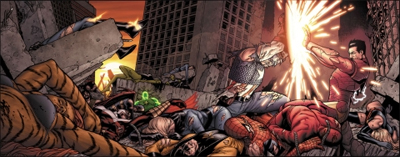
I'm sure we can iron this out...

Continue reading

House of M (Review/Retrospective)

This is the third in a series of comic book reviews that will look at the direction of Marvel’s “Avengers” franchise over the past five or so years, as they’ve been attempting to position the property at the heart of their fictional universe. With The Avengers planned for a cinematic release in 2012, I thought I’d bring myself up to speed by taking a look at Marvel’s tangled web of continuity. Get an overview of what I’m trying to take a look at here.

The X-Men represent the oddball of mainstream superhero comic books. In a genre and medium dedicated offering a static setup – things never really change or resolve – the X-Men are built upon the very idea of evolution. The whole basis of the franchise is the pursuit of equality by the genetically distinct mutant population, the idea that they and mankind can grow together. It has even been frequently suggested that these super-powered individuals represent out future or our replacements. However, the only way to actually tell a story like that is to follow it through to its logical conclusion – to let the ball roll and to let the world change. It feels a little counterproductive for Charles Xavier and his students to still be fighting for the same rights as everyone else nearly fifty years on – it might even seem a little stale. Grant Morrison’s superb New X-Men run offered a solution of sorts – it gave us a world where humanity would be extinct in a couple of generations and showed the growth and relationship between human and mutant subculture. Gone was the minority struggling against an oppressive majority – a more complex example of race relations had come into play with “mutant music” and “mutant slang” making their impression on the youth, amid a silent and almost invisible middle-class backlash. This was an ingenious approach which demonstrated the relevance of the franchise. Unfortunately, Marvel were not quite pleased with this – some people even, ridiculously, accused Morrison of telling all the remaining X-Men stories – and decided to set things right. They did that through House of M.

Dive in...

Continue reading

Planet Hulk (Review/Retrospective)

This is the second in a series of comic book reviews that will look at the direction of Marvel’s “Avengers” franchise over the past five or so years, as they’ve been attempting to position the property at the heart of their fictional universe. With The Avengers planned for a cinematic release in 2012, I thought I’d bring myself up to speed by taking a look at Marvel’s tangled web of continuity. We’re taking a bit of a detour this week, but it’ll feed into Marvel’s event-driven central narrative fairly shortly. Get an overview of what I’m trying to take a look at here.

Finally. Hulk knows who to smash.

– Hulk, less than ten pages into the event

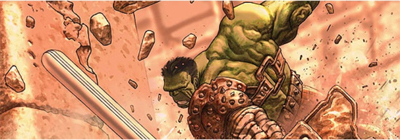
Planet Hulk is perhaps a prime example of the type of event-driven storytelling that has become increasingly common at Marvel in recent years. It isn’t really an event of itself, but there’s a strong smell of editorial mandate behind the plot. The key objective – and one conceded by the powers that be – was to isolate the Hulk character from the greater Marvel Universe during the Civil War event (which he would arguably have considerably complicated) and position him for the follow-up event World War Hulk. As such, exiling the Hulk to a foreign planet and watching him play out his own version of Gladiator isn’t exactly the most fluid storytelling direction. However, it’s to the credit of author Greg Pak that the story works as well as it does.

A smashing good time...

Continue reading

Brian Michael Bendis’ Avengers – New Avengers Vol. 1-2 (Hardcover) (Review/Retrospective)

This is the first in a series of comic book reviews that will look at the direction of Marvel’s “Avengers” franchise over the past five or so years, as they’ve been attempting to position the property at the heart of their fictional universe. With The Avengers planned for a cinematic release in 2012, I thought I’d bring myself up to speed by taking a look at Marvel’s tangled web of continuity. Get an overview of what I’m trying to take a look at here.

Alright. I figure I sound a bit hypocritical complaining about the impact of big events on Marvel’s storytelling continuity without reading said big events. Well, actually, I don’t think I’m a hypocrite – I think it’s perfectly reasonably that a reader should be able to pick up Ed Brubaker’s Captain America without having to worry about Mark Millar’s massive Civil War crossover which they either don’t know enough to care about or know enough not to care about. However, I feel like maybe – just maybe – I should try to ride this “cross-continuity” thing out just once and see if the story somehow justifies the damage it causes to the cohesion of individual runs.  Yes, I’m going to jump head-first into the event-populated minefield of continuity which is recent Marvel history, and I will be using New Avengers as a checklist to that. I’m going down the rabbit hole, following the arc from Civil War through to Siege.

Sentry is responsible for the Carnage in this run...

Continue reading

Ultimate Spider-Man – Vol. 10-11 (Hardcover) (Review)

This represents the final volume of Ultimate Spider-Man, the relaunch of the popular character created by marvel as a way of introducing the iconic webslinger to the those who might be understandably wary of the backstory and continuity tangles the character has found himself in (did you know the character sold his marriage to the devil?). It’s been a landmark run, and a popular one and – by any measure – a successful one. There’s a reason that this ‘reboot’, to borrow a cinematic term, was famous for outselling the mainstream titles. So, as it winds down, what do we think?

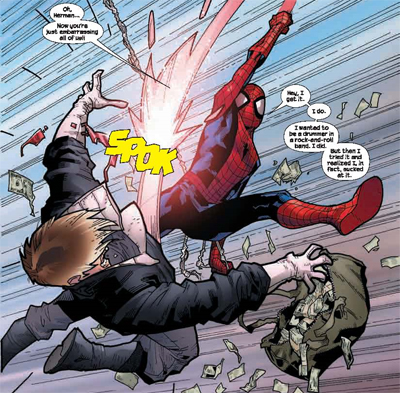
What a Shocker…

Continue reading

Hulk: Grey (Review)

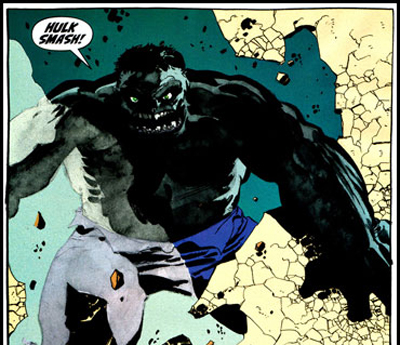
So far the final book in Jeph Loeb and Tim Sale’s superhero “colour” series (although there was a planned Captain America: White and a rumoured Iron Man: Gold which never got off the ground), Hulk: Grey is perhaps the most fascinating of the three novels. Loeb would go on to writing the on-going Hulk series (to near universal damnation, it should be conceded), suggesting perhaps a closer tie between the author and the character here than in Daredevil: Yellow or Spider-Man: Blue. As opposed to those two novels which covered a relatively large portion of the central character’s life, the flashbacks which provide the core of this particular tale cover a single night – the first night. Perhaps befitting the nature of the Hulk, the narration isn’t provided in monologue here, as it was in the other two titles, instead offering a dialogue between Bruce Banner and Doctor Leonard Sampson, his psycho-therapist. It’s a lovely little story that perhaps isn’t as strong as Daredevil: Yellow, but is still a fascinating read.

It took the Hulk a while to figure out the whole "door" concept...

Continue reading

Non-Review Review: Hulk

Ang Lee directing a superhero movie? He’s certainly a strange choice to handle the first big screen adaptation of Marvel’s iconic green monster to the big screen, but arguably a smart one. Hulk is at its best when it hints at the psychological melodrama playing out behind its lead character, but suffers greatly from the fact that it is apparently really uncertain about its source material or what it wants to be. It’s weird to see a movie so wonderfully risky in one sense, but so utterly bland in others. Hulk is an experiment, but sadly isn’t consistent enough to be a successful one.

"Hulk Splash!"

Continue reading

Wolverine: Enemy of the State (Review)

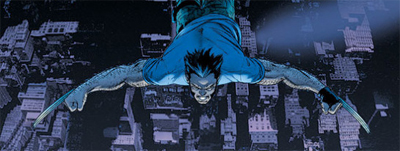
Wolverine is a bit of an odd character. He’s a bit of an odd character to have endured the sheer amount of publicity that he has and to remain a big gun at Marvel. He was introduced as an opponent in The Incredible Hulk, before ending up drafted on to Chris Claremont’s revised Uncanny X-Men roster. After that, he was lucky enough to earn his own miniseries (written by Claremont and drawn by Frank Miller), which became his on-going series which led to him featuring as a leading character in multiple team books and a title character in several solo series, all at the same time. Only Spider-Man can compete with that level of exposure, and Spider-Man arguable has a better claim to it as a richly layoured, complex and pseudo-realistic character (in the sense of being “Peter Parker: Schmuck”, rather than “Your Friendly Neighbourhood Spider-Man”… you get the idea). On the other hand, Wolverine’s defining trait is that he is very, very good at killing things.

Even an unstoppable killing machine can stop to pet the dog...

Continue reading

In Defense of Edward Norton as the Hulk…

News broke over the weekend that Edward Norton will not be returning as the not-so-jolly green giant for Joss Whedon’s The Avengers. This is after Whedon and Norton had a meeting, and Whedon reportedly blew Norton’s mind so badly that Norton (who had been iffy) cleared his schedule to work on the project – and Whedon seemed pretty cool about it as well. And then Marvel announced from on high that Edward Norton would not be returning as Bruce Banner for the big crossover superhero epic that is going to be the tentpole of 2012. And, with due respect to Marvel, that is pants. Purple, stretchy, non-ripping-when-I-turn-into-a-green-goliath pants.

You wouldn't like me when I'm angry...

Continue reading

Spider-Man: Blue (Review)

Writer Jeph Loeb and artist Tim Sale just work well together. They’re the pair behind The Long Halloween, the Batman story which strongly informed Christopher Nolan’s The Dark Knight. Somehow they bring out the best in each other, even though Loeb’s recent output has generally been less than stellar. At Marvel, they’re put together a rough thematic “trilogy” offering a nostalgic look at the early careers of various superheroes. Spider-Man: Blue is the middle part of that trilogy (coming after Daredevil: Yellow and before Hulk: Grey). I’m about to commit a cardinal sin, so brace yourself: I think Spider-Man: Blue is the weakest of the three books.

Welcome to the spider's web...

Continue reading