• Following Us

  • Categories

  • Check out the Archives


  • Awards & Nominations

John Carter: Warlord of Mars Omnibus (Review/Retrospective)

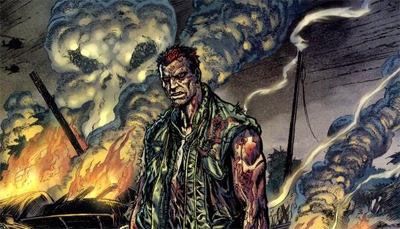
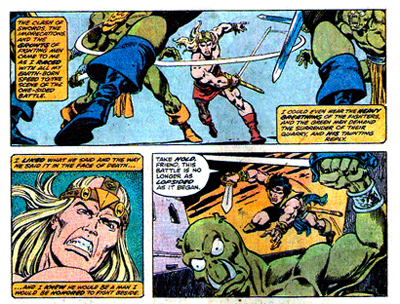
I have to admit, I have a huge amount of respect for Marvel’s Collected Editions department. Their superb “Omnibus” line, aimed at collecting giant volumes featuring entire runs on particular characters or series, hasn’t just been reserved for their iconic stable of heroes. For example, we’ve seen a three-volume set of Marv Wolfman and Gene Colan’s Tomb of Dracula, along with complete runs of Jack Kirby’s Eternals and Devil Dinosaur. In celebration of the release of John Carter, Marvel has produced a single hardcover collection of their twenty-eight issue (and three annual) series John Carter: Warlord of Mars, from the mid-seventies. Featuring an all-star group of creative talents, it’s an interesting look at a classic comic book that doesn’t involve tights or spandex, instead offering pulpy old-fashioned adventure.
An alien adventure...

Continue reading

Garth Ennis’ Run on Punisher MAX – Born (Review/Retrospective)

To celebrate St. Patrick’s Day, this month we’re going to take a look at Northern Irish writer Garth Ennis’ run on that iconic Marvel anti-hero, The Punisher. Check back every Friday and Wednesday for a review of a particular section.

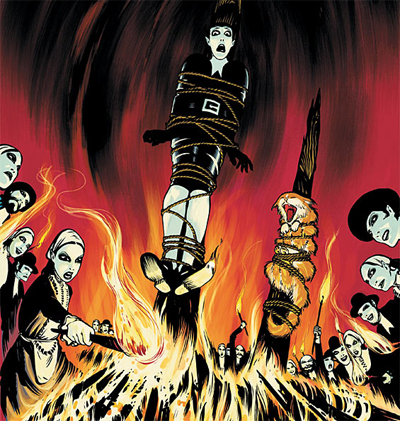
There are comic book characters that are so closely tied to one particular writer that you pity anybody trying to write them. The X-Men have Chris Claremont (although I do love Grant Morrison’s New X-Men run), Daredevil has Frank Miller (although he also has Brian Michael Bendis and Ed Brubaker), Hulk has Peter David and (I firmly believe) Green Lantern has Geoff Johns. Somehow, through some fluke, occasionally comic book characters manage to stumble across a writer who fundamentally understands them. I’d argue that this is the benefit of having these characters survive in print – none of these runs were by the original authors. Anyway, to get to the point, the Punisher has Garth Ennis.

The last Castle...

Continue reading

Absolute Crisis on Infinite Earths (Review/Retrospective)

This January, I’m going to take a look at some of DC’s biggest “events.” This week I’ll be taking at the event that started it all, Marv Wolfman and George Pérez’s Crisis on Infinite Earths, reprinted in DC’s oversized and slipcased Absolute line.

It’s interesting to reflect on Crisis on Infinite Earths, more than a quarter of a century after the twelve-issue maxi-series was published. In the time since, it seems like the editorial purpose driving the event – the desire to “simplify” DC’s tangled and messed continuity into one single and unified history by abolishing the myriad of alternate continuities – has been somewhat undone with the return of the multiverse in 52 and Final Crisis, but this arguably allows Wolfman and Pérez’s epic to be considered on its own merit. Although the series might not be as important as it once was in explaining the sometimes bizarre way that all of DC’s published line fit together, I think you can still see a huge influence of this crossover in the stories that the authors at DC are telling, and how they approach them.

Holding out for some heroes...

Continue reading

Grant Morrison’s Seven Soldiers of Victory: Klarion (Review/Retrospective)

December is “Grant Morrison month” here at the m0vie blog, as we take the month to consider and reflect on one of the most critically acclaimed (and polarising) authors working in the medium. We’ve got a special treat for you this week, which is “Seven Soldiers Week”, so check back each day for a review of one of the Seven Soldier miniseries that Morrison put together.

I think that Seven Soldiers perhaps serves to illustrate the connection between Grant Morrison and Jack “King” Kirby. I know that Morrison’s detractors will balk at such a comparison, but I think there’s a lot to this. Kirby defined Marvel, working on flagship titles like The Avengers or The Fantastic Four or The Incredible Hulk, and he was as influential as Stan Lee in establishing what readers could expect from Marvel. However, he also did a considerable body of work at DC. While not as successful or iconic as his Marvel portfolio, I do think that it was some of his more wonderful and outrageous “high concept” work – things like the New Gods, for example, or Kamandi or Etrigan the Demon. I think one of the more intriguing aspects of Seven Soldiers has been seeing Morrison work with these types of crazy and ingenious ideas.

Morrison's on fire of late...

Continue reading

Ultimate Comics: Doomsday (Hardcover) (Review)

Celebrating the 50th anniversary of the Fantastic Four, I’m taking a look at some of the stories featuring the characters over the past half-century.

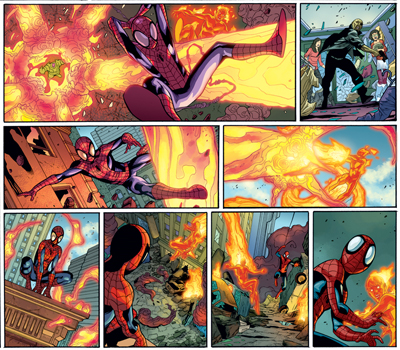
Ultimate Comics: Doomsday is a bit of a weird beast. After the events of Ultimatum, Mark Millar’s Ultimates was relaunched both as Ultimate Comics: Avengers and the clunkily-titled (and written) Ultimate Comics: New Ultimates, while Ultimate Spider-Man became Ultimate Comics: Spider-Man and Ultimate X-Men spun off into Ultimate Comics: X. That meant that the only on-going series that hadn’t fed into a relaunched series was Ultimate Fantastic Four. Perhaps it’s understandable, since the series was arguably the weakest of Marvel’s Ultimate reimaginings of popular heroes, suffering from adapting Marvel’s most innocent scientific heroes in a grim and hyper-modern context. Ultimate Comics: Doomsday collects three miniseries (Ultimate Comics: Enemy, Ultimate Comics: Mystery and Ultimate Comics: Doom), which tell a gigantic crossover crisis set in the shared universe that the “ultimate” characters inhabit, but it’s really just a vehicle to allow Brian Michael Bendis to play with the left-over bits and pieces from Ultimate Fantastic Four.

This little Spider...

Continue reading

Fantastic Four by John Byrne Omnibus (Review/Retrospective)

Celebrating the 50th anniversary of the Fantastic Four, I’m taking a look at some of the stories featuring the characters over the past half-century.

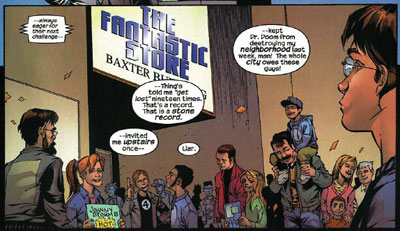
John Byrne’s Fantastic Four run is pretty major as Marvel comic book runs go. It’s generally regarded to be one of the better comic book runs of the eighties, alongside Frank Miller’s Daredevil and Walt Simonson’s Thor, but it’s also widely regarded as the best run on Marvel’s flagship family since Stan Lee and Jack Kirby finished their record-setting run establishing both the series and the shared Marvel Universe. (The length of the run has since been surpassed, appropriately enough, by Brian Michael Bendis and Mark Bagley on Ultimate Spider-Man.) This was my first time reading the run, which has received the massive omnibus treatment from Marvel. I have to admit, while not quite blown away by it, I was remarkably impressed by the love and craftsmanship that Byrne poured into the run. I wouldn’t class it as iconic or genre-defining, but it’s a remarkably solid examination of the franchise that launched the Marvel Universe.

Fantastic!

Continue reading

Mark Waid’s Run on the Fantastic Four – Vol. 1-3 (Hardcover) (Review/Retrospective)

Celebrating the 50th anniversary of the Fantastic Four, I’m taking a look at some of the stories featuring the characters over the past half-century.

The Fantastic Four helped launch Marvel to publishing greatness over the 100+ issues drafted by Stan Lee and Jack Kirby, but they’ve seldom occupied a prominent place in their publishing line-up since that dramatic introduction. Sure, the title earned a place as one of the three Ultimate on-going titles (at least before Ultimatum) and sure, there were occasionally hugely successful and iconic runs like that of John Byrne, but these were the exception rather than the rule. The title never really reached a stage like the X-Men, Spider-Man or even Avengers books (in modern Marvel), where they were clearly the title to watch. While I’m not entirely convinced he succeeded, Mark Waid is consciously trying to find a definitive approach to the title. And I respect that.

The adoring public…

Continue reading

Marvels by Kurt Busiek & Alex Ross (Review)

In celebration of the 4th of July and the release of Captain America: The First Avenger this month, we’re jumping into Marvel’s comic book alternate history and taking a look at the star-spangled avenger every Wednesday this month.

I think it’s safe to say that Marvels, the four issue miniseries from Marvel released during the nineties revolutionised the industry. An attempt to create something akin to a social history of the Marvel Universe from the perspective of “everyman” reporter Phil Sheldon charted the course of history in the fictional Marvel Universe from its humble beginnings in the adventures of the Human Torch and the Submariner through to the death of Gwen Stacey, wondering what ideas and themes could be derived from the evolution of this world populated with the magnificent and the ridiculous, the epic and embarrassing, the big and the small.

Something stuck about this miniseries...

Continue reading

Non-Review Review: X-Men – First Class

X-Men: First Class is easily the best thing to emerge from Bryan Singer’s X-Men movie franchise since X-Men II, all those years ago. Jane Goldman’s smart script and Matthew Vaughn’s confident direction help inject life back into the franchise that stirred up this current superhero blockbuster fad, providing one of the finest examples of the subgenre. Although the movie does occasionally veer a little bit too close to (and, once or twice, right into) camp, it’s also a clever, brave, bold and exciting action adventure, which provides the best characterisation of the series to date.

We've got it covered...

Continue reading

Ultimate Comics: Thor (Review/Retrospective)

With the release of Marvel’s big-budget superhero action movie Thor this summer, we’re taking a month to celebrate the God of Thunder. Check back each Wednesday for a Thor-related review.

“It burns,” Thor tells us as the comic opens. “The world tree burns… Surely this is the end of all things…” Yes, Jonathan Hickman suggests, it is indeed the end, but it is also the beginning. The lives of gods, like the myths themselves and the comic books they inspire, are cyclical and endless. This scene, as Nazi stormtroopers and frost giants march on Asgard, might be the end, but it is also the beginning.

Thor Smash!

Continue reading