• Following Us

  • Categories

  • Check out the Archives


  • Awards & Nominations

Star Trek: Deep Space Nine – Hippocratic Oath (Review)

This February and March, we’re taking a look at the 1995 to 1996 season of Star Trek, including Star Trek: Deep Space Nine and Star Trek: Voyager. Check back daily Tuesday through Friday for the latest review.

Hippocratic Oath represents a return to normality for Star Trek: Deep Space Nine. The Way of the Warrior was a feature-length war epic tasked with introducing a new regular character and a new status quo, while The Visitor was an intimate character study that stood quite apart from the show around it. With Hippocratic Oath, the show gets back to business as usual. It even has a classic a-story/b-story split with Bashir and O’Brien’s Gamma Quadrant hijinx juxtaposed with Worf learning his place on the station (and the show).

This is not to suggest that Hippocratic Oath is a bland hour of Star Trek. Indeed, it is a tightly-constructed story that hits on some of the show’s core themes and most interesting dynamics. One of the problems with the third season of Deep Space Nine was the fact that it had a strong start but no idea on how to build from that. Hippocratic Oath seems to serve very much as a “business as usual” episode of the fourth season, helping to set a baseline of quality of the show going forward.

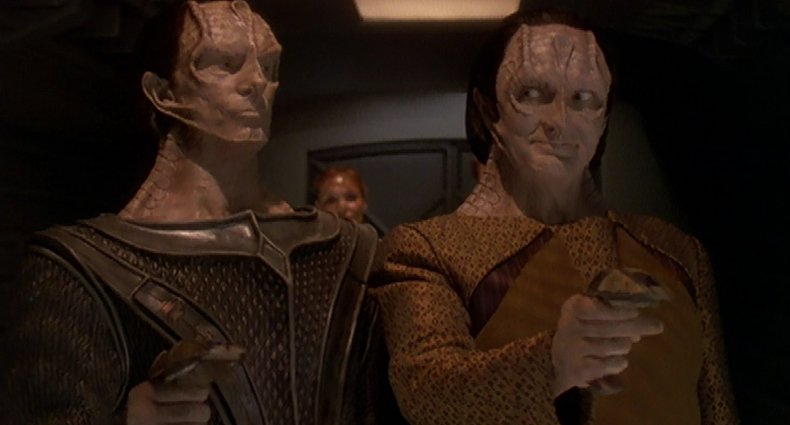
Awkward bromantic moment...

Awkward bromantic moment…

Continue reading

Star Trek: Deep Space Nine – The Way of the Warrior (Review)

This February and March, we’re taking a look at the 1995 to 1996 season of Star Trek, including Star Trek: Deep Space Nine and Star Trek: Voyager. Check back daily Tuesday through Friday for the latest review.

The third season of Star Trek: Deep Space Nine was really just a dress rehearsal for what lay ahead.

The third season had been a tumultuous time for the show, with Michael Piller departing the franchise to pursue opportunities outside Star Trek. It was the year directly after the end of Star Trek: The Next Generation, and all attention was focused on the pending release of Star Trek: Generations and the launch of Star Trek: Voyager. On top of that, the third season suffered from a great deal of confusion and disorganisation throughout the year, making it very hard for the production team to set an end goal for themselves.

"This could be the start of a beautiful friendship..."

“This could be the start of a beautiful friendship…”

In fact, the third season of Deep Space Nine was such a mess that the production team had not even managed to hit the end of season cliffhanger that they wanted. The Adversary had been drafted at the last possible minute when the studio vetoed the idea of ending the year with a Vulcan withdrawal from the Federation. This is not to discount the long list of impressive episodes produced during the season, but it does illustrate that the third season of Deep Space Nine had not progressed according to plan.

At the same time, it was a vital learning experience for the show. It provided a clear framework for what followed, providing producer Ira Steven Behr with a foundation from which he would build the rest of the run. The work put in during the third season would pay dividends in the fourth and fifth seasons, as the show began to play with and pay off ideas that had been carefully and meticulously established during that most chaotic of seasons. In fact, the show begins paying off those dividends with The Way of the Warrior, the first episode of the fourth season.

Klingons woz 'ere...

Klingons woz ‘ere…

Continue reading

Star Trek: Enterprise – The Expanse (Review)

Next year, Star Trek is fifty years old. We have some special stuff planned for that, but – in the meantime – we’re reviewing all of Star Trek: Enterprise this year as something of a prequel to that anniversary. This April, we’re doing the second season. Check back daily for the latest review.

And, finally, everything changes.

It feels inevitable. Maybe not in this particular form, maybe not in this particular way, but Star Trek: Enterprise needed something. The show needed to stop feeling like a relic of the early nineties – a great song played on loop to the point where it became nothing more than generic white noise. The Expanse gives the show a clear sense of direction and a clear sense of purpose. It is not a direction that is unanimously loved, and it is not a purpose that is realised as well as it might be, but it finally feels like Enterprise is boldly going in its own direction.

A walk among the wreckage...

A walk among the ruins…

In many respects, the obvious point of comparison for The Expanse is an episode like The Jem’Hadar or A Call to Arms. It is an episode that is clearly written to reach an ending so that the show can start doing something new. These episodes tend to tease a brave new future, one utterly unlike anything that Star Trek has done before, but they play like extended forty-five minute trailers. Watching The Expanse, it feels like show runners Rick Berman and Brannon Braga are thinking more about the direction than the destination. That’s not a bad thing at this point.

Polarising as it might be, and occasionally awkward as it might be, The Expanse was utterly necessary. Enterprise is a Star Trek show that exists in the shadow of 9/11. That horrific terrorist attack has reverberated throughout the series. The War on Terror informs and distorts narratives like Shadows of P’Jem, ShockwaveThe SeventhCease FireThe CrossingJudgmentRegeneration and Cogenitor. However, there is a sense that Enterprise never accepted that heavy pull of gravity.

Homecoming...

Homecoming…

Sometimes it worked; Judgment, Regeneration and Cogenitor are all examples of the series trying to apply its own morality to a more complicated and confusing geopolitical climate. However, the War on Terror made it hard to reconcile Jonathan Archer as both an explorer and a paranoid reactionary. The unquestioning trust in authority in The Seventh, to the point where he did not question the Vulcan High Command’s mindwipe of T’Pol? The all-consuming dread upon meeting something different in The Crossing? These do not fit well within Star Trek.

So The Expanse pushes all that to the front. The opening teaser features a strange alien ship appearing and carving a large scar in the surface of the planet – a very visual representation of the damage done to the utopian optimism of Star Trek. Now that the scar had been literalised, it could be discussed and explored. The Expanse made sure that nobody was talking around the elephant in the room; everybody was now charging right at it.
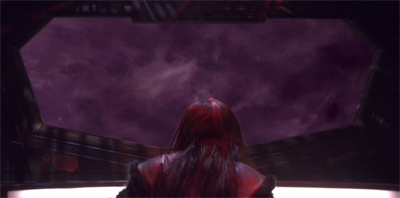
The way ahead is cloudy...

The way ahead is cloudy…

Continue reading

Star Trek: Enterprise – Judgment (Review)

Next year, Star Trek is fifty years old. We have some special stuff planned for that, but – in the meantime – we’re reviewing all of Star Trek: Enterprise this year as something of a prequel to that anniversary. This April, we’re doing the second season. Check back daily for the latest review.

Judgment is the first episode of Star Trek to do something interesting with the Klingons since Tacking Into the Wind, almost four years earlier.

After all, it never seemed like Star Trek: Enterprise had any real idea what to do with the Klingons. The show had made use of Klingons in Broken Bow, Unexpected, Sleeping Dogs and Marauders – but none of these episodes seemed particularly interested in telling a story about Klingons. Enterprise seemed primarily interested in the Klingons as a connection to the franchise’s long and distinguished history. After all, Klingons are almost as iconic a part of Star Trek as Spock; working a few bumpy-headed warriors into your script was a nice way of acknowledging the Star Trek legacy.

Trial of the twenty-second century...

Trial of the twenty-second century…

Certainly, Enterprise was not interested in committing to the same Klingon world-building in which Star Trek: The Next Generation and Star Trek: Deep Space Nine had revelled. There are a lot of reasons for this. Over ten seasons, writer Ronald D. Moore had probably said just about everything that needed to be said about the Klingons; trying to say something new or interesting without his input was certainly daunting. More than that, Enterprise had committed itself quite firmly to episodic storytelling in its first two years; even the Andorians and Vulcans were still barely developed.

So David A. Goodman’s script for Judgment is ambitious, particularly in light of the spectacular failure of his (heavily re-written) work on Precious Cargo. Constructing an episode that might easily be misread as a rehash of Star Trek VI: The Undiscovered Country was a pretty bold choice, particularly given the problems that the show had endured while trying to construct an homage to Elaan of Troyius and The Perfect Mate. On paper, Judgment is an assignment that could easily explode spectacularly. It might not be as crazy a gambit as A Night in Sickbay, but it is a story with lofty objectives.

The court has spoken.

The court has spoken.

With so much of the second season feeling like it is running on auto-pilot, the energy and enthusiasm of Judgment is infectious. Singularity, Vanishing Point, Canamar and The Crossing felt like they were constructed using blueprints of what a Star Trek episode should look like. It is refreshing to watch an episode of Enterprise that seems genuinely excited to playing with these particular toys. In that sense, Judgment sets the mood for the final stretch of the season – despite duds like Horizon and Bounty, the final run of episodes feels like a band playing an encore for a show on the cusp of monumental change.

Although not facing the same threat of cancellation that loomed at the end of the third and fourth seasons, the second season of Enterprise feels like the last gasp of a particular model of Star Trek production, one no longer as viable as it once had been. Starting with Judgment, the show seems to acknowledge that things are going to have to change dramatically and soon; however, there is a clear attempt to bid this particular iteration of Star Trek a fond farewell. As such, any and all references to The Undiscovered Country feel entirely appropriate.

“Don’t wait for the translation! Answer me now!”

Continue reading

Star Trek: Enterprise – Marauders (Review)

Next year, Star Trek is fifty years old. We have some special stuff planned for that, but – in the meantime – we’re reviewing all of Star Trek: Enterprise this year as something of a prequel to that anniversary. This April, we’re doing the second season. Check back daily for the latest review.

Well, it looks like Star Trek: Enterprise used up most (if not all) of its ambition for the second season.

The second season of Enterprise got off to a fairly decent start, Shockwave, Part II notwithstanding. Minefield and Dead Stop weren’t perfect, but they were taking the show in a direction that seemed promising. A Night in Sickbay may have been a pretty serious misfire, but it was still a very ambitious instalment of the series. However, it seemed like that ambition was not to last. The second season of Enterprise becomes fairly conventional from this point out – fairly relaxed and fairly generic.

"We don't like your kind around here..."

“We don’t like your kind around here…”

This is the type of approach that producers will frequently describe as “back to basics.” More cynical commentators might use the phrase “back to the well.” The goal seems to be to offer the audience more of what they’ve had before, to repeat what had worked in earlier episodes in earlier seasons in earlier shows. There’s a creeping sense of familiarity to the whole exercise, as if the writing staff are merely filing the numbers (and character names) off old scripts so that they can be recycled. It is very environmentally friendly.

Marauders starts the trend, offering viewers what amounts to The Magnificent Seven… in space, with Klingons!” It works quite well as a diversion or change of pace. It is significantly less satisfying as a direction for the rest of the season.

"Settlement this!"

“Settlement this!”

Continue reading

Star Trek: Enterprise – Season 1 (Review)

Next year, Star Trek is fifty years old. We have some special stuff planned for that, but – in the meantime – we’re reviewing all of Star Trek: Enterprise this year as something of a prequel to that anniversary. This January, we’re doing the first season. Check back daily for the latest review.

The first season of Star Trek: Enterprise is caught at a crossroads.

On the hand, it needs to be something new and exciting. The first Star Trek show of the new millennium, Enterprise has to find a way of updating the franchise and pushing forward. It has to find a way to challenge audience expectations and demonstrate that – after fourteen consecutive years and twenty-one overlapping seasons – Star Trek still has something fresh and exciting to offer fans. After all, the television landscape had changed significantly since the late eighties. It was time for Star Trek to change with it.

ent-brokenbow3

On the other hand, there’s a clear desire to seek familiar comforts. Star Trek has been on the air consistently for over a decade now. That wouldn’t be the case if the franchise didn’t have its own merits. There’s a sense that the first season of Enterprise is drawn to the idea that it can keep doing what worked before, offering generic Star Trek stories with a new cast and a new theme tune. This is still Star Trek, after all. There’s nothing gained by changing it to the point where it is unrecognisable.

Throughout the first season, these two impulses seem to be at odds with one another, leading to a surreal sense of whiplash. Episodes that feel as unique as Breaking the Ice, Dear Doctor or Shuttlepod One sit alongside generic shows like Civilisation, Sleeping Dogs or Rogue Planet. The show frequently pushes itself in interesting directions, only to pull relent as it approaches the point of committal. The result is a first season that is uneven, but intriguing, one that has great potential – if not necessarily the will to fulfill it.

ent-shockwavepart1m Continue reading

Star Trek: Enterprise – Detained (Review)

Next year, Star Trek is fifty years old. We have some special stuff planned for that, but – in the meantime – we’re reviewing all of Star Trek: Enterprise this year as something of a prequel to that anniversary. This January, we’re doing the first season. Check back daily for the latest review.

Detained is well-meaning, if a little clumsy and awkward.

It is a rather conscious effort to do a “message show” in the grand tradition of the Star Trek franchise, using the show’s science-fiction premise to offer a commentary on current events. Detained is very clearly structured as a response to the 9/11 attacks, even if Archer only explicitly references the internment of Japanese Americans at Manzanar. Detained is full of interesting ideas, and its heart is in the right place, but the execution feels decidedly rushed and haphazard. Detained works much better as a two-line moral than it does as a forty-five minute episode of television.

You can't call him Al...

You can’t call him Al…

Continue reading

Star Trek: Enterprise – Sleeping Dogs (Review)

Next year, Star Trek is fifty years old. We have some special stuff planned for that, but – in the meantime – we’re reviewing all of Star Trek: Enterprise this year as something of a prequel to that anniversary. This January, we’re doing the first season. Check back daily for the latest review.

There’s really very little to say about Sleeping Dogs. It’s not particularly good, it’s not particularly bad. Like Civilisation before it, it’s an episode of Star Trek constructed to a familiar formula. The ship in question answers a distress call from an alien ship. Our crew attempts a rescue mission, during which the away team end up stranded. Meanwhile, our captain tries to figure out how to communicate with an alien from a radically different culture, eventually coming to realise that he must address them on their terms.

These are all stock elements, and they are mixed into Sleeping Dogs with a minimum of fuss. The only real kink in Sleeping Dogs is that the aliens in question are Klingons. However, we’ve spent so much time with Klingons in the various other Star Trek spin-off shows that using them as a light seasoning in a fairly stock Star Trek plot doesn’t make for a particularly appetising combination.

Again with the Klingons...

Again with the Klingons…

Continue reading

Star Trek: Enterprise – Civilisation (Review)

Next year, Star Trek is fifty years old. We have some special stuff planned for that, but – in the meantime – we’re reviewing all of Star Trek: Enterprise this year as something of a prequel to that anniversary. This January, we’re doing the first season. Check back daily for the latest review.

After Breaking the Ice hinted at what Star Trek: Enterprise might become, Civilisation is an episode that nudges the show right back into its comfort zone. It’s an episode of Star Trek that feels like it could have been produced for Star Trek: The Next Generation or Star Trek: Voyager, with only a minimum amount of change to the script. However, what is strangest about Civilisation is the way that it feels like a rather direct throwback to the very classic Star Trek show, serving as a tale about our hot-blooded captain fighting evil imperialist adversaries and seducing sexy alien space babes.

Of course, there’s a sense that this sense of regression is exactly what the show is aspiring towards. After all, Archer was advertised as “Captain Kirk’s childhood hero”, and it makes sense for the show to play with the classic Star Trek tropes that are regarded so affectionately by popular culture. Unfortunately, Civilisation lacks the spark and wit necessary to make such a pulpy homage work, instead feeling too much like a dull retread.

David Ickes was right!

David Icke was right!

Continue reading

Star Trek: Enterprise – Unexpected (Review)

Next year, Star Trek is fifty years old. We have some special stuff planned for that, but – in the meantime – we’re reviewing all of Star Trek: Enterprise this year as something of a prequel to that anniversary. This January, we’re doing the first season. Check back daily for the latest review.

So, male pregnancy, eh?

Talk about a nipple slip...

Talk about a nipple slip…

Continue reading