












The first Star Trek pilot, The Cage, was produced in 1964. To celebrate its fiftieth anniversary, this December we are reviewing the second season of the original Star Trek show. You can check out our first season reviews here. Check back daily for the latest review.
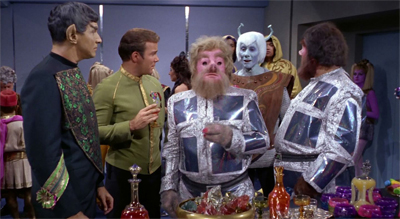
A Piece of the Action is the last script credited to Gene L. Coon.
Of course, Coon would write two episodes for (and contributed two more stories to) the show’s troubled final season under the alias Lee Cronin. However, A Piece of the Action could be seen as the last hurrah for Gene L. Coon’s vision of Star Trek. The writer and producer had helped to shape and define many of the ideas that Star Trek fans take for granted. A lot of the core Star Trek ideas that have permeated into popular culture – the Federation, the Klingons – originated with Coon.

Dey call him Boss Koik…
While Coon is often overlooked when it comes to crediting those responsible for creating Star Trek as fans have come to know it, history has tended to gloss over his wry subversive streak. In many ways, Coon could be said to be the godfather of Star Trek: Deep Space Nine. Had he not passed away at the tragically young age of forty-nine, Coon might have been coaxed back to write a first season episode of Deep Space Nine alongside Dorothy Fontana. Coon was, after all, the first Star Trek writer to shrewdly and knowingly problematicise the Federation.
So it feels appropriate that the last Star Trek script credited to Coon should have Kirk proposes the Federation as an intergalactic racket.

Top gun…
Filed under: The Original Series | Tagged: capitalism, Chicago, Cold War, dan p. harmon, exceptionalism, Feds, gangsters, Gene L. Coon, gene roddenberry, imperialism, individualism, kirk, meta-fiction, mob, star trek, star trek: the original series, stories, tos, William Shatner | 11 Comments »







 the m0vie blog
Star Trek – Bread and Circuses (Review)
The first Star Trek pilot, The Cage, was produced in 1964. To celebrate its fiftieth anniversary, this December we are reviewing the second season of the original Star Trek show. You can check out our first season reviews here. Check back daily for the latest review.
Bread and Circuses is not subtle. Then again, that is the point.
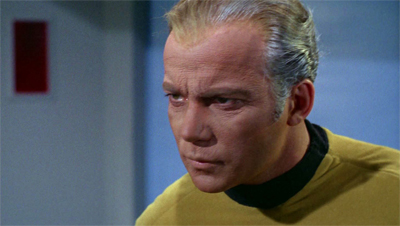
There’s a lot of interesting stuff happening in Bread and Circuses, the fourteenth episode produced for the second season, but the last to air. There’s the idea of a world dominated by “a twentieth century Rome”, a rogue captain, a Prime Directive dilemma and a scathing indictment of modern television. Not only is it one of the last episodes with a “produced by Gene L. Coon” credit, it is also an episode co-written by Roddenberry and Coon. It is also the episode of Star Trek that endorses Christianity most explicitly and heavily.
“Wait, we’re only getting it in black and white?”
Bread and Circuses is a bold and audacious piece of television, full of venom and righteous anger, rich in satire and cynicism. It’s a plot so ridiculously over-stuffed with good ideas that viewers are liable to forgive the show’s somewhat cop-out ending where Kirk and his away team beam back to the Enterprise and continue on their merry way as though little has actually happened. Bread and Circuses feels like it uses every minute of its fifty-minute runtime wisely, balancing character with world-building.
It is probably a little bit too messy and disjointed to be labelled a dyed-in-the-wool classic, particularly when compared to the shows produced around it. Nevertheless, it is a decidedly ambitious piece of work, and one that demonstrates what Star Trek could do when it sets its mind to something.
When in Rome…
Continue reading →
Filed under: The Original Series | Tagged: behind the scenes, cancellation, capitalism, Christ, christianity, competition, culture, faith, fans, fourth wall, game shows, Gene L. Coon, gene roddenberry, kirk, McCoy, ralph senensky, reality television, religion, romans, romulans, science fiction, Shatner, social commentary, space!romans, spock, star trek, star trek: the original series, Television, the all, the original series, tos | 6 Comments »