• Following Us

  • Categories

  • Check out the Archives


  • Awards & Nominations

Star Trek: Enterprise – The Breach (Review)

Next year, Star Trek is fifty years old. We have some special stuff planned for that, but – in the meantime – we’re reviewing all of Star Trek: Enterprise this year as something of a prequel to that anniversary. This April, we’re doing the second season. Check back daily for the latest review.

One of the more interesting aspects of a heightened franchise like Star Trek is the way that invites particular members of staff to define their own voices. On most of the Star Trek shows, it is easy to distinguish the work of particular writers from one another. Ronald D. Moore likes militarism and world-building; Brannon Braga likes time travel and classic science-fiction. There are clear voices that can be distinguished from the choir on each of the shows, for better or for worse.

Although it enjoyed a considerably shorter run than the other Star Trek spin-offs, Star Trek: Enterprise is no exception.  The Breach is a script credited to writers Chris Black and John Shiban. The two had collaborated unofficially on Canamar, a script credited to Shiban alone. The two would work together again on First Flight towards the end of the season. It is certainly a partnership that had considerable potential, if not for Shiban’s departure at the end of the season.

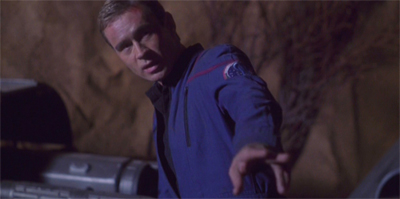
What's up, Doc?

What’s up, Doc?

In many respects, The Breach feels like the product of those two voices. Xenophobia is a major theme of The Breach – as it was in Shiban’s other scripts for the season like Minefield, Dawn or Canamar. Like their last collaboration on Canamar and their future collaboration on First Flight, it seems The Breach presents a more balanced version of Archer than episodes like The Crossing or Horizon. This is a version of Archer who feels compelled to do the right thing, but without the same oppressive self-righteousness that drives his more awkward moments.

However, it seems like Chris Black provides The Breach with its very traditional and old-fashioned Star Trek aesthetic. A veteran of genre television with an understanding of the narrative conventions associated with the franchise, Black understands how Star Trek storytelling is supposed to work. The Breach is perhaps a little too formulaic and traditional in its storytelling, but it does demonstrate that – despite its best efforts – The Crossing had not completely buried a certain optimistic strain of Star Trek ethics.

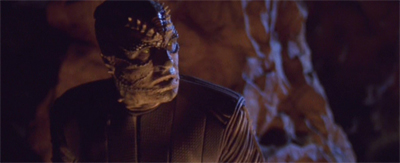
Into darkness...

Into darkness…

Continue reading

Star Trek: Enterprise – Canamar (Review)

Next year, Star Trek is fifty years old. We have some special stuff planned for that, but – in the meantime – we’re reviewing all of Star Trek: Enterprise this year as something of a prequel to that anniversary. This April, we’re doing the second season. Check back daily for the latest review.

The story behind Canamar is much more interesting than the story told in Canamar.

On the surface, Canamar is quite simple – Star Trek does Con Air.” However, it had an interesting journey from original pitch to televised episode. Indeed, Canamar developed from David A. Goodman’s attempts to break out Judgment, trying to figure out what would happen to Archer after he had been found in Klingon court. Originally, the crew would have rescued Archer from a prison transport rather than Rura Penthe. However, producer Brannon Braga took such a liking to the “Archer on a prison transport” concept that he pulled it out of Judgment and assigned it to John Shiban to script.

"Have you seen Con Air?" "No." "Good. Then this'll all seem new to you."

“Have you seen Con Air?”
“No.”
“Good. Then this’ll all seem new to you.”

However, Braga also divorced Canamar completely from Judgment. Archer would no longer be a prisoner on a Klingon prison transport. Instead, he would find himself mistakenly arrested by an entirely new alien species a couple of episodes before he’d find himself arrested by a more recognised alien species. It feels somewhat redundant, with the first act of Canamar rushing through set-up of plot beats that would feel more organic and fluid if they came from an early episode explicitly designed to build to the idea of Archer on the prison transport.

Canamar is a prime example of just how out of touch Star Trek: Enterprise was with the television landscape, reinforcing the sense that the second season of the show was a holdover from some much earlier period of television production.

"It's the ship that made the Kessel Run in less than twelve parsecs. I've outrun Imperial starships."

“It’s the ship that made the Kessel Run in less than twelve parsecs. I’ve outrun Imperial starships.”

Continue reading

Star Trek: Enterprise – Dawn (Review)

Next year, Star Trek is fifty years old. We have some special stuff planned for that, but – in the meantime – we’re reviewing all of Star Trek: Enterprise this year as something of a prequel to that anniversary. This April, we’re doing the second season. Check back daily for the latest review.

Dawn arrives at a very delicate moment in Star Trek history.

Star Trek: Nemesis had hit cinemas the weekend before The Catwalk aired. It had been an immediate and humiliating disaster for Paramount. It arrived in a stuffed Christmas season, amid a relentless onslaught of big budget blockbuster fare – competing for space against Harry Potter and the Chamber of Secrets, Die Another Day and Lord of the Rings: The Two Towers. It was the first Star Trek film not to open at the top of the United States box office, landing second to Maid in Manhattan.

Engineering a solution...

Engineering a solution…

The prognosis for Star Trek as a franchise had not been particularly optimistic for quite some time. The ratings had been in decline since Star Trek: The Next Generation went off the air. Star Trek: Enterprise was airing on a dying network. Changing management at UPN was less friendly to the franchise than it had been. However, the spectacular failure of Star Trek: Nemesis was perhaps the most public blow the franchise had taken. The critics now had ammunition; the vultures were circling; the franchise was on the ropes for the world to see.

The Catwalk had aired a few days after Nemesis crash-landed, when the franchise was still reeling. The first episode of Star Trek to air in 2003, Dawn was broadcast after the franchise and the public had time to properly process the disaster. It goes without saying that there was a lot of pressure on the episode.

Alien nation...

Alien nation…

Continue reading

Star Trek: Enterprise – Minefield (Review)

Next year, Star Trek is fifty years old. We have some special stuff planned for that, but – in the meantime – we’re reviewing all of Star Trek: Enterprise this year as something of a prequel to that anniversary. This April, we’re doing the second season. Check back daily for the latest review.

Shuttlepod One worked very well in the first season, didn’t it?

The episode was one of the highlights of the first season, received very well by both the cast and fandom. So it makes sense to revisit that basic set-up early in the second season. This time it isn’t Malcolm Reed and Charles Tucker facing death in the cold void of space. Instead, Jonathan Archer and Malcolm Reed find themselves struggling with a mine as a countdown ticks away in the background. Facing all-but-certain death, characters are thrown into conflict with one another. Sparks fly, drama happens.

Let's go outside.

Let’s go outside.

To be fair, Minefield ups the stakes dramatically. It takes the same high-stakes characters-against-the-void drama that made Shuttlepod One such a success and then blends it with Star Trek: First Contact and throws the Romulans into the mix just two months before the release of Star Trek: Nemesis. It is very much a high-concept cocktail of episode, a show with a lot going on and a lot of focus in contrast to the more relaxed pace of something like Carbon Creek.

Minefield does feel a little bit too derivative and like it is promising something that never quite arrives. However, it is built around a very sound structure, makes good use of the special effects available for the show, and gives Scott Bakula and Dominic Keating a chance to play off one another. It offers a lot of promise for the second season, only to be retroactively tainted by the fact that the second season never delivers on any of these promises.

All I need is the air that I breath...

All I need is the air that I breath…

Continue reading

The X-Files – Elegy (Review)

This February and March, we’re taking a trip back in time to review the fourth season of The X-Files and the first season of Millennium.

The first two-thirds of Elegy count as the best episode of The X-Files that John Shiban has written at this point of his tenure on the writing staff. Elegy starts out as an episode that leans into Shiban’s strengths. It is a very traditional and old-fashioned horror story, the first tried-and-tested ghost story that The X-Files has told in a while. The idea of a haunted bowling alley is so wonderfully weird and so quintessentially American that it fits The X-Files perfectly. For its first thirty minutes, Elegy is funereal and sombre, haunting and enchanting.

Elegy is a story packed with potentially interesting concepts. It is overflowing with clever ideas and memorable images. Shiban is a writer who has a great deal of affection for classic horror, and that affection shines through into Elegy. There is a slow and sorrowful atmosphere to the early stretches of the episode. Transparent grey spectres are a staple of the horror genre, but they work very well in this context. The X-Files has been quite reluctant to handle traditional monsters, so there is something rather strange and affecting about seeing such a classic depiction here.

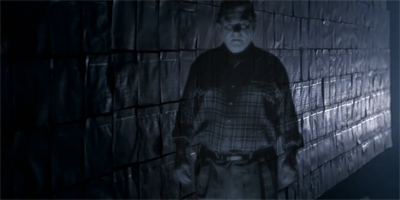
Here there be ghosts...

Here there be ghosts…

Then things go to hell. To be fair, the problems with the last fifteen of Elegy are very much suggested from the start; they are just pushed to the fore. It becomes quite clear that Elegy has no idea how to resolve a “haunted bowling alley” story, so the script hastily and clumsily transitions to an “abusive care home” plot. The first two thirds of Elegy are not that interested in the character of Harold Spuller beyond his use as a plot device; a fact that becomes quite apparent in how the final third callously disposes of him.

Elegy is an episode that brushes against greatness. Its best ideas rank with the highlights of the fourth season. Unfortunately, all of that is undercut by a truly terrible final act.

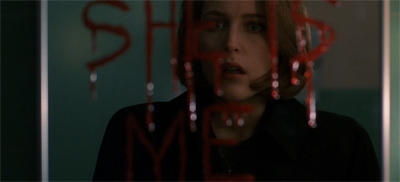
Blood on the mirror...

Blood on the mirror…

Continue reading

The X-Files – Memento Mori (Review)

This February and March, we’re taking a trip back in time to review the fourth season of The X-Files and the first season of Millennium.

It is easy to see why Scully’s cancer arc is so fondly remembered.

It arrived at a point where the show was at the very top of its game. Scully’s cancer arc comes amid a slew of beloved and classic episodes, in the middle of a season that contains Home, Unruhe, Paper Hearts and many more. It is the defining mythology plot point for the show’s fourth season, which was the point at which The X-Files just exploded into the centre of popular consciousness. More than that, the episode introducing Scully’s cancer – Leonard Betts – was the most-watched episode of The X-Files ever broadcast.

What's in your head?

What’s in your head?

Memento Mori has its own endearing aspects. If Leonard Betts was the show’s highest profile and most populist success, Memento Mori counts as one of the show’s biggest critical successes. The episode is largely responsible for winning Gillian Anderson her Primetime Emmy Award for Outstanding Lead Actress in a Drama Series. It also took home the Primetime Emmy Award for Outstanding Art Direction for a Series and received a nomination for Outstanding Writing for a Drama Series. It is perhaps the most prestigious episode of the fourth season.

However, in spite of all of that, Memento Mori remains something of a mess. It feels like a clumsy retread of One Breath, a story that worked much better in the show’s second season.

Send in the clones...

Send in the clones…

Continue reading

The X-Files – Leonard Betts (Review)

This February and March, we’re taking a trip back in time to review the fourth season of The X-Files and the first season of Millennium.

Leonard Betts is a big one. In fact, it may just be the biggest one.

Leonard Betts attracted the largest audience in the history of The X-Files, with almost thirty million people tuning in to watch the episode. This audience was largely carried over from Superbowl XXXI, but it arrived at a fortuitous moment for the series. The X-Files was exploding into the mainstream. Chris Carter and Frank Spotnitz had spent Christmas 1996 in Hawaii plotting The X-Files: Fight the Future, a blockbuster movie based on the series. The week before, Mulder and Scully had paid a visit to Springfield in The Springfield Files.

What a waste...

What a waste…

The show’s moment had arrived. Leonard Betts makes for quite the moment. It might not be the best episode in the history of the show; it might not even be the best episode of the season. However, it ranks with Pusher as one of the great archetypal episodes of The X-Files. The show captures so much of what makes The X-Files great, almost perfectly distilling the appeal of the show into a tight forty-odd minute package. It is a beautifully-crafted piece of television that checks all of the right boxes. This is a pretty fantastic introduction to the show and its world.

Leonard Betts is an episode that has been put together with incredible skill, one that demonstrates why The X-Files had such an impact on the popular consciousness.

Comfortable in his skin...

Comfortable in his skin…

Continue reading

The X-Files – El Mundo Gira (Review)

This February and March, we’re taking a trip back in time to review the fourth season of The X-Files and the first season of Millennium.

The X-Files is a show that sometimes has difficulties when it comes to portraying minorities.

There are lots of episodes that offer insightful and thoughtful explorations of isolated subcultures, without veering into offensive stereotypes or awkward cliché. Fresh Bones and Hell Money are two examples of the kinds of stories that do offer those sorts of interesting and respectful depictions of minorities. In contrast, the show can sometimes seem a little close-minded and xenophobic. Excelsis Dei, Teso Dos Bichos and Teliko are episodes with somewhat questionable depictions of other cultures.

Illegal aliens.

Illegal aliens.

Writer John Shiban likes his horror tropes. He adores the classic horror movie trappings, and revels in a very old-school approach to scary stories. Unfortunately, the horror genre has an unfortunate history of exploitation and racism when it comes to the portrayal of “the other.” The easiest way to make something scary and unknown is to make it foreign, suggesting that the outside world is filled with horrors and monstrosities. Shiban would hit on this trashy exploitation vibe repeatedly during his tenure on The X-Files.

El Mundo Gira is very much a companion piece to Shiban’s other stories about foreign monsters – the indigenous cat-people of Teso Dos Bichos and the butt-dwelling Indian fakir of Badlaa. It is a not a story set in the world of Mexican-American immigrants; it is a story set in a clumsy stereotypical depiction of the world of Mexican-American immigrants, as channelled through unfortunate racial stereotypes.

Green haze...

Green haze…

Continue reading

The X-Files – Teso Dos Bichos (Review)

This November (and a little of December), we’re taking a trip back in time to review the third season of The X-Files and the first (and only) season of Space: Above and Beyond.

It happens.

Every once in a while, there is a misfire. This is especially true when producing a genre television series churning out over twenty episodes a year. Inevitably, some of those episodes will fail; a few will fail spectacularly. Such is the way of things. It is hard to think of a twenty-odd episode season of anything that managed to maintain consistent levels of brilliance for a full season. All you can really hope is that the eventual and inevitable misfire is mostly technical.

No bones about it...

No bones about it…

Teso Dos Bichos is a terrible episode of The X-Files. It is a terrible episode of television in general. However, it is terrible in ways that are mostly banal. This isn’t a failure of overreaching ambition, like Fearful Symmetry. It isn’t a missed opportunity, like 3. It isn’t even a racist and sexist nightmare, like Excelsis Dei. Instead, Teso Dos Bichos is just bad television. It is an episode that probably didn’t work on paper, containing elements that were unlikely to work on film either.

Given how strong the third season has been, there’s a desire to brush past Teso Dos Bichos, and pretend it simply did not happen.

Cat people!

Cat people!

Continue reading

The X-Files – The Walk (Review)

This November (and a little of December), we’re taking a trip back in time to review the third season of The X-Files and the first (and only) season of Space: Above and Beyond.

The approach that The X-Files took during its third season was to hone what had worked during the first two seasons to a fine edge.

The second season had been quite playful and experimental – taking the time to figure out what did and didn’t work. Comedy episodes, like Die Hand Die Verletzt and Humbug, worked; making shows like Clyde Bruckman’s Final Repose or Jose Chung’s “From Outer Space” logical choices. Mythology-driven two-parters during sweeps had paid off, so those returned for the third season. In contrast, the heavy science-fiction of shows like Fearful Symmetry, Død Kälm or Soft Light didn’t work, and were largely forgotten.

Let some light in...

Let some light in…

The result is a third season that plays to the established strengths of The X-Files. Sure, there are still bold and experimental episodes – particularly those credited to writer Darin Morgan. However, the third season is markedly more conservative in tone than the second season – or even the fourth season. This conservatism can work very well. The third season has very few out-and-out bombs, and more than a few classics. However, it comes at a cost.

The Walk is a reasonably well-produced episode that feels a little bit overly familiar. This is the second “supernatural revenge” story that The X-Files has done in so many episodes. There’s a point where The Walk feels a lot less like a unique story than an archetypal “fill in the blanks” exercise, where a unique location and a new set of characters are caught up in an old-fashioned ghost story.

Don't worry, Stans will take good care of him...

Don’t worry, Stans will take good care of him…

Continue reading