• Following Us

  • Categories

  • Check out the Archives


  • Awards & Nominations

Star Trek: Voyager – Prototype (Review)

This September and October, we’re taking a look at the 1995 to 1996 season of Star Trek, including Star Trek: Deep Space Nine and Star Trek: Voyager. Check back daily for the latest review.

In what is becoming a recurring theme for the second season of Star Trek: Voyager, Prototype is a mess.

As with a lot of the surrounding episodes, its production was fraught and tense; tensions seemed to be building among the production team as the season progressed. Prototype was an episode that was largely driven by Michael Piller, and one opposed by Jeri Taylor. Kenneth Biller was responsible for tweaking and rewriting Nicholas Corea’s script, but he does not seem particularly fond of the episode. These tensions and disagreements would build to a climax in the second half of the year.
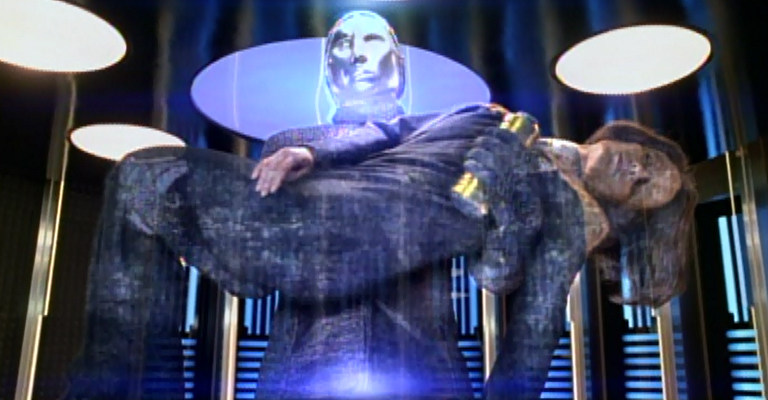
Bride of 4739...

Bride of 3947…

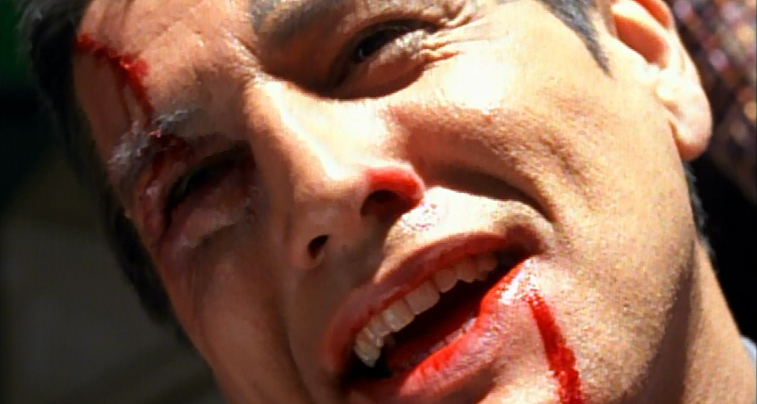
Prototype is not a good episode, by any measure. There are a lot of elements that are interesting on their own terms, but there is also something quite nasty and uncomfortable sitting at the heart of the hour. It is a story about motherhood, but one which suggests that unconventional motherhood must be monstrous and grotesque. Even beyond the awkward subtext of the episode, there are problems. Despite Piller’s attempts to energise storytelling on Voyager, the pacing of Prototype is atrocious.

Prototype is not the biggest misfire of the season. Given the season around it, this should not be misconstrued as an endorsement.

(Warp) core values...

(Warp) core values…

Continue reading

Star Trek: Voyager – Resistance (Review)

This February and March, we’re taking a look at the 1995 to 1996 season of Star Trek, including Star Trek: Deep Space Nine and Star Trek: Voyager. Check back daily Tuesday through Friday for the latest review.

Resistance is a very episodic instalment of Star Trek: Voyager.

It begins with the ship facing a convenient plot-generating fuel-shortage, the type of problem that the ship had encountered near the start of Phage or The Cloud or Tattoo. It is the kind of problem that was not mentioned in previous episodes, and which will never be presented as a potentially recurring problem. In fact, Resistance is the only episode of Voyager (or Star Trek) where the word “Tellerium” is mentioned. Many of the stock criticisms of Voyager apply here.

Fifty shades of Joel Grey...

Fifty shades of Joel Grey…

At the same time, Resistance is proof that the episodic model is not entirely without merit. For all that modern television has tended towards serialisation and arcs and long-form storytelling, there is nothing inherently wrong with a good old-fashioned done-in-one adventure. On a purely cosmetic level, Resistance is the typical Voyager episode; it relies on contrivance, it features a host of guest characters who will never appear (or be mentioned) again, it has no lasting impact. And yet it works better than any episode to this point in the second season.

As easy as it is to get distracted by arguments about serialised and episodic storytelling, or about arcs and standalones, the truth is that Voyager‘s problems are at once more simple and more complex than that. The grand irony of the second season is that it is the only season of Voyager to attempt a storytelling arc, but that storytelling arc is pretty universally derided as one of the worst things that the show ever did. (It isn’t really, but it’s still pretty bad.) The truth is that it doesn’t matter how Voyager chose to tell its stories, as long as it told them well.

Mellon head...

Mellon head…

Resistance is a fairly standard episode of Voyager, but it is elevated in the telling. The story seems unlikely to rank among anybody’s favourite Voyager episodes, but it is an efficient and effective character study with a solid script and a great central performance. The production team were able to recruit Oscar-winning actor Joel Grey as the primary guest star, lending the story an incredible level of pathos. Lisa Klink also makes quite an impression with her debut teleplay, providing a story that is careful to give most of the cast something to do.

The result is proof that there’s nothing inherently wrong with a largely episodic approach to Star Trek storytelling, as long as the material is up to scratch.

"This is knife reunion, no?"

“This is knife reunion, no?”

Continue reading

Star Trek: Voyager – Manoeuvres (Review)

This February and March, we’re taking a look at the 1995 to 1996 season of Star Trek, including Star Trek: Deep Space Nine and Star Trek: Voyager. Check back daily Tuesday through Friday for the latest review.

It is weird to think that the much-maligned Kazon provided perhaps the closest thing that Star Trek: Voyager had to a long-form story arc.

That probably says more about Voyager than it does about the Kazon. In storytelling terms, Voyager was firmly episodic. There were some loose threads that would span and connect multiple episodes, but the bulk of the show was comprised of very traditional “done in one” adventures. It seems fair to observe that Voyager represented something of a backslide for the franchise. It was much more episodic than Star Trek: Deep Space Nine, but also less interested in long-form storytelling than the later years of Star Trek: The Next Generation.

"This is still more enjoyable than Tattoo!"

“This is still more enjoyable than Tattoo!”

One suspects that the Kazon arc running through the second season had something to do with this storytelling choice. Michael Piller pushed really hard to make the Kazon a recurring threat to Voyager and to place them at the centre of the second season. As a result, they become a loose thread that runs through several of the season’s “big” episodes. They place a traitor on board Voyager in Alliances. They provided Tom Paris with a character arc culminating in Investigations. They provided the season-ending cliffhanger in Basics, Part I.

The arc was not well-received, whether by the fans or by the staff. It is not too difficult to understand why. Even before considering the quality of the arc itself – or the storytelling involved – the Kazon are hardly the most compelling Star Trek villains. Allowing for that, it seemed like the writing staff had no real idea how to serialise a story arc across a season, making all manner of clumsy mistakes along the way. The arc never gathered momentum and it never paid off, which are very real problems when trying something that ambitious.

Either you Kazon... or you be gone...

Either you Kazon… or you be gone…

Manoeuvres effectively kicks off the arc. Although the Kazon had appeared in Initiations earlier in the second season, Manoeuvres features the first reappearance of Seska and Cullah since State of Flux midway through the first season. The episode is perhaps the strongest of the “Kazon” shows, with a sense of momentum driving the first half of the script. However, things rather quickly come off the rails in the second half of the story. Already, the production team’s inexperience with serialised storytelling is showing.

Manoeuvres is perhaps as good as the Kazon ever got. It is nowhere near good enough.

So that's why they call them raiders...

So that’s why they call them raiders…

Continue reading

Star Trek: Voyager – Tattoo (Review)

This February and March, we’re taking a look at the 1995 to 1996 season of Star Trek, including Star Trek: Deep Space Nine and Star Trek: Voyager. Check back daily Tuesday through Friday for the latest review.

Tattoo is another example of the second season Star Trek: Voyager doubling down on elements that did not work in the first season.

Episodes like The Cloud and Cathexis had suggested that Chakotay might be a problematic character for the show. After all, Chakotay was the first Native American lead character to appear in the franchise, but he was played by a Mexican-American actor. More than that, the first season seemed to draw from an awkward collection of tropes and clichés in its depiction of Chakotay’s culture. The show declined to anchor Chakotay in a single specific Native American cultural tradition, instead drawing from a rake of familiar shallow iconography.

"Oh, here we go again..."

“Oh, here we go again…”

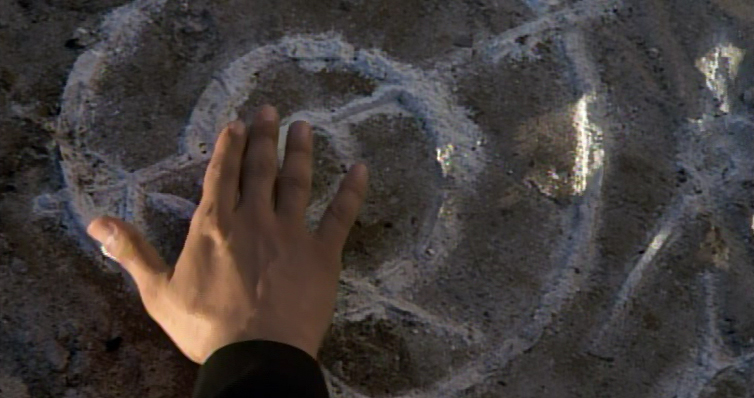
Chakotay didn’t really work in the first season. The problem is that Michael Piller seemed reluctant to accept that Chakotay’s Native American spirituality was borderline racist and offensive. So Tattoo returns to that particular well, with a much greater commitment to patronising and exploiting Native American culture. Exploring the Delta Quadrant, Chakotay comes across a seemingly abandoned moon that turns out to be the home of an ancient alien culture that made contact with Chakotay’s ancestors forty-five thousand years ago.

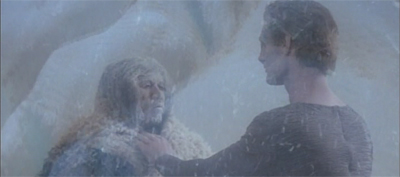
These aliens were responsible for shaping and molding Native American culture, for putting those groups in closer communion with the land and for fostering a purer spirituality. Not only is the main alien played by white actor Richard Fancy, the make-up design on these “Sky Spirits” emphasises their whiteness. So Tattoo becomes a story about how Native American culture essentially came from a bunch of super-advanced white people. It is astounding that nobody seemed to stop and think about the episode on the way to the screen.

"Oh, hey. That's a new level of offensiveness."

“Oh, hey. That’s a new level of offensiveness.”

Continue reading

Star Trek: Voyager – Persistence of Vision (Review)

This February and March, we’re taking a look at the 1995 to 1996 season of Star Trek, including Star Trek: Deep Space Nine and Star Trek: Voyager. Check back daily Tuesday through Friday for the latest review.

In some respects, the second season of Star Trek: Voyager can be seen as a conflict over the future of the show.

On the one hand, Michael Piller had returned to the franchise following the failure of the television show Legend. With Ira Steven Behr overseeing Star Trek: Deep Space Nine, Piller returned to focus his attention on the second season of the younger Star Trek show. After all, the second season was a disorganised mess, with the production team struggling to get the necessary scripts together on time. Having a safe pair of hands on board to help guide the show might come in handy.

"It's a bridge AND a tanning salon, simultaneously..."

“It’s a bridge AND a tanning salon, simultaneously…”

On the other hand, Jeri Taylor had been around the show since Caretaker. She had taken over the reins after Piller’s departure and had supervised the tail end of the first season. Taylor had arrived on the Star Trek franchise just a year after Piller, and had been a vital part giving Star Trek: The Next Generation its unique voice and mood. Over the course of the second season, it became increasingly clear that Michael Piller and Jeri Taylor had very different visions for the future of Star Trek: Voyager, and those visions were coming into conflict.

History ultimately vindicated Jeri Taylor. The second season of Voyager was the last television season of Star Trek to be directly overseen by Piller, while Jeri Taylor become the guiding light of the third and fourth seasons of the show. Whatever problems might exist with those two seasons television, they are at least more stable and consistent than the first and second years of the show. It is, of course, arguable that Piller never got his own change to exercise his own vision of the show unimpeded – and so that is not a fair measure.

Cutting the Doctor down to size...

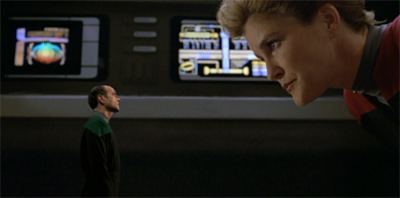
Cutting the Doctor down to size…

In a way, the conflict between Piller and Taylor’s versions of Voyager is quite clearly typified in this early run of episodes. The show had breezed through the four episodes left over from the first season production block, and desperately needed ideas to keep afloat. The senior producers rolled up their sleeves and got involved. Piller was largely responsible for Parturition and Tattoo, while Taylor oversaw Persistence of Vision. None of these episodes are perfect, but it is quite clear that Taylor is increasingly the show’s safest bet going forward.

Persistence of Vision is a very flawed episode of television, playing to some of Taylor’s more uncomfortable recurring motifs. However, it is much more interested in actually moving Voyager along than either of Piller’s contributions.

"The teacup that I shattered did come together."

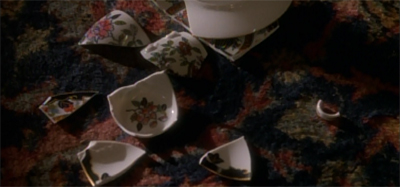
“The teacup that I shattered did come together.”

Continue reading

Star Trek: Voyager – Season 1 (Review)

This September and October, we’re taking a look at the jam-packed 1994 to 1995 season of Star Trek, including Star Trek: Deep Space Nine and Star Trek: Voyager. Check back daily for the latest review.

The best thing that can be said about the first season of Star Trek: Voyager is that it avoids being actively terrible.

This might sound like damning with the faintest of praise, but it’s worth looking at the show in the context of its siblings. None of the Star Trek spin-offs have had illustrious first seasons, often struggling to find their feet. It’s worth noting that Voyager‘s first season doesn’t contain any episodes that are as flat-out bad as something like Code of Honour, Angel One or The Passenger. While the show has more than its fair share of problems, it’s hard to look at the concept behind any episode in Voyager‘s first season and think “this is truly bad idea.”

voy-caretaker2

Of course, the logical counterpoint to that argument is the observation that the show hasn’t produced anything of equivalent quality to Heart of Glory, Conspiracy, Duet or In the Hands of the Prophets. This is perfectly legitimate criticism, and it really explains the problem with the first season of Voyager. While the show has avoided any spectacularly embarrassing decisions, it did this by completely avoiding any real risk.

The first season of Star Trek: Voyager is almost perfectly calibrated to land in the Star Trek comfort zone.

voy-learningcurve18

Continue reading

Star Trek: Voyager – Initiations (Review)

This September and October, we’re taking a look at the jam-packed 1994 to 1995 season of Star Trek, including Star Trek: Deep Space Nine and Star Trek: Voyager. Check back daily for the latest review.

Broadcast as the second episode of the second season, Initiations was the first episode produced as part of the second season of Star Trek: Voyager. As three of the four shows carried over from the first season – Projections, Elogium and Twisted – were essentially budget-saving bottle shows, the plan was to shuffle some location-heavy episodes into the broadcast order to offer something a bit more exciting and engaging.

Initiations also marked the return of producer Michael Piller to the fold. Piller had left Voyager mid-way through the first season to work on another science-fiction show for UPN. After Legend was cancelled, Piller returned to work on Voyager and found himself presiding over a very troubled second season. The second season of Voyager would be the last time that Piller was actively involved in a season of Star Trek, and so it feels like a pretty momentous occasion for the franchise.

While not spectacular, and suffering from some lingering Kazon-related problems, Initiations is still an effective forty-five minutes of television.

Stargazing...

Stargazing…

Continue reading

Star Trek: Voyager – The 37’s (Review)

This September and October, we’re taking a look at the jam-packed 1994 to 1995 season of Star Trek, including Star Trek: Deep Space Nine and Star Trek: Voyager. Check back daily for the latest review.

The 37’s did not close out the first broadcast season of Star Trek: Voyager, as the producers had intended. The last episode produced in the first season run, it was held back in the schedule into the second season – a decision made by UPN to allow Voyager to get an early start the following autumn. Still, the decision to reposition The 37‘s as the premiere of the broadcast season is quite telling.

Airing ahead of the three episodes produced before it, and ahead of any episodes produced specifically for the second season, there’s a sense that the production team intend The 37’s to be an important episode. After all, the season premiere is just as important as the season finalé in the basic structure of a broadcast season. The finalé serves as a capstone for what has come before, while (hopefully) indicating what might follow. The premiere is a way of setting up what is yet to come.

We have lift-off...

We have lift-off…

So the positioning on The 37’s is interesting, because it indicates just how much the production team had invested in the episode. This is a big episode of Voyager, this is an important episode of Star Trek. As such, it makes for a completely unsatisfying experience. The 37’s isn’t a bad episode by any measure – it has a few interesting ideas and a few memorable elements – but it’s not ambitious. It doesn’t radically change Voyager, but it also doesn’t distil it. It doesn’t offer the sense of purpose lacking for morst of the first season.

The 37’s just sort of is. It’s an episode that would be functional shuffled into the middle of a season – a few episodes earlier or later than broadcast. However, it simply doesn’t work when scheduled into a high-profile slot, particular when it has been moved so consciously and so purposefully.

A second pilot?

A second pilot?

Continue reading

Star Trek: Voyager – Ex Post Facto (Review)

This September and October, we’re taking a look at the jam-packed 1994 to 1995 season of Star Trek, including Star Trek: Deep Space Nine and Star Trek: Voyager. Check back daily for the latest review.

Ex Post Facto has a lot of problems.

It has logical problems. It has plot problems. It has character problems. It is difficult to fit within the framework of Star Trek: Voyager. It feels like a retread of A Matter of Perspective, a less-than-successful effort from the first season of Star Trek: The Next Generation that Michael Piller produced. It is a bit of a mess, a bit too casual about everything, a bit too contrived.

And yet, despite all this, it almost works. Almost.

"This isn't the head massage I asked for!"

“This isn’t the head massage I asked for!”

Continue reading

Star Trek: Deep Space Nine – The Homecoming (Review)

Star Trek: Deep Space Nine is twenty years old this year. To celebrate, I’m taking a look at the first and second seasons. Check back daily for the latest review or retrospective.

The Homecoming is notable for a number of reasons. It kicks off the franchise’s first three parter. Sure, Family provided a nice epilogue to The Best of the Both Worlds, but The Homecoming, The Circle and The Siege represents the first explicit three-part story in the history of the franchise. Star Trek: Enterprise would develop a fondness for the format in its final season and one of those three-parters (The Forge, The Awakening and Kir’Shara) would owe a conscious debt to this opening trilogy.

It also pretty much sets the tone of season premieres on Star Trek: Deep Space Nine. Star Trek: The Next Generation and Star Trek: Voyager would both display a fondness for bridging their seasons with two-part adventures. The opening episode would air as a season finalé, with the resolution airing as the opening episode of the following season. Deep Space Nine was not so literal minded. While each season premiere was informed by the themes and events of the last season’s closing episode, Deep Space Nine tended to favour opening with multi-part episodes rather than conclusions to narrative hooks.

Rather than wrapping up the threads hinted at in In the Hands of the Prophets, The Homecoming only builds on them. It suggests that the problems and the difficulties facing Bajor won’t magically disappear because ninety minutes of screen time have elapsed.

Dynamic Kira action pose!

Dynamic Kira action pose!

Continue reading