• Following Us

  • Categories

  • Check out the Archives


  • Awards & Nominations

The X-Files (Topps) #24 – Silver Lining (Review)

This February and March, we’re taking a trip back in time to review the fourth season of The X-Files and the first season of Millennium.

After the wacky and delightful excess of Donor, John Rozum steers the comic back into much more traditional fare.

There is little in Silver Lining that the comic hasn’t touched on quite recently. Guest writer Kevin J. Anderson already wrote a “vampiric object” story about a killer camera the two-part Family Portrait story only a few months earlier. John Rozum had already drafted a “haunted object drives a man to kill, but the voices are only in his head” story for The Silent Blade, a short story written specifically for The X-Files Magazine. As a result, Silver Lining feels a little overly familiar. There is nothing here that the reader hasn’t seen before; and recently, too.
Fashioning a story...

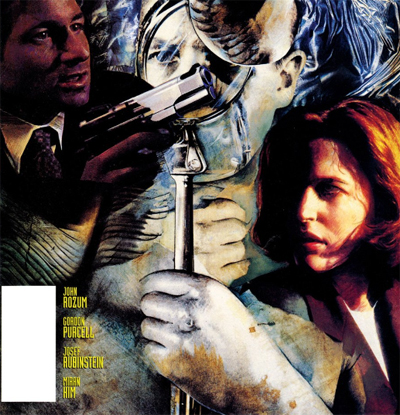
Fashioning a story…

Silver Lining reinforces the sense that Topps and Ten Thirteen are making a conscious effort to frame The X-Files as a classic horror comic book. Certainly, Silver Lining adopts the same basic storytelling elements associated with those pulpy adventures from the fifties; there is a scientist who unwittingly unleashes a horror upon the world, a physically deformed villain, a moral about how beauty is only skin deep and that vanity is called a “deadly” sin for a reason. There’s even a poetic justice to the story, where the guest villain finds themselves tormented in an ironic fashion.

There’s nothing particularly objectionable about Silver Lining, beyond how repetitive it feels. It feels like The X-Files has taken something of a step backwards since Topps and Ten Thirteen decided to part ways with writer Stefan Petrucha. The first sixteen issues of The X-Files felt like something of a Vertigo comic book, an ambitious horror anthology with no shortage of big ideas. Now the comic feels very much like an old E.C. comic without the nostalgia factor. The decline is quite striking, but no less disheartening for it.

Moral decay...

Moral decay…

Continue reading

The X-Files (Topps) #23 – Donor (Review)

This February and March, we’re taking a trip back in time to review the fourth season of The X-Files and the first season of Millennium.

Donor is the strongest of John Rozum’s work on The X-Files to this point. It might be his best work overall.

It is a story that very clearly and very strongly plays off the classic horror vibe that has been running through this stretch of episodes, taking the idea of supernatural revenge and poetic justice to almost blackly comic extremes. In many respects, John Rozum has pushed the comics towards a very traditional sort of moralistic storytelling – with characters frequently facing ironic consequences of their actions.

Organ grinder...

Organ grinder…

In The Silent Blade, a mass murderer kills himself with the blade that compelled him to kill. In The Kanashibari, a bunch of college kids who terrified an asthmatic classmate to death by locking him in a closet are themselves scared to death by a suffocating spectre. In Silver Lining, a killer murders innocent people to reclaim his good looks, only to lose them almost immediately in a fire while fleeing the FBI.

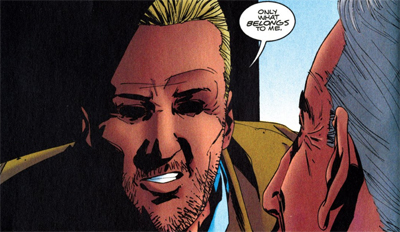
So Donor pushes this sort of storytelling to its logical extreme, as the resurrected body of Bruce Miller tries to reclaim the organs that his widow donated without his consent. Bruce Miller plans to take back what is rightfully his, harvesting various vital organs from recipients. Donor is a very dark little done-in-one story with a delightfully wry and cynical attitude that elevates it above many of its contemporaries.

"You have something that I need..."

“You have something that I need…”

Continue reading

The X-Files (Topps) #22 – The Kanashibari (Review)

This February and March, we’re taking a trip back in time to review the fourth season of The X-Files and the first season of Millennium.

The Kanashibari confirms what readers should expect from Topps’ licensed comics based on The X-Files. It is another atmospheric and episodic horror story, tightly plotted and written, with a grim sense of moral certainty underpinning it. The Kanashibari feels like something of a throwback, a modern-day take on those classic E.C. Comics horror stories – morality tales where the vengeance is exacted against those who have committed an injustice.

It is a throwback in other ways as well. The Kanashibari and Donor are both old-fashioned “supernatural revenge stories”, the kind of stories that would sit comfortably in the first season of The X-Files. Episodes like Shadows, Lazarus, Young at Heart, Born Again and Roland were all stories about characters seemingly returning from beyond the grave to wreak a terrible revenge against those had wronged them.

Who ya gonna call?

Who ya gonna call?

Continue reading

The X-Files – Home (Review)

This February and March, we’re taking a trip back in time to review the fourth season of The X-Files and the first season of Millennium.

Home is a big one.

It is an episode that is frequently ranked among the best that the show ever produced. It is an episode that many viewers remember quite clearly, even if they only saw it once years earlier. It was the first episode of the show to receive a viewer discretion warning on initial broadcast and was famously never repeated on the Fox Network. “It had one airing and then it was banned,” writer Glen Morgan quipped. “Jim and I don’t get rerun money for that.” It is also one of the rare episodes of The X-Files that is not explicitly paranormal in its subject matter, instead wandering into the macabre and the taboo.

Here there be monsters...

Here there be monsters…

Home also marks the return of writers Glen Morgan and James Wong to the series, following the cancellation of Space: Above and Beyond. With the debut of Millennium looming, the production team on The X-Files was under pressure. Fox had convinced Morgan and Wong to return to Ten Thirteen in return for producing a pilot for The Notorious Seven, one the duo’s long-gestating ideas. Morgan and Wong would produce four episodes of the fourth season of The X-Files and three episodes of the first season of Millennium.

Home is the first of their four scripts for the fourth season of The X-Files, and it sets the mood quite well. Returning from Space: Above and Beyond, the two seemed to be bristling with an electric energy and a palpable frustration. While not all four scripts are unqualified masterpieces, they each serve to push The X-Files further than it has gone before. Perhaps the most surprising thing about Home is that it is the most conventional of these four explosive scripts.

The mother of all problems...

The mother of all problems…

Continue reading

My 12 for ’14: The Guest and a Halloween Christmas Movie…

With 2014 coming to a close, we’re counting down our top twelve films of the year. Check back daily for the latest featured film.

2014 was a spectacular year for genre work. Perhaps emboldened by the success of genre fare (shared universes! talking apes! killer racoons!) in the summer movie season over the past number of years, it seemed like both major and minor studios were more willing to play with concepts that could easily seem absurd or throwaway.

’71 blended its historical real-world setting with the claustrophobia one might expect to find in horror thriller – a zombie movie set in seventies Belfast. The Babadook is a awards-caliber study of disillusioned parenthood that just happens to use the language of a supernatural horror. Birdman is a blistering Hollywood satire and character study driven by imagery and iconography more traditionally associated with fantasy. There has always been genre overlap, but it seemed particularly pronounced this year.

theguest

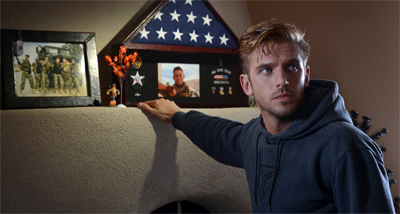
The Guest revels in its pulpy nature, offering a gleefully absurd intersection of a classic slasher movie with a more traditional holiday fare. The story of a mysterious visitor who moves in with the family of a deceased soldier, The Guest is wry and quick-witted, subversive and cheeky in equal measure. Anchored by a script from Simon Barrett that refuses to pull any punches, razor-sharp direction from Adam Wingard and a superb central performance from Dan Stevens, The Guest is a pure pulpy pleasure.

In many respects, The Guest feels like what would happen if you asked John Carpenter to make a Christmas movie. Only set at Halloween.

Flying the flag...

Flying the flag…

Continue reading

My 12 for ’14: The Babadook and Living With Demons…

With 2014 coming to a close, we’re counting down our top twelve films of the year. Check back daily for the latest featured film.

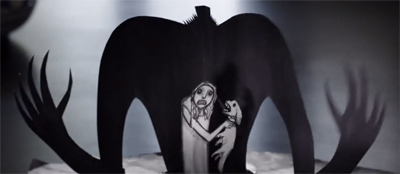
The Babadook is a delightfully well-executed Australian horror film for most of its run-time, an uncomfortable and occasionally harrowing exploration of guilt, resentment and motherhood. The scares are executed cleanly and efficiently, and director Jennifer Kent does an admirable job of ratcheting up the tension as the movie ticks along. However, the most interesting and clever aspects of The Babadook are found nestled in the movie’s final few minutes, providing a satisfying and thought-provoking conclusion to the allegorical horror film.

thebabadook5

Note: This “best of” entry includes spoilers for The Babadook. You should probably go and see the movie, particularly if you are a horror fan. Don’t worry, we’ll wait for you. Still there? Good. Let’s continue. Continue reading

Star Trek – Wolf in the Fold (Review)

The first Star Trek pilot, The Cage, was produced in 1964. To celebrate its fiftieth anniversary, this December we are reviewing the second season of the original Star Trek show. You can check out our first season reviews here. Check back daily for the latest review.

Wolf in the Fold is Robert Bloch’s third and final contribution to Star Trek.

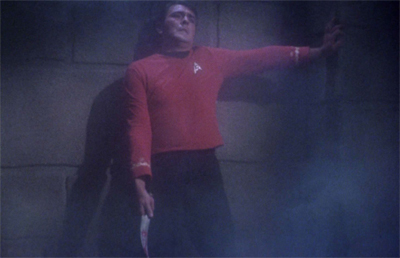
In keeping with What Are Little Girls Made Of? and Catspaw, the result is intriguing, bizarre and more than a little bit dysfunctional. More than any of the other writers drafted in to write for the science fiction show, Bloch’s fingerprints remain all over his script. Writers like Gene L. Coon and D.C. Fontana generally do a good job reconciling the work of science-fiction writers like Ray Bradbury, Theodore Sturgeon, Norman Spinrad or Harlan Ellison to make their stories fit within the frame work of Star Trek. However, even after re-writes, Bloch’s voice remains his own.

Knife to see you...

Knife to see you…

Of course, it’s quite clear that Wolf in the Fold has been through the standard re-write process. The script is a mess, struggling to tie together two basic plots (Scotty is accused of murder; the Enterprise is possessed by Jack the Ripper) in ways that don’t always work. There’s a really long and awkward expositional scene in the middle of the episode that consists primarily of Majel Barrett reading off weird-sounding words in order to assure viewers that Jack the Ripper really could be an immortal hate-fueled killing machine, given the rules of the Star Trek universe.

The are very serious problems with Wolf in the Fold. On a storytelling level, the pacing is a mess and the tone is all over the place. Bloch’s scripts continue to be even more problematic than usual when it comes to issue of gender – “Star Trek does slasher horror” is as borderline misogynistic as you might fear. However, there is something endearingly bizarre about the whole thing, as Bloch once again forces Kirk and his crew to confront an irrational universe that doesn’t necessarily conform to their understanding of it.

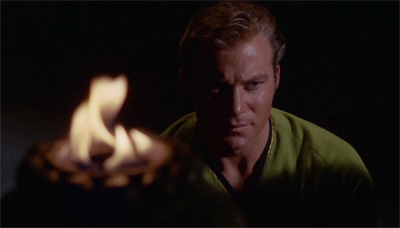
Flame on...

Flame on…

Continue reading

Star Trek (Marvel Comics, 1980) #4-5 – The Haunting of Thallus!/The Haunting of the Enterprise! (Review)

The first Star Trek pilot, The Cage, was produced in 1964. To celebrate its fiftieth anniversary, this December we are reviewing the second season of the original Star Trek show. You can check out our first season reviews here. Check back daily for the latest review.

Marvel certainly had an unconventional approach to publishing Star Trek.

The company had licensed the comic book rights following the release of Star Trek: The Motion Picture. They had released a successful adaptation of the film as part of their Marvel Super Special line and had re-package the three-part adaptation as the first three issues of an on-going Star Trek comic book. Written by Marv Wolfman and illustrated by Dave Cockrum, it was clear that Marvel had big plans for Star Trek. However, it also quickly became clear that they had no idea where they wanted to go with the comic.

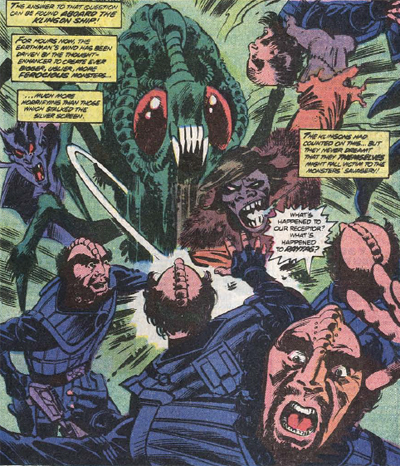
Here there be monsters...

Here there be monsters…

After all, they immediately followed up the big three-issue opening arc with a comic where the Enterprise discovered a haunted house floating in space. While it was certainly a catchy image, it wasn’t exactly a quintessential Star Trek premise. It seemed that Marvel had no idea what to do with the comic. Writer Marv Wolfman wrote the first of the two issues comprising the storyline, handing the second issue over to Mike W. Barr. He would only stick around for two issues before handing the comic over to Tom DeFalco. DeFalco wrote a single issue before moving on.

It is a rather disjointed comic book, one which lacks the strong narrative voices that DC would give to their late-eighties licensed Star Trek comics. Then again, it is probably easy enough to deduce all of this from the fact that the first original Star Trek storyline published by Marvel featured a haunted house floating in space.

In space, everyone can hear you scream...

In space, everyone can hear you scream…

Continue reading

Star Trek – Catspaw (Review)

The first Star Trek pilot, The Cage, was produced in 1964. To celebrate its fiftieth anniversary, this December we are reviewing the second season of the original Star Trek show. You can check out our first season reviews here. Check back daily for the latest review.

Catspaw was the first episode to enter production for that second season of Star Trek. However, it was not the first to air. Amok Time served as the season opener. Instead, Catspaw was produced as something of a rarity – a Star Trek holiday special. Produced in May, it was eventually broadcast during the last week of October. Given the subject matter and trappings of the episode, that seems highly appropriate.

We are, after all, looking at what amounts to a Star Trek Halloween Special.

Bones joins the cast...

Bones joins the cast…

Continue reading

Non-Review Review: Woman in Black – Angel of Death

Horror sequels are notoriously difficult beasts. Much like comedy sequels, there’s the inevitable conflict between what the audience wants and what the audience has seen before. If you plan on replicating the jump scares too faithfully, why not watch the original? If you want to do something fresh, why bother sticking the name on the front? It is an interesting challenge facing film makers, and it’s something that shows. It is very hard to think of a horror sequel that competes on the same level as the original, let alone surpasses it.

Woman in Black: Angel of Death finds itself stuck in that trap. The original Woman in Black was very much a classic Hammer Horror film, a movie more about suggestion and scale than blood and guts. Never afraid to reinforce a jump scare with an orchestra string section, there was something quite endearing and old-fashioned about the way that Woman in Black conducted itself. It was an affectionate throwback to a style of horror largely forgotten in this day and age.

"Gee... I wonder what could possibly be in this creepy basement at this hour of the night..."

“Gee… I wonder what could possibly be in this creepy basement at this hour of the night…”

Given the success of Woman in Black, a sequel was inevitable. However, Angel of Death faces a lot of the issues that tend to plague horror sequels – cast attrition, a sense of familiarity, a sense that most of the best tricks have already been used. To be fair, Angel of Death holds itself together reasonably well for its first two acts. There are creaky moments, and a sense that the movie is trying to hit too many familiar notes. However, the script comes off the rails in the third act, as the film stops trying to imitate its predecessor and attempts to offer something new.

Sadly, the third act simply doesn’t work, bouncing between an air field and a supernatural hostage crisis. The result is that Angel of Death collapses in on itself – leading to the sense that this is a rather disappointing sequel.

Sadly, Chris deBurgh has yet to provide a theme song for the series. Maybe next time?

Sadly, Chris deBurgh has yet to provide a theme song for the series. Maybe next time?

Continue reading