• Following Us

  • Categories

  • Check out the Archives


  • Awards & Nominations

Non-Review Review: Epic

Epic looks stunning. While it doesn’t necessarily push the envelope in terms of 3D rendering or animation, it’s often quite beautiful to watch. Even in 3D, the vibrant greens radiate off the screen, with the characters having a pleasant elasticity to them. The action sequences are well-staged and the choreography is generally impressive. However, despite this, Epic winds up feeling rather shallow. Perhaps it’s a result of the decision to develop the world as a priority, rather than the characters inhabiting it.

The story is more a collection of familiar tropes and set-pieces than a compelling narrative, and none of the lead characters are ever developed beyond basic archetypes. There’s the plucky heroine, the roguish hero, the gruff mentor, the free-spirited wise oracle, the drôle accented bad guy, the comic relief and even the kooky dad. None feel of any real substance, which is a problem when you’re executing a plot as straight-forward as this.

It's a slug's life...

It’s a slug’s life…

Continue reading

Star Trek – Errand of Vengeance: The Edge of the Sword by Kevin Ryan (Review)

To celebrate the release of Star Trek: Into Darkness this month, we’ll be running through the first season of the classic Star Trek all this month. Check back daily to get ready to boldly go. It’s only logical.

We’ll be supplementing our coverage of the episodes with some additional materials – mainly novels and comics and films. This is one such entry.

When you think about it, Star Trek finished its first season with its mythology reasonably well established. There were the Romulans, the Klingons and the Federation. (Oh, my!) We knew that Kirk had a brother on the colonies, who died in the season finalé. Vulcan was a hot desert planet. The Prime Directive existed, and we even got a taste of how Starfleet operated. However, these things all developed gradually over the course of the year, and early episodes couldn’t even seem to agree who exactly Kirk was working for.

The Federation was first mentioned in Arena and only fully named in A Taste of Armageddon. The Klingons were introduced in Errand of Mercy, with a cold war between the two galactic powers finally turning hot. Of course, it’s hard to write “finally” when they had only been introduced in this particular episode. So where were the Klingons during the show’s first year? How come we didn’t pick up any of the tension that must have been simmering?

Kevin Ryan’s Errand of Vengeance trilogy attempts to offer some context, suggesting that the Klingon threat had been brewing during the entire first season. It follows Jon Anderson, a new recruit to the ship’s security department, arriving just before the events of What Are Little Girls Made Of? Oh, and he’s a Klingon infiltrator.

tos-errandofvengeance1

Continue reading

Star Trek – Balance of Terror (Review)

To celebrate the release of Star Trek: Into Darkness this month, we’ll be running through the first season of the classic Star Trek all this month. Check back daily to get ready to boldly go. It’s only logical.

I’ve talked about it about it quite a bit in my earlier reviews, so I won’t dwell on it too much here, but Star Trek got really good really quickly. Balance of Terror is only the ninth ever episode of Star Trek ever produced, but it stands as one of the finest entries in the original series, and perhaps even the franchise. It also represents the moment where the model of what Star Trek would be really sort of solidified. The first eight episodes had contained any number of classic Star Trek tropes.

The Cage and Charlie X gave us old and immeasurably powerful alien civilisations, while Where No Man Has Gone Before gave us a god-like being. The Man Trap gave us space monsters. Mudd’s Women gave us awkward gender politics. The Enemy Within created the whole “transporter malfunction” and “evil duplicate” subgenres. However, Balance of Terror is the first episode to suggest outer space might be more than the place where crazy stuff happens and our heroes bump into monsters or ancient civilisations. The universe might have its own politics, its own history, its own civilisations that will emerge, contrasted with mankind’s expansion into space.

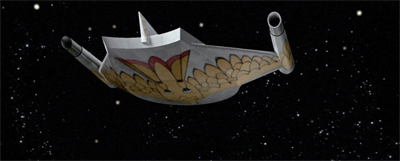
The Klingons are undoubtedly the most recognisable and iconic of the classic Star Trek races, but the Romulans are the first of the franchise mainstays to appear, and Balance of Terror is the first episode to devote considerable effort to world-building the Star Trek universe.

The not-so-great bird of the galaxy...

The not-so-great bird of the galaxy…

Continue reading

Star Trek – Charlie X (Review)

To celebrate the release of Star Trek: Into Darkness this month, we’ll be running through the first season of the classic Star Trek all this month. Check back daily to get ready to boldly go. It’s only logical.

It really is incredibly difficult to divorce Star Trek from the sixties. I know that this has become something of a (very obvious) theme in these daily reviews, but Charlie X is the kind of Star Trek episode that could only have been produced for television in the sixties. It isn’t necessarily the presence of a single factor, it’s more the package as a whole. While the general concept (“The Day Charlie Became God”, to quote Roddenberry’s succinct synopsis from his 1964 Star Trek Is… pitch) could easily be adapted for any of the spin-offs (and Hide & Q clearly plays on the same idea), the execution is so firmly anchored in the sixties that it’s very hard to separate and parse.

Part of it is the weird use of coloured lighting on the mostly grey Enterprise sets, something that Inside Star Trek suggests was down to the fact that NBC was owned at the time by RCA, a major manufacturer of colour television sets. Part of it is the somewhat confused sexuality that is a weird mix of liberated and outdated. Part of it is the fact that the show features an impromptu musical and dance number. The idea of Charlie X might be fairly simplistic, but the execution is very clearly and very distinctively Star Trek.

Screaming to the Evans...

Screaming to the Evans…

Continue reading

Star Trek – The Naked Time (Review)

To celebrate the release of Star Trek: Into Darkness this month, we’ll be running through the first season of the classic Star Trek all this month. Check back daily to get ready to boldly go. It’s only logical.

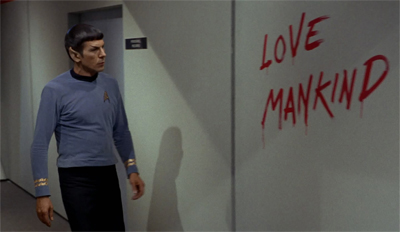
Star Trek is, by its nature, an inherently optimistic television show. I seem to keep mentioning that in these reviews, as the first season of the show subverts and plays with the notion of an idealised future. However, despite the suggestion that evil is necessary in The Enemy Within or the death of the last of a species in The Man Trap or the suggestion that man’s next evolutionary phase would be truly horrifying in Where No Man Has Gone Before, Star Trek is still a hopeful vision of a possible future. It’s a story about a world where mankind hasn’t wiped each other out and where we can go (relatively) peacefully among the stars. It’s a world without racism or classism. There is sexism in Star Trek, but I’ll give the producers the benefit of the doubt and assume it’s not intentional.

So The Naked Time feels a little weird, being – as it is – a story about the collapse of civilisation at the end of a world. Not our world, mind you, but there’s a very clear sense of social collapse mirrored in the literal collapse of planet Psi-2000.

How logical...

How logical…

Continue reading

Star Trek – The Enemy Within (Review)

To celebrate the release of Star Trek: Into Darkness this month, we’ll be running through the first season of the classic Star Trek all this month. Check back daily to get ready to boldly go. It’s only logical.

One thing that I don’t think the original Star Trek gets nearly enough credit for is the quality of the writers that Gene Roddenberry recruited to contribute scripts. Television obviously operated under a different model at the time, but there’s an impressive selection of science-fiction literary giants who contributed scripts to the show. More than that, it’s impressive how many of those stories became truly iconic Star Trek stories.

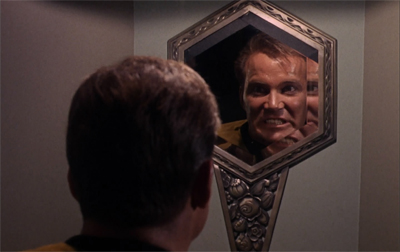
The Enemy Within is the work of author Richard Matheson, best known for stories like I Am Legend or What Dreams May Come. It’s very much a high-concept science-fiction story, but it’s also notable because it establishes two of what would become the show’s favourite tropes: transporter accidents and evil duplicates. Indeed, the two devices would be reunited in the following season’s Mirror, Mirror. These narrative elements even featured in the last season of Star Trek: Enterprise to air, in episodes like Daedalus and In a Mirror, Darkly.

Perhaps it’s a demonstration of how important these outside writers were to the development of Star Trek as a franchise that Matheson would effectively codify two stock narrative devices that would still be in use four decades later.

Mirror, mirror...

Mirror, mirror…

Continue reading

Star Trek – Mudd’s Women (Review)

To celebrate the release of Star Trek: Into Darkness this month, we’ll be running through the first season of the classic Star Trek all this month. Check back daily to get ready to boldly go. It’s only logical.

I think it’s fair to say that Star Trek had some gender issues. I say that as a fan of the show, and as a person with an immense fondness for the ensemble. It’s tempting to write off those sexist moments and decisions as attitudes that were socially acceptable at the time. After all, the sixties are almost half a lifetime away at this point. However, that doesn’t account for the fact that many of the same gender issues plagued Star Trek: The Next Generation in the late eighties, which lost two of its three female leads in its first season, and opened its second year by subjecting the remaining female lead to The Child.

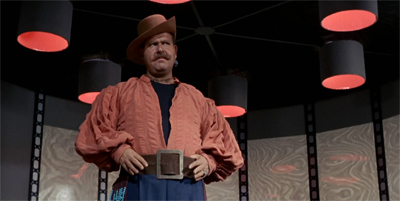
Even disregarding that, though, there comes a point where even the time when a work was produced can’t excuse certain attitudes or approaches. Star Trek doesn’t feature too many strong female characters, relegating recurring female characters like Uhura and Janice Rand to the background. This is dodgy enough, but the show’s problems with gender become a lot more obvious when a show throws sexuality into focus. Mudd’s Women is such a show. It famously introduced one of the few recurring non-crewmember characters, and it plays into the “Star Trek as space western” theme, but it is also very sexist. Very, very sexist.

Mudd-ying the waters...

Mudd-ying the waters…

Continue reading

Star Trek – The Corbomite Manoeuvre (Review)

To celebrate the release of Star Trek: Into Darkness this month, we’ll be running through the first season of the classic Star Trek all this month. Check back daily to get ready to boldly go. It’s only logical.

Again, The Corbomite Manoeuvre is one of those early episodes of Star Trek that was shuffled around in the broadcast order. Not that there’s too much internal continuity to mess up or anything like that, but it is particularly noticeable when episodes at the start of a television show get shuffled around. The writers are establishing characters and concepts, so it feels strange to watch the first episode written with McCoy after we’ve already seen him established as the ship’s doctor.

(The first episode aired, The Man Trap, centres around McCoy, which makes it strange when the ship suddenly has a different Chief Medical Officer in the Where No Man Has Gone Before.)

Fortunately though, The Corbomite Manoeuvre is the last time that this really becomes a concern, as Star Trek seems to iron out all the difficulties and the nuances on a new television show. Effectively the first regular episode of the show produced after two pilots, a large part of the charm of The Corbomite Manoeuvre is really watching it all come together.

What a dummy...

What a dummy…

Continue reading

Star Trek – Where No Man Has Gone Before (Review)

To celebrate the release of Star Trek: Into Darkness this month, we’ll be running through the first season of the classic Star Trek all this month. Check back daily to get ready to boldly go. It’s only logical.

In a way, there’s a very clear divide between The Cage and Where No Man Has Gone Before. It’s clearer than the strange new actor sitting in the middle of the Bridge or the fact that Spock is suddenly a lot less casual. In a way, each is perfectly positioned in popular consciousness. The Cage was produced in late 1964, but wouldn’t be shown on television until 1988, after spending years touring the fan circuit. It remains a strange bit of Star Trek history, sitting simultaneously outside any of the five television shows, and simultaneously a completely inexorable part of the franchise’s evolution. It’s where it all began, but not where the first Star Trek began.

In contrast, Where No Man Has Gone Before feels more like the pilot episode of Star Trek. Sure, the fashion changes a bit in the episodes to come, the entire cast has yet to be assembled, but this is recognisably the same ship and the same show as The Corbomite Manoeuvre or The Man Trap. It’s more than the actors filling roles, the consistent characterisation of Spock or the fact that it actually aired on television in September 1966. This is what the next three years of Star Trek will be like. It’s an aesthetic or an approach to storytelling that is markedly different to the way that The Cage tackled many of the same themes and ideas.

While The Cage laid down many of the philosophical underpinnings of the broader Star Trek universe – including the classic show – it is also a lot less physical and visceral than the classic Star Trek. Indeed, The Cage featured the Captain of the Enterprise reasoning with an advanced bunch of god-like aliens, appealing to human virtues. The action sequences felt a bit extraneous. In contrast, Where No Man Has Gone Before sees the Captain of the Enterprise punching a god-like being repeatedly in the face while hitting on the same themes.

I think that’s perhaps the most dynamic difference between not only The Cage and Where No Man Has Gone Before, but between Star Trek and its spin-offs.

All the old familiar faces...

All the old familiar faces…

Continue reading

Watch! New Star Trek: Into Darkness Trailer!

I’m pretty excited for the upcoming Star Trek: Into Darkness, especially since it’s now releasing a week earlier in the UK and Ireland. Anyway, there’s a new trailer released, which continues the trend of telling us absolutely nothing about the film while teasing the sense of fun and character dynamics that we all know and love. Check out the trailer below.