• Following Us

  • Categories

  • Check out the Archives


  • Awards & Nominations

Non-Review Review: The Price of Desire

This film was seen as part of the Jameson Dublin International Film Festival 2015.

I have been informed that reviews for The Price of Desire are embargoed, despite the fact it was screened as the gala opening of the Jameson Dublin International Film Festival 2015, a high-profile event with tickets available to the public that afforded the film a significant public platform. (In the interest of disclosure, I purchased my ticket with my season pass – purchased for €245. Individual tickets for this screening were €20.)  As a courtesy to any fellow reviewers affected by the embargo, I have taken down the review.

However, as the film is eligible for the festival’s “audience award”, I am leaving my rating in place.

All audience members are asked to rank films in the festival from 1 (worst) to 4 (best). In the interest of full and frank disclosure, here is my score: 1 thepriceofdesire1

Non-Review Review: A Little Chaos

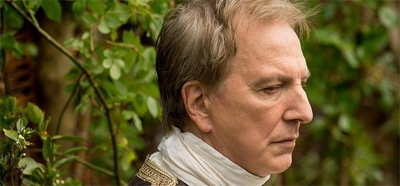
Perhaps what is most remarkable about A Little Chaos is how deftly the film blends stock romantic comedy tropes with the trappings of a loftier period piece drama. A Little Chaos fictionalises the construction of the gardens at Versailles, undertaken at the behest of King Louis XIV. However, A Little Chaos uses this historical event as the backdrop for a series of quirky romantic misadventures. Matthias Schoenaerts plays André Le Nôtre, the stickler for order who is forced to take on some hired help to ensure that he meets the assigned deadlines.

Kate Winslet is Sabine De Barra, who is hired to design one of the garden’s fountains. Whereas Le Nôtre advocates for order, De Barra argues for a little randomness. The two are introduced at loggerheads, their philosophical positions made clear when De Barra presumes to move a single potted plant in a sequence arranged by Le Nôtre. Inevitably, attraction blossoms as the two find themselves working harder and harder to meet the targets set by the sitting monarch.

Another feather in her cap?

Another feather in her cap?

For all the promise of the title, A Little Chaos packs very few surprises. The formula is quite clearly honed, and it is easy enough to plot the various character arcs and dynamics across the movie’s runtime. Indeed, A Little Chaos might even have benefited from some tightening, feeling quite stretched across its two-hour runtime. At the same time, Alan Rickman has assembled quite the cast for his second film as director. A Little Chaos can count on a superb ensemble – both above and below the title – to carry it when things get a little indulgent.

A Little Chaos is not as fun or as playful as it might be. On the other hand, it looks and feels very impressive, with an occasionally clunky script brought to life by a talented array of actors.

Long live the king!

Long live the king!

Continue reading

Millennium – The Wild and the Innocent (Review)

This February and March, we’re taking a trip back in time to review the fourth season of The X-Files and the first season of Millennium.

The Wild and the Innocent is an ambitious piece of television.

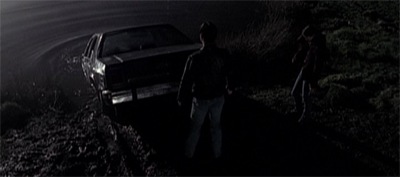
It is not a piece of television that works as well as it might, the execution of the central ideas leaving a little to be desired, but it is an episode that commits whole heartedly to something unique. In I Want to Believe, Robert Shearman refers to The Wild and the Innocent as “a plot more suited to Cormac McCarthy than Chris Carter.” He’s not wrong. The Wild and the Innocent is a story about cycles of violence and abuse in the American south, a grim road movie with some very harsh conclusions about the way that the world works.

That sinking feeling...

That sinking feeling…

It still fits within the milieu of Millennium. After all the classic “serial killer road movie” is still a serial killer story, and Millennium has already carved out that niche for itself. However, the image of Frank Black and Peter Watts following a trail of bodies from Missouri down through Arkansas suggests a different show than the one that has been airing since The Pilot. In many respects – with its heavy philosophical voice-over, its country-tinged soundtrack, its fixation on the outlaw couple – The Wild and the Innocent feels almost like some old American folk tale.

There’s something decidedly old-fashioned here, with the episode playing more like a western than a police procedural. In the documentary Order in Chaos, Carter described Frank Black as character from a story “like Shane, like any cowboy, any good movie, Western movie.” As such, he fits in quite comfortably with this new type of story.

Road warrior...

Road warrior…

Continue reading

My 12 for ’14: The Wolf of Wall Street and More!

With 2014 coming to a close, we’re counting down our top twelve films of the year. Check back daily for the latest featured film.

Everything about The Wolf of Wall Street is excessive, even its length.

Still, The Wolf of Wall Street never feels like long film. This is somewhat paradoxical. After all, the film does not have too much ground to actually cover. For a film that runs to almost three hours, the movie has a pretty straightforward plot. Cinema audiences are quite familiar with this sort of story: the story of a wealthy crook who inevitably (and spectacularly) implodes. The audience watching The Wolf of Wall Street knows the tale inside out: the arrogance, the hubris, the greed; the consequences, the price, the fallout.

thewolfofwallstreet4

Of course, our villain doesn’t really implode. It turns out that – despite what we’d like to believe – crime does pay. The Wolf of Wall Street alludes to this uncomfortable truth in its closing scene, as Belfort attracts an audience of people eager (and willing to pay) to learn his financial secrets. The cruel gag extends even beyond the movie’s own narrative into the real world; Belfort has boasted he made more from The Wolf of Wall Street than he did from his time on Wall Street. He has used very little of that money to pay back the victims he swindled.

In many ways, The Wolf of Wall Street plays like a belated companion piece to Goodfellas or Casino, a loose exploration of greed and corruption that avoids a lot of the easy moralising that audiences have come to expect from stories like this. Instead, The Wolf of Wall Street basks in its hedonism, affording its villainous protagonist almost unquestioned control of the narrative. As such, it seems to tease the audience: who would be able to refuse such luxury and such debauchery? There’s something delightful uncomfortable in how the film needles the viewer.

thewolfofwallstreet6 Continue reading

My 12 for ’14: The Babadook and Living With Demons…

With 2014 coming to a close, we’re counting down our top twelve films of the year. Check back daily for the latest featured film.

The Babadook is a delightfully well-executed Australian horror film for most of its run-time, an uncomfortable and occasionally harrowing exploration of guilt, resentment and motherhood. The scares are executed cleanly and efficiently, and director Jennifer Kent does an admirable job of ratcheting up the tension as the movie ticks along. However, the most interesting and clever aspects of The Babadook are found nestled in the movie’s final few minutes, providing a satisfying and thought-provoking conclusion to the allegorical horror film.

thebabadook5

Note: This “best of” entry includes spoilers for The Babadook. You should probably go and see the movie, particularly if you are a horror fan. Don’t worry, we’ll wait for you. Still there? Good. Let’s continue. Continue reading

My 12 for ’14: Guardians of the Galaxy and “the Day I Left Earth”…

With 2014 coming to a close, we’re counting down our top twelve films of the year. Check back daily for the latest featured film.

Guardians of the Galaxy is a Marvel movie through-and-through. It comes with burdened with all the trappings that one expects from a Marvel film. Thanos provides a mostly superfluous element that clouds the narrative while serving as an advertisement for a film several years away. Ronan the Accuser makes for a suitably banal villain, like a cosplaying fan who won’t choose between his deep abiding affection for Thor and his love of the Smurfs. The third act is a jumbled mess, one that occasionally loses sight of its characters amid all the CGI spectacle.

And, yet, it works in spite all this. One of Marvel’s biggest problems as a movie studio is the way that it tends to smother individual creators in pursuit of a more consistent project. The studio’s best films  – Jon Favreau’s Iron Man, Kenneth Branagh’s Thor, Shane Black’s Iron Man 3 – are the films that aren’t afraid to let a writer or director’s voice shine through. In contrast, the weakest entries – Captain America: The First Avenger, Thor: The Dark World, Iron Man 2 – try desperately to drown out any hint of personality in pursuit of something that can be homogenised; rendered safely within the studio’s comfort zone.

guardiansofthegalaxy1

After all, Marvel is a company that likes to play it safe. It is a studio that would replace Edgar Wright with Peyton Reed for Ant Man. It is a movie that would gladly have Agents of S.H.I.E.L.D. spin its wheels for two-thirds of a season so it can wait for Captain America: The Winter Soldier to arrive in theatres. It is a studio that has build six movies around blonde white actors named Chris without a single female- or minority-led superhero film. (Sure, Black Panther and Captain Marvel are coming… eventually, but Black Widow remains a rotating co-star.)

To be fair to Marvel, this system makes a certain amount of sense. It avoids horrific misfires like Catwoman or Elektra, but also does not allow for anything as transcendental and unique as Tim Burton or Christopher Nolan’s work with Batman. Guardians of the Galaxy is very much a product of this system. It is safe, hitting all the necessary plot beats and offering minutes of screentime (and plot convolutions) as tribute to the shared universe. However, there is just enough of James Gunn left in the final product to make it all worthwhile. The film retains a sense of oddness and charm that prevents it from ever feeling generic.

guardiansofthegalaxy6

Continue reading

Non-Review Review: Night at the Museum III – Secret of the Tomb

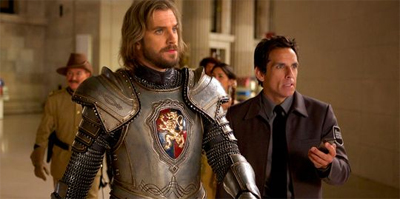
Night at the Museum III: Secret of the Tomb is fairly inoffensive family fare. It largely sets out to do what it wants to do – providing a sense of closure to the hits series while encouraging its all-star cast to have a bit of family-friendly fun together. The movie is hardly the most compelling adventure; it never manages to generate substantial stakes, it introduces a convenient third-act villain as the plot demands, it is frequently distracted by individual set pieces. At the same time, it feels like the movie largely hits the targets that it sets for itself.

Knight at the Museum...

Knight at the Museum…

Continue reading

Non-Review Review: Unbroken

The true story of Louis Zamperini is absolutely fascinating. It lends itself to this sort of big spectacle. It has everything you need for a movie that might clean up during awards season: a historical setting; a war; a sporting story about triumph of adversity; incredible physical transformations from the cast; a character enduring incredible hardship and coming out the other side. These are the sorts of ingredients that make a Best Picture contender. Unbroken just heaps more and more on top of these already alluring elements.

It isn’t the terrible and messy script that ultimately defeats Unbroken, with beloved filmmakers Joel and Ethan Cohen at the top of the bill. It isn’t the pedestrian unchallenging direction, either. It isn’t Alexandre Desplat’s condescending and patronising score, that doesn’t trust the audience to determine what they should be feeling from one moment to the next. It is not even the cynical Coldplay song playing over the closing credits, to put a pleasant life-affirming spin on events.

The Oscar race is on...

The Oscar race is on…

The detail that really shatter Unbroken is the fact that all of this has been very carefully and meticulously calibrated to check off the requisite items on the big Oscar check list. Unbroken is just as mechanical and lifeless a production as Transformers 4, but it happens to be built for a different purpose. There is no energy here, no enthusiasm, no emotion. It is just a bunch of things that have been successful in other stories heaped on top of one another, hoping to hit the high score on that fateful morning in January 2015.

Despite managing to eat up an incredible amount of attention and discussion in the larger Oscar race – taking attention off far more deserving contenders – Unbroken is a complete and utter misfire.

"This is what happens to anybody who suggests Merry Christmas Mister Lawrence is a better Japanese prisoner of war film."

“This is what happens to anybody who suggests Merry Christmas Mister Lawrence is a better Japanese prisoner of war film.”

Continue reading

Non-Review Review: Birdman (or, The Unexpected Virtue of Ignorance)

Birdman is a staggeringly cynical piece of work.

Alejandro González Iñárritu’s showbusiness satire has its knives out from the opening sequence, and never puts them away. It is a movie that is relentlessly snarky and bitter about just about any facet of the artistic process. The movie seldom pulls its punches, lawing into its targets with a vengeance. There are points where it almost seems too much, where it feels like Iñárritu might be better served to pull back or ease off for a moment as the film becomes just a little bit too much.

Showtime!

Showtime!

Then again, Iñárritu turns the film’s relentlessness into a visual motif, structuring Birdman as one long unbroken take. This structure is only slightly disingenuous. While there are any number of “cheats” that allow Birdman to stitch together multiple takes, the end result is still a hugely ambitious and impressive piece of work. Even viewers as cynical as the film itself may find themselves marvelling at some of the incredibly fluid transitions and extended sequences. Birdman‘s anger might occasionally come close to suffocating, but its energy is infectious.

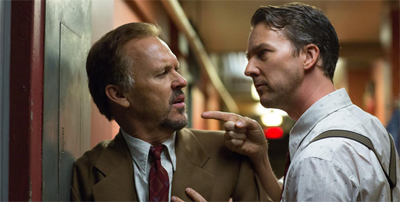
That is to say nothing of the performance at the centre of the film, with Michael Keaton playing a washed-up has-been celebrity desperately (and pathetically) fighting for artistic credibility after a career spent in blockbuster cinema. One of the more interesting aspects of Birdman is that it seems just as dismissive of the attempts at artistic rehabilitation as it does of the original “sell out” work. Birdman is a wry, clever and vicious piece of work. It is also a phenomenal accomplishment.

You wouldn't like him when he's angry...

You wouldn’t like him when he’s angry…

Continue reading

Non-Review Review: Horrible Bosses 2

Horrible Bosses 2 is a cluttered film. In many ways, it is handicapped by a reluctance to let go of what worked the first time around. As a result, the film seems to bring back just about every cast member it can, ensuring that everybody gets their own little arc and their own pay-offs. Two of the three original horrible bosses get extended subplots in the sequel, with an expanded role for another side character.

This leaves the film feeling a little crowded. The new additions to the cast seldom get room to breath. Horrible Bosses 2 brings in a rake of superb talent to fill out the supporting cast, but doesn’t have the time to do anything particularly interesting with them. Chris Pine makes the most significant impression, but Horrible Bosses 2 wastes  talent like Christoph Waltz and Jonathan Banks in fairly bland roles.

"I spot a sequel..."

“I spot a sequel…”

And yet, despite its problems managing space, Horrible Bosses 2 holds itself together. It’s a clumsy film, one that feels like it could have done with a script polish and some judicious editing at an early story phase, but it manages to hang a lot on the chemistry of its three leads. Even more than in the original film, Bateman, Sudeikis and Day find themselves playing archetypes rather than characters – but the fit rather comfortably into those archetypes.

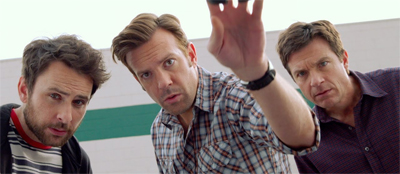
Bateman, Sudeikis and Day spend a lot of Horrible Bosses 2 talking over one another – something that more than one character acknowledges over the course of the film. The result is a lot like the film itself; it’s often difficult to separate the important material from the background noise, but there’s also an underlying sense of fun that just about keeps everything ticking over.

"We've all seen Reservoir Dogs, right?"

“We’ve all seen Reservoir Dogs, right?”

Continue reading