• Following Us

  • Categories

  • Check out the Archives


  • Awards & Nominations

Non-Review Review: Going in Style

At one point in Going in Style, octogenarian would-be bank robber Albert decides to craft an alibi for an elaborate bank robbery while working at a cotton candy stand.

This image might just encapsulate Going in Style, a very light and fluffy bank robbery film about a trio of senior citizens who embark upon a bank robbery in order to balance the books. The movie is consciously (occasionally suffocatingly) feel good story of a bunch of cynical wise-cracking pensioners embarking upon wish fulfillment revenge against the banks that have taken so much from hard-working and decent Americans. Think of it as Hell or High Water that swaps the moral ambiguity for a clumsy score.

Dinner of champions.

Going in Style is not an especially complicated film. It never pauses to evaluate what is happening, or why. It is anchored in the assumption that people are basically decent, even when pushed to extremes. It goes for as many obvious jokes as it can cram into its ninety-six-minute run-time, from a few cheap laughs about the embarrassment factor of old-age sex to other jokes about bodily functions. But its heart is in the right place, as it goes out of its way to repeatedly assure the audience.

The extent to which Going in Style could be said to work rests in the easy charm of its three leads, in the pleasure of seeing Michael Caine, Morgan Freeman and Alan Arkin play off one another. None of the trio is pushing themselves. All three leads are essentially offering some minor variation on an established schtick, with no nuance or strain. The result is a heist thriller that never feels like it is racing against the clock, more ambling in its own time.

Benched.

Continue reading

25. Gone Girl (#179)

You don’t know what you’ve got ’til it’s…

Hosted by Andrew Quinn and Darren Mooney, The 250 is a fortnightly trip through some of the best (and worst) movies ever made, as voted for by Internet Movie Database Users. New episodes are released every second Saturday at 6pm GMT, with the occasional bonus episode between them.

This time, David Fincher’s Gone Girl.

On their fifth wedding anniversary, Nick Dunne is shocked to discover that his wife Amy has disappeared. As local law enforcement begin their investigation, all clues seem to point towards Nick. But all is not as it appears to be.

At time of recording, it was ranked the 179th best movie of all time on the Internet Movie Database.

podcast-gonegirl

https://them0vieblog.com/wp-content/uploads/2016/11/podcast11.mp3%20itunes:duration=01:51:06%20itunes:explicit=no

Continue reading

Non-Review Review: Handsome Devil

Handsome Devil is a charming coming of age tale set against the backdrop of a South Dublin Rugby School.

The film follows loner and outcast Ned, who finds himself shunned at boarding school because he lacks the ability and interest to play rugby. Ned keeps to himself, even isolated from the other boys via his private room. However, Ned’s world is thrown into upheaval when the school receives a new student. Suddenly, Ned finds himself sharing the space with Conor, a promising young rugby prospect who might have the capacity to lead the team into the finals.

Seaing red.

The plot beats and themes in Handsome Devil are fairly standard, keeping very much consistent with the genre of coming of age secondary school tales; the notion of self and identity play into, juxtaposed with the urge towards conformity. There are inspiring teachers and tough decisions, eroding cynicism and brutal betrayal. Handsome Devil is aware of these expectations, to the point that all of this is laid out in the exposition-driven framing device at the start of the film.

However, Handsome Devil is elevated by a sense of genuine warmth beneath this very familiar exterior. The script is well-observed, and the direction is light enough to let a charming cast play well off one another. Like Ned, Handsome Devil is nowhere near as cynical as it appears, and it plays best when it drops the wry irony in favour of an endearing humanism.

That’s grass.

Continue reading

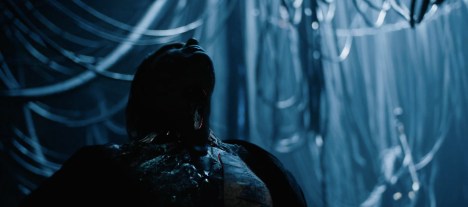
Non-Review Review: Ghost in the Shell

Ghost in the Shell is a fascinating, deeply flawed, film.

The movie is vibrant and vivid, rich both textually and texturally. Its style, as much riffing on American films inspired by Japanese cyberpunk as by Japanese cyberpunk itself, is simply breathtaking. The hypersaturated colours leap off the screen, which is somewhat ironic given that the 3D rendering mutes them ever-so-slightly. Those bright blues, those glowing greens, those rich reds, they combine to create a sensation that might be described as “bubblegum noir”, a reworking of the noir trappings of cyberpunk with the colour turned way up.

Putting the pieces together.

It is almost too much handle. There is an appealing aura of sensory overload to the world of Ghost in the Shell, as if the film might best be experienced by passively allowing the world to wash over the audience, to sink into the movie in the same way that several members of the cast threaten to sink into virtual networks. Ever frame is saturated with detail, creating a sense that the audience might drown in all the little touches that suggest this neon fantasia dystopia. Ghost in the Shell works best as a mood, a visual lava lamp of shapes in motion.

The problems only really emerge when the story and characters come into focus, the film struggling to grapple with its themes through dialogue and exposition as readily as it does through steadicam tracking shots and computer-generated establishing sequences. Every character in Ghost in the Shell speaks as if preparing for a freshman philosophy tutorial, ruminating on the threads that bind identity and memory together. Characters have little time for metaphor, often bluntly over-explaining their world and their emotional state.

Neural network.

Ghost in the Shell feels at once too smart and too dumb for its own good. This is perhaps most obvious in the allegations of whitewashing that hang over the film, the wry irony of casting Scarlett Johansson as the central character in a big-screen adaptation of a beloved piece of Japanese culture. Johansson’s presence has sparked debate about cultural appropriation and representation. To its credit, Ghost in the Shell makes an earnest attempt to engage with this idea, turning audience frustration into theme. It is a very clever way of dealing with the issue.

The only problem is that Ghost in the Shell simply cannot talk its way around this core concern. Ghost in the Shell tries to recast itself as a narrative that is fundamentally about cultural appropriation, but in doing so it cannot escape the fact that it is also an example of cultural appropriation. Like those circular debates about identity and memory, these is a sense that Ghost in the Shell is attempting to trap the audience in echoes and reflections, a glitch that betrays a fundamental flaw.

Manufactured.

Continue reading

Non-Review Review: CHiPs

CHiPs is what happens when you adapt a successful-yet-forgettable eighties action series in the style of a poorly-aged nineties sitcom.

There are a whole host of problems with CHiPs, but tone is the biggest concern. Writer and director Dax Shepard never seems entirely sure what he’s pitching, which leads to a bizarre mishmash of a juvenile gay panic comedy with retro nostalgia trappings strapped on to a lazy police thriller. None of these elements work particularly well on their own, but mashing them all together leads to even bigger problems. CHiPs tries to be several different things, and succeeds at none of them.

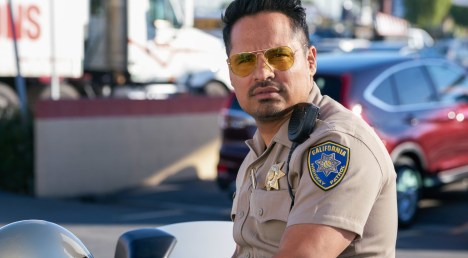
When he catches these corrupt cops, he’ll send them to the Peña-tentiary.

Who is the target market for CHiPs? The film pitches itself as a raunchy parodic reimagining of a show that was beloved at the time, but has faded into history. There’s obvious precedent here, and CHiPs can be reasonably placed as part of the movement that includes 21 Jump Street and Baywatch. However, CHiPs does not aim for nostalgia enough to appeal to fans of the show, and is not clever enough to attract the same audience as 21 Jump Street. The result is a reboot of an eighties motorcycle cop show aimed at fourteen-year-old boys.

Ironically, CHiPs feels retro for all the wrong reasons. CHiPs is largely defined by the idea that bodily functions (and male sexual organs) are hilarious, and that there is nothing funnier than two dudes touching each other’s erogenous zones, particularly when there’s at least one dude pointing out how hilarious it is. CHiPs is defensive nineties gay panic wrapped in eighties nostalgia. It is a strange cocktail.

Cashing their CHiPs.

Continue reading

Non-Review Review: Life

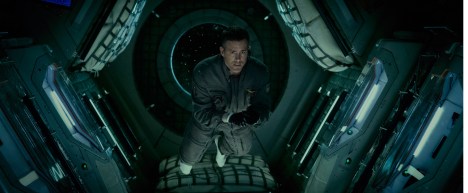
Life has a certain endearing b-movie schlock value to it, a cheesy and derivative deep space creature feature that indulges all manner of body horror in its race to the climax. With all due respect to the esteemed philosopher Forrest Gump, most viewers know exactly what they are going to get.

The biggest problem with Life is that the film is very predictable. There is very little here that seasoned science-fiction horror film fans will not have seen before. Indeed, this is arguably reflected in the biggest problem with its central monster. The first life form discovered in outer space, the creature that stalks the crew in Life is initially appealingly alien; a translucent starfish evolving into a mass of tentacles with a love of bodily orifices. Unfortunately, the creature quickly becomes more conventional. The movie even names the beast “Calvin.”

Caught in the Gravity of Alien.

And yet, there is a quirky appeal to all this. Life is a movie with an attitude mirroring that creature. It begins as something intriguing before morphing into something far too familiar. More than that, there is a ruthless efficiency to the film. Characters are rendered as little more than archetypes, information is delivered primarily as plot set-up rather than character development, the first act of the film races through what should be huge dramatic beats in order to get to the squidgy monster mayhem. Life knows what it is, even when it’s not pretty.

There is something endearing about this ruthless efficiency, the commitment with which Life seizes upon its b-movie stylings as a vehicle for really creepy space scares. Life suffers a little bit from its by-the-numbers second act, but it demonstrates enough enthusiasm for its schlocky sensibilities that it’s hard to hard. Life finds a way.

Needing some space.

Continue reading

Non-Review Review: Beauty and the Beast (2017)

The best and worst thing that can be said for Beauty and the Beast is that it beautifully recreates the animated source material.

A lot of love and affection went into Beauty and the Beast. The production design is amazing, a truly stylish blend of physical objects and computer-generated imagery to create something that feels like a hybrid between live action and animation. It is a very skillful blending of two different approaches to film making. On a purely technical level, judged as a mechanical adaptation, Beauty and the Beast succeeds triumphantly. It is a live action fantasia recreation of a beloved animated film.

More than that, Beauty and the Beast works largely because it is so effective an adaptation. Beauty and the Beast scores phenomenally well because it so carefully and precisely translates material that has incredible emotional power. There is a case to be made that the original Disney adaptation is one of the best films in the company’s canon, with some of the best songs and the most memorable set pieces. The live action adaptation ensures that very few of these moments get lost in translation, which lends the movie a compelling weight.

Unfortunately, it is also a reminder that a nigh-perfect adaptation of this version of the story already exists. Beauty and the Beast runs a muscular two-hours-and-six minutes to the animated film’s eighty-two minutes, but that statistic is misleading. The additions are pointless at best and distracting at worst. As a whole, Beauty and the Beast makes the animated original look like a more streamlined take on this tale that cuts a lot of the fat, telling the same story in a way that is at once more concentrated and more concise.

Mirror, mirror.

Continue reading

Non-Review Review: Tschick

This film was seen as part of the Audi Dublin International Film Festival 2017.

Tschick is a charming, if disorganised and overly episodic, coming of age road movie.

The basic set-up of Tschick is effective, if a little familiar. Maik Klingenberg is an imaginative and socially awkward teenager, the child of an alcoholic (if well-meaning) mother and a distant (and philandering) father. He is invisible to his classmates, except to the eponymous Tschick. Andrej Tschichatschow is a new arrival from Russia. He is antisocial, he smells bad, and he suffers from alcoholism despite only being a teenager. Naturally, he proves even less popular than Maik. The other students don’t know Maik exists, but they hate Tschick.

Cliffhanger ending.

Cliffhanger ending.

With his mother checked into rehab and his father absent for other reasons, Maik is left to fend for himself. He ends up embarking upon a cross-country road trip with Tchick in a stolen car. Along the way, the pair have a series of encounters with a wide variety of people and intersect with various other walks of life. As a result, Maik and Tschick have a unique shared experience, forging a deep bond and a mutual respect. The resulting journey is full of wry well-observed comedy and heart-warming moments, largely held together by the charm of leads Tristan Göbel and Anand Batbileg.

However, Tschick lacks the focus necessary to tie these elements together. It is both too focused on its own narrative and character arcs to fully embrace a stream-of-consciousness “on the road” travelogue style and too episodic to cohere into a single strong narrative. The result is a film that feels rather uneven and disjointed, a road trip constantly hitting speed bumps.

Venturing far afield.

Venturing far afield.

Continue reading

Non-Review Review: Headshot

This film was seen as part of the Audi Dublin International Film Festival 2017.

The obvious (and easy) comparison for Headshot is The Raid.

Part of that is down to the superficial similarities. Both are relatively straightforward Indonesian action movies starring Iko Uwais with an emphasis on martial arts. Even beyond that, The Raid was a breakout hit and exists as one of the defining modern martial arts movies for wider audiences. Even without the similar stuntwork and the combination of lead actor and genre, The Raid would be a stock point of comparison for Headshot. The film even seems to invite and encourage the comparison, with directors Kimo Stamboel and Timo Tjahjanto consciously evoking Gareth Evans’ style.

Headed into danger.

Headed into danger.

The comparison does Headshot no favours. For all the similarities between the two films, the differences are telling. Headshot has a style that consciously evokes The Raid, but it lacks its streamlined efficiency. It has a number of impressive prop-heavy set pieces that call to mind the impressive work in The Raid, but it never embraces the loose and freewheeling style that made The Raid so striking. More than that, Headshot never manages the delicate balance between rudimentary character work and a solid story, leading to a film that feels both paper-thin and over-developed.

Headshot is a solidly middle-of-the-road martial arts slugfest, but it lacks the sheer “wow!” factor that made The Raid pop.

Bar none.

Bar none.

Continue reading

Non-Review Review: The Farthest

This film was seen as part of the Audi Dublin International Film Festival 2017.

The Farthest is a fascinating documentary looking at the history and the legacy of the “Voyager” space programme.

Assembling a panel of experts from both inside and outside the development process, director Emer Reynolds crafts a captivating examination of mankind’s first journey beyond the boundaries of the solar system and into the untested void. The Farthest is a romantic tribute to the idea of space exploration, to the wonders that it holds and the inquiries that it inspires. It is a documentary that looks to the stars and wonders, as interested in what mankind is putting out there as it is in what wonders lie in wait.

thefarthest

The Farthest is bookended by a number of beautiful shots from Reynolds. The camera stares upwards at the sky as it pans slowly across a number of different locations. The sky can be narrowly glimpsed between the branches of tall trees. The audience’s eye is channeled upwards through the framework of a steel pylon. Occasionally, the sky is clear and blue. Sometimes there are faint signs of human activity, with planes charting the sky at a much more manageable scale than the craft at the centre of the documentary’s narrative.

There is something very striking and very beautiful in these opening and close shots, something that captures the sensation of looking up into the wild blue (or black) yonder and wondering what is out there or what might be staring back. The Farthest feels like romantic ode to the majesty of space, and one that deserves to be seen on the big screen.

thefarthest1

Continue reading