• Following Us

  • Categories

  • Check out the Archives


  • Awards & Nominations

New Podcast! Scannain Podcast (2018) #1!

New year, new Scannain podcast!

The wonderful folk over at Scannain, spearheaded by the fantastic Niall Murphy, are relaunching the Scannain podcast. I was lucky enough to appear as a guest and panelist on some of the older episodes, and was thrilled to be invited back for the launch of the new and improved Scannain podcast that will see a rotating pool of guests discussing the week in film – what we watched, film news, the top ten and new releases.

I’m thrilled to be part of a panel including Niall Murphy, Jay Coyle and Grace Duffy. Give it a listen below.

61. Three Billboards Outside Ebbing, Missouri – This Just In (#122)

Hosted by Andrew Quinn and Darren Mooney, and this week with special guest Stacy Grouden, This Just In is a subset of The 250 podcast, looking at notable new arrivals on the list of the 250 best movies of all-time, as voted for by Internet Movie Database Users.

This time, Martin McDonagh’s Three Billboards Outside Ebbing, Missouri.

Continue reading

Non-Review Review: The Commuter

The Commuter is the best Neeson Season movie since The Grey and the best movie about the financial crisis since The Big Short.

On paper, The Commuter is a mildly interesting premise that feels very much of a piece with the typical January awards-fare counter-programming. It is very much a high-concept action film that feels populated from a mad lib. [Liam Neeson/Bruce Willis/Gerard Butler] is a [former cop/current cop/law enforcement official] who finds himself embroiled in a race against time to [protect/rescue/expose/defeat] a [loved one/conspiracy].

McCauley took the instruction not to fire the gun inside the carriage a little… literally.

The Commuter is very much of piece with Liam Neeson’s other collaborations with director Jaume Collet-Serra; Unknown, Non-Stop, Run All Night. It is a movie about a weary protagonist embroiled in a situation beyond his control, the perfect fodder for a midweek movie to be enjoyed with a bucket of pop corn and a soft drink of choice. However, what elevated The Commuter above these earlier collaborations is similar to what elevated Collet-Serra’s The Shallows above so many familiar shark movies.

The Commuter has the look and feel of a big dumb action movie, a film inviting the audience to engage on its own terms rather than theirs. However, there is a very knowing and self-aware quality to The Commuter, an understanding of what the audience expects of the film and what the film can expect from the audience in return. The result is a film that always feels smarter and better than it needs to be, very carefully calibrated; just serious enough to work, just self-aware enough to charm. The result is a delightfully enjoyable action film.

Dial “C” for Commuter.

Continue reading

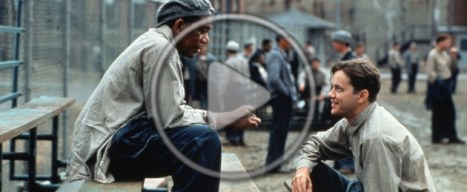
60. The Shawshank Redemption (#1)

Hosted by Andrew Quinn and Darren Mooney and this week with special guest Charlene Lydon, The 250 is a (mostly) weekly trip through some of the best (and worst) movies ever made, as voted for by Internet Movie Database Users. New episodes are released Saturday at 6pm GMT, with the occasional bonus episode along with them.

This time, Frank Darabont’s The Shawshank Redemption.

Convicted of murdering his wife, Andy Dufresne is sentenced to two life sentences in Shawshank Penitentiary. A harsh and unforgiving prison, Andy struggles to hold on to hope as the years go by.

At time of recording, it was ranked the best movie of all time on the Internet Movie Database.

Continue reading

Non-Review Review: All the Money in the World

All the Money in the World is an intriguing and uneven anthropological study of wealth.

Ridley Scott’s drama documenting the abduction of Paul Getty treats its subjects as members of a different species. In an introductory voice-over, the character of Paul Getty explains that the truly rich may as well come from “another planet.” They might look the same, but they are fundamentally different from ordinary people. At one point, John Paul Getty recalls an argument on how a publisher tried to change the title of his book from How to be Rich to How to Get Rich. Getty complains, “Getting rich is easy. Any fool can get rich. Being rich, that’s something else entirely.”

A Plum(mer) Role.

This idea simmers through All the Money in the World, the notion that there is something more than just a bank balance that separates the wealthy from the poor. “Money is never just money,” reflects advisor Fletcher Chase, and All the Money in the World suggests as much repeatedly. Throughout the film, journalists and paparazzi stalk the Getty family like wildlife photographers trying to snap a picture of some rare beast in its natural habitat. The Getty’s stand apart, and that sense of otherness is compounded by some measure beyond a balance in any account.

All the Money in the World is fascinating in its exploration of this idea, but it suffers from a lack of focus and clarity. All the Money in the World feels more like a series of vignettes than a single narrative story, a set of compelling sequences that never add up to a fulfilling whole. There is something intangible missing, as if the figures don’t quite add up. Then again, that flaw seems perfectly suited to the characters at the centre of the narrative.

Oil’s well that ends well.

Continue reading

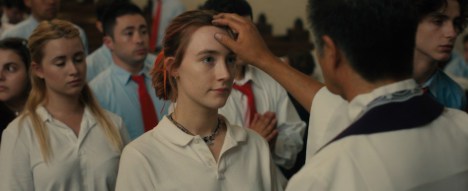
Non-Review Review: Lady Bird

Lady Bird is a sweet and charming little film, one anchored in two great central performances from Saoirse Ronan and Laurie Metcalf.

Lady Bird is relaxed and casual, a story of teenage anxiety unfolding at its own pace without any tangible sense of stakes or scale. Lady Bird is a refreshingly quiet and sincere movie, one that captures a lot of the listlessness associated with youth, the obliviousness to the reality of the outside world, the struggle to define a unique identity. For all the film is anchored in its Californian surroundings, Lady Bird is a universal coming of age story.

Blessing in disguise.

Like its protagonist, Lady Bird is smart and wry, if a little directionless and unsure of itself. However, the movie works in large part because of the decision to build its emotional core around the relationship between the eponymous character and her mother. Ronan is phenomenal here, but Metcalf is just as able to match her co-star. Both actors deliver raw and genuine performances that perfectly capture the push-and-pull of any real-life familial dynamic.

Lady Bird is perhaps a little too eccentric and a little too whimsical in places, drawing its supporting cast in broad strokes and leaning a little too heavily into stereotypes of adolescence, but the film has a warm and beating heart that sustains it for its ninety-three-minute runtime.

Bye, bye, birdie.

Continue reading

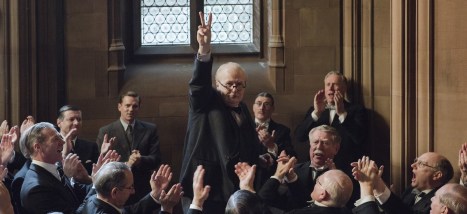
Non-Review Review: Darkest Hour

Darkest Hour is a powerhouse performance nested inside a fairly formulaic film.

In terms of plot, Darkest Hour is very much a familiar cinematic biography. Building off the template cemented by writer Peter Morgan on The Deal, The Queen, The Special Relationship and Rush, this is a film that explores its subject through the lens of a single event. The plot of Darkest Hour unfolds across May 1940, in the shadow the Second World War. It charts the life of Winston Churchill from the resignation of Prime Minister Neville Chamberlain to the evacuation of Dunkirk. It is tightly focused, and perhaps the better for that.

Winston, Loseton.

In many ways, Darkest Hour feels like a collection of pop culture standards. Churchill is such an iconic part of European history, and this month was so crucial, that audiences have almost reached saturation point with narratives documenting key moments in the life of the statesman. Darkest Hour cannot help but evoke shades of everything from The King’s Speech to The Crown to Dunkirk, all of which share some sense of the same time and place. Darkest Hour simply combines a lot of pop culture Churchill into what amounts to a “greatest hits” package.

With that in mind, it should be no surprise that Darkest Hour is elevated by the central performance from an almost unrecognisable Gary Oldman. If pop culture has synthesised Churchill’s history to a collection of “greatest hits”, then it is the delivery that truly matters. Oldman carries the film home.

Two-finger salute.

Continue reading

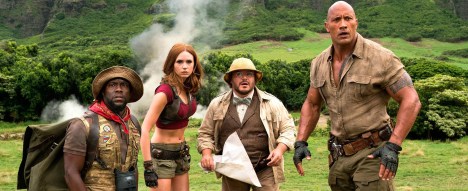
Non-Review Review: Jumanji – Welcome to the Jungle

Jumanji: Welcome to the Jungle is a weird and interesting experiment, in part because it is a nostalgic and belated sequel that remains caught between its past and the present.

Welcome to the Jungle joins a long (and perhaps undistinguished) line of twenty-first century franchise revivals for beloved nineties properties. The original Jumanji was a hardly a breakout hit, even if it did make an impression on a younger generation who would have grown up on it as part of Robin Williams’ nineties family-friendly oeuvre along with Hook or Ms. Doubtfire. Indeed, Jumanji is arguably the nineties Robin Williams film most perfectly suited to a revival like this, in that it involves a premise that can be divorced from its iconic and beloved star.

Franchises find a way.

At the same time, Jumanji is undoubtedly near the bottom of nineties adventure films in need of a revival, lurking in the shadow of other resurrected blockbusters like Independence Day or Jurassic Park. Perhaps because of this distance, and perhaps because of the lack of a true cult iconography, Jumanji serves as an interesting control case. This is a film with one leg in the present, aimed at what modern families expect from blockbuster entertainment. The other leg it planted firmly in the past, harking back to certain aspects of formula that seem almost quaint.

Welcome to the Jungle is not a particularly good film, but it is an interesting one. It serves as a prism through which certain aspects of nostalgia might be deconstructed and explored.

Players.

Continue reading

Non-Review Review: The Post

The Post is clean, efficient and timely.

Even to those unfamiliar with the historical events that inspired the film, there will be very little in The Post that is surprising. The Post follows a very clear trajectory for a prestige picture coming into awards season, setting up its character arcs and trajectories in a very straightforward manner and following them all on their clearly defined paths towards the end credits. It is very easy to see where the story will end up, and there are surprisingly few twists and turns in the narrative as it develops.

Food for thought.

However, there is something endearing in this efficiency. The Post famously came together in a hurry while director Steven Spielberg was waiting for postproduction work on Ready Player One, and the film serves as a showcase for the effectiveness of the creative talent involved in the production. The Post is unlikely to become a defining or signature film for anybody involved in its production, but instead exists as a testament to the sheer technique and craft of that production team.

The Post is not a masterpiece or a classic, but it is a sleek and well-made film.

Old news.

Continue reading

Non-Review Review: I, Tonya

I, Tonya is a biopic for the post-truth era. It is also brilliant.

The subject of I, Tonya will be casually familiar to most viewers, the figure skater Tonya Harding who was implicated in an attack on fellow figure skater Kerrigan. The incident was a flashpoint for the nascent twenty-four hour news cycle in the early nineties, although most people remember it as a warm-up for the O.J. Simpson case only shortly afterwards. As such, I, Tonya feels like the perfect window through which to examine the modern era’s obsessive celebrity-focused culture and the desire to turn our heroes into monsters for the audience’s viewing pleasure.

Putting her own spin on it.

I, Tonya is fascinating on that level alone. Its characters repeatedly break the fourth wall in an attempt to steer and control the narrative, but occasionally do so to indict the audience for their complicity. I, Tonya is a film that understands it cannot be about this media maelstrom without being part of this media maelstrom. There’s a canny knowingness to I, Tonya, an understanding that a movie about culture’s slipping grip on the idea of reality cannot be too earnest or too sincere.

I, Tonya repeatedly suggests that its story may stray into the realm of fantasy and fiction, but the movie still packs a real punch.

Get your skates on, mate.

Continue reading