• Following Us

  • Categories

  • Check out the Archives


  • Awards & Nominations

Non-Review Review: The Mauritanian

The Mauritanian is an odd film in a number of ways.

In some ways, The Mauritanian feels like it has arrived late to the party. Obviously, the War on Terror is still a major defining event of the twenty-first century. Guantánamo Bay is still open and housing forty inmates. It’s possible to trace the xenophobia that defines so much of contemporary American politics back to the War on Terror, most obviously by looking at the countries affected by President Donald Trump’s infamous “travel ban.” So the War on Terror is very much an ongoing concern that merits discussion and exploration.

Maur, Maur, Maur…

However, it is also a period of American history that has been very thoroughly explored in film and television, particularly in the context of prestige awards-season releases. The Hurt Locker won Best Picture a decade ago. Zero Dark Thirty was a major awards contender a few years after that. The War on Terror has been dissected through the lens of forensic introspection in movies like The Report and through broad satire in movies like Vice. As such, any movie hoping to explore the War on Terror exists in the shadow of larger culture.

This is perhaps the biggest issue with The Mauritanian. Director Kevin Macdonald’s earnest exploration of the incarceration and torture of Mohamedou Ould Salahi feels like a movie that should have been released during the early wave of this cinematic excavation. Even allowing for the fact that Salahi was only released five years ago, those five years feel like a very long time. The result of all this is that The Mauritanian feels like a movie displaced in time, feeling like a retread of the earliest films grappling with the topic, like Lions for Lambs.
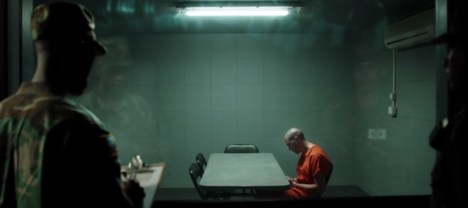
Interrogating the War on Terror.

Continue reading

Non-Review Review: Raya and the Last Dragon

Raya and the Last Dragon offers a reminder of just how quietly and efficiently Disney have managed their animated properties.

For a while at the turn of the millennium, the company seemed to struggle to defines its place among younger and hungrier animation studios like Pixar or Dreamworks. The company responded with a push away from the princess-centric movies like The Little Mermaid, Beauty and the Beast, Pocahontas and Mulan that had anchored their renaissance-era output, pivoting sharply: first to animated movies aimed at boys like Atlantis and Treasure Planet, and then to computer-animated adventures like Chicken Little, Meet the Robinsons and Bolt.

Raya hope?

However, towards the end of the decade, the company arguably found its feet again, with a wave of somewhat traditionalist stories. The Princess and the Frog is often treated as the end of an era of hand-drawn animation, but it also marked a rejuvenation of the classic “princess” movie. It was followed by Tangled, Frozen, Moana and Frozen II, all of which were computer-animated takes on a familiar Disney archetype.

Raya and the Last Dragon is a reminder of just how sturdy that old “princess” movie template is, demonstrating the hard work that the company has put in to keep its oldest archetype both resonant and recognisable.

Continue reading

219. Dom za vešanje (Time of the Gypsies) – This Just In (#220)

Hosted by Andrew Quinn and Darren Mooney and with special guests Jason Coyle and Ronan Doyle, This Just In is a subset of The 250 podcast, looking at notable new arrivals on the list of the 250 best movies of all-time, as voted for by Internet Movie Database Users.

This time, Emir Kusturica’s Dom za vešanje.

Perhan lives a simple life in a gypsy community outside of Skopje. He dreams of marrying Azra, but his social standing is not high enough. Events conspire to take Perhan away from his community, embarking on a trip to Italy with local legend Ahmed and with the promise of a new and prosperous life waiting for him. Inevitably, Perhan discovers that this life is not what was promised, and faces the possibility that he might also be something different than he expected himself to be.

At time of recording, it was ranked the 220th best movie of all time on the Internet Movie Database.

Continue reading

Non-Review Review: The Little Things

The Little Things was reportedly written by John Lee Hancock in the mid-nineties, and it shows.

The film is largely set against the backdrop of October 1990. There frequent reminders that this is effectively a period piece. During the opening sequence, one potential serial killer victim sings along with Roam from the B-52s on her car stereo. Another victim has a pink flyer for No Doubt pinned up on her fridge and a poster for The Lost Boys hanging in her living area. There are repeated references to how Richard Ramirez, “the Night Stalker”, still lingers in the living memory of the Los Angeles Police Department.

A new release window.

However, The Little Things feels like a period piece in some more fundamental ways. Most obviously, there’s the fact that The Little Things exists as a star vehicle, its cast including Oscar winners Denzel Washington and Jared Leto, along with Oscar nominee Rami Malek. The film is not based on any existing intellectual property, even if it is highly derivative in other ways. More than that, it harks back to the serial killer boom of mid-nineties cinema, when big studio films were dominated by procedural thrillers and forensic meditation.

The Little Things is neither an exemplar nor a deconstruction of the genre, but instead a straightforward reminder of its tropes and conventions seemingly cobbled together to construct something close to the statistical mean. The common refrain with a film like The Little Things is to suggest that this is the kind of film that they don’t make any more. The more worrying thought is that The Little Things seems to illustrate why.

Continue reading

Non-Review Review: Malcolm and Marie

The reactions to Malcolm and Marie have been divided, to the say the least.

On one extreme, some critics have been quick to laud Sam Levinson’s black-and-white character study as a surprise late addition to the awards race, a bracing old-fashioned character drama anchored in two compelling performances that interrogates a relationship that never seems certain whether it will implode or explode. It is the kind of film that invites comparisons to works like Who’s Afraid of Virginia Woolf?, The Boys in the Band or even something like Autumn Sonata: characters trapped in a confined space, with the drama ready to boil over.

On the other extreme, critics have been quick to argue that Malcolm and Marie is an indulgent mess anchored in a grossly unlikeable and shallow protagonist that never digs beneath the skin of its central characters. More than that, Levinson seems to use the film as an opportunity to work through his own issues as a promising (and privileged) young filmmaker who feels like he has not necessarily been given the critical respect that he deserves. Malcolm and Marie is a series of self-serious monologues delivered in the aesthetic of a (very pretty) Calvin Klein commercial.

As ever, the truth lies somewhere between these two extremes.

Continue reading

Non-Review Review: Outside the Wire

Outside the Wire often feels like Netflix resurrected Cannon Films, and tasked them with remaking Terminator 2: Judgment Day and Training Day, without any constraints in terms of logic or internal consistency.

Outside the Wire is a bad film, but it is a bad film in somewhat interesting ways. This is not the dull lifeless quality of Wild Mountain Thyme. It is instead the gonzo “throw everything at the wall, regardless of how it fits together” energy of a film like Serenity or Book of Henry. It is a film that makes a number of bizarre choices that often seem to confusingly double back on one another, to the point that any review of the film inevitably comes across as a deranged play-by-play rather than coherent criticism.

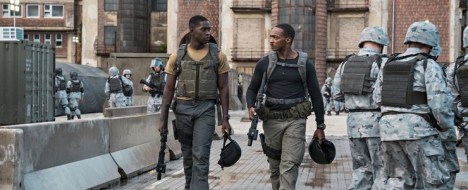
“You’re a droid, and I’m a ‘noid.”

Outside the Wire is set in Eastern Europe in the distant future of 2037, as a new Cold War brews between Russia and the United States, raging as a proxy war in the Ukraine. (It perhaps says something about the state of current politics that this reference feels very dated.) Lieutenant Thomas Harp is a drone pilot. During a routine assignment, he breaks the chain of command and fires a missile that kills two servicemen. As a penalty, Harp is assigned to active duty on the frontier.

This is a fairly standard set-up. It recalls movies that meditate on the morality of drone warfare, like Good Kill or Eye in the Sky. Indeed, as Harp arrives on site, the commanding officer outlines the brutal cynicism of this punishment. “You’re here because somebody deemed the dollar value of your training to be higher than the lives of those two men. If you survive, air force keeps a pilot. If you die, you’re a cautionary tale to all the other fly-by-wire assholes.” The stakes are grounded, logical. The moral at play is clear. Harp is going to learn what war is really like.

Robot Wars.

Then, in the space of three minutes, Harp is assigned to work with an officer named “Leo.” Leo is an oddity. “He’s not like us,” the commanding officer warns. Leo works alone in a large office, filled with records. He listens to vinyl music. He types on an analogue keyboard. Within minutes of arriving, Leo has already conscripted Harp on a covert mission behind enemy lines. It initially seems like Leo is planning to deliver a set of vaccines to a local children’s hospital. “So you’re hearts and minds, sir?” Harp asks. Leo replies, “Yes, I’m hearts and minds. Ostensibly.”

It turns out that the vaccine run that Harp has been assigned moments after arriving to his first active deployment is actually a clandestine strike mission to take out local war lord Victor Koval. Koval is plotting to take control of the Ukrainian nuclear arsenal, and Leo is committed to stopping that from happening. Leo walks Harp through an elaborate exposition machine, involving photo plays and interactive maps. There’s a lot of elaborate detail, but the mission is clear. This is a “save the world” buddy movie.

And then Leo takes off his shirt, and reveals that he is android. All of this is twenty minutes into the film.

Continue reading

New Escapist Video! “Outside the Wire – Review in 3 Minutes”

I’m thrilled to be launching 3-Minute Reviews on Escapist Movies. Over the coming weeks and months, I will be joining a set of contributors in adding these reviews to the channel. For the moment, I’m honoured to contribute a three-minute feature film review to the channel, discussing Outside the Wire.

Non-Review Review: Pieces of a Woman

If only Pieces of a Woman were interested in allocating more space to its central female character.

Pieces of a Woman is notable as Vanessa Kirby’s first cinematic lead role. The actor has a long career in theatre and on television, and has made an impression with a couple of strong supporting turns in blockbusters like Mission: Impossible – Fallout or Hobbs and Shaw. However, Pieces of a Woman marks the first time that Kirby takes centre stage, and the film gives her the juicy role of a young woman trying to come to terms with a home birth that ended in tragedy, as her life falls to pieces around her.

Where’s LaBeouf?

Kirby is great in Pieces of a Woman, offering a central performance that is layered and nuanced, one that often opts for interiority instead of extroversion. It’s a quiet performance, but a rich one. Kirby deserves a lot of credit for her work. However, Pieces of a Woman refuses to give Kirby’s performance the credit that it deserves, instead drowning out that powerhouse dramatic in a sea of prestige drama clichés and larger-than-life supporting turns from actors like Shia LeBeouf. Kirby winds up somewhat lost in a film that should be centred on her, through no fault of her own.

If Pieces of a Woman is a story of a fractured response to grief, it often feels like some of the pieces get lost because the film has no real interest in looking.

Pregnant pause.

Continue reading

Non-Review Review: One Night in Miami

The past year has seen an interesting resurgence in old fashioned stage-to-screen adaptations.

It is been a common criticism that screen adaptations of classic stage plays tend to be “stagey” rather than traditionally “cinematic.” After all, many plays are written in such a way as to play to the strengths of theatre as a medium, built around core characters delivering monologues on standing sets in an intimate scale. One of the more common criticisms of movies like Doubt is that they fail to fully translate the material so that it is optimised to work in the language of cinema. As a result, quite a few adaptations will try to disguise their theatrical origins.

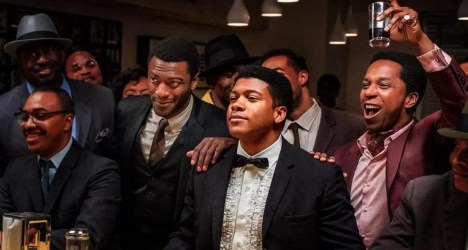
The cast is great, bar none.

However, this past year has seen a number of high-profile stage performances adapted for film, completely unashamed of their roots. Hamilton was not a conventional cinematic adaptation of the hit musical, but instead a recording of a performance pieced together in such a way as to attempt to recreate the experience of watching the show in a theatre. On Netflix, The Boys in the Band and Ma Rainey’s Black Bottom made no effort to disguise their theatrical roots. Even Ryan Murphy’s The Prom embraced the hyperrealism of Broadway.

One Night in Miami is another example of this trend, with playwright Kemp Powers adapting his own play for the screen. Director Regina King never tries to make One Night in Miami seem especially cinematic or epic in scope, instead opting to focus on what made Powers’ play such a success in the first place. One Night in Miami is a piercing and biting snapshot of an ongoing argument in progressive minority circles, powered by sharp dialogue and a set of winning performances. It is perhaps a little too stagey for its own good, but it still works a treat.

Raising the roof…

Continue reading

214. Citizen Kane – Christmas 2020 (#97)

Hosted by Andrew Quinn and Darren Mooney, and this week with special guest Niall Murphy, The 250 is a weekly trip through some of the best (and worst) movies ever made, as voted for by Internet Movie Database Users. New episodes are released Saturdays at 6pm GMT.

So this week, Orson Welles’ Citizen Kane.

Following the death of Charles Foster Kane, reports of the magnate’s final word slip out to the press. Trying to parse a portrait of the public figure’s life and times, a reporter attempts to discern the meaning of the word, “Rosebud.”

At time of recording, it was ranked 97th on the list of the best movies of all time on the Internet Movie Database.

Continue reading