• Following Us

  • Categories

  • Check out the Archives


  • Awards & Nominations

The X-Files (Topps) #38 – Cam Rahn Bay (Review)

This May and June, we’re taking a trip back in time to review the fifth season of The X-Files and the second season of Millennium.

Cam Rahn Bay returns to one of the recurring themes of John Rozum’s run on Topps’ X-Files tie-in comic book.

It is essentially a cautionary tale amount mankind tampering with nature and the unforeseeable repercussions of such meddling. As such, it feels very much in keeping with scripts like Skybuster or Scum of the Earth. This idea of human hubris is a theme that is very much in keeping with The X-Files as a franchise, perhaps most keenly reflected in Chris Carter’s deep affection for Mary Shelley’s Frankenstein and for environmental causes. Cam Rahn Bay is very much in keeping with that aesthetic.

All at sea...

All at sea…

However, there are problems with the story. Most obviously, Rozum’s prose seems a little clunky and awkward. Cam Rahn Bay is a heavy-handed and clumsy meditation on mankind’s fixation with imposing its will over the natural world. However, there is also something slightly hypocritical about the story. As much as Cam Rahn Bay criticises the use of animals in a military capacity, it never seems to question the use of animals in captivity. While the training of dolphins to do military work is treated as deplorable, training them to do tricks for entertainment is lauded.

Cam Rahn Bay feels a little tonally ill-judged, with this fairly significant blindspot undermining a lot of Mulder’s impassioned rhetoric about how mankind treats the natural world.
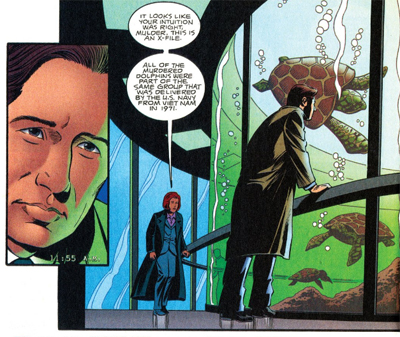
"Sorry, I was just thinking abotu Deep Throat..."

“Sorry, I was just thinking abotu Deep Throat…”

Continue reading

Star Trek – The Immunity Syndrome (Review)

The first Star Trek pilot, The Cage, was produced in 1964. To celebrate its fiftieth anniversary, this December we are reviewing the second season of the original Star Trek show. You can check out our first season reviews here. Check back daily for the latest review.

The Immunity Syndrome is an underrated masterpiece, the first genuine classic overseen by producer John Meredyth Lucas.

It is bold, brilliant and more than a little bit weird. This is Star Trek as pure sixties science-fiction. It is a psychedelic ecological tale focused on mankind’s place in the larger universe. It doesn’t just pit the Enterprise against a giant space amoeba, it suggests that the universe itself is a singular gigantic organism, a complex system in which the Enterprise is just one part. The Immunity Syndrome is weird and wonderful, eerie and beautiful in equal measure. It is one of Star Trek‘s most effective encapsulations of the sixties.

Freak out!

Freak out!

Continue reading

Star Trek IV: The Voyage Home by Vonda N. McIntyre (Review)

This June, we’re taking a look at some classic Star Trek movie tie-ins. Check back daily for the latest reviews and retrospectives.

Comedy doesn’t always translate well between different media. That’s not to suggest that comedy works better in one medium as compared to others, merely to contend that certain forms of comedy don’t translate perfectly between different media. It works any number of ways. Something that is funny in sound and vision is not necessarily hilarious in prose. Gags relying on delivery might play better with a seasoned performer than in the mind’s eye of a reader. Witty prose doesn’t always lend itself to narration or articulation on film.

Much of Star Trek IV: The Voyager Home plays as broad farce, following a bunch of time-travelers from the future (and refugees from television land) as they try to interact with the real world. The movie does have some wonderful character moments – notably Spock’s character arc that beautifully brings him a full circle and Kirk’s relationship with Spock – but it also plays the Star Trek ensemble in a highly caricatured manner, more as archetypes than fully-realised three-dimensional characters.

This is grand. After all, these are fictional characters rather than real people. After all stories are more than just excerpts from the biographies of fictional characters. While it’s nice to have consistent characterisation, suggesting that you can’t have Kirk and Spock acting in an exaggerated fashion for the sake of comedy is a very narrow and restrictive view of what Star Trek is or should be.

The Voyage Home gets the big character beats right – Spock’s insistence that the crew rescue Chekov, Kirk convincing Gillian to trust him, Spock “guessing” – that we can excuse the crew’s lack of awareness about a time period they have visited before and the general flippancy of the movie itself. The novelisation, however, is another matter. Vonda N. McIntyre clearly cares a great deal about the characters. That was one of the strengths of her work on the novelisations of the last two films. Here, however, McIntyre struggles to balance that with the tone of the story.

startrekiv Continue reading

Non-Review Review: Rio 2

Rio 2 is a solidly-constructed sequel. It lacks the emotional heft that has come to distinguish most of the more memorable family films. Instead, it opts for a constant barrage of music and colour to keep the young audience engaged. Nothing ever lingers too long, with a set piece or a musical number sure to kick off within a scene or two. There’s nothing wrong with this approach – Rio 2 is a perfectly enjoyable piece of family film.

At the same time, it never slows itself down (or even tones itself down) long enough for use to invest in the characters. There is always something happening, which means that our characters never seem to catch their breath. Given the movie’s story touches on heavy themes like connecting with one’s roots, cultural identity, and environmentalism, there is a sense that these ideas might work better if given room to breath a bit.

Still, the result is engaging and diverting, if not entirely satisfying.

All the way to Rio...

All the way to Rio…

Continue reading

Alan Moore’s Run on Swamp Thing – Saga of the Swamp Thing (Books #5-6) (Review/Retrospective)

This January, I’m going to take a look at some of DC’s biggest “events.” You can probably guess which event I’m leading into, but I don’t want to spoil it…

Alan Moore’s Swamp Thing is a run to treasure. I mean, I’m looking forward to getting my hands on Scott Snyder’s new run on the character, especially since DC have decided to release it in hardcover, but Moore’s Swamp Thing remains one of Moore’s longer runs in mainstream comic books, demonstrating that it is possible for an extended in-continuity run on a (relatively) mainstream character to still transcend the expectations of the superhero genre. The eighties were full of fascinating creative ideas in comics, both in miniseries, independent and mainstream books, but I’d still argue that Moore’s Swamp Thing is remarkable due to its work redefining the superhero genre and its impressive length.

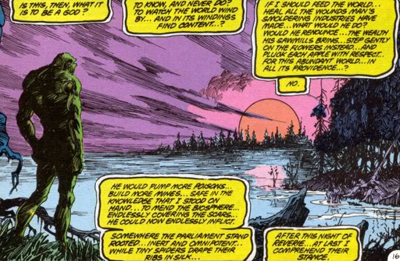
Into the sunset...

Continue reading