• Following Us

  • Categories

  • Check out the Archives


  • Awards & Nominations

Star Trek: Enterprise – Unexpected (Review)

Next year, Star Trek is fifty years old. We have some special stuff planned for that, but – in the meantime – we’re reviewing all of Star Trek: Enterprise this year as something of a prequel to that anniversary. This January, we’re doing the first season. Check back daily for the latest review.

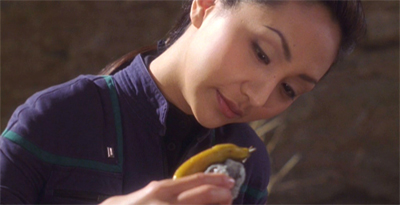
So, male pregnancy, eh?

Talk about a nipple slip...

Talk about a nipple slip…

Continue reading

Star Trek: Enterprise – Strange New World (Review)

Next year, Star Trek is fifty years old. We have some special stuff planned for that, but – in the meantime – we’re reviewing all of Star Trek: Enterprise this year as something of a prequel to that anniversary. This January, we’re doing the first season. Check back daily for the latest review.

Strange New World is the first episode of Star Trek: Enterprise to come from a writing team other than Brannon Braga and Rick Berman. Berman and Braga would dominate the writing credits for the first season. Even when the final teleplay was credited to another writer or writing team, there was often a “story by” credit given to Berman and Braga. Braga himself has conceded that he essentially re-wrote all of the episodes of the first season.

Still, Strange New World is credited to the writing team of Mike Sussman and Phyllis Strong. Both had worked on Star Trek: Voyager before migrated to Star Trek: Enterprise along with André Bormanis. Sussman had pitched the story for Meld and worked on a number of solo stories and scripts before teaming with Strong on the seventh and final season of the show. The two would remain a writing team for the first two seasons of Star Trek: Enterprise, hitting their stride with some of the strongest episodes of the troubled second season.

Picture perfect...

Picture perfect…

Strange New World is an interesting début for the pair. On the hand, it is a story that celebrates the unique place of Star Trek: Enterprise in the Star Trek pantheon. It’s a story about how great it must be to set foot on an alien planet, and how wondrous it must be to breath air from outside our atmosphere. With its emphasis on shuttlepods and primitive transporters, it does remain relatively true to the prequel premise of Enterprise.

On the other hand, Strange New World is a very familiar Star Trek template. Indeed, it’s a very familiar first season template. It’s the episode where the crew of the ship are exposed to some strange outside force that makes them all act out of character. It’s something of a Star Trek standard. The original Star Trek had The Naked Time and Star Trek: The Next Generation had The Naked Now, while Star Trek: Deep Space Nine had both Babel and Dramatis Personae. In many ways, Strange New World feels like a familiar old story.

Strange yellow daisy fields forever...

Strange yellow daisy fields forever…

Continue reading

Star Trek: Enterprise – Fight or Flight (Review)

Next year, Star Trek is fifty years old. We have some special stuff planned for that, but – in the meantime – we’re reviewing all of Star Trek: Enterprise this year as something of a prequel to that anniversary. This January, we’re doing the first season. Check back daily for the latest review.

Fight or Flight is reasonably solid as second episodes go. It’s very clear that Rick Berman and Brannon Braga are making a conscious effort to avoid the mistakes of Star Trek: Voyager. There’s a sense that they are trying to give Star Trek: Enterprise its own unique mood and flavour. As such, Fight or Flight feels like a story that isn’t just tailor-made for Enterprise, but is tailor-made for early in the first season of the show. It isn’t a story that could be done by another spin-off, and it’s also not a story that could be done by Enterprise even a year later.

While Fight or Flight works on a conceptual level, the execution feels a little strange. While Broken Bow was a big and bombastic Star Trek pilot with its own feel and rhythm, Fight and Flight feels almost quaint. As a piece of television, it’s constructed in a very meticulous and very precise manner, one that seems suspiciously outdated for a show broadcast in late 2001.

Slugging it out...

Slugging it out…

Continue reading

Star Trek: Enterprise – Broken Bow (Review)

Next year, Star Trek is fifty years old. We have some special stuff planned for that, but – in the meantime – we’re reviewing all of Star Trek: Enterprise this year as something of a prequel to that anniversary. This January, we’re doing the first season. Check back daily for the latest review.

Broken Bow is probably the strongest pilot in the Star Trek canon, with Emissary and The Cage vying for second place.

That’s not saying a lot. Broken Bow is still a troubled production with some rather sizeable issues marring what is otherwise an ambitious début for a new Star Trek show. Watching, Broken Bow – as with watching most of the first few years of Star Trek: Enterprise (or just Enterprise) – it feels like the show is at war with itself. It wants to be something new and fresh and exciting, but it also wants to be an important part of this larger tapestry. And the episode has difficulty reconciling that.

New (old) frontier...

New (old) frontier…

So we get new aliens like the Suliban, but a plot that revolves around the Klingons; we get an entirely new crew with a Vulcan science officer and Southern gentleman as the Captain’s best friend; we get a ship without most of the conveniences that we take for granted on Star Trek, but with substitutes and a resolution that relies on technological gimmickry; we get to explore an uncharted part of the Star Trek canon, but with the intrusion of the future to help make it feel a little more familiar.

From the first episode, Star Trek: Enterprise seems to exist as a show trapped between what it could have been and what it has to be. It’s a premise rich with potential, but which still feels a little too much like everything that came before.

Into the sunset...

Into the sunset…

Continue reading

Star Trek – The Ultimate Computer (Review)

The first Star Trek pilot, The Cage, was produced in 1964. To celebrate its fiftieth anniversary, this December we are reviewing the second season of the original Star Trek show. You can check out our first season reviews here. Check back daily for the latest review.

The Ultimate Computer is the second classic produced by John Meredyth Lucas, following on from The Immunity Syndrome. (Although it is credited to him, Journey to Babel was actually overseen by Gene L. Coon.) Like The Immunity Syndrome before it, The Ultimate Computer is a bottle show, filmed on the show’s standing set. It features a relatively small guest cast, even trimming the number of extras appearing on the Enterprise sets.

It seems that these sorts of constraints and pressures brought out the best in Lucas. Lucas steps behind the camera on The Ultimate Computer, and helps to bring the show to life. Although he is using familiar sets, he often figures out ways to shoot them that feel original and fresh – no mean accomplishment two years into the show’s run. The guest cast that Lucas has assembled is superb – with William Marshall turning in one of the best one-shot guest appearances in the history of Star Trek.

Does not compute...

Does not compute…

However, what is most notable about The Ultimate Computer is the funereal atmosphere that haunts the episode. There is a solemn and reflective tone to the episode, particularly during the early tests of the M-5 computer. The Enterprise is dark, abandoned, empty. Kirk is reflective. As with Bread and Circuses at the end of Gene L. Coon’ tenure, Spock offers McCoy an olive branch. In many respects, The Ultimate Computer seems to hark forward to the film series, with Kirk wondering how he might define himself if he is not a starship captain.

Appropriately enough for a series staring down the barrel at cancellation, The Ultimate Computer would have made for a pretty great finalé.

"Dammit, I told you we should have used a surge protector..."

“Dammit, I told you we should have used a surge protector…”

Continue reading

Star Trek – The Immunity Syndrome (Review)

The first Star Trek pilot, The Cage, was produced in 1964. To celebrate its fiftieth anniversary, this December we are reviewing the second season of the original Star Trek show. You can check out our first season reviews here. Check back daily for the latest review.

The Immunity Syndrome is an underrated masterpiece, the first genuine classic overseen by producer John Meredyth Lucas.

It is bold, brilliant and more than a little bit weird. This is Star Trek as pure sixties science-fiction. It is a psychedelic ecological tale focused on mankind’s place in the larger universe. It doesn’t just pit the Enterprise against a giant space amoeba, it suggests that the universe itself is a singular gigantic organism, a complex system in which the Enterprise is just one part. The Immunity Syndrome is weird and wonderful, eerie and beautiful in equal measure. It is one of Star Trek‘s most effective encapsulations of the sixties.

Freak out!

Freak out!

Continue reading

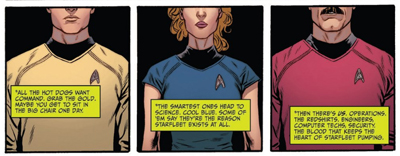
Star Trek (IDW, 2009) #13 – The Red Shirt’s Tale (Review)

The first Star Trek pilot, The Cage, was produced in 1964. To celebrate its fiftieth anniversary, this December we are reviewing the second season of the original Star Trek show. You can check out our first season reviews here. Check back daily for the latest review.

The IDW monthly comic series that launched after the release of Star Trek is an interesting beast.

Writer Mike Johnson has been on board since the title launched in September 2011, lending the comic a sense of creative consistency. Much has been made of the involvement of Roberto Orci as “creative consultant” on the title, as if to imply that the comic might somehow be legitimised in relation to the blockbuster franchise that spawned it. Certainly, the series does not enjoy the same loose attitude towards contemporary continuity that characterised the DC comics series published during the mid-eighties.

Suit up!

Suit up!

At the same time, it is not as if IDW’s on-going Star Trek comic series can claim a closer relation to canon. After all, the events of the comic’s first arc were rendered explicitly non-canonical by a casual conversation between Pike and Kirk in the first twenty minutes of Star Trek Into Darkness. This is not a problem of course – any more than continuity issues were a problem for the mid-eighties DC series – but they do suggest that the series’ fixation on continuity is perhaps misplaced.

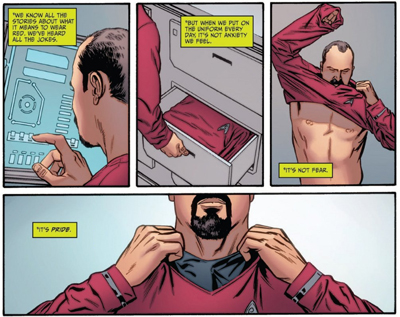
This weird fetishisation of “continuity” defined the first year or so of the title’s existence, with issues dedicated to essentially re-telling classic Star Trek stories using the new cast and crew. (Indeed, only one story from that year – Vulcan’s Vengeance – was not based on a classic episode.) The Red Shirt’s Tale serves as something of a half-way marker as the comic began to transition away from these sorts of continuity-heavy retellings, focusing a bit more on the new characters and the new world. The issue is a retelling of The Apple, but in a way that is more thoughtful and playful than a lot of what came before.

Colour-coded...

Colour-coded…

Continue reading

Star Trek – Wolf in the Fold (Review)

The first Star Trek pilot, The Cage, was produced in 1964. To celebrate its fiftieth anniversary, this December we are reviewing the second season of the original Star Trek show. You can check out our first season reviews here. Check back daily for the latest review.

Wolf in the Fold is Robert Bloch’s third and final contribution to Star Trek.

In keeping with What Are Little Girls Made Of? and Catspaw, the result is intriguing, bizarre and more than a little bit dysfunctional. More than any of the other writers drafted in to write for the science fiction show, Bloch’s fingerprints remain all over his script. Writers like Gene L. Coon and D.C. Fontana generally do a good job reconciling the work of science-fiction writers like Ray Bradbury, Theodore Sturgeon, Norman Spinrad or Harlan Ellison to make their stories fit within the frame work of Star Trek. However, even after re-writes, Bloch’s voice remains his own.
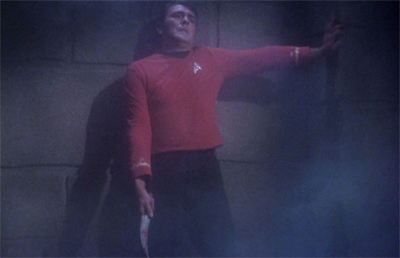
Knife to see you...

Knife to see you…

Of course, it’s quite clear that Wolf in the Fold has been through the standard re-write process. The script is a mess, struggling to tie together two basic plots (Scotty is accused of murder; the Enterprise is possessed by Jack the Ripper) in ways that don’t always work. There’s a really long and awkward expositional scene in the middle of the episode that consists primarily of Majel Barrett reading off weird-sounding words in order to assure viewers that Jack the Ripper really could be an immortal hate-fueled killing machine, given the rules of the Star Trek universe.

The are very serious problems with Wolf in the Fold. On a storytelling level, the pacing is a mess and the tone is all over the place. Bloch’s scripts continue to be even more problematic than usual when it comes to issue of gender – “Star Trek does slasher horror” is as borderline misogynistic as you might fear. However, there is something endearingly bizarre about the whole thing, as Bloch once again forces Kirk and his crew to confront an irrational universe that doesn’t necessarily conform to their understanding of it.
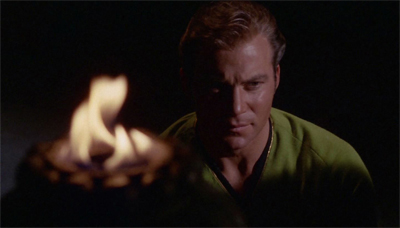
Flame on...

Flame on…

Continue reading

Star Trek: The Next Generation – Yesterday’s Enterprise (Review)

This January and February, we’ll be finishing up our look at the second season of Star Trek: The Next Generation and moving on to the third year of the show, both recently and lovingly remastered for high definition. Check back daily for the latest review.

Yesterday’s Enterprise is one of the best-loved pieces of Star Trek ever produced. Its inclusion is a given in absolutely any “best of” poll being run for Star Trek: The Next Generation or even the franchise as a whole. A rather thoughtful piece of high-concept science-fiction exploring the importance of the right people in the right time, Yesterday’s Enterprise is proof that The Next Generation has truly come of age. After two years of wandering in the wilderness, the show has finally found its feet.

Of course, the production of Yesterday’s Enterprise was quite traumatic. The story and script went through multiple iterations between the original pitch and the version presented on the screen. The episode was written by pretty much the entire writing staff over the Thanksgiving weekend, racing against the clock to get it finished. Due to scheduling issues with Denise Crosby and Whoopi Goldberg, it was filmed in late December instead of early January.

As with so much of the third season, there’s a sense that the episode was held together by chewing gum and rubber bands. However, also like most of the third season, that sense only comes from those delving into the behind-the-scenes stories. Looking at the episode itself, this was a show on the top of its game.

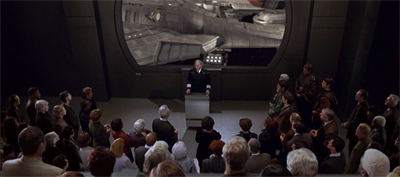
The battle bridge...

The battle bridge…

Continue reading

Star Trek – The Man Trap (Review)

To celebrate the release of Star Trek: Into Darkness this month, we’ll be running through the first season of the classic Star Trek all this month. Check back daily to get ready to boldly go. It’s only logical.

It really is amazing how busy the Star Trek universe is. Or, well, how busy it was at one point. Although there are plenty of alien civilisations scattered across the vast gulf space, numerous empires vying for power and glory, the first season of Star Trek seems fixated on the notion that the universe is packed with the relics and ruins of long-dead civilisations. The Man Trap is just one example, as Kirk and his crew investigate an archaeological dig on the planet M-113, decorated with “the ruins of an ancient and long-dead civilisation.” Of course, the civilisation isn’t quite dead, but there’s a definite funereal atmosphere about The Man Trap.

That somewhat grim atmosphere makes the show’s fixation on long-dead worlds somewhat fascinating, given how the series is primarily about mankind’s optimistic future. However, it creates a sense – palpable throughout the first year of Star Trek – that the human race is a relatively new arrival on the scene, but emerging following the collapse and decay of countless ancient civilisations. It’s an old universe, but it’s a new dawn.

Suckers!

Suckers!

Continue reading