• Following Us

  • Categories

  • Check out the Archives


  • Awards & Nominations

La La Land and Nostalgia’s End

One of the enduring criticisms of La La Land is the extent to which it indulges in nostalgia.

This is true of both the film and its characters. The opening scene proudly declares that the movie has been filmed in “Cinemascope”, with the landscape heavily saturated with bright colours that evoke classic Hollywood musicals even before a final showstopping number that evokes everything from An American in Paris to 7th Heaven. In this day and age, producing any big budget musical would feel like an act of nostalgia, but La La Land is a love letter to a genre that has fallen even further to the wayside than the western.
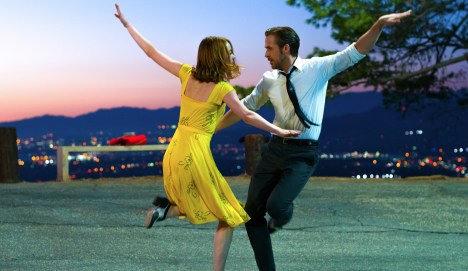
lalaland2

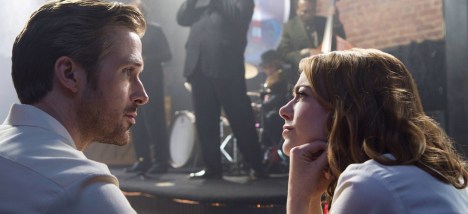
Even the characters inhabiting the film’s world are defined by nostalgia. This is most obvious with Sebastian, a jazz nerd who desperately wants to construct a loving shrine to the artform as he loves it. “It’s dying,” he urges Mia. “It’s withering on the vine.” Sebastian laments the conversion of a cultural landmark into a “samba and tapas” restaurant. However, Mia is implied to be just as nostalgic. Her room is decorated with classic Hollywood memorabilia. When she finishes a rendition of her one-woman show, she asks Sebastian, “Is it too nostalgic?”

This sense of nostalgia has become an obvious line of attack against La La Land, particularly once it emerged as a Best Picture frontrunner. This is the way that things work; the same accusations were leveled at films like The Artist and Argo, to pick two recent examples. However, these criticisms miss one of the more compelling and nuanced aspects of La La Land‘s nostalgia. The film clearly pines for a lost past, wistfully remembering a world that no longer exists. However, it also accepts that loss. Unlike most exercises in nostalgia, La La Land understands that things can have value because they end.
lalaland4

Note: This post contains spoilers for La La Land, including a discussion of the film’s ending. Go see it. Then come back.

Continue reading

The X-Files – Milagro (Review)

This July, we’re taking a trip back in time to review the sixth season of The X-Files and the third (and final) season of Millennium.

The teaser establishes the mood quite quickly. It is a rather striking opening sequence for an episode of The X-Files, focusing on a writer staring at a blank page. The sequence cuts through time as the writer searches for inspiration, trying to take his cue from the index cards helpfully arranged on the wall. Eventually, the writer makes a grand gesture. He reaches into his chest, and pulls out his heart. It is a very effective opening sequence, one that makes it clear that Milagro will not be a normal episode of The X-Files.

The sequence also makes it clear that Milagro will not will it be a subtle piece of television. The teaser is not a particularly elegant metaphor, but it is an effective one. What is writing but tearing out a piece of yourself? Sometimes you have to wear your heart on your sleeve; sometimes you have to put it on the page. The teaser to Milagro is a very earnest piece of work from Chris Carter, a clear acknowledgement that what follows is a deeply personal piece of work.

Burning heart...

Burning heart…

Continue reading

The X-Files – Two Fathers (Review)

This July, we’re taking a trip back in time to review the sixth season of The X-Files and the third (and final) season of Millennium.

This is the end. I never thought I’d hear myself say those words after all these years. You put your life into something… build it, protect it… The end is as unimaginable as your own death or the death of your children. I could never have scripted the events that led us to this. None of us could. All the brilliant men… the secret that we kept so well. It happened simply, like this.

– the Cigarette-Smoking Man channels his inner Chris Carter

In case you were wondering about the title...

In case you were wondering about the title…

Continue reading

The X-Files – The End (Review)

This May and June, we’re taking a trip back in time to review the fifth season of The X-Files and the second season of Millennium.

The End is a watershed moment for the show.

There is a reasonable argument to be made that The End accomplishes very little in terms of narrative. It doesn’t really do a great job bridging to The X-Files: Fight the Future. It certainly doesn’t do a great job wrapping up any of the show’s long-running concerns. Indeed, it adds two characters who will go on to become major (if controversial) players in the show’s overarching mythology. Even the big dramatic twist at the end of the episode feels familiar, with The End closing on a more memorable visualisation of the cliffhanger to The Erlenmeyer Flask.

Burn, baby, burn...

Burn, baby, burn…

Nevertheless, The End does feel like an end of sorts. It closes out five seasons of The X-Files. Carter had suggested in interviews that he only wanted to do five seasons of the show before transitioning into feature films, and so The End marks the conclusion of the run that Carter had originally planned for the show. After all, The X-Files had crossed the hundred episode mark earlier in the year. It was ripe for syndication. It was at the stage where Fox and Ten Thirteen did not need to keep the show on the air to keep printing money.

At the same time, The End marks another more definitive sort of end. It would be the last piece of The X-Files to be filmed in Vancouver until The X-Files: I Want to Believe a decade later. Vancouver was a part of the show’s DNA. It had been the show’s production hub since The Pilot. More than two decades later, The X-Files would return to Vancouver for its six-episode wrap-up miniseries. Discussing the revival, Carter argued that Vancouver was “a natural place to make a show like The X-Files.” Certainly, the mood and atmosphere lent itself to the series.

"My video collection!"

“My video collection!”

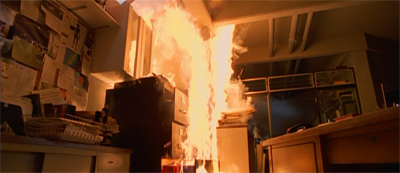
So The End marks a fond farewell from the production team to a city and region that had served them well.  In that respect, it feels like a more definitive sort of ending. The End opens with a scene that is confident enough to let Canada be Canada. As with the opening scene of Herrenvolk, it is almost comical how hard The End flags its “and starring Canada as Canada” cred, to the point where a mountie rushes to the aid of an assassination victim. The closing scene of The End burns down the show’s most iconic and memorable sets.

While The End is not necessarily a satisfying mythology episode or season finalé in its own right, it does feel like a suitably big moment in the evolution of the show.

Smoking gun...

Smoking gun…

Continue reading

Daredevil – Nelson v. Murdock (Review)

To celebrate the launch of Marvel’s Daredevil and the release of Avengers: Age of Ultron, we are reviewing all thirteen episodes of the first season of Marvel and Netflix’s Daredevil. Check back daily for the latest review.

Franklin P. “Foggy” Nelson is perhaps the most constant fixture of Matt Murdock’s personal life.

The lawyer was created by Stan Lee and Bill Everett for the first issue of the comic, published in April 1964. It seems like Foggy has always been there for Matt in one form or another. “Nelson and Murdock” is the heart of Matt Murdock’s life as a lawyer, and so Foggy is generally around to deal with the fallout from whatever crisis has engulfed Matt’s life from one moment to the next. However, Foggy is notable because he is really the only member of the Daredevil cast who can be described as a “regular” character since the book’s inception.

daredevil-nelsonvmurdock2

Despite the fact that Stan Lee and Bill Everett were clearly inspired by The Amazing Spider-Man, Daredevil never developed an ensemble with quite the same depth and breadth. While casual comic book fans can list off dozens of Peter Parker’s friends and colleagues from the earliest years, Matt Murdock has always had a rougher time building up a steady and reliable supporting cast. Part of this is undoubtedly down to the book’s difficulty finding its own identity. Characters came and went as the creative team tried new directions.

Through all of that, Foggy stuck around.

daredevil-nelsonvmurdock5

Continue reading

Non-Review Review: The Hobbit – Battle of the Five Armies

It has become a stock criticism to suggest that Peter Jackson did not need a full trilogy to adapt The Hobbit for the big screen. That said, The Hobbit: The Desolation of Smaug was an unexpected pleasure – a movie not all hindered by the pacing concerns of the trilogy and instead interested in its own central narrative. You could cut the opening scene from The Hobbit: Battle of the Five Armies onto the end of The Desolation of Smaug and you would have pretty much everything that you need.

While this approach benefited The Desolation of Smaug, it puts Battle of the Five Armies at something of a disadvantage. It is debatable whether there was enough material to support three full films based on The Hobbit – even drawing from other sources in the Tolkien canon – but this is clearly not the best way of structuring those three films. There is a sense that Battle of the Five Armies suffers from the decision to extend the planned duology into a full-blown trilogy.

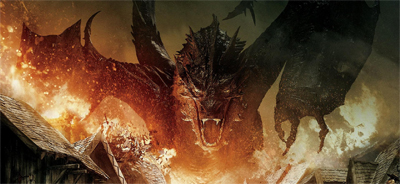
The not-so-magic dragon...

The not-so-magic dragon…

To be fair to Peter Jackson, he does avoid the ending issues that haunted The Lord of the Rings: The Return of the King. However, he does that by editing Battle of the Five Armies as a brief epilogue to the previous two films, following by a massive battle sequence. This is quite impressive from a technical standpoint, but there is a sense of fatigue to it all. As the title implies, this is a five-way battle involving thousands of participants; both organic and computer-generated. A lot gets lost in the shuffle, and the plot – as it stands – could be explained in two sentences.

More than that, Battle of the Five Armies is hindered by its status as a prequel. The fact that everybody in the audience has likely seen The Lord of the Rings: The Fellowship of the Ring means that they know all this spectacle is really for nothing. The first two films in the trilogy largely avoided the problem by pitching the story as a working-class version of The Lord of the Rings, allowing characters to engage in quests that are deeply personal even as they ripple to larger events.

A messed-up character orc...

A messed-up character orc…

Continue reading

The Trouble With Trilogies: Why Superhero Fanchises Have Trouble With the Third Instalment…

So, it turns out that The Dark Knight Rises has a top secret ending. That’s very interesting, and I wonder what it could be. A few obvious possibilities have popped into my head, but there’s one facet of this news which really fascinates me: this piece of information gives weight to the suggestion that Nolan is going to give his superhero franchise a definitive ending, something that perhaps explains why we don’t really have a “classic” superhero trilogy yet, despite the fact that quite a few comic book characters have pushed well past the third film. So will Batman be able to do what Superman, Spider-Man, the X-Men and even another Batman have failed to do before him? Will he craft a complete and wonderful trilogy?

Batman really wants to know what the ending is...

Continue reading

End of the Line: Unearned Happy Endings…

I reviewed Baby Mama earlier today and – while I was impressed with the film’s willingness to tackle a somewhat controversial topic – I was less than impressed by the somewhat conventional ending tacked on to the film. And then I mellowed out a bit. “It is a comedy after all,” I reminded myself, in the hope that I would forgive the film because it wasn’t a black comedy – most lighthearted comedies call for a light-hearted ending, after all. Besides, this particular film isn’t the only film in recent memory to resort to a disappointingly conventional ending, so why does it bother me so much?

Not everybody gets a fairytale ending...

Note: As you may have guessed from the topic, I’ll be discussing endings here – particularly the one from Baby Mama. Consider yourself warned, there are spoilers ahead.

Continue reading

What Constitutes a Spoiler?

What constitutes a spoiler? I mean, really? Is discussing anything about the ending of a film a spoiler? What about talking about a twist earlier on, or an underlying theme or premise that pays off at the end? Is that a spoiler? How long does a movie have to be out before you can talk about it without worrying that you’ll spoil the ending for some poor unsuspecting individual who deserves to see the movie and take it in without having their perception coloured? Some stuff got me thinking about this and I’m not really sure I know where the line falls.

I see a twist coming...

I see a twist coming...

Spoiler: This article contains spoilers. Lots and lots of spoilers. But that was kind of obvious from the header, wasn’t it? I wonder if anyone ever actually heeds these warnings. Tell you what, cycle down to the end of the article and leave a comment if you do. Nah, I’m just kidding, but still… spoilers ahoy!

Continue reading