• Following Us

  • Categories

  • Check out the Archives


  • Awards & Nominations

Star Trek: Deep Space Nine – Past Tense, Part I (Review)

This September and October, we’re taking a look at the jam-packed 1994 to 1995 season of Star Trek, including Star Trek: Deep Space Nine and Star Trek: Voyager. Check back daily for the latest review.

It’s weird to think that Past Tense aired at the very end of the period where Star Trek: Deep Space Nine was the only Star Trek on television. The two parts were broadcast in early January 1995, after the release of Star Trek: Generations but before the broadcast of Caretaker, the pilot episode of Star Trek: Voyager.

In a way, these are the most “Star Trek”-y episodes of the third season of Deep Space Nine. Embracing the franchise’s utopianism and optimism, the two episodes are even structured as a gigantic homage to The City on the Edge of Forever. Unlike the somewhat cynical and jaded run of episodes leading into them, Past Tense seems to exist as an episode that could draw fans of Star Trek: The Next Generation into Deep Space Nine.

Panic in the streets...

Panic in the streets…

It would have made sense to position the episodes earlier in the season, where they might have done a better job of attracting casual Star Trek viewers jonesing for a fix after The Next Generation went off the air. Unconnected to the serialised long-form plot of Deep Space Nine, engaging with important social issues of contemporary society and playing with familiar Star Trek tropes like time travel, it’s hard to imagine an episode of the third season of Deep Space Nine better suited to reeling in viewers.

As it stands, though, Past Tense aired at the last possible moment where Deep Space Nine could truly claim to be “the only Star Trek on television”, making the two-parter feel more like a footnote than a crescendo. It’s a shame, as Past Tense remains a vastly underrated instalment of the show’s third season.
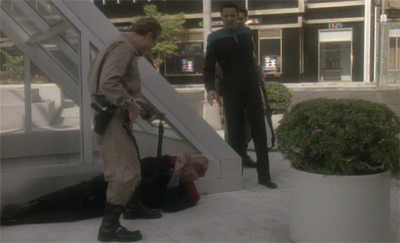
Arresting drama...

Arresting drama…

Continue reading

Star Trek IV: The Voyage Home (DC Comics, 1986) (Review)

This June, we’re taking a look at some classic Star Trek movie tie-ins and other interesting objects. Check back daily for the latest reviews and retrospectives.

The comic book adaptation of Star Trek IV: The Voyage Home does a surprisingly good job of translating the comedy adventure into comic book form. Relying the creative team of Mike W. Barr and artist Tom Sutton to produce a one-shot comic book adaptation of the feature film, DC Comics have reached a point where they are able to consistently and reliably churn out comic books based around the Star Trek franchise.

Indeed, one might imagine that the somewhat lighter tone of The Voyage Home would pose a challenge for the duo, eschewing the grand space opera of Star Trek III: The Search for Spock in favour of something more firmly rooted in modern sensibilities. However, Barr and Sutton do a wonderful job adapting the screenplay into a charming comic, even if it does seem to be aimed more squarely at hardcore Star Trek fans than casual viewers.

Standing tall...

Standing tall…

Continue reading

Star Trek: The Next Generation – The Best of Both Worlds, Part II (Review)

This January and February, we’ll be finishing up our look at the second season of Star Trek: The Next Generation and moving on to the third year of the show, both recently and lovingly remastered for high definition. Check back daily for the latest review.

The Best of Both Worlds, Part II was always going to feel like a bit of an anti-climax. After all, the show had spent so much time building up the Borg as this implacable and undefeatable adversary. In Q Who?, it had taken the interference of a god-like entity to allow the Enterprise a chance to escape their unstoppable foe. In The Best of Both Worlds, Part I, the Enterprise had been able to run for a while – but the Borg eventually caught up with them and took what they wanted.

Since The Best of Both Worlds, Part II was never going to end with the Borg destroying Earth, and since Star Trek: The Next Generation was never going to be a show willing to exact a dramatic cost high enough to justify victory against such overwhelming odds, the resolution to the two-parter was never going to live up to the heightened drama and impossible stakes suggested by The Best of Both Worlds, Part I.

Still, the second part of the adventure is charming and exciting enough that it never completely falls apart. While the resolution to the crisis does seem a little trite and convenient, The Best of Both Worlds hangs together as the show’s best two-part adventure until at least Chain of Command in the sixth season.

A Number One fan?

A Number One fan?

Continue reading

Star Trek: The Next Generation – The Royale (Review)

This January and February, we’ll be finishing up our look at the second season of Star Trek: The Next Generation and moving on to the third year of the show, both recently and lovingly remastered for high definition. Check back daily for the latest review.

“None of it makes any sense, sir,” Riker succinctly states before the credits role on The Royale. The Royale is a decidedly nonsensical episode of Star Trek: The Next Generation, where an away team find themselves trapped inside an atrocious casino melodrama and have to figure out how to return to the ship. The episode is packed with interesting visuals and a bizarre situations, but it never quite comes together in the end.

And, yet, despite the obvious problems, The Royale is intriguing. Visually, it’s one of the most striking and memorable episodes of the show’s first two season. The rotating door to nowhere is a beautifully strange image, and the sight of the Enterprise away team wandering around a twentieth century casino is enough to prevent the episode from ever becoming boring. The Royale isn’t the best constructed episode of the show’s first two years, and it has more than its fair share of problems.

However, it’s also a wonderfully bizarre and adventurous piece of science-fiction, as if Riker has beamed into a cheap imitation of The Twilight Zone. That’s enough to make it well worth a watch.

The whole plot revolves around absurdities...

The whole plot revolves around absurdities…

Continue reading

Doctor Who: Born Again (Review)

To celebrate the fiftieth anniversary of the longest-running science-fiction show in the world, I’ll be taking weekly looks at some of my own personal favourite stories and arcs, from the old and new series, with a view to encapsulating the sublime, the clever and the fiendishly odd of the BBC’s Doctor Who.

Born Again originally aired in 2005.

Can you change back?

Do you want me to?

Yeah.

Oh.

Can you?

No.

– Rose and Doctor

Davies revived Doctor Who devoted considerable time to reintroducing the core concepts of the series. Unlike The TV Movie, Davies saw no need to over-complicate Rose by featuring the regeneration from the previous Doctor to the current lead. The Ninth Doctor was introduced as-is to an entire generation of new viewers. Only a quick examination of his features in Rose seemed to hint that he was getting used to his new face.

The prospect of “regeneration” hadn’t been flagged too heavily by the time The Parting of the Ways aired. This makes sense. For one thing, there’s a sense that Eccleston’s departure was not something that the production team had accounted for – which makes it even stranger that the whole first season seems to be building towards his redemption in death. For another thing, it’s very hard to drop “by the way, I change into somebody else when I die” casually into conversation.

So the regeneration at the end of The Parting of the Ways was kind of a big deal, and a huge moment for the series. After all, the classic Doctor Who had enjoyed more than three seasons with its lead character before having to swap him out – Hartnell being the last member of the original ensemble to depart. And, given the rules of television narratives in 2005, there was no way that the show’s first regeneration wasn’t going to be a pretty significant event.

Somebody needs a Doctor...

Somebody needs a Doctor…

Continue reading

Doctor Who: Survival (Review)

To celebrate the fiftieth anniversary of the longest-running science-fiction show in the world, I’ll be taking weekly looks at some of my own personal favourite stories and arcs, from the old and new series, with a view to encapsulating the sublime, the clever and the fiendishly odd of the BBC’s Doctor Who.

Survival originally aired in 1989.

Where to now, Ace?

Home.

Home?

The TARDIS.

Yes, the TARDIS. There are worlds out there where the sky is burning, where the sea’s asleep, and the rivers dream. People made of smoke, and cities made of song. Somewhere there’s danger, somewhere there’s injustice, and somewhere else the tea’s getting cold. Come on, Ace, we’ve got work to do!

– the Doctor and Ace turn off the lights on their way out

There was a long gap between Survival and Rose. It was filled with stuff. It was filled with lost of interesting and different Doctor Who stuff. There were books and audio plays and even a television movie to help fill the decade and a half when Doctor Who was not a regular feature of British television. A lot of that stuff was important, and a lot of it helped determine and shape what Doctor Who would become when it did return. It’s telling that the many members of the writing staff on the revived Doctor Who cut their teeth on novels and short stories and audio plays and specials in the wilderness years, while no writers returned from the classic show.

At the same time, however, the gap between Survival and Rose doesn’t feel as profound as it might. It’s misleading to suggest that Survival was a clear bridge towards the Russell T. Davies era, or even to hint that the revival could have emerged fully formed from this three-part closing serial. At the same time, Survival is really the closest that the classic series ever came to the spirit of the Davies era, hitting on quite a few familiar themes and ideas and settings, as if Cartmel’s vision of the future of Doctor Who was not too far from the version proposed by Davies.

Survival was the end of an era, but it also motioned towards the start of another.

Riding into the sunset...

Riding into the sunset…

Continue reading

Doctor Who: The End of Time, Part II (Review)

To celebrate the fiftieth anniversary of the longest-running science-fiction show in the world, I’ll be taking weekly looks at some of my own personal favourite stories and arcs, from the old and new series, with a view to encapsulating the sublime, the clever and the fiendishly odd of the BBC’s Doctor Who.

The End of Time, Part II originally aired in 2010.

I don’t want to go.

– the Doctor channels David Tennant and Russell T. Davies

The End of Time, Part II is an incredibly confident piece of science-fiction. It’s also fiendishly self-indulgent. “Where are you going?” Wilf asks the Doctor after the Doctor takes a fatal dose of radiation. “To get my reward,” the Doctor responds, as if he has earned enough credit and kudos that he can cash it in for one last victory lap around the cosmos. Cue an exceptionally sentimental sequence in which the Tenth Doctor visits most of his major companions (and a few minor ones) before he departs.

It’s a nice excuse to trot out the familiar characters from the Davies era one last time. Martha is there; Jack shows up; even Jackie Tyler gets a look-in. It’s not just the Tenth Doctor’s farewell tour of the universe, it’s a reminder of how skilfully Davies has built a world around his lead character. And this was really the last chance for the show to say goodbye to all of that. It makes a great deal of sense, and it’s well earned. Davies resurrected a television show that died a joke and turned it into a success story that was strong enough to anchor the Christmas and New Year schedules. He’s earned the right to be this self-indulgent.

Worlds apart...

Worlds apart…

The problem is that the show seems more than a little entitled, more than a little brash about what is owed to it. The universe owes the Tenth Doctor one last go around; the audience owes Tennant and Davies enough to put up with this sort of ham-fisted sentimentality. There’s a moment when the Doctor seems to honestly consider leaving Wilf to die from radiation poisoning, and rants against the cruelty of the universe. How dare the universe put him in a position where he has to make this sort of moral choice!

The problem is that the episode tries to present this a sympathetic moment. We’re supposed to emphasise with the Doctor as he considers walking away from a poor old man who has been nothing but helpful and trustworthy and friendly to him. The End of Time, Part II is clearly intended as a celebratory romp in the style of Journey’s End, a reminder of how Doctor Who conquered television. The problem is that The End of Time, Part II overplays its hand a bit, and over-estimates how much the audience loves the Tenth Doctor.

Not quite a blaze of glory...

Not quite a blaze of glory…

Continue reading

Doctor Who: The Waters of Mars (Review)

To celebrate the fiftieth anniversary of the longest-running science-fiction show in the world, I’ll be taking weekly looks at some of my own personal favourite stories and arcs, from the old and new series, with a view to encapsulating the sublime, the clever and the fiendishly odd of the BBC’s Doctor Who.

The Waters of Mars originally aired in 2009.

Adelaide, I’ve done this sort of thing before. In small ways, saved some little people, but never someone as important as you. Oh, I’m good.

Little people? What, like Mia and Yuri? Who decides they’re so unimportant? You?

For a long time now, I thought I was just a survivor, but I’m not. I’m the winner. That’s who I am. The Time Lord Victorious.

– the Doctor does a pretty poor job of comforting Adelaide

The Waters of Mars is the strongest of the specials that ran from the end of the fourth season of Doctor Who through to David Tennant’s regeneration into Matt Smith on New Year’s Day 2010. Despite teasing the issue in The Next Doctor and Planet of the Dead, The Waters of Mars is the first time that the show really engages with the mortality of the Tenth Doctor – exploring the idea that it might be time for the Tenth Doctor to leave. As much as the Tenth Doctor might be reluctant to leave, The Waters of Mars suggests that the character’s flaws are gaining critical mass and that his ego runs the risk of collapsing in on itself.

It’s a very bold and daring piece of Doctor Who, which is quite striking given the audience-pleasing “comfort food” nature of the other specials. Reinforcing ideas that Davies has been hinting at since the very start of the relaunch, The Waters of Mars is about how the Doctor can sometimes be absolutely terrifying.

This is what happens when the Doctor goes wrong.

This is what happens when the Doctor goes wrong.

Continue reading

Doctor Who: Terror of the Zygons (Review)

To celebrate the fiftieth anniversary of the longest-running science-fiction show in the world, I’ll be taking weekly looks at some of my own personal favourite stories and arcs, from the old and new series, with a view to encapsulating the sublime, the clever and the fiendishly odd of the BBC’s Doctor Who.

Terror of the Zygons originally aired in 1975.

Right, let’s see what other damage we can do. Anybody know what this is?

I haven’t the faintest idea.

You tell us.

I will. It’s a self-destructor, and it works like this.

– the Doctor demonstrates to the Duke and Lamont that you don’t ask a question without knowing the answer

Terror of the Zygons is a strange beast. Tom Baker’s first season was bookended by two relics from the Jon Pertwee era. Robot was essentially a Pertwee-era invasion story where the only real difference was Tom Baker’s larger-than-life performance; Revenge of the Cybermen had been commissioned by Barry Letts and felt more like a Pertwee-era space story than anything Hinchcliffe and Holmes would produce.

In contrast, Terror of the Zygons is very definitely an episode of Doctor Who produced by Philip Hinchcliffe and script edited by Robert Holmes. It kicks off one of the show’s strongest seasons, and plays into many of the recurring themes of the era. There are fallen gods and body horror and a sense of the Doctor as a bohemian who won’t be bound by society’s rule. And yet, at the same time, there’s also a sense that Terror of the Zygons is derived from the same basic structure of Pertwee-era invasion story.

In short, Terror of the Zygons feels like it straddles two very different eras of the show, and provides an opportunity for the show to very definitely transform from one form into another.

Let Zygons be Zygons...

Let Zygons be Zygons…

Continue reading

Doctor Who: The Poison Sky (Review)

To celebrate the fiftieth anniversary of the longest-running science-fiction show in the world, I’ll be taking weekly looks at some of my own personal favourite stories and arcs, from the old and new series, with a view to encapsulating the sublime, the clever and the fiendishly odd of the BBC’s Doctor Who.

The Poison Sky originally aired in 2008.

They’ve taken it. I’m stuck on Earth like, like an ordinary person. Like a human. How rubbish is that? Sorry, no offense, but come on.

– take that, Jon Pertwee!

Like The Sontaran Stratagem before it, The Poison Sky is pretty effective at accomplishing what it sets out to do. The first two-parter was always a troubled part of the Davies era, and so it feels strangely appropriate that the production team should manage to nail it on the fourth and final go-round. The Poison Sky isn’t the best episode of the show’s superlative fourth season, but neither it nor The Sontaran Stratagem are the worst, either. Instead, it’s a solidly entertaining feature-length adventure featuring the return of various old favourites from the classic show (U.N.I.T.! Sontarans!) and the revived series (Martha! the Valiant!).

It is goofy, silly, and fluffy, but it’s entertaining fluff.

His finger on the button...

His finger on the button…

Continue reading