• Following Us

  • Categories

  • Check out the Archives


  • Awards & Nominations

Star Trek: Deep Space Nine – The Abandoned (Review)

The September and October, we’re taking a look at the jam-packed 1994 to 1995 season of Star Trek, including Star Trek: Deep Space Nine and Star Trek: Voyager. Check back daily for the latest review.

The Abandoned is a problematic episode.

It’s brave and provocative and challenging, but it’s also incredibly grim and cynical. In fact, it is probably the most relentlessly pessimistic episode of Star Trek: Deep Space Nine‘s third season. And, given the episodes surround it, that is quite an accomplishment. Deep Space Nine has subverted classic Star Trek storytelling before. The Maquis was really a watershed moment for the series, suggesting that paradise itself might be unsustainable – attacking Roddenberry’s utopia rather brutally.

However, The Abandoned pushes things even further. There’s a social and racial subtext to this episode that grounds it in the racial politics of Los Angeles in the mid-nineties. The story of a young angry drug-addicted killer can’t help but feel associated with the increased profile of Los Angeles’ gangland in the early-to-mid-nineties. Casting the episode’s young Jem’Hadar soldier using African American actors invites this comparison, something that director Avery Brooks himself has conceded.

The racial politics of The Abandoned are decidedly uncomfortable, but they are clearly meant to be. Still, there’s something rather cynical and pessimistic about the episode’s conclusion that this young boy cannot be saved from a life of brutality and violence.
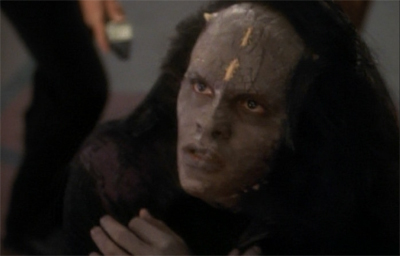
A Jem?

A Jem?

Continue reading

Star Trek: Deep Space Nine – Second Skin (Review)

The September and October, we’re taking a look at the jam-packed 1994 to 1995 season of Star Trek, including Star Trek: Deep Space Nine and Star Trek: Voyager. Check back daily for the latest review.

Second Skin continues the identity and reality themes running through the third season of Star Trek: Deep Space Nine. The Search revealed that the Dominion is led by shape-changing aliens who can impersonate anybody, after our heroes spend an episode in a virtual reality. House of Quark stemmed from lies Quark told about himself, only to discover that Klingon culture is not what it claims to be. Equilibrium revealed that Dax held secrets even from herself, having a whole other life. Second Skin confronts Kira with the idea that she may be everything she hates.

The theme will continue in the episodes ahead. The Abandoned is a rather cynical meditation on the nature-against-nurture debate. Civil Defense involves the Deep Space Nine crew discovering that the station itself is not as safe as they like to think. Meridian involves a subplot about Kira’s right to control her own body. Defiant is built around a crisis of identity for a doppelganger. Past Tense features Sisko stepping into the identity of a historical figure. And so it continues. Things are not what they appear to be; the truths we take for granted are not true.

Rewatching this first block of Deep Space Nine‘s third season, it’s amazing how cynical the show could be.

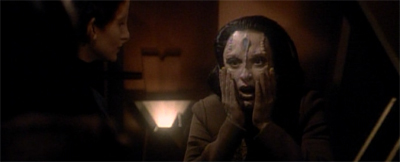
Face of the enemy...

Face of the enemy…

Continue reading

Star Trek: Deep Space Nine – Fearful Symmetry by Olivia Woods (Review)

The September and October, we’re taking a look at the jam-packed 1994 to 1995 season of Star Trek, including Star Trek: Deep Space Nine and Star Trek: Voyager. Check back daily for the latest review.

Fearful Symmetry had a long and painful history. The novel was originally scheduled for release April 2007. This would have seen the novel published about a year after the release of the previous Star Trek: Deep Space Nine relaunch novel, Warpath. The plan had been for new author Leanna Morrow to write the novel. When that proved impossible, Olivia Wood stepped in to rescue the assignment. Fearful Symmetry was eventually published in June 2008, over a year behind the initial schedule.

It’s interesting to speculate how that delay affected the Deep Space Nine relaunch. The next novel in the series, The Soul Key, would be the last published before the print Star Trek universe realigned as part of the Typhon Pact and The Fall, very much “event” books that served to relaunch the fictional universe. It is interesting to speculate whether the year between Warpath and Fearful Symmetry contributed to the decision to discontinue that particular iteration of the Deep Space Nine relaunch.

Still, whatever the reason, Fearful Symmetry is more interesting than successful. It is a book written with a number of great ideas, but some very flawed execution. It adopts a very “comic book” approach towards the Star Trek universe – featuring high concepts and crossovers and character who have been exaggerated slightly and distorted so as to fit the general perception of them rather than any consistent internal characterisation.

Fearful Symmetry is a bold and ambitious piece of work, particularly from a first time novelist. Unfortunately, it doesn’t work quite as well as it needs to.

ds9-fearfulsymmetry

Continue reading

Star Trek: Deep Space Nine – Equilibrium (Review)

The September and October, we’re taking a look at the jam-packed 1994 to 1995 season of Star Trek, including Star Trek: Deep Space Nine and Star Trek: Voyager. Check back daily for the latest review.

Equilibrium is another troubled Dax episode. Dax is probably the hardest character on the Star Trek: Deep Space Nine cast to write for, if only because of the character’s central premise. “Well-adjusted functionally immortal alien slug inside a young woman’s body” is a nice character description, but it’s hard to ground a character-driven story in that. It’s tempting just to turn the Dax symbiote into a convenient macguffin that can drive various plots.

To date, Playing God is really the only Dax-centred episode of Deep Space Nine that has placed the emphasis on Jadzia rather than the slug inside here. (Although Blood Oath did at least try to deal with how a current Trill host deals with obligations incurred by past lives.) In Dax, the symbiote was a gateway to a pretty conventional and generic murder mystery story. In Invasive Procedures, the symbiote was something particularly valuable to be stolen and exploited.

The biggest problem with Equilibrium is that – like Dax and Invasive Procedures before it – the episode uses the Dax symbiote as a springboard to a story that is more driven by Sisko and Bashir than it is by Jadzia Dax. While Equilibrium does have a great hook and some biting social commentary, Dax feels more like a plot point than a character in her own right.

Shocking behaviour...

Shocking behaviour…

Continue reading

Star Trek: Deep Space Nine – The Search, Part II (Review)

The September and October, we’re taking a look at the jam-packed 1994 to 1995 season of Star Trek, including Star Trek: Deep Space Nine and Star Trek: Voyager. Check back daily for the latest review.

In a way, The Search feels almost like a parody of the classic Star Trek season-bridging cliffhanger. It is a story told under the same title, but with both halves of the story feeling distinct enough to stand on their own two feet. Written by two different writers and directed by two different directors, it very much feels like two very different stories linked primarily by an efficient cliffhanger.

It’s not radically dissimilar to the two-parters from Star Trek: The Next Generation. Redemption and Descent come to mind, two-part adventures that very much feel like two different stories melded together rather than one single over-arching story. This disjointedness makes a great deal of sense, given the standard operating procedure when it came to Star Trek cliffhangers, as established by Michael Piller with The Best of Both Worlds, Part I. The logic is simple: write part one; go away for a few months; return and try to write part two.

Of course, The Search very clearly isn’t a season-bridging cliffhanger. It’s a season-opening two-parter. And it’s so cleverly and consciously structured as two very different episodes that it can’t help but feel like a sly nod at the inevitable outcome of that approach to writing – playfully self-aware of how disjointed the whole experience feels as a single story.

A whole new Vorta problem...

A whole new Vorta problem…

Continue reading

Star Trek: Deep Space Nine – The Search, Part I (Review)

The September and October, we’re taking a look at the jam-packed 1994 to 1995 season of Star Trek, including Star Trek: Deep Space Nine and Star Trek: Voyager. Check back daily for the latest review.

The Search, Part I is interesting. It is an episode that, in effect, serves as something of a second pilot for the show. It’s an episode that re-conceptualises the show, while taking a great deal of trouble to ensure that any new viewers will be brought up to speed. In fact, The Search is a rather disjointed two-parter as a whole. The first part feels like a lot of set-up with a cliffhanger tacked on to the end of the episode, while the second part is very clearly its own story.

It makes sense. At this point, Star Trek: Deep Space Nine is the only Star Trek on television. It’s a period that doesn’t last, and which is really just a scheduling fluke. The show’s second season continued on past the airing of All Good Things…, the final episode of Star Trek: The Next Generation. The third season began broadcasting before the airing of Caretaker, the pilot of Star Trek: Voyager. Star Trek: Generations was released somewhere in the middle. So the stretch where Deep Space Nine was “the only Trek on television” feels largely illusory.

Still, The Search, Part I feels like a conscious attempt to welcome any wayward Star Trek fans. Including, appropriately enough, new staff writer Ronald D. Moore.

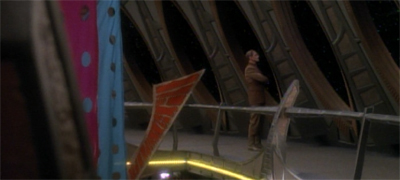
Staring into space...

Staring into space…

Continue reading