












This October/November, we’re taking a trip back in time to review the eighth season of The X-Files and the first (and only) season of The Lone Gunmen.
In a way, the entire final third of the eighth season is an extended finalé for The X-Files – or, at the very least, an extended finalé for a version of The X-Files starring Mulder and Scully.
This seems quite ironic, considering the confusion that existed towards the end of the seventh season, when it seemed like the production team were unsure whether they could (or should) commit to the idea of The X-Files coming to an end. The seventh season was never entirely sure what (if anything) was going to come next, and so it did not have the opportunity to gracefully set up all of its plot points. As a result, the eighth season had to retroactively incorporate elements like Mulder’s brain illness or Scully’s fertility treatment.
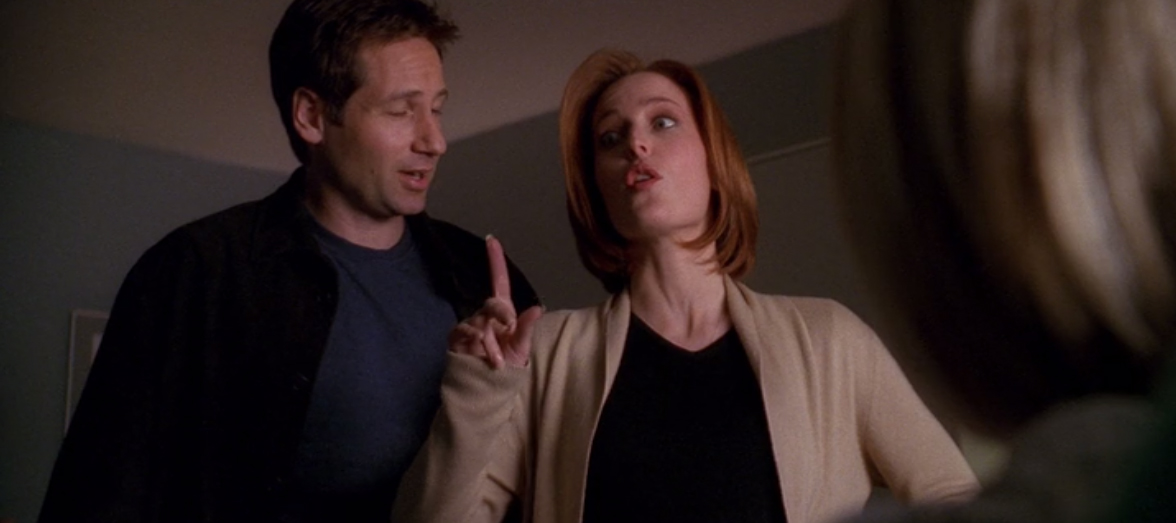
Cue cliché marriage jokes.
In contrast, the eighth season seemed quite conscious of the end. The entire eighth season is structured as a strange hybrid; it feels like it could serve as both the final season of the show as it aired for seven years, while also serving as a launching pad to something new and exciting. The final eight episodes of the eighth season are largely about tidying away the character arcs and dangling plot thread associated with Mulder and Scully so that their journey might finally end. If the ratings are strong enough, then Doggett might get to launch his own show.
As such, Alone is positioned very much like Je Souhaite had been and like Sunshine Days would be. It is potentially the “one last monster of the week” story marking the end of an era. While Je Souhaite had marked the end of the Mulder and Scully era of the show, Alone seems to mark the end of the transitional period between Mulder and Scully and whatever is supposed to come next. It is a very light episode, no less effective for that. As with a lot of the late eighth season, its biggest problem is the way that the nineth season creative decisions retroactively undercut it.
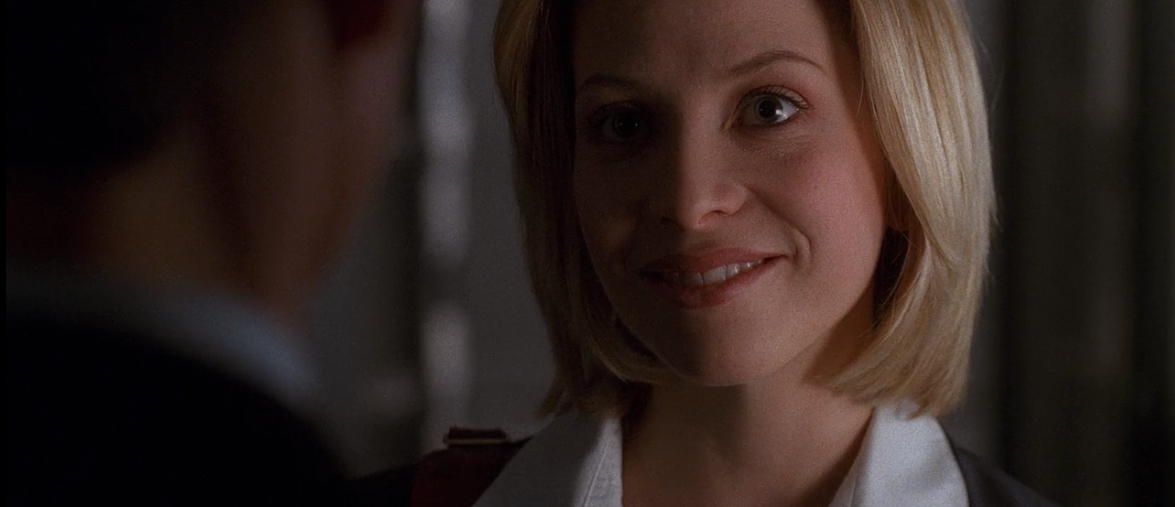
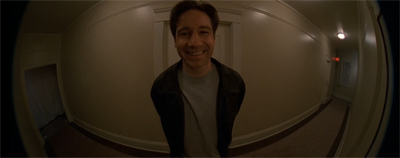
Leyla… L-E-Y-L-A… Leyla.
Filed under: The X-Files | Tagged: alone, auteur, continuity, dreamland, fandom, frnak spotnitz, leyla harrison, queegqueg, Television, the x-files, tv, x-files | 5 Comments »





 the m0vie blog
The X-Files – Dreamland II (Review)
This July, we’re taking a trip back in time to review the sixth season of The X-Files and the third (and final) season of Millennium.
Morris Fletcher is (and remains) one of the more interesting aspects of the Dreamland two-parter.
Fletcher would go on to become perhaps the most unlikely recurring character in the history of The X-Files. Michael McKean would reprise the role for a brief cameo in Three of a Kind at the end of the season. As with Kersh, he would disappear from the show’s world for the troubled seventh season, but would return the following year. He made a guest appearance in All About Yves, the finalé of The Lone Gunmen. Fletcher would then follow the Lone Gunmen back to The X-Files, appearing in Jump the Shark during the final season.
And the shippers went wild…
A large part of what makes Fletcher work is the wonderful guest performance of Michael McKean. McKean is a veteran actor with a long history of great work, dating back to his breakout role as Lenny (and Squiggy) on the sitcom Laverne and Shirley. Along with the move to Los Angeles, the sixth season of The X-Files began to drift away from Chris Carter’s initial reluctance to cast recognisable actors in significant roles. The X-Files: Fight the Future had featured guest appearances from Martin Landau, Blythe Danner, Armin Muller-Stahl and Glenne Headly.
The two-parter built around Michael McKean paves the way for appearances from Ed Asner, Lily Tomlin and Bruce Campbell. These are all superb guest performances, and consciously play into the idea that the sixth season of The X-Files has taken on a more playful or vaudevillian style. It is too much to describe these guest roles as “stunt casting” in the same way that putting Jerry Springer in The Post-Modern Prometheus or Burt Reynolds in Improbable was stunt casting, but the casting decisions are part of a broader change in the show.
Our man Morris…
On paper, Morris Fletcher could easily come off as a one-note creep. After all, he is a character who thinks nothing of using his body swap with Fox Mulder to cheat on his wife of twenty years. There is a creepy and pervy banality to his evil, one that mirrors that of Eddie Van Blundht in Small Potatoes. However, while Small Potatoes felt a little too sympathetic to pathetic Eddie Van Blundht, Dreamland strikes a better balance in its portrayal of Morris Fletcher. McKean plays Fletcher as a very human character, but one who is no less creepy for his well-practiced charm.
It goes almost without saying that Michael McKean’s guest performance is a major reason why Dreamland (mostly) works.
Not particularly reflective…
Continue reading →
Filed under: The X-Files | Tagged: commentary, deconstruction, dreamland, frank spotnitz, john shiban, kim manners, Michael McKean, morris fletcher, mulder, science fiction, scully, subversion, vince gilligan, x-files | 1 Comment »