• Following Us

  • Categories

  • Check out the Archives


  • Awards & Nominations

Doctor Who: Planet of the Ood (Review)

To celebrate the fiftieth anniversary of the longest-running science-fiction show in the world, I’ll be taking weekly looks at some of my own personal favourite stories and arcs, from the old and new series, with a view to encapsulating the sublime, the clever and the fiendishly odd of the BBC’s Doctor Who.

Planet of the Ood originally aired in 2008.

How many Ood in total?

I’d say about two thousand, sir.

We can write them off. That’s what insurance is for.

– Halpen and Kess remind us that these are not nice people

Planet of the Ood is a bit blunt. And by “a bit”, I mean “a lot.” It’s an allegorical exploration of unchecked capitalism and slavery, using the science-fiction setting to tell a story with a familiar moral.Then again, Planet of the Ood largely works because that moral remains rather timely and relevant, but also because it’s a fantastically produced piece of television. It’s fast and pacey, it looks stylish, it has a fantastic cast and an efficient script. Sure, there are rough edges, but Planet of the Ood continues a fairly strong start for the fourth season.

Soaring...

Soaring…

Continue reading

Doctor Who: The Web of Fear (Review)

To celebrate the fiftieth anniversary of the longest-running science-fiction show in the world, I’ll be taking weekly looks at some of my own personal favourite stories and arcs, from the old and new series, with a view to encapsulating the sublime, the clever and the fiendishly odd of the BBC’s Doctor Who.

The Web of Fear originally aired in 1968.

See, now this is interesting.

The Enemy of the World had the luxury of arriving almost unannounced, a genuine honest-to-goodness classic story that had been written off by all but a minority of fans as a generic run-around James Bond pastiche. It was recovered, it turned out to be quite brilliant, and so was a massive surprise. Indeed, even if it had been merely “good” or “fine”, it would have been a joy to watch, because the episode was being measured against a popular imagination that had never really been too bothered with it. I don’t think it was too near the top of the majority of fans’ “would love to recover…” lists.

There were no expectations, so The Enemy of the World didn’t have to worry about measuring up to anything. The fact that it was quite brilliant was icing on the cake. In contrast, The Web of Fear has a lot of expectations to live up to. It is being measured not against the weight of continuity – featuring a much loved monster and introducing a recurring character – nor the sky-high expectations of fans. It is measured against the popular imagination. While The Enemy of the World probably seemed like an after-though to most Doctor Who fans, The Web of Fear is a massive part of what Doctor Who is to the general public.

Fur and loathing...

Fur and loathing…

Continue reading

Doctor Who: Day of the Daleks – Special Edition (Review)

To celebrate the fiftieth anniversary of the longest-running science-fiction show in the world, I’ll be taking weekly looks at some of my own personal favourite stories and arcs, from the old and new series, with a view to encapsulating the sublime, the clever and the fiendishly odd of the BBC’s Doctor Who.

Day of the Daleks originally aired in 1972.

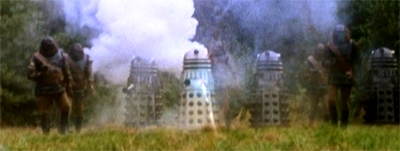
Day of the Daleks is a rather wonderful little story that’s been tucked away and forgotten about due its fairly lousy execution. After all, it’s hard to take a story particularly seriously when it suggests that the fate of the world will be decided by an assault on an old country house by three Daleks and a handful of extras. The wonderful people on the Doctor Who Restoration Team have done a wonderful job putting together a special edition of the adventure, using enhanced CGI effects and new footage to give the story the scale that it really deserves. After all, Day of the Daleksrepresents a bold attempt to do something new with the time travel at the very heart of the series.

Dawn of the Daleks...

Continue reading

Doctor Who: Doomsday (Review)

To celebrate the fiftieth anniversary of the longest-running science-fiction show in the world, I’ll be taking weekly looks at some of my own personal favourite stories and arcs, from the old and new series, with a view to encapsulating the sublime, the clever and the fiendishly odd of the BBC’s Doctor Who.

Doomsday originally aired in 2006.

Daleks, be warned. You have declared war upon the Cybermen.

This is not war. This is pest control.

We have five million Cybermen. How many are you?

Four.

You would destroy the Cybermen with four Daleks?

We would destroy the Cybermen with one Dalek. You are superior in only one respect.

What is that?

You are better at dying.

– the Cyberleader and Dalek Sec compete for the title of “bitchiest Doctor Who villain”

Part of my frustration with Doomsday is the same problem that I have with the rest of the second season’s weaker episodes. Like Fear Her or Rise of the Cybermen, the second season finalé lacks ambition. It feels complacent, it feels comfortable. It feels like putting the Daleks and the Cybermen together in one episode is enough to merit attention, without anything more than exchanging pithy one-liners. It feels like the separation of the Doctor and his companion is the biggest and most important thing in the universe, without really convincing us that this isn’t the best possible outcome. It feels like the easiest way to make these threats palpable is to set them in modern London, without any real sense of consequence or scale.

The tears of a Time Lord...

The tears of a Time Lord…

Continue reading

Doctor Who: The Green Death (Review)

To celebrate the fiftieth anniversary of the longest-running science-fiction show in the world, I’ll be taking weekly looks at some of my own personal favourite stories and arcs, from the old and new series, with a view to encapsulating the sublime, the clever and the fiendishly odd of the BBC’s Doctor Who.

The Green Death originally aired in 1973.

Where are you off to?

To pack a suitcase.

Oh, good. Give me a couple of minutes and we’ll be off.

Off? Off where?

Well, Metebelis III, of course.

I’m not going to Metebelis III.

Why? Where are you thinking of going to?

Well, South Wales, of course. Llanfairfach.

– the Doctor and Jo discuss travel plans… why would you want to go to Metebels III when you can visit South Wales?

The Green Death is a great example of the Jon Pertwee era. It offers a pretty solid showcase of the best of the era, along with the glaring structural and thematic weaknesses that the show never really tackled head-on. It’s a great yarn, an affectionate run-around. There is a reason, after all, that the overgrown maggots have managed to wedge themselves in British popular consciousness. There’s a conscious sense that The Green Death is a season finalé, in the biggest and boldest terms possible.

In an era where television wasn’t really structured in that way, you can trace a pretty clear line between The Green Death and the big epic series finalés of the Russell T. Davies era of Doctor Who.

And the Beatz go on...

And the Beatz go on…

Continue reading

Doctor Who: Army of Ghosts (Review)

To celebrate the fiftieth anniversary of the longest-running science-fiction show in the world, I’ll be taking weekly looks at some of my own personal favourite stories and arcs, from the old and new series, with a view to encapsulating the sublime, the clever and the fiendishly odd of the BBC’s Doctor Who.

Army of Ghosts originally aired in 2006.

How long are you going to stay with me?

Forever.

– the Doctor and Rose tempt fate

It’s only logical that anybody diving head-first into a fifty-year-old television show is going to have an opinion that radically diverges from the fandom consensus on a couple of stories. So, for example, I’ll concede that I like The Talons of Weng-Chiang, but less than most. However, the biggest divide – and the point on which I feel furthest from consensus – comes with Army of Ghosts and Doomsday, Russell T. Davies’ massive farewell to Rose Tyler, the companion he introduced all the way back in Rose. It’s generally acknowledged as one of the high points of Davies’ tenure and one of the truly great Tenth Doctor stories.

I am far from convinced.

The cracks are starting to show...

The cracks are starting to show…

Continue reading

Doctor Who: The Hand of Fear (Review)

To celebrate the fiftieth anniversary of the longest-running science-fiction show in the world, I’ll be taking weekly looks at some of my own personal favourite stories and arcs, from the old and new series, with a view to encapsulating the sublime, the clever and the fiendishly odd of the BBC’s Doctor Who.

The Hand of Fear originally aired in 1976.

Come on, where are we?

We’re in a quarry.

Yes, I know we’re in a quarry, but where?

Well, how do I know? I don’t know all the quarries that–

– the Doctor and Sarah Jane get a bit meta

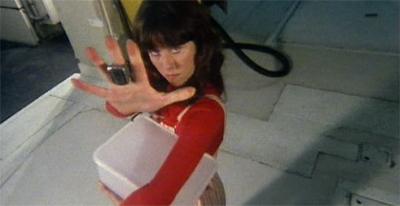
The Hand of Fear is odd, because it’s the end of an era – but it’s not the end of the era for the rather obvious reason that it bids farewell to one of the franchise’s best-loved companion character. The Hand of Fear is best known as the final story to feature Sarah Jane Smith. Indeed, the DVD comes with a helpful sticker informing any potential purchasers of the story’s significance.

However, watching The Hand of Fear with the benefit of hindsight, it isn’t Sarah Jane’s departure that is the most striking part of the show.

Keep it handy...

Keep it handy…

Continue reading

Doctor Who: Warriors of the Deep (Review)

To celebrate the fiftieth anniversary of the longest-running science-fiction show in the world, I’ll be taking weekly looks at some of my own personal favourite stories and arcs, from the old and new series, with a view to encapsulating the sublime, the clever and the fiendishly odd of the BBC’s Doctor Who.

Warriors of the Deep originally aired in 1984.

“Release the Myrka.”

– three words to create dread in even the toughest Doctor Who fan

I’ve always been somewhat less fond of Johnny Byrne’s Doctor Who than most fans. I can never, for example, understand the high esteem generally reserved for The Keeper of Traken (although it is a better story than Logopolis), and I really disliked Arc of Infinity. So I suspect some of the problems with Warriors of the Deepwere quite fundamental. However, there’s also a sense that those flaws were only exaggerated by a combination of other factors, including a low budget, a tight schedule and a script editor who believed an adventure’s pathos could be measured by its bodycount.

Everybody's dead, Davison...

Continue reading

Doctor Who: The Sea Devils (Review)

To celebrate the fiftieth anniversary of the longest-running science-fiction show in the world, I’ll be taking weekly looks at some of my own personal favourite stories and arcs, from the old and new series, with a view to encapsulating the sublime, the clever and the fiendishly odd of the BBC’s Doctor Who.

The Sea Devils originally aired in 1973.

If Horatio Nelson had been in charge of this operation, I hardly think that he would have waited for official instructions.

Yes, a pretty impulsive fellow, if one can believe the history books.

History books? Captain Hart, Horatio Nelson was a personal friend of mine. Come on, Jo.

– Namedropping? The Doctor? Never!

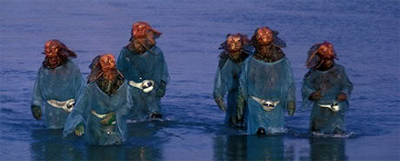
When it comes to Doctor Who, “sequel” stories get a bit of a hard time from fandom. It seems to be easy to dismiss Snakedance in favour of Kinda, and to praise Spearhead from Space at the expense of Terrors of the Autons and even elevate The Daleks above The Dalek Invasion of Earth. It seems that time, and conventional wisdom, tend to favour the original serials. Of course, there are undoubtedly examples where follow-up scripts have disappointed (the ridiculously padded The Monster of Peladon following The Curse of Peladon). Still, for my money, The Sea Devils represents a tighter, complimentary and ambitious sequel to Doctor Who and the Silurians, easily one of the most highly regarded adventures of the seventies. It’s a fairly impressive accomplishment, but The Sea Devils is more than up to it.

Everybody out of the water!

Continue reading

Doctor Who: And the Silurians (Review)

To celebrate the fiftieth anniversary of the longest-running science-fiction show in the world, I’ll be taking weekly looks at some of my own personal favourite stories and arcs, from the old and new series, with a view to encapsulating the sublime, the clever and the fiendishly odd of the BBC’s Doctor Who.

And the Silurians originally aired in 1970.

Doctor Who and the Silurians always struck me as a very strange episode title. I know that some of the spin-off media, like the books, have a habit of titles like “Doctor Who and the [title]”, but it really feels strange to have an episode title like that. Perhaps it’s because it seems to suggest the character’s name is actually “Doctor Who”, or perhaps it’s my internal OCD flying out of whack, finding it very strange that there’s only one televised episode to use that particular naming convention. Still, all of this debate about naming conventions aside, there’s no denying that The Siluriansstands as one of the highlights of Pertwee’s era, a fitting instalment in a superb first season that proved there was more to science-fiction than strange monsters each and every week.

The Doctor attempts to take the matter in hand...

Continue reading