• Following Us

  • Categories

  • Check out the Archives


  • Awards & Nominations

Doctor Who: Meglos (Review)

To celebrate the fiftieth anniversary of the longest-running science-fiction show in the world, I’ll be taking weekly looks at some of my own personal favourite stories and arcs, from the old and new series, with a view to encapsulating the sublime, the clever and the fiendishly odd of the BBC’s Doctor Who.

Meglos originally aired in 1980.

To control the output, it will be necessary to increase the violence of the emissions.

Then you’ll be in danger yourself.

Well, hardly. I’m a Time Lord. Having lived in the future I can hardly die in the present.

That can’t be true. That’s a philosophical paradox.

No, it’s merely beyond your comprehension.

– Meglos and Deedrix get their “parody” on

Meglos is one of those stories that has undergone something of an alternative interpretation among Doctor Who fans. Much like The Web Planet went from “a brave attempt to realise a truly alien world” to a “complete and utter embarrassment”, Meglos has gone from “that episode where a talking cactus tries to take over the universe” to “that parody where a talking cactus tries to take over the universe.” In fairness, looking at the serial, it is very hard not to see Meglos as an intentional and subversive parody of a bad Doctor Who story, but I have to concede that it doesn’t stop the adventure from being a bad Doctor Who story itself.
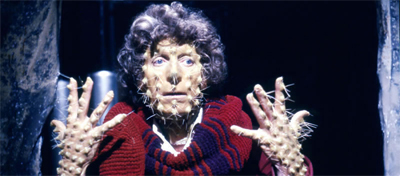
Okay, not every review this week is going to open with a close-up of Tom Baker in distress...

Continue reading

Doctor Who: The Leisure Hive (Review)

To celebrate the fiftieth anniversary of the longest-running science-fiction show in the world, I’ll be taking weekly looks at some of my own personal favourite stories and arcs, from the old and new series, with a view to encapsulating the sublime, the clever and the fiendishly odd of the BBC’s Doctor Who.

The Leisure Hive originally aired in 1980.

Look what you’ve done.

What have I done?

You’ve got the century wrong, you’ve got the season wrong and you’ve got K9’s sea-water defences wrong.

Well, I can’t get everything right.

Just something would be a help.

– Romana and the Doctor really do seem like an old married couple, don’t they?

The Leisure Hive represented a bold new beginning for the show, as it saw John Nathan-Turner move into the role of producer, very quickly putting his mark on the show with a new theme tune and opening sequence, a stronger emphasis on science-fiction and arguably a very “gimmick-y” approach to the show itself. Nathan-Turner would go on to be the longest-serving – and most controversial – producer of the show, serving in the role until the series’ untimely cancellation in 1989. It really is quite tough to discuss The Leisure Hive without getting side-tracked on to any number of tangents, isn’t it?

Is Baker getting to old for the role?

Continue reading

Doctor Who: Journey to the Centre of the TARDIS (Review)

“Good guys do not have zombie creatures. Rule one, basic storytelling.”

– Clara understands the way the universe works

And here our big theory that this anniversary season is a “greatest hits” collection runs into a bit of bother. Okay, Cold War was definitely a Troughton-era throwback. And Hide had a definite Hinchcliffe-and-Holmes feeling to it. (“The Baker Street irregulars” in 1974.) Maybe you could stretch it a little bit and argue that The Bells of St. John is a tribute to the Pertwee era by way of Russell T. Davies; and The Rings of Akhaten definitely feels a little like a classic bit of Hartnell-era world-building.

Making the case for The Journey to the Centre of the TARDIS is just a little bit harder. After all, The Crimson Horror is another throwback to Hinchcliffe and Holmes, while Nightmare in Silver is another “base under siege by classic monster” tribute to Troughton. So there’s only one missing piece here. If that “greatest hits” argument holds, then Journey to the Centre of the TARDIS must be one gigantic shout out to the John Nathan Turner era.

Hear me out.

A shining beacon of light...

A shining beacon of light…

Continue reading

Doctor Who: The Power of Kroll (Review)

To celebrate the fiftieth anniversary of the longest-running science-fiction show in the world, I’ll be taking weekly looks at some of my own personal favourite stories and arcs, from the old and new series, with a view to encapsulating the sublime, the clever and the fiendishly odd of the BBC’s Doctor Who.

The Power of Kroll originally aired in 1978 and 1979. It was the fifth part of The Key to Time saga.

What? Well, you’d better introduce me.

As what?

Oh, I don’t know. As a wise and wonderful person who wants to help. Don’t exaggerate.

– the Doctor and Romana meet the locals

The Power of Kroll is a strange little serial, apparently the result of Robert Holmes being told to create the largest monster even on Doctor Who. Holmes wasn’t necessarily convinced that this was the best idea (and one can sense that from the story), but the adventure isn’t quite the mess that most people would have you believe. At the very least, it serves as a dry run (see what I did there) for the much stronger Caves of Androzani, but it also has an interesting idea or three along the way.

The power of CSO, more like...

Continue reading

Doctor Who: The Androids of Tara (Review)

To celebrate the fiftieth anniversary of the longest-running science-fiction show in the world, I’ll be taking weekly looks at some of my own personal favourite stories and arcs, from the old and new series, with a view to encapsulating the sublime, the clever and the fiendishly odd of the BBC’s Doctor Who.

The Androids of Tara originally aired in 1978. It was the fourth part of The Key to Time saga.

Ah! That takes me back… or forward… that’s the trouble with time travel, you can never remember…

– The Doctor

There are some things that I know I should probably feel guilty about – cases where my opinion is so clearly distinct from the general consensus that I feels some sense of obligation to apologise for my radical and far-out ideas. While it falls just short of that mark, I honestly enjoy The Androids of Tara as the best story of The Key to Time. I’ll concede it isn’t as masterfully written as The Ribos Operation, nor as full of wonderfully clever constructs as The Pirate Planet, but The Androids of Tarais a refreshingly small-scale adventure that manages to accommodate the awkward humour that this era of the show is accustomed to, while remaining an excellent adventure in its own right.

Eyes without a face...

Continue reading

Doctor Who: Stones of Blood (Review)

To celebrate the fiftieth anniversary of the longest-running science-fiction show in the world, I’ll be taking weekly looks at some of my own personal favourite stories and arcs, from the old and new series, with a view to encapsulating the sublime, the clever and the fiendishly odd of the BBC’s Doctor Who.

Stones of Blood originally aired in 1978. It was the third part of The Key to Time saga.

Doctor, might I ask you  a personal question?

Well, I don’t see how I could stop you from asking.

Are you from outer space?

No.

Oh.

I’m more from you’d call inner time.

Ah.

– Professor Rumford and the Doctor clarify things

Stones of Blood was a bit of a landmark for the television show. Not only was it the 100th Doctor Who story broadcast, but it also aired remarkably close to the show’s fifteenth anniversary. The Three Doctorshad demonstrated that the show could celebrate its anniversaries in style, but producer Graham Williams seemed to want a more restrained celebration of the show’s run – vetoing an early scene in the TARDIS where Romana and K-9 give the Doctor a birthday cake and a present (a new scarf). Instead, it was decided that the show would celebrate its time on the air by returning to two of its more defining genres, blending those two distinct types of story into one four-part adventure. So we end up with a story that is half gothic horror and half outer space adventure.

A celebration, out of the blue!

Continue reading

Doctor Who: The Last of the Time Lords (Review)

To celebrate the fiftieth anniversary of the longest-running science-fiction show in the world, I’ll be taking weekly looks at some of my own personal favourite stories and arcs, from the old and new series, with a view to encapsulating the sublime, the clever and the fiendishly odd of the BBC’s Doctor Who.

The Last of the Time Lords originally aired in 2007.

I just need you to listen.

No, it’s my turn. Revenge!

– the Doctor and the Master

I like quite a lot of The Last of the Time Lords. I think, for example, that Russell T. Davies does an exceptional job creating a version of the Master that manages to remain true to the character’s pantomime roots, while also seeming a credible threat and dark mirror to the Doctor. I also think that Martha’s character arc has a fairly logic and fluid conclusion. On the other hand, there’s a great deal about the resolution to The Last of the Time Lords that feels a bit rushed, a bit convenient, a bit tidy.

I’m quite fond of Davies’ writing style, but I’ll concede that he tends to favour theme and character over plot and structure. The Last of the Time Lords does an excellent job illustrating this, providing a bunch of fascinating thematic and character-based moments, but positioning them in a plot that doesn’t really work.

You know, for once I actually feel sorry for the Master...

You know, for once I actually feel sorry for the Master…

Continue reading

Doctor Who: Frontier in Space (Review)

To celebrate the fiftieth anniversary of the longest-running science-fiction show in the world, I’ll be taking weekly looks at some of my own personal favourite stories and arcs, from the old and new series, with a view to encapsulating the sublime, the clever and the fiendishly odd of the BBC’s Doctor Who.

Frontier in Space originally aired in 1973.

To celebrate the tenth anniversary of the show, the four-part serial The Three Doctors was produced. However, it was also decided that Jon Pertwee’s fourth season in the role should also contain something quite a bit grander than the average Doctor Who serial. Clearly intended to rival the epic (and lost) Daleks’ Master Plan in terms of scale and scope, an epic twelve-part adventure was conceived that would run across two back-to-back serials. It would open with Frontier in Space, before easing gently into Terry Nation’s Planet of the Daleks.

Unfortunately the adventure was never quite able to measure up to the series’ earlier Dalek epic, primarily due to problems with the second serial. Still, though somewhat weakened by the necessity to dovetail into the story directly following, Frontier in Space remains a rather wonderful example of the series on its largest scale, offering epic space opera with large-scale consequences.

Lost in space…

Continue reading

Doctor Who: The Sound of Drums (Review)

To celebrate the fiftieth anniversary of the longest-running science-fiction show in the world, I’ll be taking weekly looks at some of my own personal favourite stories and arcs, from the old and new series, with a view to encapsulating the sublime, the clever and the fiendishly odd of the BBC’s Doctor Who.

The Sound of Drums originally aired in 2007.

Doctor.

Master.

I like it when you use my name.

You chose it. Psychiatrist’s field day.

As you chose yours. The man who makes people better. How sanctimonious is that?

– the Doctor and the Master

The Sound of Drums is really more interesting than it is successful. Building off Utopia as the second part of a three-part finalé, building the longest single story in the revived Doctor Who, The Sound of Drums does an excellent job moving the characters along and getting everything where it needs to be for the requisite cliffhanger. Unfortunately, Davies’ weaknesses when it comes to plotting are at play here. While Utopia took advantage of a leisurely pace and conventional plot in order to do some nice set-up, The Sound of Drums doesn’t have that luxury. Utopia came out of left-field, with the last ten minutes taking the audience by surprise. Now the audience knows the game is afoot, so the rules have changed.

The Sound of Drums kicks off with everything in full swing, and Davies has to ratchet up the tension from there. The result is that Davies does solid character work, but that the plot points and set-ups occasionally feel a bit forced. That’s especially true when it comes to the ideas that will be important to the resolution of The Last of the Time Lords.

The End of the World... oh, wait, we already did that one...

The End of the World… oh, wait, we already did that one…

Continue reading

Doctor Who: Revelation of the Daleks (Review)

To celebrate the fiftieth anniversary of the longest-running science-fiction show in the world, I’ll be taking weekly looks at some of my own personal favourite stories and arcs, from the old and new series, with a view to encapsulating the sublime, the clever and the fiendishly odd of the BBC’s Doctor Who.

Revelation of the Daleks originally aired in 1985.

There’s an argument to be made that Revelation of the Daleks is the only truly classic episode that Doctor Who produced during Colin Baker’s stint in the leading role. I’m not sure I agree – I’d argue that Vengeance on Varos, despite a misleading title, is surprisingly solid and clever – but I can see the logic. In fact, Revelation of the Dalekswas a fitting choice to close out Baker’s first season in the role, the last episode to air before BBC placed the series on hiatus, as it represents the very best of mid-eighties Doctor Who.

We can see right through the Daleks’ plan…

Continue reading