• Following Us

  • Categories

  • Check out the Archives


  • Awards & Nominations

Star Trek: Deep Space Nine – Improbable Cause (Review)

This September and October, we’re taking a look at the jam-packed 1994 to 1995 season of Star Trek, including Star Trek: Deep Space Nine and Star Trek: Voyager. Check back daily for the latest review.

Improbable Cause is an episode that should be a mess. It was originally conceived as a sort-of-sequel to Second Skin, building off Garak’s murder of Entek in that episode. The idea was that Garak would face the consequences of that action, with the Obsidian Order planning an assassination attempt. However, the script was incredibly difficult to break. The resolution felt contrived and forced, closing the story out with Garak blackmailing is adversaries into compliance using a never-before-referenced isolinear rod felt overly convenient.

With the script not working, desperate action was taken. It was decided to extend Improbable Cause into a two-parter at the last minute, tying it into the proposed sequel to Defiant. The decision was made so late in the production schedule that it was impossible to pull the script back out of production. Even though Improbable Cause aired after Through the Looking Glass, it was produced beforehand. Writer René Echevarria re-wrote the last two acts of Improbable Cause with The Die is Cast screenwriter Ronald D. Moore in a frenzy, to tie both parts together.
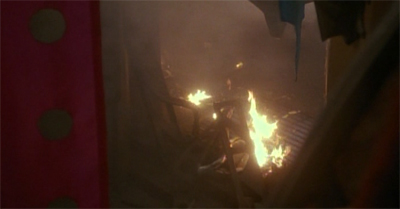
Everything burns...

Everything burns…

This is the very definition of “production nightmare.” It recalls one of those stories that you hear about blockbuster movies that start shooting without a finished script, or directors being locked out of the editing suite. By all accounts, Improbable Cause should have been a trainwreck held together by duct tape and good thoughts. Instead, there’s a credible argument that Improbable Cause is the strongest episode of the third season. It’s certainly the strongest episode broadcast since Star Trek: Voyager came on the air.

And that’s down to one simple fact: every single aspect of Improbable Cause works extraordinarily well.

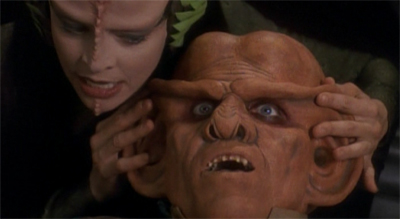
Odo has the scent...

Odo has the scent…

Continue reading

Star Trek: Deep Space Nine – The Soul Key by Olivia Woods (Review)

This September and October, we’re taking a look at the jam-packed 1994 to 1995 season of Star Trek, including Star Trek: Deep Space Nine and Star Trek: Voyager. Check back daily for the latest review.

The Soul Key would wind up being the last novel published as part of the Deep Space Nine relaunch.

The Soul Key was published in July 2009. The next month, Una McCormack’s wonderful The Never-Ending Sacrifice would be published. However, McCormack’s novel was very written outside the relaunch, running as a companion to the series and unfolding in the immediate aftermath. After that, the Deep Space Nine book line found itself folded into various crossovers, like Typhon Pact and The Fall. There was a sense that the line was drifting away from Deep Space Nine and being recontextualised in Pocket Books’ larger Star Trek series.

The Soul Key picks up where Fearful Symmetry left off, following Kira, mirror!Iliana and Vaughn as they venture into the mirror universe in pursuit of the crazed Iliana Ghemor.

ds9-soulkey

Continue reading

Star Trek: Deep Space Nine – Through the Looking Glass (Review)

This September and October, we’re taking a look at the jam-packed 1994 to 1995 season of Star Trek, including Star Trek: Deep Space Nine and Star Trek: Voyager. Check back daily for the latest review.

It’s very tempting to write off the problems with the mirror universe episodes of Star Trek: Deep Space Nine as diminishing returns – the idea that repeated exposure to what was once novel robs that item of its novelty. It is possible to become immune to the charms of camp, dulled to absurd space opera, and just worn out by watching the cast play “space pirates meet Star Wars.”

However, this does a bit of a disservice to the mirror universe as a concept. As iconic as it has become, Mirror, Mirror worked very well as a piece of introspection for the original Star Trek. Crossover stands out as one of the strongest episodes in the first two years of Deep Space Nine, because it manages to capture the thoughtful-yet-campy self-criticism of Mirror, Mirror.

Let's face it, after what O'Brien's been through, nobody would be surprised if he snapped...

Let’s face it, after what O’Brien’s been through, nobody would be surprised if he snapped…

In contrast, Through the Looking Glass marks the point at which the mirror universe really ceases to be a clever concept, and becomes something that is simply kept around because it’s old and because the production team like the idea of playing “roguish rebels and evil empires” in a way that’s impossible in the mainstream Star Trek universe.

While the episode does have an interesting central premise and is nowhere near as weak as some of the mirror universe episodes ahead, Through the Looking Glass is the moment where the mirror universe seems to get away from Deep Space Nine.

They really nailed Rom to the wall...

They really nailed Rom to the wall…

Continue reading

Star Trek: Deep Space Nine – Visionary (Review)

This September and October, we’re taking a look at the jam-packed 1994 to 1995 season of Star Trek, including Star Trek: Deep Space Nine and Star Trek: Voyager. Check back daily for the latest review.

Visionary confirms that “O’Brien must suffer” is to become an annual tradition on Star Trek: Deep Space Nine. The second season of the show had made a good start with episodes like Whispers and – to a lesser extent – Armageddon Game, but Visionary confirms that this will really be O’Brien’s niche in the ensemble from this point on. Visionary sees O’Brien randomly jumping forward through time, inevitably glimpsing some horrible tragedy that must be avoided. (Boy, it sure is lucky that he started jumping at this point, isn’t it?)

Visionary should feel contrived and convenient, hinging on a pretty flimsy plot hook. That said, the episode ultimately works quite well, even if it doesn’t stand out as a classic piece of Star Trek. Watching Visionary, there’s very much a sense that Visionary only really works as well as it does because Deep Space Nine has built up a larger mythology of characters and long-form plotting that can support what might otherwise be a fairly flimsy premise.

"Why the hell doesn't this ever happen to Julian?!"

“Why the hell doesn’t this ever happen to Julian?!”

Continue reading

Star Trek: Deep Space Nine – Prophet Motive (Review)

This September and October, we’re taking a look at the jam-packed 1994 to 1995 season of Star Trek, including Star Trek: Deep Space Nine and Star Trek: Voyager. Check back daily for the latest review.

Now that Star Trek: Voyager is on the air, there’s a sense that Star Trek: Deep Space Nine can be more relaxed. The show was undeniably contrarian during the short period when it was the only Star Trek on the air, presenting a series of uncompromisingly cynical episodes to assure viewers that it would not be trying to fill the void left by Star Trek: The Next Generation. At the same time, there’s also a sense that show was acutely aware of it potentially wider audience watching during that window.

During that first half of the season, a new adversary was pushed to the fore, the show did a story about Klingons and featured three guest stars from The Next Generation – although not necessarily the guest stars anybody would have chosen. More than that, though, the show seemed to consciously avoid its more controversial types of episodes. Even by the show’s third year, it had become clear that certain “types” of episodes appeared a few times a year – a couple of “old favourites” for the writing team to fall back on while constructing a twenty-six episode season.

'Ear me out 'ere...

‘Ear me out ‘ere…

As such, it’s telling that the most divisive parts of any Deep Space Nine season were pushed into the second half of the season.  So Ira Steven Behr and Robert Hewitt Wolfe’s two Ferengi-centric scripts came after Voyager had premiered. Sure, Quark got to be the focus of the season’s third episode, House of Quark, but he shared that with the popular Klingons. The season’s two big Bajoran plot lines (Life Support and Shakaar) were positioned towards the end of the year.

Prophet Motive feels like the kind of Star Trek episode that could only be produced on Deep Space Nine as part of Ira Steven Behr’s unique vision for the show. It’s the kind of weird script that the show seemed to get away with by virtue of being “the other Star Trek on television.” That doesn’t mean that it’s particularly good, mind you, just that it’s distinctly a Deep Space Nine story.

Quark is a by-the-book Ferengi...

Quark is a by-the-book Ferengi…

Continue reading

Star Trek: Deep Space Nine – The 34th Rule by Armin Shimerman & David R. George III (Review)

This September and October, we’re taking a look at the jam-packed 1994 to 1995 season of Star Trek, including Star Trek: Deep Space Nine and Star Trek: Voyager. Check back daily for the latest review.

The 34th Rule is a particularly notable piece of Star Trek fiction. It is the first Star Trek novel credited to a main cast member while their show was still on the air. Armin Shimerman, Eric A. Sitwell and David R. George III had pitched the idea for The 34th Rule as an episode of Star Trek: Deep Space Nine. When the producers were not interested in developing the idea, Shimerman and George decided to expand the idea out into a full-length novel. The 34th Rule was released during the seventh season of Deep Space Nine.

Shimerman was not the first actor to be credited on a Star Trek novel. William Shatner had already launched his own “Shatner-verse” series of novels following the “resurrection” of James Tiberius Kirk after his death in Star Trek: Generations. However, Shatner was pretty much done with the franchise at this point – having officially passed the torch to his successors as part of Generations. However, Shimerman was the first to publish a novel while the show was on the air.

The 34th Rule is a decidedly ambitious piece of work. It is clumsy in places, perhaps a little heavy-handed and on the nose. Nevertheless, it is a well-constructed and thoughtful Star Trek epic – one the feels in keeping with the mood of Deep Space Nine, even if it occasionally veers a little too far.

the34thrule

Continue reading

Star Trek: Deep Space Nine – Heart of Stone (Review)

This September and October, we’re taking a look at the jam-packed 1994 to 1995 season of Star Trek, including Star Trek: Deep Space Nine and Star Trek: Voyager. Check back daily for the latest review.

Heart of Stone feels quite similar to Life Support. Once again, there’s a main plot that doesn’t involve Kira quite as much as it should. Once again, this is supplemented by a subplot involving Quark’s mischievous nephew, Nog. And yet – while still flawed in a number of ways – Heart of Stone works a lot better than Life Support did, primarily because it’s a lot more thoughtfully constructed. The lack of focus on Kira is explained as part of the plot; Nog isn’t holding down an unfunny comedy subplot, he’s getting some nice character development.

Heart of Stone is occasionally a little heavy-handed in its character beats, but it works well because it pitches its plot at the right level, focusing on the characters at the heart of these stories.

A rock and a hard place...

A rock and a hard place…

Continue reading

Star Trek: Deep Space Nine (Malibu Comics) – The Rules of Diplomacy (Review/Retrospective)

The September and October, we’re taking a look at the jam-packed 1994 to 1995 season of Star Trek, including Star Trek: Deep Space Nine and Star Trek: Voyager. Check back daily for the latest review.

One of the more interesting aspects of Star Trek: Deep Space Nine is the way that the cast actively involved themselves in the mythology of the show. Armin Shimerman originally pitched The 34th Rule as an episode of the show, along with Eric A. Sitwell and David R. George III. Andrew Robinson published A Stitch in Time, a novel based on notes he had been making about Garak during the production of the series. Even J.G. Hertzler co-wrote the Left Hand of Destiny duology.

Of course, this was not a unique occurrence. Walter Koenig had written an episode of Star Trek: The Animated Series, an issue of Marvel’s on-going Star Trek comic and even The Machiavellian Principle, a play performed at the Ultimate Fantasy convention. John DeLancie had co-written The Gift, a story published in DC’s Star Trek: The Next Generation comics. Ethan Phillips and Robert Picardo would lend their names to tie-in Star Trek: Voyager books.

However, it seems reasonable to observe that the supporting cast on Deep Space Nine were particularly interested in fleshing out and developing their characters. So it seems appropriate that Aron Eisenberg should co-write The Rules of Diplomacy, a special about Nog earning some credits before shipping off to Starfleet Academy.

You can't go home again...

You can’t go home again…

Continue reading

Star Trek: Deep Space Nine – Prophecy & Change: The Orb of Opportunity by Michael A. Martin and Andy Mangels (Review/Retrospective)

The September and October, we’re taking a look at the jam-packed 1994 to 1995 season of Star Trek, including Star Trek: Deep Space Nine and Star Trek: Voyager. Check back daily for the latest review.

It is fun to imagine the negative space that exists between various episodes of Star Trek: Deep Space Nine. In its third season, the show was making nods towards serialisation, but there was never really a point where the series could not be broken down into reasonably well-defined episodic units. Even during the ten-hour series finalé, each of the constituent elements had its own narrative thrust and its own clear purpose. So it is fun sometimes to try to connect these threads together.

The ordering of episodes in a season of television is very interesting. It creates a fascinating connective tissue in the minds of fans. Although each episode is its own story, they come together to form something larger and more intriguing. On The X-Files, for example, placing Never Again directly after Leonard Betts changed the whole context of the episode. There are threads that do not necessarily exist within the individual episodes, but can be implied by the sequencing of the shows.

Placing Heart of Stone directly after Life Support is an interesting choice in several respects. It creates all sorts of interesting implications and developments, contradictions and possibilities. It is weird to have an episode about Odo’s attraction to Kira air directly after an episode focusing on the death of Kira’s long-term love interest; give her a week or two of space, guys. Similarly, it is strange to go from Nog’s characterisation in Life Support to his development in Heart of Stone.

The Orb of Opportunity is very clearly intended to bridge the gap between those two episodes, explaining how and why Nog developed in the way that he did.

ds9-prophecyandchange

Continue reading

Star Trek: Deep Space Nine – Past Tense, Part II (Review)

This September and October, we’re taking a look at the jam-packed 1994 to 1995 season of Star Trek, including Star Trek: Deep Space Nine and Star Trek: Voyager. Check back daily for the latest review.

Past Tense, Part II is a nice way to close out Star Trek: Deep Space Nine‘s solo run, the only period in the show’s history where it was the only Star Trek on television. Caretaker, the première of Star Trek: Voyager, would be the next episode of the franchise to air. Deep Space Nine spent a lot of its early third season attacking various foundations of the Star Trek universe, as if hoping to demonstrate how profoundly different the show was from its predecessors.

The Search promised a war brewing on the horizon, and presented a cynical view of Starfleet foreign policy, where pacifism amount to appeasement. House of Quark reduced the Klingon Empire to a joke. Equilibrium suggested that Sisko could live with (and passively enable) a government lie if it kept his friend alive. Second Skin hinted that things might not be as they appear to be. The Abandoned embraced the idea that sometimes people are incapable of being anything more than what their genes might tell them to be. Defiant was the story of sibling desperately trying to prove his unique identity.

Everything is under control...

Everything is under control…

Part of me wonders if this very cynical stretch of episodes is responsible for the perception of Deep Space Nine as an incredibly cynical and pessimistic television show – one consciously at odds with the utopian ideals of the franchise. After all, this was the stretch where Deep Space Nine was most in the spotlight. It had the spot previously allocated to Star Trek: The Next Generation in most markets. It had no televised competition. If ever Star Trek fans were going to jump on board Deep Space Nine, this was the moment. It seems quite possible that this run of episodes cemented the show’s reputation.

So it seems strange that Deep Space Nine should wait until its last possible moment in the sun to embrace the humanism and optimism at the heart of the franchise. Past Tense is a story about building paradise, and about how humanity has the capacity to be so much better than we currently are. In short, it’s quintessential Star Trek, right down to the occasionally heavy-handed moralising and utopian idealism.

Keep your hat on...

Keep your hat on…

Continue reading