• Following Us

  • Categories

  • Check out the Archives


  • Awards & Nominations

The Defenders – Mean Right Hook (Review)

The shared universe is a feature of comic book storytelling that has gradually crept into the mainstream.

In some ways, it is a logical escalation of the concept of sequels, a way of expanding storytelling opportunities in a way that beacons in fans of existing properties. The shared universe is a prime example of modern pop culture’s investment in intellectual property ahead of personality, where the familiar concept behind a film or television series is often as attractive as any star headlining. The Marvel Cinematic Universe is perhaps the most successful example, spanning movies, novels and television shows all (in theory) set within the same fictional world.

It’s a big universe out there.

The shared universe has become the default mode for big-budget storytelling in the twenty-first century, a structure towards which studios aspire. The most obvious examples are the shared comic book universes from Disney and Warner Brothers, with another coming from Sony in the near future. However, there are countless other examples. Disney has begun constructing standalone stories within its Star Wars universe. James Wan has built up an unlikely blockbuster horror shared universe.

The Defenders is an interesting beast, the culmination of a shared subuniverse. It brings together the primary characters from Daredevil, Jessica Jones, Luke Cage and Iron Fist in their own weird little corner of the shared Marvel cinematic universe.
Devil in the details.

Continue reading

Star Trek: Voyager – Dark Frontier, Part I (Review)

The fifth season of Star Trek: Voyager arrives at a point when the Rick Berman era of the Star Trek franchise has hit its midlife crisis.

Star Trek: Deep Space Nine is coming to an end, bring down the curtain on a seven-year period where there were always two franchise series boldly going simultaneously. Star Trek: Insurrection had been released into cinemas as a snapshot of that midlife crisis, where Michael Piller’s last script for the franchise found the cast of Star Trek: The Next Generation desperately chasing their own youth and vitality on a planet with a fountain of youth.

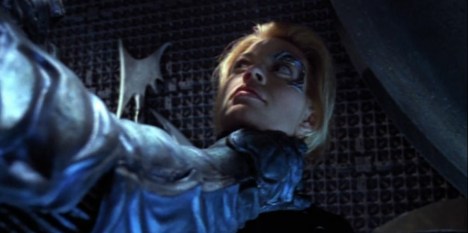
Seven gets back in touch with her roots.

On the fifth season of Voyager, it seemed like the show turned inwards. The scripts for the fifth season are surprisingly retro and nostalgic in tone; Janeway’s reflections on the events of Caretaker in Night, the return of the Maquis and the Cardassians in Nothing Human, the indulgence of retro thirties sci-fi in Bride of Chaotica!, Tuvok’s childhood flashbacks in Gravity, the “telepathic pitcher plant” in Bliss, Seven’s trip back to the launch of Voyager in Relativity, Janeway’s investigation of her ancestor in 11:59.

However, there was a fundamental problem with all of this introspection. Voyager was a television series that had long struggled to define a unique identity, too often feeling like a half-hearted reheat of the leftovers from The Next Generation. It was very hard to turn the focus inwards when there wasn’t a lot unique or distinctive about Voyager. This is a show that was much closer to its end than to its beginning, and it still lacked any true sense of identity or self.

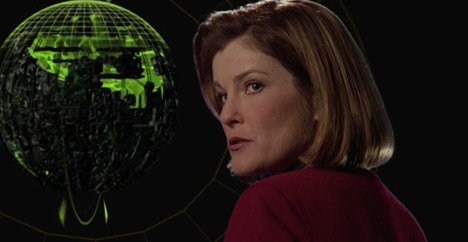
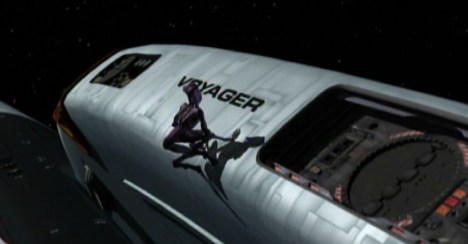
There’s coffee… I mean transwarp coils in that there Borg Sphere.

Dark Frontier, Part I and Dark Frontier, Part II serve as an example of this nostalgic indulgence, both in form and plot. It is a two-parter consciously designed to recapture the success of broadcasting The Killing Game, Part I and The Killing Game, Part II on the same night in the late fourth season. It is also a television movie that is very clearly patterned off the story for Star Trek: First Contact, borrowing key story beats and clear characters from that memorable Next Generation film.

However, Dark Frontier, Part I and Dark Frontier, Part II also demonstrate the shallowness of Voyager‘s own internal memory. This is a story built around an act of narrative archeology within the larger Star Trek universe, touching on the secret history of humanity’s true first encounter of the Borg. However, that history is ultimately illusory, built around what feels like a misremembrance of one of the franchise’s most iconic alien species. As Voyager turns its gaze backwards, it discovers that it has no real history.

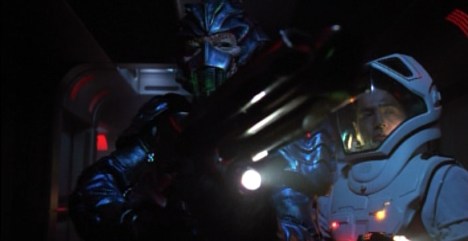
Drone warfare.

Continue reading

Star Trek: Deep Space Nine – The Emperor’s New Cloak (Review)

The Emperor’s New Cloak is a disaster.

To be fair, it is not a messy disaster. There is nothing particularly novel in how terrible The Emperor’s New Cloak actually is. Most of the awfulness is carried over from Through the Looking Glass and Shattered Mirror. The sharp decline in quality and merit of the mirror universe episodes since the concept’s reintroduction in Crossover has become a gentle slope. The Emperor’s New Cloak is unfunny and broadly homophobic nonsense, clumsily plotted and horribly paced. If it sets a lower bar for these mirror universe episodes, that bar is not appreciably lower.

Not quite having a blast…

The Emperor’s New Cloak is terrible in the same way that Prodigal Daughter and Field of Fire are terrible. It is as though Star Trek: Deep Space Nine has reached a point where its bad episodes are no longer surprising, simply uninspired. No audience member watching The Emperor’s New Cloak will wonder how any of these ideas made it to screen. There is none of the novelty that defined the horrors in episodes like Meridian, Let He Who Is Without Sin… or even Profit and Lace. There is just a creeping sense of fatigue.

In some ways, it makes sense that the most disappointing episodes of the seventh season should be affected by this feeling of exhaustion. The end is nigh, the production team have been working on the series for seven years. Even their bad jokes are no longer shocking, simply tired.

A dark moment for all involved.

Continue reading

Star Trek: Deep Space Nine – Treachery, Faith and the Great River (Review)

Treachery, Faith and the Great River is a beautiful piece of Star Trek: Deep Space Nine.

It is a meditation on everything suggested by the title, recurring themes across the seven-season run of Deep Space Nine. Indeed, it is a reflection on how each of those three concepts all tie back to the same notion of belief. Treachery is what happens when belief is betrayed, faith is what happens when belief is held without validation, and the great river reflects a more generic belief in the balance and distribution of the wider universe. Treachery, Faith and the Great River is a story about belief and the various forms that it takes, and the rewards that it offers.

“And how can man die better than facing fearful odds, for the ashes of his fathers, and the temples of his Gods?”

In many ways, Treachery, Faith and the Great River marks a return to the sort of softer religious belief that defined the early seasons of Deep Space Nine. It is an episode that engages with the challenges of faith, rather than taking it at face value. It is no small irony that an episode as nuanced as Treachery, Faith and the Great River should be credited to the writers responsible for The Reckoning. In many ways, Treachery, Faith and the Great River asks what it means to truly believe in something, even knowing that this belief might never be rewarded.

Treachery, Faith and the Great River is a story about looking for the divine, and the answers that are offered in return.

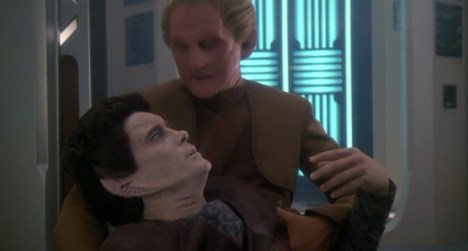
Weyoun Six, Weyoun Seven…
All good clones go to heaven…

Continue reading

Doctor Who: World Enough and Time (Review)

The Moffat era will likely be remembered for its “wibbly wobbly, timey wimey” plotting, so perhaps World Enough and Time is an appropriate end point.

World Enough and Time begins what will be Steven Moffat’s last season finale, and what will be his last run as both writer and showrunner on Doctor Who. It is the beginning of the end. It is in some ways a less dramatic farewell than that overseen by his predecessor, with a year of specials meaning that Russell T. Davies was credited on the last nine episodes of his tenure. Instead, World Enough and Time is the first of Steven Moffat’s last three scripts for Doctor Who.

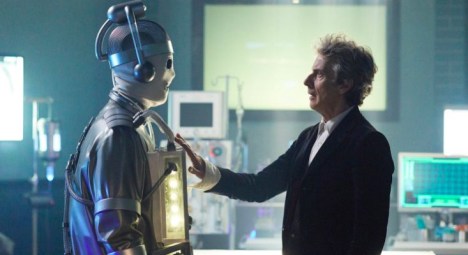
Heart-to-heart-implant.

World Enough and Time is bookended by these references, reminding the audience that time is running out for the Doctor. The teaser suggests an inevitable regeneration, as the Doctor stumbles out of the TARDIS burning with energy. The closing shot of the “Next Time” trailer at the end of the episode is the Doctor digging his hand into the soil as the energy flows through his body. There is a definite sense that the Twelfth Doctor is (a lot) closer to his end than two his beginning.

Indeed, even the inclusion of the Cybermen in World Enough and Time plays into this idea. The Daleks have arguably always functioned as the death drive within Doctor Who, the Last Great Time War serving as a metaphor for the traumatic cancellation. The Cybermen provide an interesting inversion. They represent the continuation of life through grotesque means. The Cybermen are monsters that sacrificed their humanity to survive. While the only answer to the Daleks is life, the only answer to the Cybermen is death. Death comes to time.

No time for Missy-ing.

There are several interesting aspects of World Enough and Time, from the decision to build the two-parter around the Cybermen rather than the Daleks through to the decision to include two versions of the Master. However, the most strikingly “Moffat-y” aspect of the episode is how it approaches the question of time itself. The central hook of World Enough and Time is a colony ship where time has been dialated by a black hole, but that is not the most interesting “timey wimey” element of the series.

Instead, World Enough and Time is notable as a surprisingly nostalgic indulgence. It is an episode seems to bring the show back to its earliest days, from the Master’s campy disguise to his rubbish beard to the quite pointedly “Mondasian Cybermen” to the time spent watching a black-and-white show waiting a week to see what would happen next. World Enough and Time is a surreal curiousity, rather than a bombastic event. There is something very surreal in that.

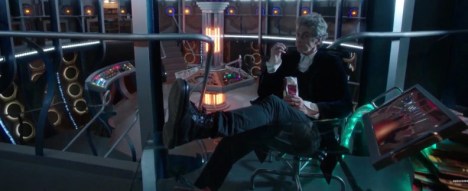
Doctor Who watches Doctor Who.

Continue reading

Star Trek: Voyager – Extreme Risk (Review)

Extreme Risk is another example of Star Trek: Voyager squandering an intriguing premise.

Hunters introduced a number of new and intriguing ideas to Voyager. Suddenly, Janeway was no longer in a long-term relationship with Mark, which made it possible for her to consider romantic entanglements in the Delta Quadrant. Suddenly Starfleet was aware that Voyager was still in one piece, rather than missing in action. These creative choices opened up new storytelling possibilities, paving the way for episodes like Counterpoint or Pathfinder.

Diving right in.

However, the most interesting revelation in Hunters was that the Maquis had been destroyed while Voyager was lost in the Delta Quadrant. This was not a surprise to Star Trek fans who had been watching Star Trek: Deep Space Nine, given that this development had been covered in Blaze of Glory. However, it should have been a big deal to the characters on Voyager. Chakotay and Torres were members of the Maquis. Tuvok had been a spy working for Starfleet in the Maquis. Even Paris had spent some time in the organisation. This news should have been a big deal.

Extreme Risk feels like an interesting development of this idea, albeit one that has been greatly delayed. How would the Maquis crew members react to the news that most of their friends were dead and that the rest were in Federation custody? Voyager has never been a show particularly engaged with long-term consequences, but there is an interesting story to be told there. Extreme Risk tells one such story, suggesting that the new plunged Torres into a depression that led her to self-harm. It is certainly an intriguing and compelling story hook.

Building a better future.

However, Extreme Risk fumbles the delivery in a number of ways. It makes the standard Voyager mistake of assuming that character-driven plots still have to have a compelling action-adventure element to them, and so provides a very generic subplot about a probe that has been lost in the atmosphere of a gas giant and the resulting “old-fashioned space race” that results, including the construction of a new ship. As a result, the plotting of the episode feels very trite, offering Torres a very convenient clear-cut redemption arc at the climax.

That said, the biggest problem with Extreme Risk is much more basic than the awkward juggling of primary and secondary plots. As with Night before it, Extreme Risk demonstrates that the rigidly episodic structure of Voyager is woefully ill-equipped to tell a profound (and sincere) story about the struggles of living with clinical depression.

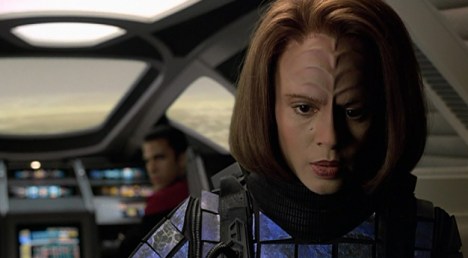
She knows kung fu.

Continue reading

Star Trek: Deep Space Nine – Season 6 (Review)

The sixth season of Star Trek: Deep Space Nine seems to brush up against the limits of what the show could do.

To be fair, Deep Space Nine spent most of its fourth and fifth seasons smashing through the arbitrary boundaries imposed upon what a Star Trek show could and could not do. Overseen by executive producer Ira Steven Behr, the writing staff very consciously and very vigourously pushed past the limitations imposed by the so-called “Roddenberry Box” and the style of television overseen by franchise leader Rick Berman. The storytelling became more complex, serialisation crept in, the music became more noticeable, conflict became more evident.

This all built to a climax in the second half of the fifth season, a series of interlinked stories that stretched from In Purgatory’s Shadow and By Inferno’s Light through to Call to Arms. Diplomatic tensions rose, character arcs became clear. Then, at the very end of the season, the unthinkable happened. The Federation went to war with the Dominion. More than that, the Federation started a war with Dominion. It was a bold creative choice, one that chipped away at so many of the assumptions underlying the utopian future of Star Trek.

The sixth season faces a number of serious problems. Most obviously, the fourth and fifth seasons had pushed so far that there was only so much ground left to cover. The sixth season explored that ground thoroughly. There is an argument to be made that the arc that opens with Call to Arms and continues through the first six episodes of the sixth season ranks as the single most ambitious stretch of the Rick Berman era. Episodes like Far Beyond the Stars, Inquisition and In the Pale Moonlight pushed the franchise well outside its comfort zone.

At the same time, there was a clear sense that the production team was butting up against the limits of the form, that they had pushed Deep Space Nine almost as far as it was possible to push a nineties Star Trek show, and so the season lacked the same sense of forward momentum as the fourth and fifth seasons had. Many creative decisions in the sixth season feel like the result of creative compromise, whether the sense that the writers had told all the big stories that they wanted to tell or because they had to bow in some way to the conventions of television storytelling.

The result is a frustrating season of television. The sixth season of Deep Space Nine features some of the best Star Trek episodes in the fifty-year history of the franchise. However, it also contains a lot of thwarted ambitions. For every barrier that the sixth season smashes through, it brushes up against another. It is a reminder of just how far Deep Space Nine had pushed the franchise during its run. In some ways, it felt like the sixth season of Deep Space Nine was not so much brushing up against the limits of Star Trek as against the limits of nineties television.

Continue reading

Star Trek: Voyager – Prey (Review)

Prey is a fantastic piece of television, and stands as one of the best standalone episodes of the fourth season of Star Trek: Voyager.

It is an episode built around a very simple premise, pitting two of Voyager‘s more memorable alien creations against one another and throwing a nice character arc into the midst of this epic conflict. Prey is an exciting thriller built around the established characteristics of both the Hirogen and Species 8472, using two very distinctive cultures to tell a compelling and engaging story with the regular cast thrown into the fray. “Lone Hirogen hunter pursues lost member of Species 8472” is a great hook for an episode.

Here come the big guns.

However, Prey goes even further than that. The basic plot is intriguing on its own terms, but Prey cleverly grounds the story in what we know about these characters and their dynamic. As much as Voyager is caught in the crossfire of this horrific situation, the crew are also forced to make tough decisions. How will Janeway react to a wounded member of a hostile (and nigh-invulnerable) species? How will Seven of Nine respond when asked to save the life of a creature that participated in a brutal war with the Borg Collective?

This is intriguing stuff, largely anchored in what the audience already knows of the characters and delivered with top-notch production values and a great sense of pacing. Prey is an episode that plays to all the strengths of the fourth season, from the appeal of the Hirogen and Species 8472 through to the chemistry between Kate Mulgrew and Jeri Ryan.

There’ll be hull to pay.

Continue reading

Star Trek: Voyager – Hunters (Review)

Hunters is a weird episode of Star Trek:Voyager, perhaps most notable for the manner in which it flirts with serialisation.

More than any other episode of the fourth season, with the possible exception of The Gift, this mid-season episode seems to exist primarily in relation to the episodes around it. The script is very consciously a sequel to Message in a Bottle, with the crew discovering the ancient network of space stations is a two-way radio back to the Alpha Quadrant. It also introduces the Hirogen, an alien species that will recur in Prey, The Killing Game, Part I and The Killing Game, Part II. The story also sets up a narrative thread that will pay off in Hope and Fear, the season finale.

“Prey, tell.”

More than that, Hunters is an episode that is very consciously engaged with dangling threads of continuity. It resolves the relationship between Janeway and Mark that has haunted the lead character since Caretaker, offers Tom Paris some hint of reconciliation with the father who seemed so disappointed in Persistence of Vision, and even resolves the Maquis plot thread by tying back to Blaze of Glory. This is an episode that exists as something of a storytelling nexus point, a variety of intersecting threads all tied together as part of a single narrative.

Voyager had largely eschewed any attempt at long-form storytelling, perhaps in response to the trauma of the troublesome Kazon arc in the second season that led to ill-judged misfires like Alliances and Investigations. However, those early attempts at serialisation were heavily plot-driven, a series of stories building towards a number predetermined plot points. In contrast, the serialisation suggested by Hunters is looser; a collection of character beats, some earlier details that had largely been forgotten, some elements that might be useful in the future.

The farthest woman from home.

That said, Hunters seems just as cautious about long-form storytelling as The Gift was. As much as Hunters revives old story lines and character beats, it also makes a conscious effort to close many of them. Hunters makes it very clear that this level of serialisation will not be the default for the series going forward. The episode tidies away more loose threads than it unravels. The relationship between Kathryn Janeway and Mark Johnson is brought back purely so it can be ended. The Maquis are mentioned only to confirm they have been destroyed.

Still, there is something oddly intriguing about Hunters, a mostly quiet episode that exists primarily as both prelude and coda rather than a narrative in its own right. It is a quieter, stranger Voyager episode, even while introducing a race of giant space!hunters.

Gripping stuff.

Continue reading

Star Trek: Voyager – Message in a Bottle (Review)

Message in a Bottle is an intriguing episode, although not necessarily for the most obvious of reasons.

Working with Andy Dick can be tough.

Working with Andy Dick can be tough.

Message in a Bottle is notable for its stunt casting, featuring controversial comedian Andy Dick as the Emergency Medical Hologram, Mark II. Given his background and his interests, Andy Dick is a very strange choice for a Star Trek guest role. Then again, it takes all sorts; Star Trek: Deep Space Nine cast Iggy Pop in The Magnificent Ferengi and Star Trek: Voyager finds room for the Rock in Tsunkatse. However, the last time the franchise attempted to cast a famous comedian, Star Trek: The Next Generation ended up with The Outrageous Okona.

Understand, Andy Dick tends to be the focal point for discussion around Message in a Bottle. However, the episode is notable for other reasons. In a weird way, Message in a Bottle kicks off a very loose serialised arc that plays through the next handful of episodes. It introduces the communications grid that plays a major role in Hunters, and features the first glimpse of the Hirogen. The Hirogen go on to play a major role in episodes like Prey, The Killing Game, Part I and The Killing Game, Part II.

"What the hell are YOU doing in my Star Trek show?"

“What the hell are YOU doing in my Star Trek show?”

Message in a Bottle also comes at the half-way point in Voyager‘s run, speaking in terms of structure rather than episode count. Message in a Bottle is positioned mid-way through the middle season of Voyager‘s seven year run. Although the count is skewed somewhat by the series’ abridged first season, it feels like the last point at which Voyager is closer to its beginning than to its end. As such, there is something strangely appropriate in the fact that Message in a Bottle allows Voyager to reconnect with Starfleet and the Alpha Quadrant.

This is perhaps the point where the end of the journey “seems a little closer.”

"This never would have happened if they'd just gone with the Bashir model!"

“This never would have happened if they’d just gone with the Bashir model!”

Continue reading