• Following Us

  • Categories

  • Check out the Archives


  • Awards & Nominations

The X-Files – War of the Coprophages (Review)

This November (and a little of December), we’re taking a trip back in time to review the third season of The X-Files and the first (and only) season of Space: Above and Beyond.

It is very odd to describe any Darin Morgan episode as “underrated.” And yet, despite that, War of the Coprophages feels like the underrated Darin Morgan teleplay.

Clyde Bruckman’s Final Repose had appeared towards the start of the season, featuring a powerhouse guest performance from Peter Boyle. Both Boyle and Morgan would win Emmys for their work on that episode, and Clyde Bruckman’s Final Repose is perhaps Morgan’s most conventional script for The X-Files or Millennium. In contrast, Jose Chung’s “From Outer Space” is perhaps the most adventurous and gonzo episode of The X-Files ever produced, coming at the end of the season and relentlessly (but affectionately) mocking the show’s core iconic mythology.
Down the drain...

Down the drain…

In contrast, War of the Coprophages sits in the middle, literally and figuratively. It is positioned almost precisely in the middle of the third season, with Morgan writing the screenplay in an exceptionally short period of time. It isn’t a truly exceptional example of a monster-of-the-week episode in the way that Clyde Bruckman’s Final Repose was, but it also isn’t as off-the-walls and bizarre as Jose Chung’s “From Outer Space.” It doesn’t feel like it has as much to say about death as Clyde Bruckman’s Final Repose, nor as much about life as Jose Chung’s “From Outer Space.”

And yet, in its own way, War of the Coprophages as an incisive and well-constructed commentary on The X-Files as a television show while allowing Morgan to tackle his recurring themes about society and humanity, and whether the world is what we would like to think that it is.
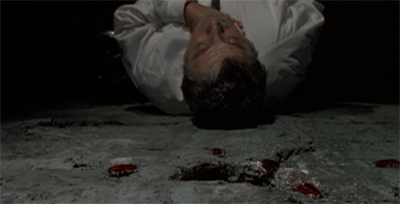
Bug hunt...

Bug hunt…

Continue reading

The X-Files – 731 (Review)

This November (and a little of December), we’re taking a trip back in time to review the third season of The X-Files and the first (and only) season of Space: Above and Beyond.

731 is a lot more substantial than Nisei.

This is most likely due to the episode’s production history. Frank Spotnitz had pitched the episode that would become 731 as a single standalone episode, but the production team discovered that the show was too large to fill a single forty-five minute block. So the show was extended into a two-parter. Given that Spotnitz was the credited writer on 731, it would seem that the second part retained most of the substance.

It's in the eye of the beholder...

It’s in the eye of the beholder…

This makes a great deal of sense, given that the two-parter eschews the stand format of a two-part X-Files episodes, featuring a frantic run-around in the first forty-five minutes and a tighter more intimate story in the second. Coupled with the fact that the episode is more about working through what we already know instead of heaping more information on top, and the two-parter seems a lot more substantial than most of the series’ big mythology shows.

Thoughtful, introspective, and unnerving, 731 is perhaps the highpoint of the show’s entire nine-season conspiracy arc.

Where the bodies are buried...

Where the bodies are buried…

Continue reading

Space: Above and Beyond – Choice or Chance (Review)

This November (and a little of December), we’re taking a trip back in time to review the third season of The X-Files and the first (and only) season of Space: Above and Beyond.

Hostile Visit and Choice or Chance follow the two-part template established by The X-Files, keeping things fresh by offering a pretty dramatic shift between the two episodes in question.

Hostile Visit featured a covert trojan house mission to infiltrate enemy space and stage a devastating attack behind enemy lines. The episode ended with the mission a failure and our heroes drifting through space. Choice or Chance features our heroes landing on a prison planet maintained by the Silicates, the evil artificial organisms that have skirted around the edge of the show’s mythology to this point.

Here's Douggie!

Here’s Douggie!

Choice or Chance comes very close to working. It is a lot more dynamic than Hostile Visit was, which is a good thing for the second half of a two-parter airing during November Sweeps. However, while Hostile Visit felt a little padded and extended, never quite building the momentum necessary for the story to work, Choice or Chance feels a little over-stuffed. There’s a lot of nice stuff here, but no room to properly digest it. It’s an episode that comes up with something for every member of the cast to do, but this inevitably means that the character arcs feel abbreviated and shortened.

There is a  pretty solid two-part episode to be constructed out of the ingredients of Hostile Visit and Choice or Chance. Sadly, the resulting two-parter is not it.

Crash and burn...

Crash and burn…

Continue reading

The X-Files – Nisei (Review)

This November (and a little of December), we’re taking a trip back in time to review the third season of The X-Files and the first (and only) season of Space: Above and Beyond.

The most interesting aspect of Nisei and 731 is the fact that there’s very little forward movement by the end of it.

The previous multi-part conspiracy episodes typically featured big hooks and shock revelations. Duane Barry and Ascension demonstrated that the government was officially responsible for alien abductions, to the point where they could arrange Scully’s abduction. Colony and End Game featured shape-shifting aliens and confirmation that Samantha Mulder was a big part of this. Anasazi, The Blessing Way and Paper Clip revealed that Mulder’s father was part of a conspiracy involving Second World War criminals working on American soil to create an alien-human hybrid.

The only way its getting off this planet is in a bodybag...

The only way its getting off this planet is in a bodybag…

Nisei and 731 don’t contain any truly seismic revelations. The biggest moments here – the reveal that Japanese war criminals have been experimenting on Americans with the assistance of the government, and that the bodies in the box car in Anasazi were probably originally human – all build on what Paper Clip already established. There’s nothing as significant as the reveal of the Bill Mulder’s complicity in the conspiracy from Paper Clip, or the first appearance of the Black Oil in Piper Maru.

Nisei and 731 really seem to be about taking stock of what has happened so far in the show – as close to a “breather” mythology episode as the show could manage at this point. Of course, this being The X-Files, this “breather” episode still moves a break-neck pace and climaxes with a death-defying leap on to a moving train. As you do.

The doctors are in...

The doctors are in…

Continue reading

Space: Above and Beyond – Hostile Visit (Review)

This November (and a little of December), we’re taking a trip back in time to review the third season of The X-Files and the first (and only) season of Space: Above and Beyond.

At this point, Space: Above and Beyond could do a lot worse than learn from The X-Files.

There are quite a few echoes of The X-Files in Space: Above and Beyond, becoming more pronounced as the show approaches the middle of the season. Eyes built on the suggestion of conspiracy and cover-up to assure viewers that Space: Above and Beyond was just as cynical about authority as The X-Files ever was. The Enemy felt like an attempt to copy the formula that Morgan and Wong had worked so well back in Ice.

Picture imperfect...

Picture imperfect…

Hostile Visit and Choice or Chance feels like an attempt to do a big sweeps two-parter in the style of The X-Files. This was a crucial moment for Space: Above and Beyond. The series had been scheduled outside of its comfort zone, had not been drawing huge ratings, had found itself preempted and bounced around the schedule as a result of factors outside its control. It needed a strong performance for the November sweeps, which were a matter of pride (and money) for the networks and a matter of interest for the advertisers.

So structuring a two-parter around that period makes a great deal of sense. Unfortunately, Hostile Visit does not make for the most compelling first half.

"I want a good clean sweep."

“I want a good clean sweep.”

Continue reading

The X-Files – D.P.O. (Review)

This November (and a little of December), we’re taking a trip back in time to review the third season of The X-Files and the first (and only) season of Space: Above and Beyond.

What is interesting about the third season of The X-Files is the way that everything seemed to click into place. After two years of figuring out how various parts of the show worked, the series was in a place where it worked like a finely-honed machine. The conspiracy episodes hit all the right boxes. The second season had demonstrated the show could do experimental or even humourous episodes. Even the standard “monster of the week” shows were delivered with more confidence and style.

While D.P.O. may not be the strongest episode of the third season, it is an example of how comfortable the show has become. It is an episode that move incredibly well, where the vast majority of the pieces click, and one which is fondly remembered by the fan base. There’s a very serious argument to be made that writer Howard Gordon was the best author of “monster of the week” scripts working on the show at this point, and D.P.O. demonstrates how well he crafts these sorts of stories.

Cooking up a storm...

Cooking up a storm…

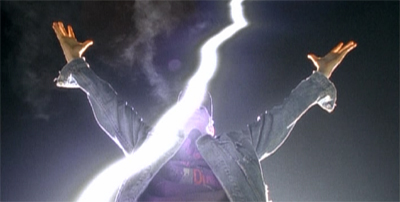
D.P.O. also benefits from any number of elements that make it seem memorable, even if it is “business as usual” after a massive three-part conspiracy epic. The opening sequence – featuring Ring the Bells by James – is one of the first times the show has so successfully integrated music into its action, something that would become a memorable part of later shows and even Millennium. The guest cast features Giovanni Ribisi and Jack Black. The episode also perfectly captures teen angst in an insightful manner.

The show was apparently drawn from an index card labelled “lightning boy”, which had been on Chris Carter’s white board since the first season. It’s very hard to imagine the show pulling off something like D.P.O. during its first season. While it might have worked towards the end of the second season, the start of the third season seems the perfect place for it.

Cloudy with a chance of angst...

Cloudy with a chance of angst…

Continue reading

The X-Files – Paper Clip (Review)

This November (and a little of December), we’re taking a trip back in time to review the third season of The X-Files and the first (and only) season of Space: Above and Beyond.

And now we return to your scheduled viewing.

In many respects, Paper Clip feels like the real third season premiere. It establishes a lot of the recurring themes and ideas for the mythology of the season, from Krycek-on-the-run through to collaboration in the wake of the Second World War. It builds on the successful multi-part formula established by episodes like Ascension or End Game during the show’s second season. It moves things along in a way that The Blessing Way simply refused to. (It even resolves the cliffhanger from the last episode on screen.)

The light at the end of the tunnel...

The light at the end of the tunnel…

Paper Clip demonstrates the strengths of the third season of The X-Files. The third season was the point at which the show really pushed the mythology out, building on earlier implications that there was form to be found in the shadows. The third season also looked to the second season to determine what had worked and what had not worked. Paper Clip is very clearly modelled on the successful aspects of second parts like Ascension or End Game.

It moves. The power of Paper Clip comes from an incredible forward momentum that allows the show to maintain tension and excitement while refusing to allow the audience to catch their breath. Instead of resolving the bigger plot threads from the first episode, questions and hints are thrown out with reckless abandon as the script just drives through set pieces and emotional beats and suspenseful sequences. It is a very meticulously, very cleverly constructed piece of television.

Watching the skies...

Watching the skies…

Continue reading

The X-Files – The Blessing Way (Review)

This November (and a little of December), we’re taking a trip back in time to review the third season of The X-Files and the first (and only) season of Space: Above and Beyond.

The Blessing Way is the first mythology episode of The X-Files that doesn’t really work.

And it doesn’t really work for a lot of the same reasons that some of the later mythology episodes don’t really work. Its pacing is terrible. It wallows in new age mysticism, allocating characters thoughtful monologues that awkwardly state themes and render subtext as supratext. It plays into the deification of Mulder, trying to bend Mulder’s story to fit into an archetypal “chosen one” narrative. More than that, it is very clearly a holding pattern, an effort to eat up time without moving forward.

Wiping it all out...

Wiping it all out…

However, despite the fact that The Blessing Way really doesn’t work, it is still a fascinating episode. It’s a wonderful demonstration of how The X-Files has developed a fleshed-out world inhabited by compelling characters. The best moments in The Blessing Way are character-focused, with Skinner caught between his duty to the government and his loyalty to his agents, the Cigarette-Smoking Man revealed to be middle-management at best, and the implication that even vast sinister government conspiracies are hostage to chaos.

The Blessing Way is an oddity, a rather strange piece of television that is almost endearing in its stubborn refusal to deliver what the audience wants and expects. That doesn’t make it good, but it does make it interesting.

The truth is up there...

The truth is up there…

Continue reading

The X-Files – Season 2 (Review)

This August (and a little of September), we’re taking a trip back in time to review the second season of The X-Files. In November, we’ll be looking at the third season. And maybe more.

The first few seasons of a television show are very much about defining the show – figuring out what works and what doesn’t, and what form the show will take. After all, a lot of discussion and planning takes place during development, but all of that is on paper. It’s only once you’ve worked with the cast and had a chance to gauge audience response that it is possible to truly understand a television show.

The first two seasons of The X-Files seem like an attempt to map out the show, to mark the boundaries and do some fine calibration. The show had been a sleeper hit in its first season, popular enough to secure a second season on Fox. However, the second season had seen the series become a breakout hit. It climbed rather dramatically in the ratings, and the show would continue that ascent through to the fifth season in the lead-in to the feature film. However, the second season still feels like it’s a learning curve.

xfiles-onebreath6

There are exceptional episodes in the second season. The season provides a wealth of classic stories. Fresh Bones and Our Town stand out as two of the best monster-of-the-week stories that the show had done by this point in its life-cycle. Even outside of that, there are classics like One Breath or Humbug or The Host or F. Emasculata. However, there are also quite a few misfires like Fearful Symmetry or Excelsis Dei or 3.

There are a lot of points in the second season where it feels like The X-Files is experimenting, trying new things that would ultimately become part of the show’s unique identity. Not all of these elements worked, but that is the luxury of a second season. It allows the production team to do that sort of experimentation so they might find their groove.

xfiles-duanebarry16 Continue reading

The X-Files (Topps) #7 – Trepanning Opera (Review)

This August (and a little of September), we’re taking a trip back in time to review the second season of The X-Files. In November, we’ll be looking at the third season. And maybe more.

Trepanning Opera is something of a one-shot story, albeit the story where Stefan Petrucha begins to concede that his first year writing The X-Files tie-in comic is really one single long-form story. Initially, Trepanning Opera looks like a standard monster-of-the-week (or perhaps that should be “monster-of-the-month”) story, only to eventually reveal that the connections to the rest of Petrucha’s run are more than simply thematic in nature. “Everything is connected, Mulder,” his contact assures him. “Everything.”

Head's up...

Head’s up…

Continue reading