• Following Us

  • Categories

  • Check out the Archives


  • Awards & Nominations

House of M (Review/Retrospective)

This is the third in a series of comic book reviews that will look at the direction of Marvel’s “Avengers” franchise over the past five or so years, as they’ve been attempting to position the property at the heart of their fictional universe. With The Avengers planned for a cinematic release in 2012, I thought I’d bring myself up to speed by taking a look at Marvel’s tangled web of continuity. Get an overview of what I’m trying to take a look at here.

The X-Men represent the oddball of mainstream superhero comic books. In a genre and medium dedicated offering a static setup – things never really change or resolve – the X-Men are built upon the very idea of evolution. The whole basis of the franchise is the pursuit of equality by the genetically distinct mutant population, the idea that they and mankind can grow together. It has even been frequently suggested that these super-powered individuals represent out future or our replacements. However, the only way to actually tell a story like that is to follow it through to its logical conclusion – to let the ball roll and to let the world change. It feels a little counterproductive for Charles Xavier and his students to still be fighting for the same rights as everyone else nearly fifty years on – it might even seem a little stale. Grant Morrison’s superb New X-Men run offered a solution of sorts – it gave us a world where humanity would be extinct in a couple of generations and showed the growth and relationship between human and mutant subculture. Gone was the minority struggling against an oppressive majority – a more complex example of race relations had come into play with “mutant music” and “mutant slang” making their impression on the youth, amid a silent and almost invisible middle-class backlash. This was an ingenious approach which demonstrated the relevance of the franchise. Unfortunately, Marvel were not quite pleased with this – some people even, ridiculously, accused Morrison of telling all the remaining X-Men stories – and decided to set things right. They did that through House of M.
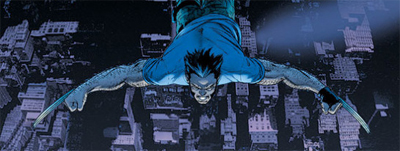
Dive in...

Continue reading

Brian Michael Bendis’ Avengers – New Avengers Vol. 1-2 (Hardcover) (Review/Retrospective)

This is the first in a series of comic book reviews that will look at the direction of Marvel’s “Avengers” franchise over the past five or so years, as they’ve been attempting to position the property at the heart of their fictional universe. With The Avengers planned for a cinematic release in 2012, I thought I’d bring myself up to speed by taking a look at Marvel’s tangled web of continuity. Get an overview of what I’m trying to take a look at here.

Alright. I figure I sound a bit hypocritical complaining about the impact of big events on Marvel’s storytelling continuity without reading said big events. Well, actually, I don’t think I’m a hypocrite – I think it’s perfectly reasonably that a reader should be able to pick up Ed Brubaker’s Captain America without having to worry about Mark Millar’s massive Civil War crossover which they either don’t know enough to care about or know enough not to care about. However, I feel like maybe – just maybe – I should try to ride this “cross-continuity” thing out just once and see if the story somehow justifies the damage it causes to the cohesion of individual runs.  Yes, I’m going to jump head-first into the event-populated minefield of continuity which is recent Marvel history, and I will be using New Avengers as a checklist to that. I’m going down the rabbit hole, following the arc from Civil War through to Siege.

Sentry is responsible for the Carnage in this run...

Continue reading

Geoff Johns’ Run on The Flash – Wonderland, Blood Will Run & Iron Heights

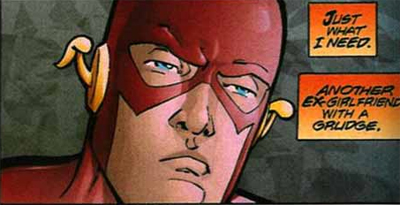
Geoff Johns is pretty much on top of the world. He’s a renowned comic book writer, who has got to work on all his favourite childhood properties – in many cases making them as popular as they’ve been in decades. He’s in charge of DC’s multimedia approach – he’s the guy in charge of the movies and television shows based around the iconic properties. Without his work on the character, next year’s Green Lantern movie wouldn’t be happening. And yet he had to begin somewhere. Although it doesn’t represent his earliest work in comics by a long stretch, in 2000 he took over as writer on The Flash. Despite a string of solid work behind him – and a really successful run for Mark Waid on the title – it was this creative pairing which would arguably propel both writer and character into the spotlight like never before. A decade later, Johns has returned to the book which made him famous, so I think it’s time to begin a trip down memory lane.

Wally's going to have to think fast...

Continue reading

Wednesday Comics: Sgt. Rock & Easy Co.

Earlier this week I reviewed Wednesday Comics, a rather spanking anthology from DC Comics. I kinda figured, however, it might be worth my while to break out some of those fifteen stories on their own (but not all of them) and discuss them, as it’s easy to lose sight of a particular writer/artist’s work in an anthology. Now we’re going back to a “new” old bunch of pulp characters.

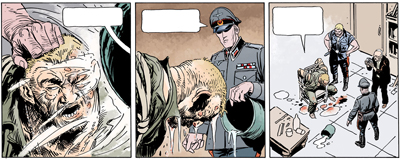
Sgt. Rock & Easy Co. is an interesting choice for the anthology. Although it’s a war comic, it was only introduced in 1959, long after the end of the conflict and in the twilight days of the newspaper strips that this anthology is meant to reproduce. It’s inclusion arguably speaks more to the desire by DC to create a nostalgia for a long legacy that never quite existed than it does to the character’s popularity or place within DC continuity. Sgt. Rock & Easy Co. is one of only three non-superhero strips included – the post-apocalyptic adventures of Kamandi and the Strange Adventures strip, following Adam Strange: Space Hero – and it seems a logical fit if the goal was to create the impression of a large interconnected tapestry of DC history. After all, the only thing as pulpy as a superhero story is good old fashioned war yarn.

That's the closest you'll come to a splash page in this storyline...

Continue reading

Wednesday Comics: Superman

Earlier this week I reviewed Wednesday Comics, a rather spanking anthology from DC Comics. I kinda figured, however, it might be worth my while to break out some of those fifteen stories on their own (but not all of them) and discuss them, as it’s easy to lose sight of a particular writer/artist’s work in an anthology. I’ve done Batman and Wonder Woman, so I figure I should round out the trinity with the Man of Steel.

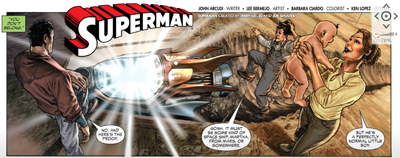
John Arcudi’s Superman project was arguably the comic in Wednesday Comics with the most banking on it. Aside from featuring perhaps the most iconic superhero on the face of the planet, it was also serialised in USA Today. That’s a pretty solid forum for publicising a comic book event, a respectable newspaper with an international circulation. So I can understand that DC might have wanted to avoid a particularly “challenging” or even “geeky” story. However, they ended up choosing perhaps the must dull and lifeless story in the collection to serialise to the public at large. Even more than that, Arcudi’s Superman is a perfect illustration of everything that’s wrong with the character in recent years and why he has seen his hold on popular culture somewhat diminished.

Superman's ship isn't the only thing which crashes and burns...

Continue reading

Wednesday Comics: Kamandi

Earlier this week I reviewed Wednesday Comics, a rather spanking anthology from DC Comics. I kinda figured, however, it might be worth my while to break out some of those fifteen stories on their own (but not all of them) and discuss them, as it’s easy to lose sight of a particular writer/artist’s work in an anthology. I thought I’d turn my attention to one of the conspicuously non-superhero titles in the anthology, an adaptation of the classic Kirby comic, Kamandi.

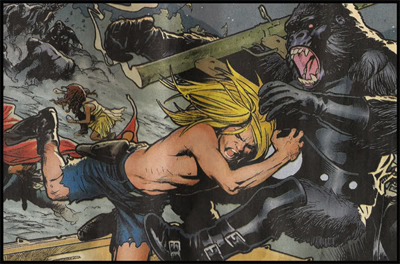
Although Kamandi only debuted in 1972, there’s an argument to be made that the character is better suited to this particular format and style of storytelling than the DC superheroes which otherwise populate the collection. Created by the legendary Jack Kirby, Kamandi is the story of the last boy on earth, attempting to survive in a post-apocalyptic future ruled by hyper-evolved talking animals (rats, cats and – most viciously – apes). The character has a lasting cult appeal, but was never necessarily the most popular property at the publisher, but it’s nice that they dusted him off for this project. I have to admit being a bit surprised at the creative team – Dave Gibbons is regarded as an author, but made his name as an artist, so it’s strange to see him writing this – but it works, it really comes together and suits the unique format of the project perfectly.

Gibbons successfully apes the adventure comics of yore...

Continue reading

Wednesday Comics: Batman

Earlier this week I reviewed Wednesday Comics, a rather spanking anthology from DC Comics. I kinda figured, however, it might be worth my while to break out some of those fifteen stories on their own (but not all of them) and discuss them, as it’s easy to lose sight of a particular writer/artist’s work in an anthology. And I thought that the opening strip deserved a bit of discussion, as it’s perhaps come under a bit of fire for a lot of flaws that are present through a lot of the stories collected.

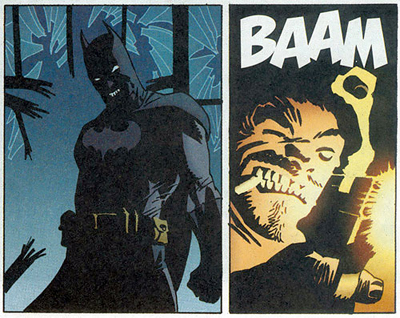
Batman is the story arc which opens Wednesday Comics. Indeed, it was the story which would find itself peering out at the reader week-on-week. Perhaps it was unfortunate that Brian Azzarello’s take on the Caped Crusader went first, because it’s typically drawn a lot of criticism that the stories told failed to take advantage of the format. A lot of the criticism of the story can also be directed at a lot of the subsequence serials, but the Dark Knight draws the brunt of the negativity. Which is a shame, because – despite its conventional nature – Azzarello and artist Eduardo Risso offer a pretty effective snapshot of the Caped Crusader.

Go with a bang...

Continue reading

Wednesday Comics

Hawkman unsheathes his knife and crawls into the gasping T-Rex’s jaws, thinking “Sadly, this is not the craziest thing I’ve ever done.”

– Hawkman

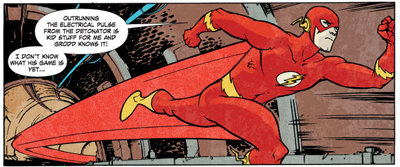
Wednesday Comics is an amazing little experiment, a bit of comic book nostalgia delivered by some of the most talented people in the business with a smile on their face and a skip in their step. For those who don’t know, DC Comics – always the more boldly experimental of the two major companies – ran a twelve-week collection of newspaper comic strips. Fifteen strips bundled together, the reader was offered one page of a given comic at a time on a super-sized newspaper sheet, with a full story told week-on-week. It was a bold little experiment and while the whole is almost certainly greater than the sum of its parts, there’s much to love here.

There in a Flash...

Continue reading

Geoff Johns’ Run on Green Lantern – Blackest Night: Black Lantern Corps (Vol. I & II) & Rise of the Black Lanterns

All right, gang. Let’s go shoot some zombies.

– Captain Cold, Blackest Night: Flash

It wouldn’t be a massive world-ending crisis of a DC Universe cross-over if there weren’t tie-in issues by the bucketful. Sinestro Corps War, Geoff Johns’ earlier Green Lantern mega-event, was relatively low-key in its ambitions, only really spilling across into four specials that dealt with the wider DC Universe. This time there’s close to thirty, which is, as you’d imagine, quite a lot. Given the relatively simplistic nature of the event (it’s basically “superhero zombies”), you’d be forgiven for expecting that the crossovers and tie-ins would become dull or monotonous, but they mostly avoid that. It’s partially due to the variety of perspectives offered, but also due to the extremely talented pool of writers and artists on hand.

As cold... as ice...

Continue reading

Absolute Kingdom Come

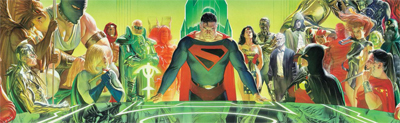
The nineties were a tough decade for the comic book medium. Violence sold. “Grim and gritty” represented the direction for most major comic books. Superman died. Batman was crippled. Green Lantern became a genocidal maniac. The Flash had long since abandoned the comic book universe. This was the era back-to-back Venom miniseries, the rise of Rob Liefeld and the lethal vigilante. A lot of people trace back this trend to the success of groundbreaking series like Watchmen or The Dark Knight Returns, which demonstrated that darker imaginings of conventional superhero comics could sell. Of course, that wasn’t the point of the comics at all, but such complexity is not the speciality of managers and executives. However, if the birth of that so-called “Dark Age” of comic books could be traced back to those roots, then perhaps Kingdom Come can be identified as the birth of a counter-movement against such trends.

Superman brings a lot to the table...

Continue reading