• Following Us

  • Categories

  • Check out the Archives


  • Awards & Nominations

Star Trek: Enterprise – Storm Front, Part I (Review)

This May, we’re taking a look at the fourth (and final) season of Star Trek: Enterprise. Check back daily for the latest review.

Storm Front, Part I and Storm Front, Part II arrive at a transitory time for Star Trek: Enterprise.

The third season of the show had wrapped on a somewhat unexpected cliffhanger, finding Archer confronted by an evil!alien!space!Nazi in the midst of what looked to be the Second World War. Given that the third season had been written as a single extended dramatic arc about Archer and his crew saving Earth from an alien threat, the twist seemed to come out of nowhere. Instead of allowing Archer and his crew to return home, Zero Hour threw out one final hurdle for the characters; a bump in the road home.

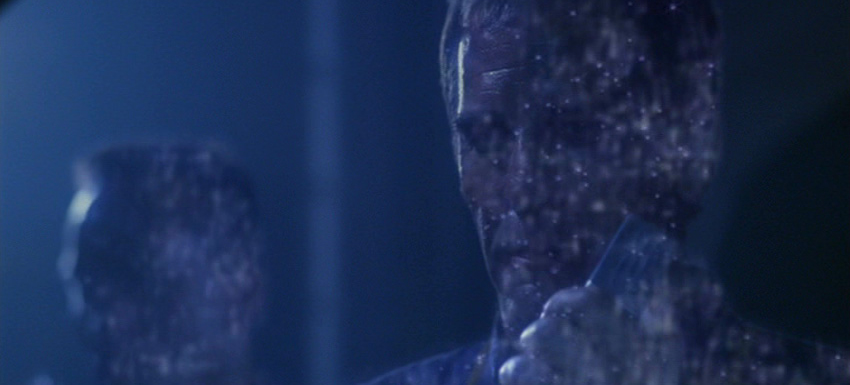
Ship shape.

Ship shape.

However, the episodes also marked a transition behind the scenes. This particular iteration of the Star Trek franchise was on borrowed time. There had been warning signs as early as the first season, but the massive reworking of the show in The Expanse suggested that the network had adopted a “do or die” approach to the future of this lucrative science-fiction franchise. The fact that the third season had its episode order cut and there were suggestions that a fourth season was unlikely suggested that the show had not “done.”

Even aside from all that, the start of the fourth season saw Rick Berman and Brannon Braga taking a step back from the franchise and handing the reins to executive producer Manny Coto. In that respect, Storm Front, Part I and Storm Front, Part II might be seen as the collective last gasp of the Berman and Braga era. Give or take These Are The Voyages…

Back to the future.

Back to the future.

Continue reading

Star Trek: Voyager – Flashback (Review)

This February and March (and a little bit of April), we’re taking a look at the 1995 to 1996 season of Star Trek, including Star Trek: Deep Space Nine and Star Trek: Voyager. Check back daily for the latest review.

Flashback was largely advertised as Star Trek: Voyager‘s contribution to the thirtieth anniversary celebrations of the Star Trek franchise.

It featured guest appearances from three alumni of the original show. It was set during the events of Star Trek VI: The Undiscovered Country. It featured Tuvok and Janeway dressing up in movie-era uniforms. It was publicised as “a very special episode.” It aired only three days after the thirtieth anniversary, while Star Trek: Deep Space Nine waited nearly two months to broadcast Trials and Tribble-ations. Anybody would be forgiven for looking at Flashback as the obligatory nostalgic celebratory adventure to mark the thirtieth anniversary of the Star Trek franchise.

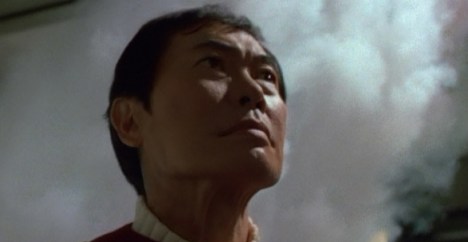
Hero shot.

Hero shot.

Put simply, Flashback does not work in that context. Although it features Captain Hikaru Sulu, the episode doesn’t actually allow him to accomplish anything. As far as “secret histories” go, the episode turns out to be a bit of a cul de sac. More to the point, the continuity is a mess, both in broad franchise terms and specifically with regards to the feature film it heavily references. Although it is great to see Grace Lee Whitney and George Takei back, the script only allows them to interact with Tim Russ and (fleetingly) Kate Mulgrew.

In fact, it could convincingly be argued that Future’s End, Part I and Future’s End, Part II do a much better job of filling the “celebratory thirtieth anniversary story” slot than Flashback, despite the notable absence of any actual characters from the original show. Future’s End, Part I and Future’s End, Part II feel like a gigantic (and enjoyable) homage to Star Trek IV: The Voyage Home, which is both hugely fun and also weirdly appropriate in a play-on-words sort of way. That is more in line with what fans were expecting for the anniversary: nostalgic fun.

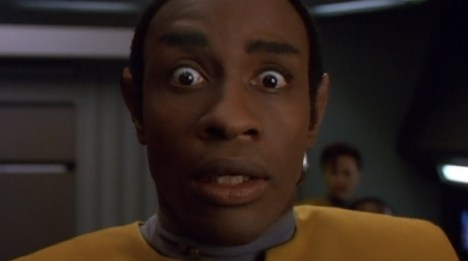
Tim Russ was as excited as anyone to get a Tuvok episode.

Tim Russ was as excited as anyone to get a Tuvok episode.

In contrast, Flashback is something altogether stranger. Brannon Braga had been working on the story before it was suggested that Voyager should do a thirtieth anniversary episode, and Flashback plays more as a Brannon Braga script that ties into an anniversary more than an anniversary episode that happens to be written by Brannon Braga. Despite its high-profile guest cast, Flashback has more in common with Braga’s mind-bending scripts for Frame of Mind or Projections than with Trials and Tribble-ations.

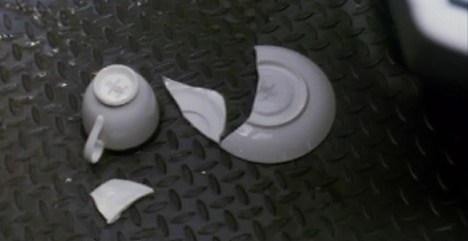
Nevertheless, there is something fascinating about Flashback, because it allows Braga to use the springboard of the thirtieth anniversary to talk about memory.

The teacup that he shattered didn't come together...

The teacup that he shattered didn’t come together…

Continue reading

Star Trek: Voyager – Deadlock (Review)

This February and March, we’re taking a look at the 1995 to 1996 season of Star Trek, including Star Trek: Deep Space Nine and Star Trek: Voyager. Check back daily for the latest review.

In some ways, Deadlock is Star Trek: Voyager‘s original sin.

Of course, Deadlock is good. It is really good. It is a well-constructed piece of television that moves with an incredible momentum; it gathers speed and builds towards a suitably epic finalé. In many ways, Deadlock is one of the strongest episodes from the first two seasons of Voyager. There is a credible argument to be made that Deadlock belongs on any list of “best Voyager episodes ever”, thanks to the potent combination of Brannon Braga’s high-concept script and David Livingston’s dynamic direction.

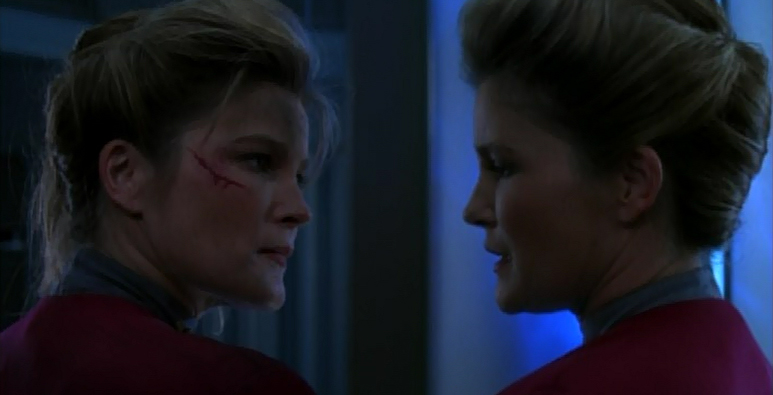
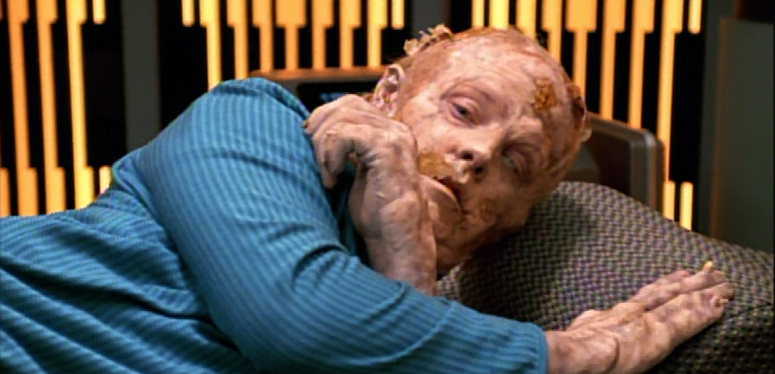
Janeway²...

Janeway²…

At the same time, it is hard not to look at Deadlock in retrospect and see the shape of things to come. It is, perhaps, the ultimate “reset” button episode; it provides a clear template for later “blow up Voyager and kill Janeway” episodes like Year of Hell or Timeless. The trick works very well once; it loses any real impact when it is repeated several times over the course of the show’s run. More than that, the episode feels somewhat generic. Due to the nature of the high-concept premise, there is little room for detail specific to Voyager.

It seems that the end of the second season set the course for the next five years of Voyager. The production team had tried to tell an experimental story specific to Voyager with Investigations, only to fail spectacularly; it would be the last time that the show attempted anything so bold. In contrast, the production team managed to construct a fantastic episode around a generic premise in Deadlock, perhaps indicating that the future of the show lay in that direction. It is easy to see why that production team opted for safe and generic ahead of ambitious and experimental.

Ghost stories...

Ghost stories…

Continue reading

Star Trek: Voyager – Threshold (Review)

This February and March, we’re taking a look at the 1995 to 1996 season of Star Trek, including Star Trek: Deep Space Nine and Star Trek: Voyager. Check back daily Tuesday through Friday for the latest review.

Threshold is hated by fandom.

Veteran reviewer Jamahl Epsicokhan described it as “one of the all-time worst episodes of Star Trek ever filmed.” He is far from the only voice raised in protest. Winston O’Boogie remarked that, watching the episode, “you can’t help but think that something has gone terribly, terribly wrong with the world that allowed this to happen.” Assessing writer Brannon Braga’s contributions to the larger franchise, Jim Wright reflected, “Whatever else he may accomplish, he’s as forever shackled to Threshold as George Lucas to Jar-Jar.”

It's not even the worst episode of the season...

It’s not even the worst episode of the season…

Threshold is terrible. There is no way around that. It is a very stupid episode that is never entirely sure what it is trying to say from one moment to the next. More than that, positioning it as an important Tom Paris arc in the middle of the second season serves to sabotage the already confused character arc running between Alliances and Investigations. There is absolutely no context in which Threshold could be described as a “good” (or even “competent”) hour of television.

At the same time, it is not one of the worst episodes of the franchise ever produced; it is not even one of the worst episodes of the series. Surrounded by episodes like Tattoo or Alliances, the episode cannot even make a particularly confident claim to being the worst instalment of the season. None of this should be confused as an endorsement of Threshold. It is condemnation of everything that exists around Threshold.

The great mutato!

The great mutato!

Continue reading

Star Trek: Voyager – Cold Fire (Review)

This February and March, we’re taking a look at the 1995 to 1996 season of Star Trek, including Star Trek: Deep Space Nine and Star Trek: Voyager. Check back daily Tuesday through Friday for the latest review.

Cold Fire is an episode that exemplifies the feeling that second season’s treading water.

Cold Fire opens with a somewhat unconventional recap of Caretaker. Unlike most “previously on…” sections of Star Trek: Voyager (or the Star Trek franchise as a whole), this block is narrated by Majel Barrett in-character as the ship’s computer. It becomes clear that Cold Fire is interested in following up on the dangling threads left by Caretaker, with the crew of Voyager encountering the female mate alluded to in Janeway’s conversations with the eponymous Nacene character from Caretaker.

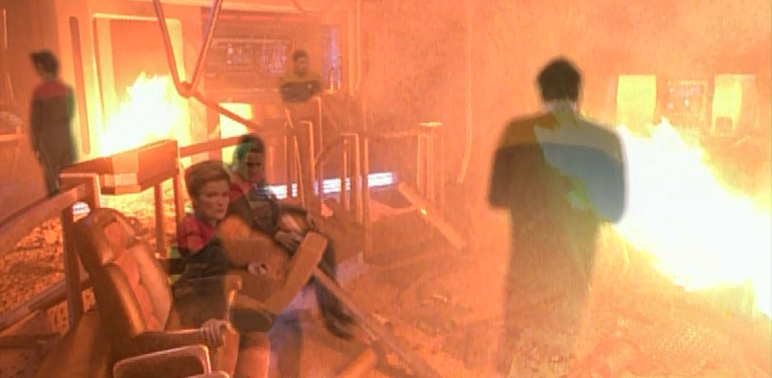
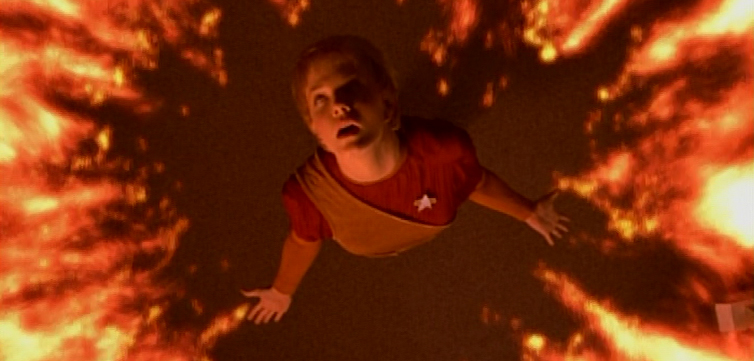
Everything burns...

Everything burns…

This should be a big deal. After all, the Caretaker is the character responsible for plucking Voyager and the Val Jean out of the Alpha Quadrant and depositing them on the other side of the galaxy. Finding another being with a similar amount of power presents a very real and tangible opportunity for Janeway to get her crew home. If the Caretaker could pull them all the way across the Milky Way, then it stands to reason that Suspiria could send them all the way back. Cold Fire presents a potential end to Voyager’s journey.

Unfortunately, Cold Fire never really does anything with that storytelling angle. Even when Janeway comes face-to-face with Suspiria at the climax of the episode, she never asks the powerful entity to send her crew home. So Cold Fire feels like an episode that spends forty-five minutes walking in circles, accomplishing little of note.

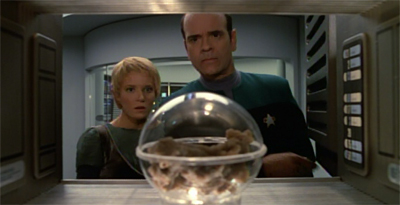
"It's probably just the inertial dampeners acting up..."

“It’s probably just the inertial dampeners acting up…”

Continue reading

Star Trek: Enterprise – Zero Hour (Review)

Next year, Star Trek is fifty years old. We have some special stuff planned for that, but – in the meantime – we’re reviewing all of Star Trek: Enterprise this year as something of a prequel to that anniversary. This August, we’re doing the third season. Check back daily for the latest review.

There was a very real chance that Zero Hour might have been the last episode of Star Trek: Enterprise to air.

In fact, it was entirely possible that Zero Hour‘s distinctive (and downright provocative) closing shot of an evil!alien!space!Nazi might have been the last shot of Star Trek to air on television for quite some time.

Time is running out...

Time is running out…

Continue reading

Star Trek: Enterprise – Damage (Review)

Next year, Star Trek is fifty years old. We have some special stuff planned for that, but – in the meantime – we’re reviewing all of Star Trek: Enterprise this year as something of a prequel to that anniversary. This August, we’re doing the third season. Check back daily for the latest review.

The stock comparison for Damage is In the Pale Moonlight.

This makes a great deal of sense. After all, both are Star Trek episodes that hinge on a series of morally questionable decisions made by the lead actor in a moment of sheer desperation. In In the Pale Moonlight, Benjamin Sisko starts a chain of events that builds towards the assassination of a Romulan Senator to trick the Romulans into joining the war effort. In Damage, Jonathan Archer resorts to piracy in order to obtain the parts necessary to make a meeting with Degra in order to plead against the use of the Xindi weapon.

A met a man who wasn't there...

A met a man who wasn’t there…

There are some notable differences, of course. In purely practical plotting terms, Sisko dominates the narrative of In the Pale Moonlight; the entire story is related directly by Sisko to the audience in the form of a personal log. In contrast, Damage is split between the demands of Archer’s own arc in the episode and various other continuity elements; the episode needs to get Archer back to his ship and devote a considerable amount of time to T’Pol’s addiction. As a result, it lacks the keen focus that made In the Pale Moonlight so compelling.

At the same time, there is something much more direct about Damage. Sisko is quite detached from the horrors of In the Pale Moonlight, with the audience insulated from his choices through the use of a framing device and Sisko himself insulated through his use of Garak to conduct all the unpalatable actions. In contrast, Archer makes a point to bloody his own hands over the course of Damage. He doesn’t have somebody else to make the decision for him; he leads the boarding party himself.

Everything comes apart...

Everything comes apart…

It is a very bold an unsettling choice, a culmination of a character arc that has been pushing Archer towards this sort of horrific choice since Anomaly. The third season of Star Trek: Enterprise has not been entirely consistent when it comes to its character arcs, working better in broad strokes than in fine detail. Nevertheless, Damage represents a very clear commitment to the promise of the third season of Enterprise; an interrogation of the franchise’s core values in an increasingly morally ambiguous world.

Damage is a deeply uncomfortable and unsettling episode of Star Trek, but it is arguably a necessary one. It is, in many ways, a criticism of the moral absolutism that informs a lot of discussion about terrible situations, suggesting that reality is often a lot more complicated than people might hope it would be.

Drowning his sorrows...

Drowning his sorrows…

Continue reading

Star Trek: Enterprise – Carpenter Street (Review)

Next year, Star Trek is fifty years old. We have some special stuff planned for that, but – in the meantime – we’re reviewing all of Star Trek: Enterprise this year as something of a prequel to that anniversary. This August, we’re doing the third season. Check back daily for the latest review.

This is the point at which it becomes all but impossible to argue that the production team knew what they were doing this season.

The third season of Star Trek: Enterprise holds together reasonably well, if the viewer pulls back to a big enough distance. The broad arcs are discernible and logical – there is a clear start point and a reasonable trajectory, even if the first half of the season tends to get a bit lost. It really pulls itself together during the second half of the season, with one or two exceptions, building towards a finalé that satisfies both the demands of a year-long arc and the franchise surrounding it. It is not perfect, but it is not bad for a first attempt.

Hey kids! It's Leland Orser!

Hey kids! It’s Leland Orser!

Of course, it is also quite clear that the production team really had no idea what they were doing – or even what they were trying to do. The fact that it comes together in the second half of the season all but concedes that it doesn’t hold together in the first half. The first half of the third season is populated with standalone episodes that tend to either fit thematically (North Star, Similitude) or tonally (Impulse, Exile) with the general direction of the show, but a rather limited sense of progress or advancement.

Carpenter Street is the point at which any real sense of trust between the audience and the production team snaps like a twig. It is a story that features the characters time travelling to modern-day Earth in the middle of a gigantic story arc about how they are more isolated than they ever have been before. It throws away any sense of internal logic or consistency, never really exploring how an alien species that can travel back to Detroit in 2004 should have a problem with Earth in 2153. And, crucially, it is not fun enough to excuse those issues.

Hey kid! It's Jeffrey Dean Morgan! (Really!)

Hey kid! It’s Jeffrey Dean Morgan!
(Really!)

Continue reading

Star Trek: Enterprise – Anomaly (Review)

Next year, Star Trek is fifty years old. We have some special stuff planned for that, but – in the meantime – we’re reviewing all of Star Trek: Enterprise this year as something of a prequel to that anniversary. This August, we’re doing the third season. Check back daily for the latest review.

Anomaly continues the sense that the third season of Star Trek: Enterprise is essentially a new first season of the show.

That is most obvious in the way that the script works hard to establish the ground rules of the Expanse. There is a sense that the episode is very clearly establishing rules and plot points that will come into play later in the run. Anomaly not only explains why mining for trellium-D is such a profitable enterprise; explaining that ships without it are susceptible to all sorts of strange distortions to the laws of physics. Anomaly also introduces the spheres, strange structures that will become a key part of the third season’s mythology.

A good man goes to war...

A good man goes to war…

The show is also marking out ground for later exploration. Anomaly becomes a lot more potent in hindsight, with various decisions here reversed in later episodes. In Anomaly, Archer is a victim of piracy; in Damage, he is forced to commit piracy. In Anomaly, Archer tortures a prisoner in order to procure information that he needs; in Countdown, Hoshi is tortured by Dolim in order to procure information that he needs. It is not entirely clear whether these plot beats were figured out ahead of time, but – like the destroyed Xindi home world in The Xindi – they lend the third season a nice sense of moral symmetry.

Most interestingly – and, perhaps, most pointedly – Anomaly represents a clear return to two very early episodes of the first season. The script of Anomaly touches quite overtly on plot points from Fight or Flight and Strange New World. In some ways, it could be seen as a belated do-over.

Sparks fly...

Sparks fly…

Continue reading

Star Trek: Enterprise – The Xindi (Review)

Next year, Star Trek is fifty years old. We have some special stuff planned for that, but – in the meantime – we’re reviewing all of Star Trek: Enterprise this year as something of a prequel to that anniversary. This August, we’re doing the third season. Check back daily for the latest review.

Delivering on change is always more difficult than promising change.

The first block of episodes in the third season of Star Trek: Enterprise struggle with the weight of expectation and the sense that the production team have no real idea of how to manage this sort of storytelling. Rick Berman and Brannon Braga had consulted with Ira Steven Behr towards the end of the second season, suggesting that they wanted to model the storytelling loosely on the blend of episodic and serialised scripting that Behr oversaw on Star Trek: Deep Space Nine. It makes sense, as Deep Space Nine was the only Star Trek series to really engage with that sort of storytelling.

A primate example of the Xindi...

A primate example of the Xindi…

In hindsight, it seems a shame that the writing room on Deep Space Nine was allowed to disintegrate so thoroughly. Ira Steven Behr, Hans Beimler and Rene Echevarria departed immediately following What You Leave Behind. Ronald D. Moore migrated briefly over to Star Trek: Voyager, but quit quite promptly following creative disagreements with former collaborator Brannon Braga. The veteran writers on Enterprise came from Voyager. Brannon Braga, Mike Sussman, Phyllis Strong and André Bormanis were all writers who had come into their own working on Voyager.

Star Trek: Voyager a show that was incredibly episodic and seemed to actively resist serialisation even more than Star Trek: The Next Generation. This is not a reflection on the production team. Braga had lobbied to expand Year of Hell into a year-long story arc during the fourth season, but his proposal had been rejected. Discussing the Xindi arc, Braga has talked about how he wanted to tell a year-long Star Trek story, and it is telling that one of his post-Star Trek writing assignments was on 24.

The ascent...

The ascent…

Nevertheless, it meant that the writers working on Enterprise faced a sharp learning curve when it came to structuring the third season. The experience accumulated during the arc-building on Deep Space Nine was largely lost to the franchise, and a lot of the early part of the third season sees Enterprise making a number of teething mistakes. The early stretch of the third season struggles to pace itself, and it struggles to integrate stand-alone stories with its larger serialised arc.

The Xindi is a prime example of this, an episode that has a wealth of interesting ideas and great concepts, but one that stumbles in the execution.

Pointing the finger...

Pointing the finger…

Continue reading