As well as counting down the top twelve films, I’m also going to count down my top twelve movie related “moments” of 2012. The term “moment” is elastic, so expect some crazy nonsense here. And, as usual, I accept that my taste is completely absurd, so I fully expect you to disagree. With that in mind, this is #10…
I know that Joseph Gordon-Levitt has been around a while. I was fond of the actor back when he was appearing on Third Rock From the Sun, which already seems like a lifetime ago. More recently, he appeared in perhaps the best romantic comedy of the last decade, (500) Days of Summer. He has been running his own production company, hitRECordjoe since 2009. Even last year the actor was headlining movies like 50/50. As such, it feels a bit disingenuous to suggest that he really burst on to the scene this year, but 2012 has been a great year for the actor, and it’s always great to see a deserving young talent emerge.
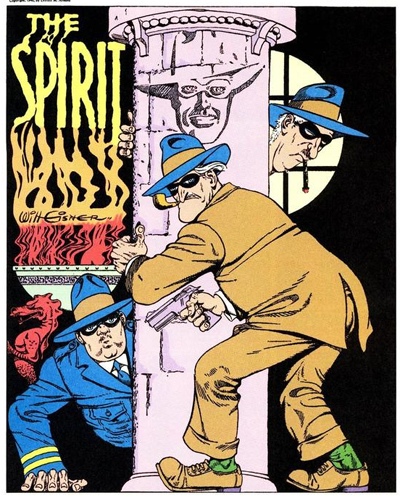
There’s a sense that Eisner and his staff knew that the end was rapidly approaching. Narratively speaking, there’s a lot of different elements here that suggest – at least unconsciously – an effort to tidy up The Spirit so that it could be neatly folded up and put away. Eisner hadn’t completely abandoned his creation to its fate at this point, but it seemed like he was well aware that the strip might not continue forever. The Spirit Archive, Vol. 22 seems a bit more reflective than the editions that came before, acknowledging that the worm is slowly turning.
The new trailer for Man of Steel has arrived and… I’m actually pretty excited about it. I’m a pretty big Superman fan, although I’ll admit that the character can be very tough to adapt. While Batman lends himself to all manner of interpretations, the Man of Steel is a lot harder to get a handle on. Batman is – despite being an orphan billionaire – much easier to relate to than an alien from another world. It’s hard to write a character who can do almost anything, and tough to emotionally invest in a hero who can shrug off bullets.
And, yet, despite that, I am cautiously optimistic about this Man of Steel, if only because it seems to grasp something about the character – something that Christopher Nolan’s Dark Knight trilogy understood about Batman. These truly iconic characters are important for what they say about us, and our culture. It’s fun to watch Superman smash alien ships and fly into the sun, but what does his appearance suggest about the world he inhabits. Can we trust him? Can he trust us? Nolan grasped that Batman was about hope in the face of despair – the notion that one man could make a difference and ascend to the status of myth. It seems, based on this trailer, that Man of Steel is about optimism and faith.
The CGI looks grand, but it’s the personal stuff that I responded to. The moment where Clark confesses that his father worries about him. He’s the strongest man in the world, impervious to bullets, and yet Jonathan Kent fears what the world will do to his son – that somehow they might “reject” him, and that would be worse than any physical harm that could befall the child he raised. That’s a fascinating (and strangely natural) hook. There’s something very human about a father’s selfish desire to put his child ahead of the greater good.
When Clark flat out asks his father if he should have allowed those kids to die, Jonathan Kent selfishly replies, “Maybe.” It’s a strangely natural moment, and it feels organic for a father to place the security of his family above the greater good. It doesn’t make Jonathan seem shallow or cynical. It just makes him seem a bit more real. And, naturally, Superman is about transcending that sort of understandable selfishness. With great power, to quote another iconic hero, comes great responsibility, and the heart of Superman suggests that if a man were to find himself gifted these incredible powers, he would use them for the betterment of mankind rather than keep them locked away for personal gain.
There’s another nice moment where Clark asks Lois if she thinks the world is ready – because Superman is a concept that can’t work without absolute trust. If the character can’t be trusted by the world at large, then he loses any moral authority. Unlike Batman who exists as an underdog and can work outside the establishment, the nigh-all-powerful Superman has to be wary of being portrayed as an alien fascist imposing his will on a less powerful mankind.
Superman Returns didn’t realise this and eroded away Superman’s moral high ground, turning the character into a spoilt and entitled teenager with the power of a god. Superman Returns was a disaster and more of a horror movie than a superhero film. It’s not about creating a world that immediately accepts Superman, but in recognising that he has to convince it of his worth. Superman’s real victory isn’t pounding Zod into a skyscraper, it’s convincing people to believe in him. After all, Superman is the very embodiment of optimism, the notion that – were a man suddenly able to fly and deflect bullets – he would use his powers to make the world a better place. If we can believe in the basic goodness of Superman, we can believe in our own capacity to do the impossible.
If Man of Steel can embrace the character without a hint of irony, I think we might be on to something.
Join us the December as we take a dive into the weird and wonderful Will Eisner Spirit Archives, the DC collections of the comic strip that helped define the medium.
With this second collection of six months worth of strips, we can see Eisner’s vision of The Spirit really cement itself, as well as the true beginnings of the more experimental work that the writer and artist would do with the newspaper strip. While a lot of people would argue that Eisner truly hit his stride in the postwar era of The Spirit, I think we can see him beginning to truly hone his craft here, and can get a sense of an artist slowly testing the horizons of an eight-page newspaper comic strip. It might not be his best work on the title, but it’s still fascinating stuff.
This month I’m taking a look at DC’s massive “Infinite Crisis” Event. Although it was all published in one massive omnibus, I’ll be breaking down the lead-in to the series to tackle each thread individually, culminating in a review of the event itself. Check back for more.
Infinite Crisis is a fantastic concept with a somewhat muddled execution. The idea of reflecting on the way the DC Universe has evolved since Crisis on Infinite Earths is a fascinating hook for an event miniseries, and writer Geoff Johns does an effective job of exploring how times have changed. However, the original Crisis on Infinite Earths had a tendency to seem too vast and too all-encompassing for its own good, randomly jumping between a cast of hundreds lost in a maelstrom. Given that Marv Wolfman had twelve issues to tell that story, and still occasionally ended up a little confused, it seems a little unfair for Geoff Johns to attempt a similar effort in only seven issues.
There are times when Infinite Crisis feels less like one cohesive story and more like a series of vignettes based around a theme. That doesn’t mean there isn’t a lot of interesting stuff going on here – or that Johns doesn’t have something compelling to say about modern superhero comics – it just means that Infinite Crisis is a bit of a mess. A bold and ambitious mess, but a mess nevertheless.
This month I’m taking a look at DC’s massive “Infinite Crisis” Event. Although it was all published in one massive omnibus, I’ll be breaking down the lead-in to the series to tackle each thread individually, culminating in a review of the event itself. Check back for more.
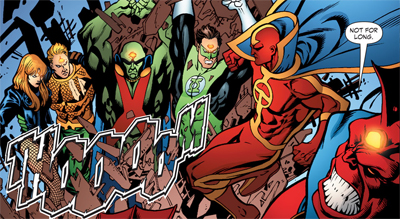
Crisis of Conscience exists of something of a bridge between Identity Crisis and Infinite Crisis. Of course, other tie-ins (like Villains United) have already explored that fertile ground, but Crisis of Conscience is very much about exploring the implications of that earlier crisis crossover. After all, how can the heroes trust one another, or themselves, when they’ve been tampering and playing with memory and personality. Ultimately, Crisis of Conscience doesn’t necessarily resolve anything. It really just lines up all the final pieces before we jump into Infinite Crisis proper. However, it’s an interesting exploration of just how far these characters have come since the innocence of the Silver Age.
This month I’m taking a look at DC’s massive “Infinite Crisis” Event. Although it was all published in one massive omnibus, I’ll be breaking down the lead-in to the series to tackle each thread individually, culminating in a review of the event itself. Check back for more.
I’ve always been a fan of the “hokey science-fiction” corner of the DC Universe. Adam Strange is perhaps my second-favourite Silver Age DC hero (behind the Flash). I loved Alan Moore’s trip to the stars during his Swamp Thing run. While many thought that Stars my Destination, the penultimate mega-arc of James Robinson’s Starman, went on far too long, I loved every page. Geoff Johns’Green Lantern is one of my favourite modern comic book runs. I confess all this so that my bias is upfront, when I admit that Rann-Thanagar War is one of my favourite Infinite Crisis tie-ins, even though it’s one of those least directly connected to the event itself.
This month I’m taking a look at DC’s massive “Infinite Crisis” Event. Although it was all published in one massive omnibus, I’ll be breaking down the lead-in to the series to tackle each thread individually, culminating in a review of the event itself. Check back for more.
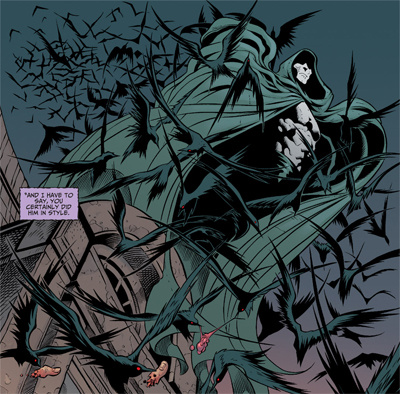
It seems like, within the last decade or so, DC has had a great deal of difficulty organising its “magic and mystic” books. DC generally provided a nice home for books like Alan Moore’s Swamp Thing or John Ostrander’s Spectre, but it seemed like there wasn’t really an abundance of successful magic-themed books in the early part of the new millennium. DC would consciously attempt to remedy this with their “dark” line as part of the “new 52” relaunch, but Day of Vengeance feels like something of an awkward earlier attempt to streamline that corner of the shared universe and to prepare it for some sort of creative relaunch.
One for sorrow, two for joy… What for a few dozen?
Frank Miller’s The Dark Knight Returns might just be the most influential Batman comic ever written. It offers a glimpse an alternate future where Batman has retired as Gotham’s protector, and where a new wave of violence brings him back out of that retirement. It is also, and perhaps more notably, a study of the character’s psychology. It’s notable for suggesting that Bruce Wayne’s obsessions might be ultimately self-destructive and that there’s a primal conflict between the “Batman” part of his persona and Bruce Wayne. Like Watchmen, it’s generally recognised as one of the comics that represented a maturity in the medium.
Warner Brothers have produced an animated adaptation of Frank Miller’s classic, and I can’t help but admire it a great deal. While Alan Moore’s Watchmen was a novel that never really lent itself to film, Miller’s The Dark Knight Returns always had a cinematic quality that I think director Jay Oliva captures remarkably well.
This month I’m taking a look at DC’s massive “Infinite Crisis” Event. Although it was all published in one massive omnibus, I’ll be breaking down the lead-in to the series to tackle each thread individually, culminating in a review of the event itself. Check back for more.
Note: Although technically not a lead-in, and not included in the Omnibus, Planet Heist leads directly to Rann-Thanagar War, so I thought I’d take a look at it. Also, it’s a pretty damn fine series.
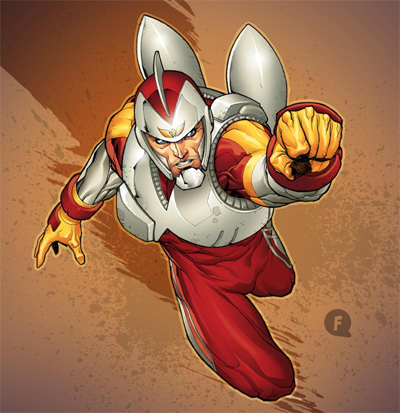
I’ve always had a soft spot for Adam Strange. Along with The Flash, Strange’s adventures in Mystery in Space are among my favourite of DC’s Silver Age comic books. (That would suggest a fondness for Carmine Infantino, who – his Batman work aside – is certainly a favourite of mine.) I’m boggled that DC has never managed to make more of Strange than they have. A delightful science-fiction concept, blending John Carter of Mars with a fifties ray-gun aesthetic, it seems ripe for pulpy exploitation. In fact, before Marvel announced Guardians of the Galaxy, I figured that Strange might prove DC’s best big screen hope of distinguishing themselves from Marvel.
Andy Diggle and Pascal Ferry’s Planet Heist is a delightful eight-issue miniseries featuring the character, updating him for a new era. I can’t help but feel a little sad that the pair didn’t extend the miniseries into a run, and that Adam Strange remains a neglected character in the DC pantheon.





















 the m0vie blog