• Following Us

  • Categories

  • Check out the Archives


  • Awards & Nominations

Doctor Who: Doomsday (Review)

To celebrate the fiftieth anniversary of the longest-running science-fiction show in the world, I’ll be taking weekly looks at some of my own personal favourite stories and arcs, from the old and new series, with a view to encapsulating the sublime, the clever and the fiendishly odd of the BBC’s Doctor Who.

Doomsday originally aired in 2006.

Daleks, be warned. You have declared war upon the Cybermen.

This is not war. This is pest control.

We have five million Cybermen. How many are you?

Four.

You would destroy the Cybermen with four Daleks?

We would destroy the Cybermen with one Dalek. You are superior in only one respect.

What is that?

You are better at dying.

– the Cyberleader and Dalek Sec compete for the title of “bitchiest Doctor Who villain”

Part of my frustration with Doomsday is the same problem that I have with the rest of the second season’s weaker episodes. Like Fear Her or Rise of the Cybermen, the second season finalé lacks ambition. It feels complacent, it feels comfortable. It feels like putting the Daleks and the Cybermen together in one episode is enough to merit attention, without anything more than exchanging pithy one-liners. It feels like the separation of the Doctor and his companion is the biggest and most important thing in the universe, without really convincing us that this isn’t the best possible outcome. It feels like the easiest way to make these threats palpable is to set them in modern London, without any real sense of consequence or scale.

The tears of a Time Lord...

The tears of a Time Lord…

Continue reading

Doctor Who: Army of Ghosts (Review)

To celebrate the fiftieth anniversary of the longest-running science-fiction show in the world, I’ll be taking weekly looks at some of my own personal favourite stories and arcs, from the old and new series, with a view to encapsulating the sublime, the clever and the fiendishly odd of the BBC’s Doctor Who.

Army of Ghosts originally aired in 2006.

How long are you going to stay with me?

Forever.

– the Doctor and Rose tempt fate

It’s only logical that anybody diving head-first into a fifty-year-old television show is going to have an opinion that radically diverges from the fandom consensus on a couple of stories. So, for example, I’ll concede that I like The Talons of Weng-Chiang, but less than most. However, the biggest divide – and the point on which I feel furthest from consensus – comes with Army of Ghosts and Doomsday, Russell T. Davies’ massive farewell to Rose Tyler, the companion he introduced all the way back in Rose. It’s generally acknowledged as one of the high points of Davies’ tenure and one of the truly great Tenth Doctor stories.

I am far from convinced.

The cracks are starting to show...

The cracks are starting to show…

Continue reading

Jason Aaron’s Run on Wolverine & The X-Men – Avengers vs. X-Men (Review/Retrospective)

To celebrate the release of The Wolverine later in the month, we’re taking a look at some classic X-Men and Wolverine comics every Monday, Wednesday and Friday here. I’m also writing a series of reviews of the classic X-Men television show at comicbuzz every weekday, so feel free to check those out.

Wolverine and the X-Men is one of the best comics that is being published by Marvel at present. Along with Waid’s Daredevil and Fraction’s Hawkeye, it’s a celebration of the strange and surreal side of comics. Jason Aaron doesn’t get enough credit for his character work, but his handle on the wonderfully wacky side of the X-Men mythos makes Wolverine and the X-Men a joy to read for anybody with an open mind and a willingness to try something a bit different.

Although the Avengers vs. X-Men tie-in issues are hardly the best place to witness Aaron’s artful approach to the franchise, often feeling a little disjointed and more all-over-the-map than usual, they still contain a lot of what makes Aaron’s work with the characters so appealing.

Burn, baby, burn...

Burn, baby, burn…

Continue reading

The Sopranos: A Hit is a Hit (Review)

A Hit is a Hit works a lot better than Boca, despite the fact that it’s structurally quite similar. It introduces a bunch of new characters and concepts to the series which don’t really extend beyond the episode in question. Massive G never appears again, and the pending lawsuit he threatens is never discussed in any later episode. It’s a light stand-alone tale coming towards the end of a season which has dedicated so much time and effort to building a full-formed world.

However, A Hit is a Hit doesn’t feel completely disposable. Part of that is down to the wonderful B-plot in which Tony finds himself struggling for acceptance among more the more reputable members of his neighbourhood, but it’s also down to the fact that the main plot feels like develops the themes of The Sopranos a lot better than Boca did, and that Christopher’s character arc feels like a logical progression rather than simply “an issue of the week.”

Ain't that a shot in the head?

Ain’t that a shot in the head?

Continue reading

Non-Review Review: Pacific Rim

The generic way of describing Pacific Rim seems to be Transformers vs. Godzilla, which really says more about how hard it is to sell an original blockbuster these days than it does about the quality of the film itself. There are obvious and superficial similarities between Pacific Rim and the two film series cited – giant robots and monsters from the ocean – but that cynical synopsis doesn’t do justice to director Guillermo Del Toro’s bold vision.

Pacific Rim is a punchy old-school summer blockbuster, one which remembers that characters are the foundation of drama, and which imbues its flesh-and-blood cast with as much personality as the flesh-and-blood spectacle unfolding overhead.

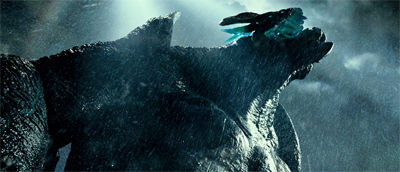
Here there be monsters...

Here there be monsters…

Continue reading

Kieron Gillen’s Run on Uncanny X-Men – Avengers vs. X-Men (Review/Retrospective)

To celebrate the release of The Wolverine later in the month, we’re taking a look at some classic X-Men and Wolverine comics every Monday, Wednesday and Friday here. I’m also writing a series of reviews of the classic X-Men television show at comicbuzz every weekday, so feel free to check those out.

Kieron Gillen is one of the unsung heroes of modern superhero comics. Over the past few years, Gillen has come to the attention of readers for replacing or supplementing a-list talent on a-list books. He took over Thor after J. Michael Straczynski abruptly wrapped up his run on the Norse god, only to shuffle off the book when Matt Fraction took over. While Straczynzki’s run was collected in an omnibus, Gillen’s has yet to receive hardcover status. He wrote the wonderfully underrated Journey into Mystery as a supplement to Fraction’s Thor, which might hopefully get a deluxe reprinting at some point in the future.

He took over Uncanny X-Men following Fraction’s departure. He barely had time to establish his run on Marvel’s merry mutants before writer Jason Aaron up-ended the status quo with Schism, essentially restructuring Marvel’s X-Men line. Gillen remained on Uncanny X-Men in the wake of Schism, the title resetting to #1. However, less than a year into the run, Gillen’s Uncanny X-Men was caught up in Marvel’s high profile crossover of the year, Avengers vs. X-Men.

Explosive...

Explosive…

Gillen departed the book following Avengers vs. X-Men, in yet another reshuffle of Marvel’s X-Men line. (Brian Bendis promised to push the line in a new direction, writing both All-New X-Men and Uncanny X-Men.) Half of Gillen’s run on the relaunched Uncanny X-Men was tied into the gigantic Avengers vs. X-Men.

But don’t let that fool you. It’s really very, very good. In fact, it ranks as among the very best X-Men work since Joss Whedon and John Cassaday left Astonishing X-Men.

All fired up...

All fired up…

Continue reading

Doctor Who: Time and the Rani (Review)

To celebrate the fiftieth anniversary of the longest-running science-fiction show in the world, I’ll be taking weekly looks at some of my own personal favourite stories and arcs, from the old and new series, with a view to encapsulating the sublime, the clever and the fiendishly odd of the BBC’s Doctor Who.

Time and the Rani originally aired in 1987.

Right, that all seems quite clear. Just three small points. Where am I? Who am I? And who are you?

– the Doctor

A Doctor’s first story is always difficult. Even if it’s not as explicit as it was in Power of the Daleks, the new actor his constantly fighting against the weight of expectation, trying to cast off the spectre of their predecessor and make the show their own. There’s also a sense that the production team is trying to reinvent the show around their new lead. It’s transitional, and it’s not too difficult to see how the task could be daunting.

If that’s a typical first story, imagine how frustrating Time and the Rani must have been at the time. Hastily cobbled together in a rush, coming out of a season that had been a spectacular failure and with the shadow of cancellation looming heavy, there’s a lot of pressure on Time and the Rani. It is a story that is routinely trashed and mocked, and perhaps deservedly so. However, I must concede, it’s not as bad as it could have been and I’d be very reluctant to rank it among the worst Doctor Who serials of all time.

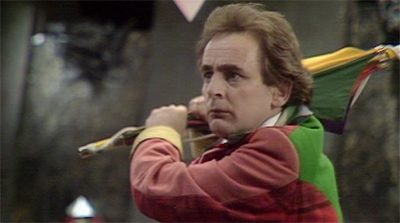
He's got an umbrella and he's not afraid to use it!

He’s got an umbrella and he’s not afraid to use it!

Continue reading

Doctor Who: The Trial of a Time Lord – The Ultimate Foe (Review)

To celebrate the fiftieth anniversary of the longest-running science-fiction show in the world, I’ll be taking weekly looks at some of my own personal favourite stories and arcs, from the old and new series, with a view to encapsulating the sublime, the clever and the fiendishly odd of the BBC’s Doctor Who.

The Trial of a Time Lord originally aired in 1986.

In all my travellings throughout the universe I have battled against evil, against power-mad conspirators. I should have stayed here. The oldest civilisation, decadent, degenerate and rotten to the core. Ha! Power-mad conspirators, Daleks, Sontarans, Cybermen, they’re still in the nursery compared to us. Ten million years of absolute power, that’s what it takes to be really corrupt.

– the Doctor

There really are no excuses for the mess that The Trial of a Time Lord became. I mean, seriously. The producers had eighteen months to plan everything out. The task shouldn’t be that difficult. If you are going to fictionalise the persecution of Doctor Who by the BBC in the form of a trial, you really should have some idea what you plan to do or say at the end of it. If your fourteen episode season-long story arc is about defending a show that is coming close to cancellation, then perhaps it might be a good idea to be able to tell us why it shouldn’t be cancelled. The Trial of a Time Lord is a gigantic mess, and something that makes a stronger case in favour of Michael Grade’s attempts to cancel that show than it does against them.

The Ultimate Foe isn’t as soul-destroyingly horrible as Terror of the Vervoids, but that may be because Pip and Jane Baker only wrote half of it.

Only himself for company...

Only himself for company…

Continue reading

Doctor Who: The Trial of a Time Lord – The Mysterious Planet (Review)

To celebrate the fiftieth anniversary of the longest-running science-fiction show in the world, I’ll be taking weekly looks at some of my own personal favourite stories and arcs, from the old and new series, with a view to encapsulating the sublime, the clever and the fiendishly odd of the BBC’s Doctor Who.

The Trial of a Time Lord originally aired in 1986.

Well, this is a charade.

– the Doctor gets the idea quickly enough

The Doctor had been off screens for eighteen months following Revelation of the Daleks. Michael Grade was desperately trying to cancel the show, and it only limped back to screen with a significantly reduced budget and much shorter run of episodes. The show length was also reverted back to its default value. This season would only run for fourteen half-hour episodes – what would become the set length for Doctor Who in the years to come. (Indeed, counting the Christmas Special, the revived series also runs to that length, albeit in forty-five minute episodes.)

By all accounts, the production on the infamous Trial of a Time Lord was a disaster for reasons natural and otherwise. Veteran writer Robert Holmes was to provide the opening and closing scripts, but passed away before his work on the finalé could be finished. Script editor Eric Saward and producer John Nathan-Turner clashed over the climax of the trial, prompting Saward to resign and Nathan-Turner to temporarily become script editor himself. Colin Baker couldn’t make sense of Mindwarp. The last episode of the season was written by two writers wrapping up from Holmes’ first part, but unable to examine his notes on how he planned to conclude it.

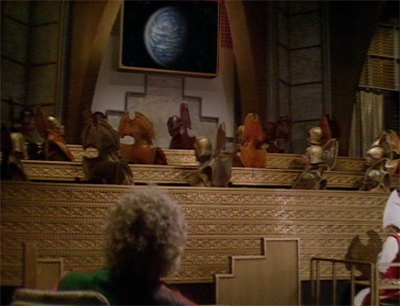
Believe me when I state that every last ounce of this behind-the-scenes friction was visible on-screen by the end of the year. Luckily enough, the show does a decent enough job concealing these approaching problems in the first story of the arc. That’s not to say that The Mysterious Planet is an unsung classic, merely to point out that it is at least unburdened by the seemingly real time collapse of Doctor Who.

Ah, it's a fourteen-week adventure about watching Doctor Who!

Ah, it’s a fourteen-week adventure about watching Doctor Who!

Continue reading

Non-Review Review: Despicable Me 2

Despicable Me 2 doesn’t quite have the same charm as Despicable Me. It’s not that there’s any aspect of the production that is noticeably weaker, it’s just that the original film had a much stronger hook. The story of a supervillain who adopts three young girls as a means to an end, only to find himself coming to care for those kids, might seem a bit cliché (okay, it might sound a lot cliché), but it worked because the film had a solid emotional core.

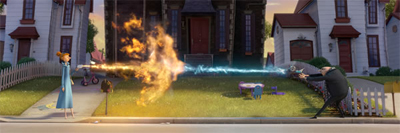
Despicable Me 2 doesn’t have the same emotional core or stakes. There are subplots and character development (with the sequel going to a lot of effort to make sure almost every returning character has something to do), but the stakes don’t seem quite as high. It’s stunningly well-animated, it’s consistently funny and the cast are as charming as ever, but it just feels a tiny bit shallower than the first film.

You're hot and you're cold...

You’re hot and you’re cold…

Continue reading