• Following Us

  • Categories

  • Check out the Archives


  • Awards & Nominations

The X-Files – Season 8 (Review)

This October/November, we’re taking a trip back in time to review the eighth season of The X-Files and the first (and only) season of The Lone Gunmen.

The eighth season of The X-Files would be the perfect last season of the show, and a pretty solid first season of a new show born from the ashes.

In many ways, television is a conservative medium – more in an artistic sense than a political one. Network television is largely built around churn, a conveyor belt model that is designed to generate product according to tight schedules and oppressive deadlines. Routine and familiarity make the production schedule easier to manage, particularly for shows with large season orders. More than that, if a show has figured out an approach that has worked, it makes no sense to deviate from that pattern.
xfiles-deadalive33a

Why risk changing something that has been proven to work and to which the audience has responded? For all the (deserved) praise The X-Files gets for popularising (or repopularising) serialised storytelling in prime-time television, it was just as conservative as any other show. The production team were working under incredible pressure, so it makes sense they would not want to change a formula that made sense. As such, the really big changes to the show were largely driven by external factors.

The mythology largely developed from Scully’s abduction in Duane Barry and Ascension, an attempt by the writers to work around Scully’s abduction. The decision to film The X-Files: Fight the Future between the fourth and fifth seasons was at the behest of Fox rather than the production team. David Duchovny forces the move to Los Angeles in the sixth season. The eighth season represents the most seismic shift in the creative life of The X-Files, and – as with those other big decisions – it was largely driven by choices outside the production team.
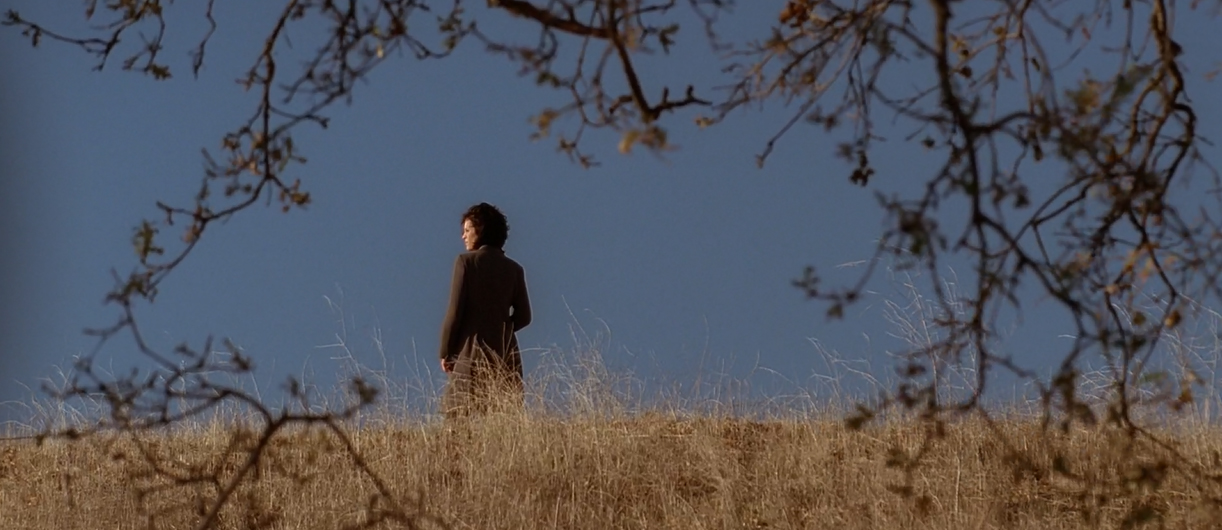
xfiles-thisisnothappening13a

In hindsight, it seems obvious that the show could not continue forever. Duchovny and Anderson were headlining a show that filmed twenty-odd episodes a season. The show had begun diffusing its focus in the fourth and fifth seasons by focusing on members of the supporting cast, but it was still effectively a two-lead show. That is a tremendous strain. Something had to give. It turned out that something was Duchovny. At the end of the seventh season, with everything coming down to the wire, Duchovny made it clear he would not appear in a full eighth season.

This forced the show to change, but in a way that afforded some measure of stability. The idea of doing The X-Files without either Mulder or Scully was horrifying to the production team and horrifying to certain sections of fandom, but Duchovny’s willingness to stick around for half of the eighth season afforded some measure of compromise. The change did not need to be jarring. Easing David Duchovny out of the show would allow for a smoother transition. It would allow the show to say a proper (and extended) farewell to Mulder.
xfiles-empedocles23a

This is perhaps the strongest aspect of the eighth season, the sense that it has a certainty and finality that the seventh season lacked. Even during the post-production of Requiem, the production team had no idea whether the seventh season would be the final season of the show. As a result, the seventh season is decidedly non-committal on the issue of closure. The eighth season is a lot more enthusiastic about the prospect of wrapping things up, once and for all. There is a sense that this is the final season of a version of the show, at the very least.

The eighth season finds itself in the impossible position of having to imagine The X-Files without Mulder. The only real issue is that it succeeds all too well. The biggest problem with the eighth season is that it is followed by a ninth season.
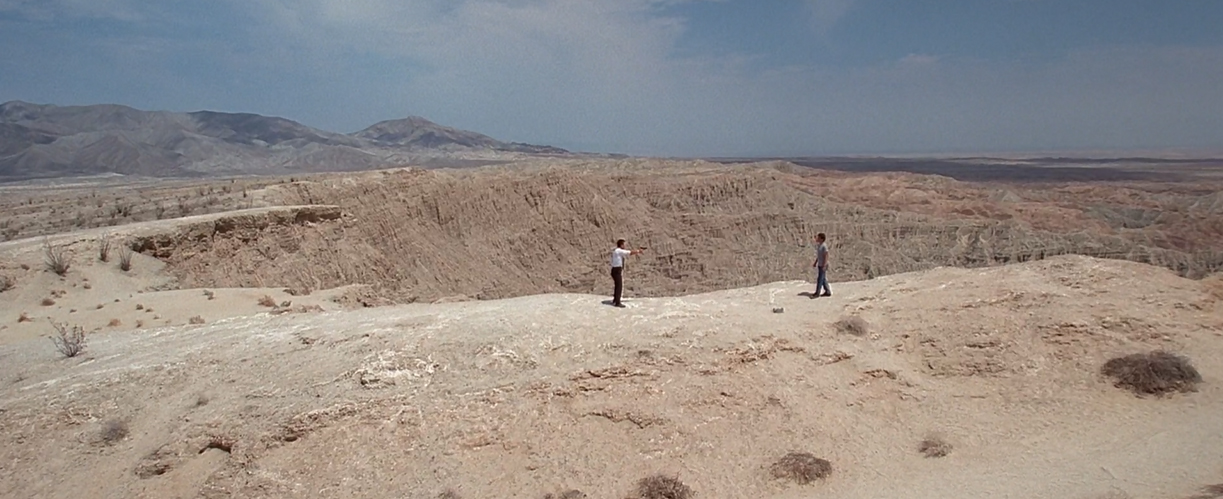
xfiles-without2a Continue reading

Jessica Jones – AKA You’re a Winner! (Review)

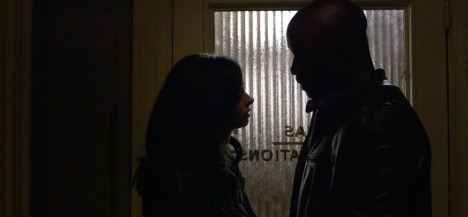
AKA You’re a Winner! is certainly a much better standalone episode than AKA 99 Friends.

Of course, the episode is tied more tightly into the arc of the season around. Although AKA You’re a Winner! does little to advance Jessica’ on-going pursuit of Kilgrave, it does allow the show to advance many of its individual character plots. In particular, it allows Jessica and Luke a bit of space to advance their own plot while Hope Slottman deals with the consequences of her trauma and while Kilgrave begins to enact his own endgame. There is a sense of pieces moving around a chessboard, but moving with purpose.

jessicajones-youreawinner21a

Despite the fact that AKA You’re a Winner! is less literally tied to the hunt for Kilgrave than AKA Crush Syndrome or AKA It’s Called Whiskey, it feels like it adds substantial more momentum to the on-going plot. The middle stretch of Jessica Jones represents the point at which the show has the clearest sense of drive and identity, the point at which the show is most comfortable in its own skin. AKA You’re a Winner! is a relatively light character-driven piece than the episodes around it, but it retains a firm grasp of the characters involved.

AKA You’re a Winner! feels like the kind of episode that Jessica Jones should have employed earlier in the season.

jessicajones-youreawinner38a

Continue reading

The X-Files – Closure (Review)

This November, we’re taking a trip back in time to review the seventh season of The X-Files and the first (and only) season of Harsh Realm.

Sein und Zeit and Closure don’t fit together at all.

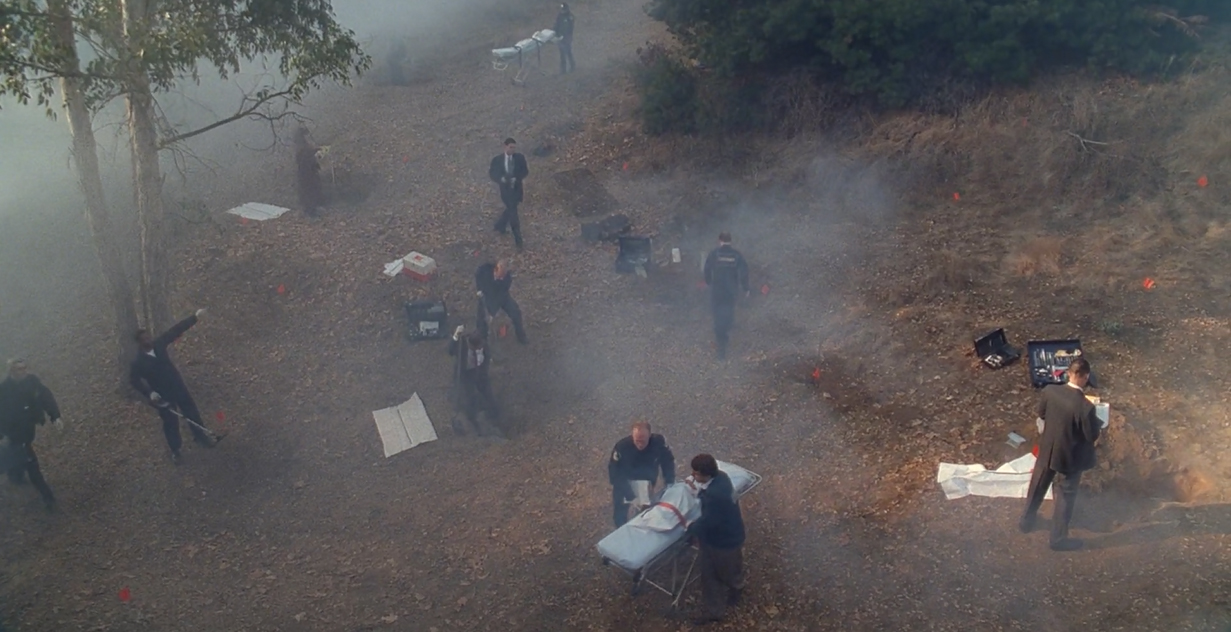
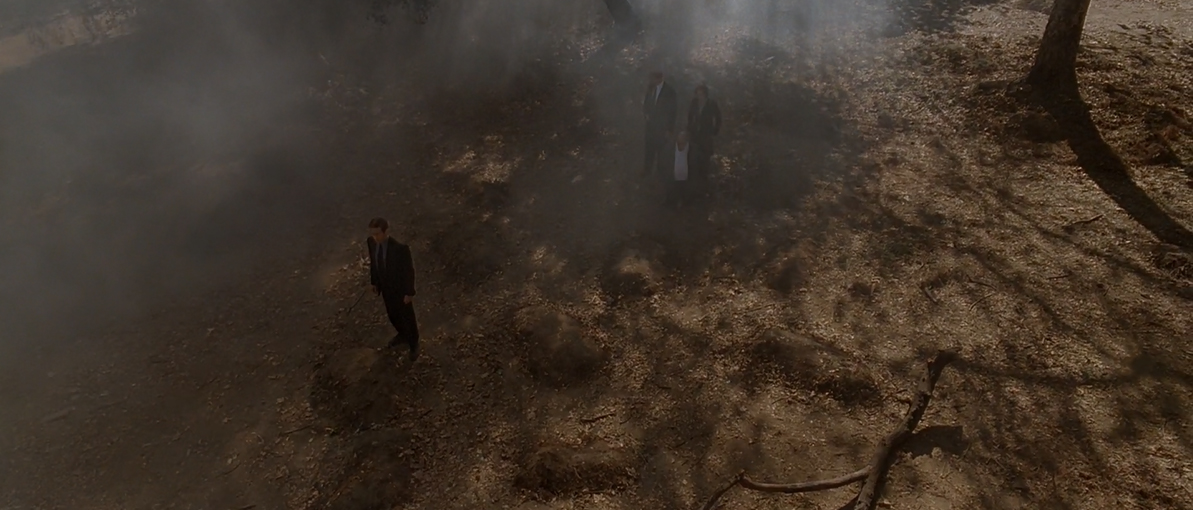
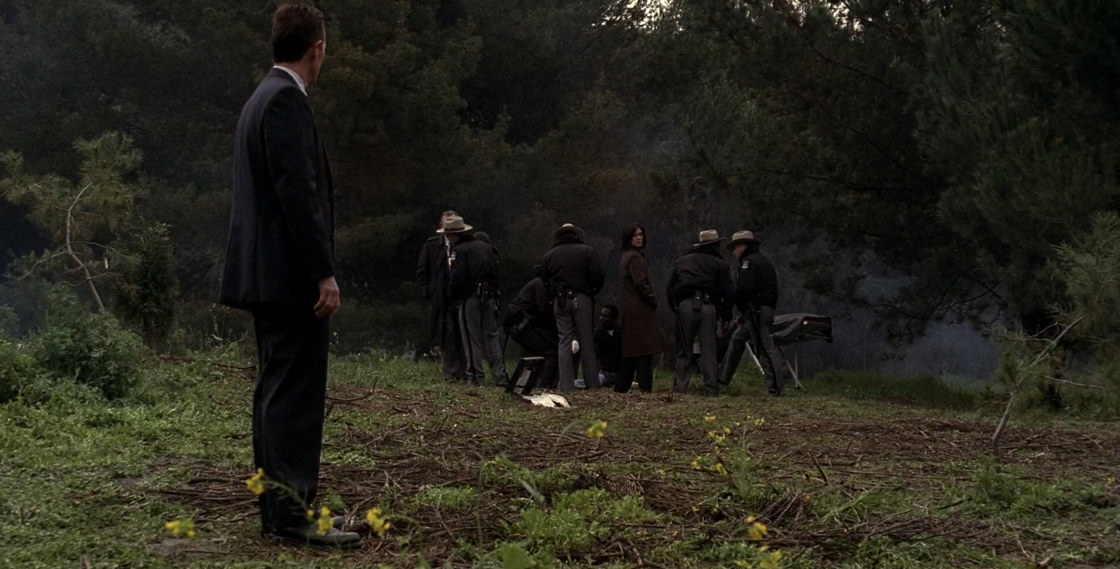
There is a nice symmetry to the stories, with Sein und Zeit closing with Mulder standing amid a mass grave and Closure opening with the excavation of the same mass grave. The contrast between the two shots of the same space says a lot about the differences between Sein und Zeit and Closure. Sein und Zeit is an episode that isolates Mulder, demonstrating how alone he truly is in the world and how all his beliefs might be empty; Closure responds by cluttering up the narrative and revealing an absurdly convoluted explanation of what happened to Samantha.

A grave subject...

A grave subject…

Even the themes of the two episodes are almost unique. Both Sein und Zeit and Closure are driven by Mulder’s desire to make sense of what happened to his sister, but both adopt diametrically different approaches towards the question. Sein und Zeit proposes that the world is a random and cruel place where bad things happen to children for no reason beyond the sadistic whims of strangers, while Closure embraces the idea that there is a larger scheme in which these horrible events occur.

There is a yin-and-yang structure to Sein und Zeit and Closure, a sense that the two episodes are almost at odds with one another when it comes to the fate of Samantha Mulder. Closure offers something approaching hope. It is too much to describe Closure as a happy-ending to the character arc that ran through the first seven seasons of the series, but it does offer Samantha an ending that is not soul-destroyingly bleak. It offers Mulder resolution and understanding. In his own words, it offers him freedom.

"Conscience... it's just the voices of the dead... trying to save us from our own damnation."

“Conscience… it’s just the voices of the dead… trying to save us from our own damnation.”

It is a very hopeful suggestion. It is a particularly hopeful suggestion coming at the middle of the show’s seventh season, as the resolution to Mulder’s character arc. The audience has spent seven years watching Mulder deal with the trauma of the loss of his sister, wrestling with the fear that he might never find an answer; or that he might find an answer that fails to make sense of it all. What if he found an answer that made sense of everything? What if Samantha’s disappearance wasn’t just part of a government conspiracy? What if it was part of something bigger?

What if the disappearance of Samantha Mulder meant everything?

A man alone.

A man alone.

Continue reading

The X-Files – Sein und Zeit (Review)

This November, we’re taking a trip back in time to review the seventh season of The X-Files and the first (and only) season of Harsh Realm.

Sein und Zeit and Closure don’t fit together at all.

There is a clear demarcation that exists between the two episodes, to the point where they cannot really be described as a single two-part story. Following the disappearance of Amber Lynn LaPierre from her home, Sein und Zeit closes with the arrest of a serial child-murderer and the discovery of a mass grave. There is not a whiff of the show’s central mythology to be found, despite Mulder’s insistence and anxiety. Although Closure picks up where Sein und Zeit left off, it embarks on its own separate story that does draw heavily from the show’s established mythology.

A grave subject...

A grave subject…

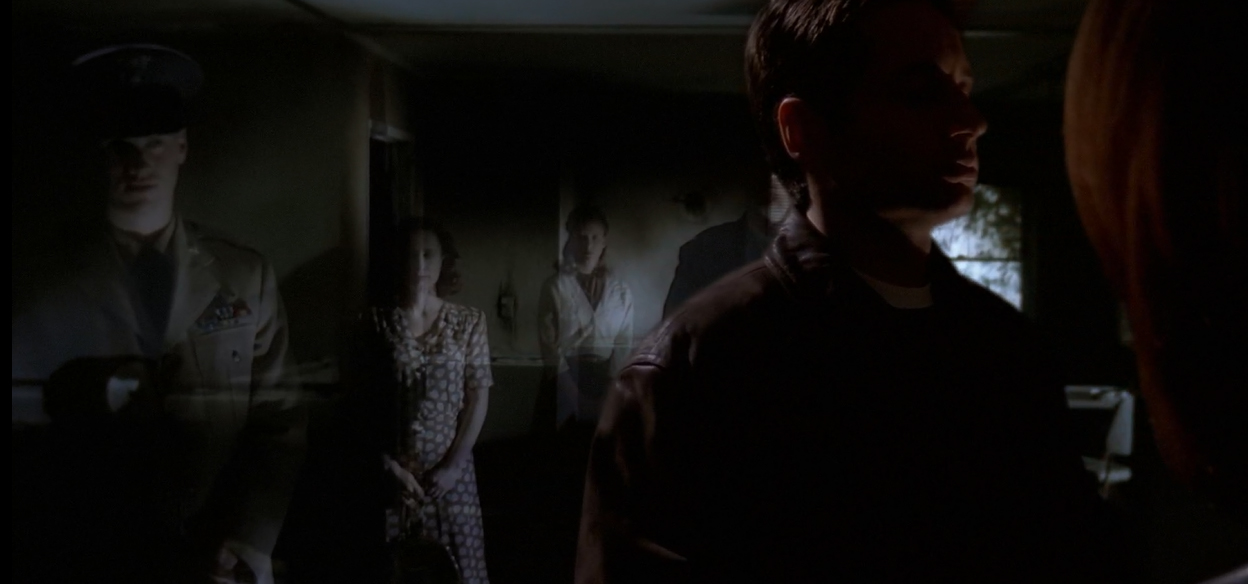
Even the guest casts of the two episodes are almost unique. Outside of David Duchovny and Gillian Anderson, only two guest stars appear in both episodes. Rebecca Toolan and Megan Corletto both play characters who die in Sein und Zeit, but appear as ghosts in Closure. The featured guest stars in Sein und Zeit do not reappear in Closure, and vice versa. Even the series’ recurring cast is firmly divided between the two halves; Walter Skinner appears in Sein und Zeit, while the Cigarette-Smoking Man plays an important role in Closure.

There is a yin-and-yang structure to Sein und Zeit and Closure, a sense that the two episodes are almost at odds with one another when it comes to the fate of Samantha Mulder. Sein und Zeit dares to ask what might happen if there was no rhyme or reason to her abduction; what if it was just a tragedy, like the tragedies that happen to happy families all the time? Mulder has invested so much of himself in the quest to explain what happened on that night in late November 1973; what would happen if there were no meaningful explanation?

"Conscience... it's just the voices of the dead... trying to save us from our own damnation."

“Conscience… it’s just the voices of the dead… trying to save us from our own damnation.”

It is a very bleak suggestion. It is a particularly bleak suggestion coming at the middle of the show’s seventh season, as the resolution to Mulder’s character arc. The audience has spent seven years watching Mulder dig deeper and deeper into a sinister conspiracy against mankind, largely motivated by the fact that his sister’s disappearance is a part of some larger puzzle. What if it wasn’t? What if Mulder’s whole quest were simply a lie that he had told himself? What if Mulder wanted to believe so badly that he convinced himself that this made sense?

What if the disappearance of Samantha Mulder meant nothing?

A man alone.

A man alone.

Continue reading

Star Trek: Enterprise – Azati Prime (Review)

Next year, Star Trek is fifty years old. We have some special stuff planned for that, but – in the meantime – we’re reviewing all of Star Trek: Enterprise this year as something of a prequel to that anniversary. This August, we’re doing the third season. Check back daily for the latest review.

If you can end on a high note, the audience will forgive a lot.

The third season of Star Trek: Enterprise is one of the boldest and most ambitious seasons of Star Trek ever produced; it is certainly the most adventurous season of the franchise to air outside of Star Trek: Deep Space Nine. However, on an episode-to-episode basis, the quality is quite variable. There are great episodes (Impulse, Twilight), underrated episodes (North Star, Exile), fun episodes (Stratagem), and experimental episodes (Harbinger), but there are also a lot of episodes that are more interesting in theory than in practice.

Explosive finalé...

Explosive finalé…

It becomes increasingly obvious over the course of the season that the writing staff did not plan the year-long arc far enough in advance and that the show struggles to figure out where it wants to go after the initial burst of speed wears off. There are even a couple of outright stinkers that rank with the worst that the franchise ever produced. However, there is a lot to be said for an ending. The third season of Enterprise hits a few speed bumps along the way, but it manages to rally for an impressive and largely satisfying conclusion.

Azati Prime begins the march towards the end of the season. It was the first episode to be filmed after the Christmas break, suggesting that it was the work of a revitalised writing staff and an energised production team. More than that, it was broadcast as the last episode before a six-week break in the broadcast schedule, suggesting that everybody involved knew exactly the kind of hit that they had on their hands. It injects an incredible energy into a show that might be racing towards its own apocalypse.

Future's end...

Future’s end…

Continue reading

Star Trek: Enterprise – Harbinger (Review)

Next year, Star Trek is fifty years old. We have some special stuff planned for that, but – in the meantime – we’re reviewing all of Star Trek: Enterprise this year as something of a prequel to that anniversary. This August, we’re doing the third season. Check back daily for the latest review.

It goes almost without saying that the third season of Star Trek: Enterprise was an attempt to revitalise a franchise that had already been on television for a decade and half. It was an attempt to do something quite radical and dynamic with a television property that had become rather staid and conservative. Star Trek: The Next Generation had been perfectly calibrated for the late eighties and early nineties, but its approach towards storytelling was increasingly outdated after seven seasons of Star Trek: Voyager.

One of the recurring issues in the first season of Enterprise was the conflict between the established franchise structure and something more adventurous and exciting. So many of those first season episodes seemed laboriously paced and awkwardly arch; there was a sense of dull routine rather than exciting adventure. The show would occasionally try to deviated from the established template (to varying degrees of success) with stories like Dear Doctor, Shuttlepod One, and A Night in Sickbay, but narrative conservatism won out in the sophomore season.

"So... sweeps?"

“So… sweeps?”

In many ways, Harbinger plays as a return to those earlier experiments in story structure. It is an episode that is not driven by story. Although the strange alien discovered by the crew provides a suitably dramatic climax, most of Harbinger is built around established character dynamics. Trip and T’Pol begin working through the sexual tension that has existed between them since the start of the third season; Reed and Hayes do something similar in a very different fashion. In the meantime, the ship just cruises along en route to the third season’s next big plot beat.

Harbinger is not entirely successful in this regard. There is a sense that the franchise is still figuring out how to construct episodes that don’t conform to a rigid story structure, with the mysterious alien visitor serving as an effective crutch to help get around these problems. Still, it is an interesting experiment and an example of how the show is consciously trying to reinvent itself in a manner that is more than simply cosmetic.

Expanding his Sphere of influence...

Expanding his Sphere of influence…

Continue reading

Star Trek: Enterprise – Stratagem (Review)

Next year, Star Trek is fifty years old. We have some special stuff planned for that, but – in the meantime – we’re reviewing all of Star Trek: Enterprise this year as something of a prequel to that anniversary. This August, we’re doing the third season. Check back daily for the latest review.

With Stratagem, the third season of Star Trek: Enterprise gets its head back in the game.

The recent stretch of third season episodes seemed to lose sight of what made this such an intriguing premise. Although Rick Berman had conceded that there was an escape hatch in place in case the Xindi arc could not sustain a full season of television, it was increasingly clear that the third season of Enterprise would be a single extended arc exploring Archer’s attempts to find the source of a deadly threat against mankind. It was a bold experiment for a show that had been quite rigidly episodic to this point. At least in theory.

Archer's on candid camera...

Archer’s on candid camera…

In practice, the third season of Enterprise seemed to flounder a little bit once it got past the initial burst of speed powering it into the third season. All of a sudden, the crew found themselves involved in a number of increasingly stand-alone adventures with superficial ties to the larger arc. Episodes like Extinction and Chosen Realm could easily have been produced and broadcast during the show’s first two seasons, with minor alterations. Exile and North Star were only loosely connected to the season’s plot. Carpenter Street was a time travel episode.

Proving Ground had suggested that the show was ready to re-focus its attention on the matter at hand and get back to the imminent threat posed by the Xindi. At the same time, the episode was also keen to stress its episodic nature – most notably in its role as the show’s annual check-in with the Andorians. Stratagem is very much its own self-contained story, but it is a lot more confident about how it fits in the larger scheme of things, and where it fits in the broader arc of the season.

Engineering a convincing set-up...

Engineering a convincing set-up…

Continue reading

Star Trek: Enterprise – Proving Ground (Review)

Next year, Star Trek is fifty years old. We have some special stuff planned for that, but – in the meantime – we’re reviewing all of Star Trek: Enterprise this year as something of a prequel to that anniversary. This August, we’re doing the third season. Check back daily for the latest review.

Proving Ground is an odd episode to sit in the middle of the third season’s larger arc involving the Xindi and the threat against Earth.

In a very real sense, it is more serialised than a lot of the episodes leading up to it. The episode even opens with a fairly sweeping “previously…” section that is sure to include a lot of nice action shots from the first half of the year. Proving Ground contributes more to the arc than anything like Carpenter Street or Chosen Realm, featuring the testing of the Xindi weapon. It also features the Andorians, suggesting that Star Trek: Enterprise has not completely divorced itself from its original place in the Star Trek canon.

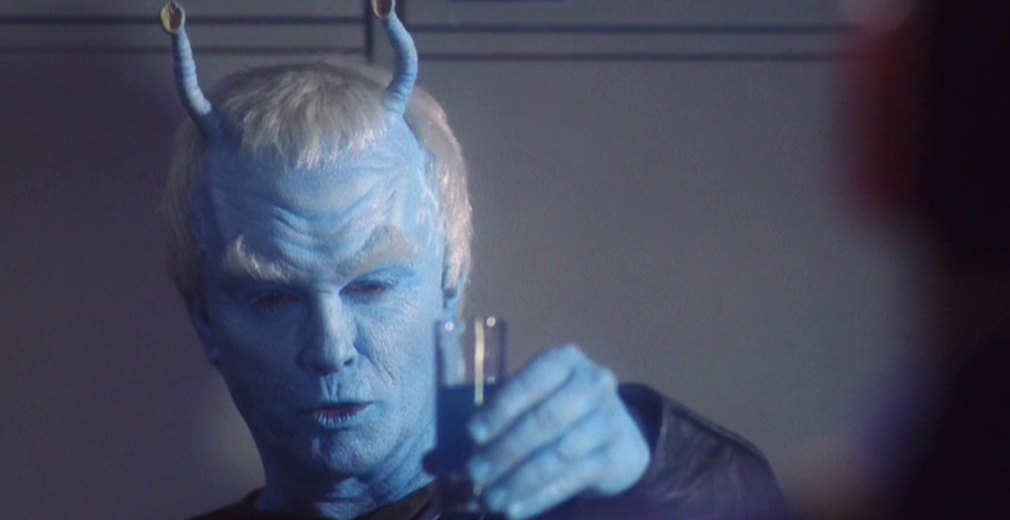
Drinking away the blues...

Drinking away the blues…

At the same time, the episode is also very episodic. Shran makes a very quick cameo in Zero Hour, but this is the extent to which the Andorians are involved in the larger plot of the third season. Much like the second season, there is a sense that Shran has been slotted into “the obligatory Andorian episode” as a way to fill a production slot in a chaotic season. The sense of weight and impact of the episode is relatively minimal, like Cease Fire before it. The conclusion seems to be that Shran might be a nice guy underneath it all. It’s hardly shocking.

More than that, the structure and plot of the episode can’t help but emphasise some of the more misguided creative decisions of the third season, with Proving Ground introducing a bunch of clever (and exciting concepts) into the arc only to take them right away at the end. The fact that Proving Ground is so fun and enjoyable is almost a detriment, inviting the audience to wonder whether some of that love and affection might have been distributed across the season.

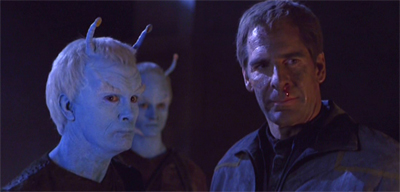
Look who just blue in...

Look who just blue in…

Continue reading

Star Trek: Enterprise – The Shipment (Review)

Next year, Star Trek is fifty years old. We have some special stuff planned for that, but – in the meantime – we’re reviewing all of Star Trek: Enterprise this year as something of a prequel to that anniversary. This August, we’re doing the third season. Check back daily for the latest review.

An episode like The Shipment has been inevitable since The Expanse was first broadcast.

Nobody watching The Expanse could have truly believed that Star Trek would ever truly lose itself in the midst of an epic War on Terror analogy. Trip’s character arc over the course of the third season is not hard to predict. His raw anger and hatred in The Expanse are not a new status quo for the character, they are very clearly the starting point for a character arc that will circle back around to the core values associated with Star Trek. Trip might be raw and vengeful, but he will come to forgive and heal.

Woah, woah, woah... he's on fire...

Woah, woah, woah… he’s on fire…

That is largely the arc of the third season, albeit with a coda where Archer punches out an evil lizard man atop a flying bomb, because evil lizard men and flying bombs are pretty damn fun. Indeed, the third season works through the bulk of its big moral arc in The Council, so that the final two episodes of the season can be devoted to “stuff blowin’ up real good” without any of those awkward analogies getting in the way. The effort to resolve the big moral arc of the season two episodes before the finalé would seem to suggest that this resolution is a foregone conclusion.

As such, The Shipment feels a little redundant – particularly this early in the season. It is an episode designed to reassure viewers that Jonathan Archer has not suddenly transformed himself into Jack Bauer. However, at this point in the season, the audience has been given little reason to fear that Archer has been so transformed. The Shipment seems like an overly preemptive reassurance that arrives a little bit too early for its own good.

#NotAllXindi

#NotAllXindi

Continue reading

Star Trek: Enterprise – Cease Fire (Review)

Next year, Star Trek is fifty years old. We have some special stuff planned for that, but – in the meantime – we’re reviewing all of Star Trek: Enterprise this year as something of a prequel to that anniversary. This April, we’re doing the second season. Check back daily for the latest review.

It is weird to think that Star Trek was dying in early years of the twenty-first century.

After all, the original series had greatly increased its cultural cachet at the height of the Cold War. The adventures of James Tiberius Kirk offered an optimistic alternative to total nuclear annihilation and a doomsday clock that was rapidly approaching midnight. Logic would suggest that utopian fantasy was all the more essential when contrasted against harsh reality. In fact, it seemed like cynicism and pessimism thrived in the (relatively) peaceful and prosperous decade following the collapse of the Cold War. The X-Files and Star Trek: Deep Space Nine were inescapably products of the nineties.

I'm blue dabba dee dabba dii...

I’m blue dabba dee dabba dii…

So one imagines that the dread and fear that took root in the wake of 9/11 might somehow make the optimism and hope of Star Trek all the more essential. After all, pundits and commentators wasted no time in suggesting that irony and cynicism were passé. Stephen Thompson, editor of The Onion, suggested that the age of irony had ended only a week after the attacks.  Graydon Carter, editor of Variety, observed, “I think it’s the end of the age of irony. Things that were considered fringe and frivolous are going to disappear.” In a highly publicised Time article, Roger Rosenblatt rejoiced.

Of course, irony was far from dead, as films like Team America: World Police demonstrated. The Colbert Report became a cultural phenomenon. The Onion is still in business. However, the speed with which these commentators latched on to the idea of the death of irony suggested that the mood had changed perceptibly. Maybe not definitively, maybe not completely, but there was a change in the air. If ever there was a time for the optimism and the utopianism of Star Trek, it would be this particular moment.

"This is the point where everything changed..."

“This is the point where everything changed…”

However, it seemed like 9/11 eroded the franchise’s faith in utopia. Understandably – and perhaps inevitably – Star Trek: Enterprise found itself warped by images and iconography associated with the attacks. The tradition idyllic alien worlds associated with the franchise – visible in early episodes like Strange New World and Civilisation were quickly replaced by landscapes evoking the popular mood – apocalyptic cityscapes of Shadows of P’Jem and Shockwave, Part II, the deserts of Desert Crossing, the militaristic settings of Detained and The Communicator, or even the darkness of Rogue Planet.

It was as if 9/11 had warped the psychological landscape of the Star Trek universe, throwing everything into doubt. Far from responding to that real-world tragedy with optimism and hope, it seemed that Enterprise only lost certainty in itself. Cease Fire is an episode that feels plagued by self-doubt and insecurity, even as it tries to find its way back to the franchise’s trademark idealism. It may not quite find its way back to the path, but it makes a reasonable effort.

It's all in ruins...

It’s all in ruins…

Continue reading