Next year, Star Trek is fifty years old. We have some special stuff planned for that, but – in the meantime – we’re reviewing all of Star Trek: Enterprise this year as something of a prequel to that anniversary. This April, we’re doing the second season. Check back daily for the latest review.
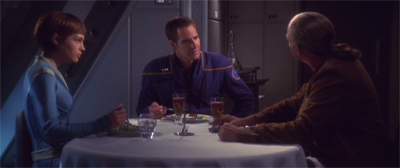
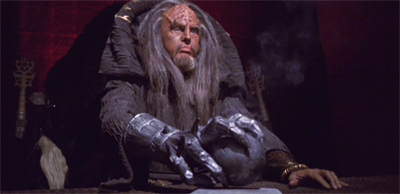
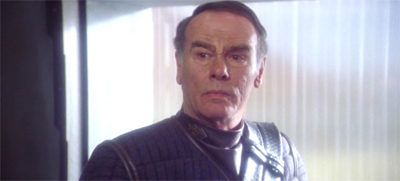
Judgment is the first episode of Star Trek to do something interesting with the Klingons since Tacking Into the Wind, almost four years earlier.
After all, it never seemed like Star Trek: Enterprise had any real idea what to do with the Klingons. The show had made use of Klingons in Broken Bow, Unexpected, Sleeping Dogs and Marauders – but none of these episodes seemed particularly interested in telling a story about Klingons. Enterprise seemed primarily interested in the Klingons as a connection to the franchise’s long and distinguished history. After all, Klingons are almost as iconic a part of Star Trek as Spock; working a few bumpy-headed warriors into your script was a nice way of acknowledging the Star Trek legacy.

Trial of the twenty-second century…
Certainly, Enterprise was not interested in committing to the same Klingon world-building in which Star Trek: The Next Generation and Star Trek: Deep Space Nine had revelled. There are a lot of reasons for this. Over ten seasons, writer Ronald D. Moore had probably said just about everything that needed to be said about the Klingons; trying to say something new or interesting without his input was certainly daunting. More than that, Enterprise had committed itself quite firmly to episodic storytelling in its first two years; even the Andorians and Vulcans were still barely developed.
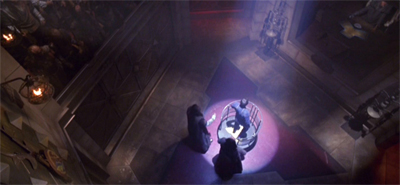
So David A. Goodman’s script for Judgment is ambitious, particularly in light of the spectacular failure of his (heavily re-written) work on Precious Cargo. Constructing an episode that might easily be misread as a rehash of Star Trek VI: The Undiscovered Country was a pretty bold choice, particularly given the problems that the show had endured while trying to construct an homage to Elaan of Troyius and The Perfect Mate. On paper, Judgment is an assignment that could easily explode spectacularly. It might not be as crazy a gambit as A Night in Sickbay, but it is a story with lofty objectives.

The court has spoken.
With so much of the second season feeling like it is running on auto-pilot, the energy and enthusiasm of Judgment is infectious. Singularity, Vanishing Point, Canamar and The Crossing felt like they were constructed using blueprints of what a Star Trek episode should look like. It is refreshing to watch an episode of Enterprise that seems genuinely excited to playing with these particular toys. In that sense, Judgment sets the mood for the final stretch of the season – despite duds like Horizon and Bounty, the final run of episodes feels like a band playing an encore for a show on the cusp of monumental change.
Although not facing the same threat of cancellation that loomed at the end of the third and fourth seasons, the second season of Enterprise feels like the last gasp of a particular model of Star Trek production, one no longer as viable as it once had been. Starting with Judgment, the show seems to acknowledge that things are going to have to change dramatically and soon; however, there is a clear attempt to bid this particular iteration of Star Trek a fond farewell. As such, any and all references to The Undiscovered Country feel entirely appropriate.
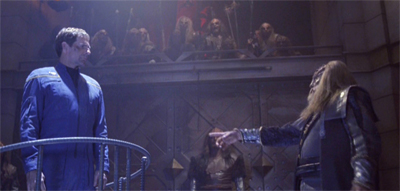
“Don’t wait for the translation! Answer me now!”
Continue reading →
Filed under: Enterprise | Tagged: 9/11, allegory, c ontinuity, civil rights, david a. goodman, david goodman, enterprise, free speech, iraq, iraqi war, j.g. hertzler, klingons, metaphor, operation iraqi freedom, star trek: enterprise, the undiscovered country, war on terror | 15 Comments »





















 the m0vie blog
Non-Review Review: Zootropolis (aka Zootopia)
This film was seen as part of the Audi Dublin International Film Festival 2016.
Zootropolis is a solidly entertaining family film that strains under the weight of its core premise.
There is a great idea in here, a detective film set in an anthropomorphised world featuring a rabbit and fox who must team up to solve a number of mysterious disappearances. Along the way, writers Jared Bush and Phil Johnston fashion the story into an allegory rich with social commentary about race and class issues in American cities. It helps that the script is light on its feet and packed with enough fast gags that it breezes along without ever getting stuck in the same place for too long.
However, this becomes a problem in and of itself. There is a sense that Zootropolis struggles to do too much in the space afforded to it. The plot covers quite a lot of ground as our plucky heroes embark on their investigation, including extended (and overt) riffs on pop culture standards like The Godfather and Breaking Bad. There are points at which it feels like Zootropolis might be a much stronger film if it slowed down a bit, instead of hopping from one set-up to the next in the style of its rabbit protagonist.
Zootropolis largely works, but it never comes together in the way that the best Disney outings do. There are points at which Zootropolis feels more like a turducken than a chimera.
Continue reading →
Filed under: Non-Review Reviews | Tagged: adiff, adiff 16, allegory, animated, anthropomorphic, commentary, disney, non-review review, racism, review, zootopia, zootropolis | 4 Comments »