• Following Us

  • Categories

  • Check out the Archives


  • Awards & Nominations

The X-Files – Herrenvolk (Review)

This February and March, we’re taking a trip back in time to review the fourth season of The X-Files and the first season of Millennium.

After Talitha Cumi, Herrenvolk cannot help but seem like a little bit of a disappointment.

Towards the end of the episode, the Alien Bounty Hunter hunts down Jeremiah Smith. Mulder begs for mercy, but the Bounty Hunter will hear nothing of it. “He shows you pieces, but tells you nothing of the whole,” the Bounty Hunter remarks to Mulder. It feels like that sentiment encapsulates Herrenvolk in a nutshell. Mulder goes on the run with Jeremiah Smith and sees a collection of vague but compelling things that may or may not tie into colonisation.
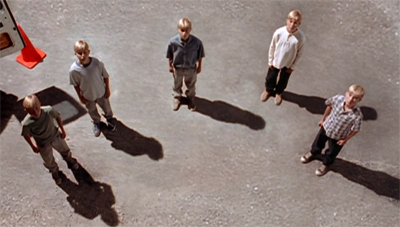
"Now you're thinking, 'I hope that's shepherd's pie in my knickers!'"

“Now you’re thinking, ‘I hope that’s shepherd’s pie in my knickers!'”

Like a lot of the mythology in the fourth and fifth seasons, it feels like a holding pattern. Talitha Cumi was surprisingly candid in its revelations. The aliens were plotting to colonise Earth in collaboration with the human conspirators. The date had been set, the plot was in motion. That was a pretty big bombshell, confirmed in unequivocal terms. It was arguably the clearest and most transparent that the conspiracy arc would ever be. There was a clear goal, a deadline, and a sense of purpose.

Almost immediately, Herrenvolk works to muddy the water. It stalls, it procrastinates, it delays, it evades. It is a plot structured around a collection of ominous conspiracy buzz words (DNA, smallpox, colonies, clones) without a clear purpose or objective.
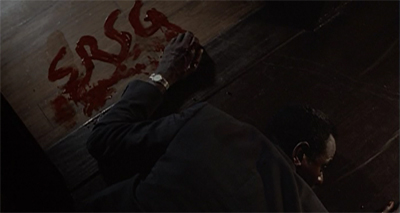
A bloody mess...

A bloody mess…

Continue reading

Star Trek: Enterprise – Fight or Flight (Review)

Next year, Star Trek is fifty years old. We have some special stuff planned for that, but – in the meantime – we’re reviewing all of Star Trek: Enterprise this year as something of a prequel to that anniversary. This January, we’re doing the first season. Check back daily for the latest review.

Fight or Flight is reasonably solid as second episodes go. It’s very clear that Rick Berman and Brannon Braga are making a conscious effort to avoid the mistakes of Star Trek: Voyager. There’s a sense that they are trying to give Star Trek: Enterprise its own unique mood and flavour. As such, Fight or Flight feels like a story that isn’t just tailor-made for Enterprise, but is tailor-made for early in the first season of the show. It isn’t a story that could be done by another spin-off, and it’s also not a story that could be done by Enterprise even a year later.

While Fight or Flight works on a conceptual level, the execution feels a little strange. While Broken Bow was a big and bombastic Star Trek pilot with its own feel and rhythm, Fight and Flight feels almost quaint. As a piece of television, it’s constructed in a very meticulous and very precise manner, one that seems suspiciously outdated for a show broadcast in late 2001.

Slugging it out...

Slugging it out…

Continue reading

Star Trek – By Any Other Name (Review)

The first Star Trek pilot, The Cage, was produced in 1964. To celebrate its fiftieth anniversary, this December we are reviewing the second season of the original Star Trek show. You can check out our first season reviews here. Check back daily for the latest review.

By Any Other Name is very much a stock episode of Star Trek. It hits on all manner of familiar themes and ideas. It’s a story about powerful aliens who seem to overpower the crew, only to be outmanoeuvred themselves. It is about the Enterprise literally going where no human has gone before. It is about how humans are undeniably and incomparably special – about how becoming human opens up the aliens to a world of sense and experience.

However, By Any Other Name never really has anything particularly insightful to say about any of this stuff. The script to the episode is a mess, despite the best efforts of D.C. Fontana to develop the character beats. For a show based around such core Star Trek concepts and storytelling devices, By Any Other Name is surprisingly all over the place, with a wildly dissonant tone and a sense that the script was desperately padded in order to extend it out to the requisite fifty minutes.

"No dice, Captain..."

“No dice, Captain…”

By Any Other Name is not a terrible episode of Star Trek, but it’s not a particularly good one either. It is just “there.” In many ways, it feels like an example of an episode designed to fill a gap in twenty-odd-episodes-a-year schedule. After all, the last eight episodes of the season were pushed into production at short notice when NBC opted to pick up the show for the rest of the season during the production of The Gamesters of Triskelion. It makes sense that the episodes in this final stretch of the third season are somewhat rough.

By Any Other Name is a familiar Star Trek plot with a somewhat bloated script and a sense that the show is just trying to eat up minutes between here and the end of the season.

"It appears the rock knows as little as we do, sir..."

“It appears the rock knows as little as we do, sir…”

Continue reading

The X-Files – Talitha Cumi (Review)

This November (and a little of December), we’re taking a trip back in time to review the third season of The X-Files and the first (and only) season of Space: Above and Beyond.

Talitha Cumi is a staggeringly confident piece of television, the kind of episode casually produced by a show at (or approaching) the top of its game.

It is interesting just how much this season finalé seems to promise business as usual. It is perhaps the least radical of the show’s season-ending cliffhangers, with the third season closing on an immediate rather than a conceptual threat to our leads and to The X-Files as a show. The Erlenmeyer Flask ended with the death of Deep Throat and the closing of the X-files. Anasazi ended with Mulder being burnt alive in a boxcar filled with alien bodies. Gethsemane ups the ante further.

A stab in the dark...

A stab in the dark…

In contrast, Talitha Cumi ends with the Alien Bounty Hunter walking towards Mulder and Scully in a rather menacing fashion. It is very effective television – and a solidly suspenseful cliffhanger – but it also feels rather low-key when compared to other season-ending episodes. Talitha Cumi feels like a pretty effective hook, rather than a game-changer. There’s an immediacy to the cliffhanger, but nothing that threatens to upend the show as a whole.

Then again, one suspects that is entirely the point. The third season has been largely about consolidation of The X-Files. It makes sense that it wouldn’t throw everything up into the air at the end of the season.

It's been a long year...

It’s been a long year…

Continue reading

The X-Files – Jose Chung’s “From Outer Space” (Review)

This November (and a little of December), we’re taking a trip back in time to review the third season of The X-Files and the first (and only) season of Space: Above and Beyond.

Then there are those who care not about extraterrestrials, searching for meaning in other human beings. Rare or lucky are those who find it. For although we may not be alone in the universe, in our own separate ways, on this planet, we are all alone.

– Darin Morgan takes his bow

It came from beyond the stars...

It came from beyond the stars…

Continue reading

The X-Files – War of the Coprophages (Review)

This November (and a little of December), we’re taking a trip back in time to review the third season of The X-Files and the first (and only) season of Space: Above and Beyond.

It is very odd to describe any Darin Morgan episode as “underrated.” And yet, despite that, War of the Coprophages feels like the underrated Darin Morgan teleplay.

Clyde Bruckman’s Final Repose had appeared towards the start of the season, featuring a powerhouse guest performance from Peter Boyle. Both Boyle and Morgan would win Emmys for their work on that episode, and Clyde Bruckman’s Final Repose is perhaps Morgan’s most conventional script for The X-Files or Millennium. In contrast, Jose Chung’s “From Outer Space” is perhaps the most adventurous and gonzo episode of The X-Files ever produced, coming at the end of the season and relentlessly (but affectionately) mocking the show’s core iconic mythology.

Down the drain...

Down the drain…

In contrast, War of the Coprophages sits in the middle, literally and figuratively. It is positioned almost precisely in the middle of the third season, with Morgan writing the screenplay in an exceptionally short period of time. It isn’t a truly exceptional example of a monster-of-the-week episode in the way that Clyde Bruckman’s Final Repose was, but it also isn’t as off-the-walls and bizarre as Jose Chung’s “From Outer Space.” It doesn’t feel like it has as much to say about death as Clyde Bruckman’s Final Repose, nor as much about life as Jose Chung’s “From Outer Space.”

And yet, in its own way, War of the Coprophages as an incisive and well-constructed commentary on The X-Files as a television show while allowing Morgan to tackle his recurring themes about society and humanity, and whether the world is what we would like to think that it is.

Bug hunt...

Bug hunt…

Continue reading

Space: Above and Beyond – Choice or Chance (Review)

This November (and a little of December), we’re taking a trip back in time to review the third season of The X-Files and the first (and only) season of Space: Above and Beyond.

Hostile Visit and Choice or Chance follow the two-part template established by The X-Files, keeping things fresh by offering a pretty dramatic shift between the two episodes in question.

Hostile Visit featured a covert trojan house mission to infiltrate enemy space and stage a devastating attack behind enemy lines. The episode ended with the mission a failure and our heroes drifting through space. Choice or Chance features our heroes landing on a prison planet maintained by the Silicates, the evil artificial organisms that have skirted around the edge of the show’s mythology to this point.

Here's Douggie!

Here’s Douggie!

Choice or Chance comes very close to working. It is a lot more dynamic than Hostile Visit was, which is a good thing for the second half of a two-parter airing during November Sweeps. However, while Hostile Visit felt a little padded and extended, never quite building the momentum necessary for the story to work, Choice or Chance feels a little over-stuffed. There’s a lot of nice stuff here, but no room to properly digest it. It’s an episode that comes up with something for every member of the cast to do, but this inevitably means that the character arcs feel abbreviated and shortened.

There is a  pretty solid two-part episode to be constructed out of the ingredients of Hostile Visit and Choice or Chance. Sadly, the resulting two-parter is not it.

Crash and burn...

Crash and burn…

Continue reading

Space: Above and Beyond – Hostile Visit (Review)

This November (and a little of December), we’re taking a trip back in time to review the third season of The X-Files and the first (and only) season of Space: Above and Beyond.

At this point, Space: Above and Beyond could do a lot worse than learn from The X-Files.

There are quite a few echoes of The X-Files in Space: Above and Beyond, becoming more pronounced as the show approaches the middle of the season. Eyes built on the suggestion of conspiracy and cover-up to assure viewers that Space: Above and Beyond was just as cynical about authority as The X-Files ever was. The Enemy felt like an attempt to copy the formula that Morgan and Wong had worked so well back in Ice.

Picture imperfect...

Picture imperfect…

Hostile Visit and Choice or Chance feels like an attempt to do a big sweeps two-parter in the style of The X-Files. This was a crucial moment for Space: Above and Beyond. The series had been scheduled outside of its comfort zone, had not been drawing huge ratings, had found itself preempted and bounced around the schedule as a result of factors outside its control. It needed a strong performance for the November sweeps, which were a matter of pride (and money) for the networks and a matter of interest for the advertisers.

So structuring a two-parter around that period makes a great deal of sense. Unfortunately, Hostile Visit does not make for the most compelling first half.

"I want a good clean sweep."

“I want a good clean sweep.”

Continue reading

The X-Files – Paper Clip (Review)

This November (and a little of December), we’re taking a trip back in time to review the third season of The X-Files and the first (and only) season of Space: Above and Beyond.

And now we return to your scheduled viewing.

In many respects, Paper Clip feels like the real third season premiere. It establishes a lot of the recurring themes and ideas for the mythology of the season, from Krycek-on-the-run through to collaboration in the wake of the Second World War. It builds on the successful multi-part formula established by episodes like Ascension or End Game during the show’s second season. It moves things along in a way that The Blessing Way simply refused to. (It even resolves the cliffhanger from the last episode on screen.)

The light at the end of the tunnel...

The light at the end of the tunnel…

Paper Clip demonstrates the strengths of the third season of The X-Files. The third season was the point at which the show really pushed the mythology out, building on earlier implications that there was form to be found in the shadows. The third season also looked to the second season to determine what had worked and what had not worked. Paper Clip is very clearly modelled on the successful aspects of second parts like Ascension or End Game.

It moves. The power of Paper Clip comes from an incredible forward momentum that allows the show to maintain tension and excitement while refusing to allow the audience to catch their breath. Instead of resolving the bigger plot threads from the first episode, questions and hints are thrown out with reckless abandon as the script just drives through set pieces and emotional beats and suspenseful sequences. It is a very meticulously, very cleverly constructed piece of television.

Watching the skies...

Watching the skies…

Continue reading

The X-Files – The Blessing Way (Review)

This November (and a little of December), we’re taking a trip back in time to review the third season of The X-Files and the first (and only) season of Space: Above and Beyond.

The Blessing Way is the first mythology episode of The X-Files that doesn’t really work.

And it doesn’t really work for a lot of the same reasons that some of the later mythology episodes don’t really work. Its pacing is terrible. It wallows in new age mysticism, allocating characters thoughtful monologues that awkwardly state themes and render subtext as supratext. It plays into the deification of Mulder, trying to bend Mulder’s story to fit into an archetypal “chosen one” narrative. More than that, it is very clearly a holding pattern, an effort to eat up time without moving forward.

Wiping it all out...

Wiping it all out…

However, despite the fact that The Blessing Way really doesn’t work, it is still a fascinating episode. It’s a wonderful demonstration of how The X-Files has developed a fleshed-out world inhabited by compelling characters. The best moments in The Blessing Way are character-focused, with Skinner caught between his duty to the government and his loyalty to his agents, the Cigarette-Smoking Man revealed to be middle-management at best, and the implication that even vast sinister government conspiracies are hostage to chaos.

The Blessing Way is an oddity, a rather strange piece of television that is almost endearing in its stubborn refusal to deliver what the audience wants and expects. That doesn’t make it good, but it does make it interesting.

The truth is up there...

The truth is up there…

Continue reading