• Following Us

  • Categories

  • Check out the Archives


  • Awards & Nominations

Non-Review Review: First Reformed

This film was seen as part of the Audi Dublin International Film Festival 2018.

First Reformed is an unholy mess.

On paper, First Reformed has some very interesting ideas. It is a film grappling very consciously with weighty themes and heavy subject matter. It is about the challenge of finding faith in a modern and cynical world, and about reconciling the mundane maintenance of spiritual belief with the euphorically elevation of pure devotion. This is a broad theme that resonates in a world that feels increasingly disconnected and diffused, in a time when people feel increasingly distant from purpose or meaning.
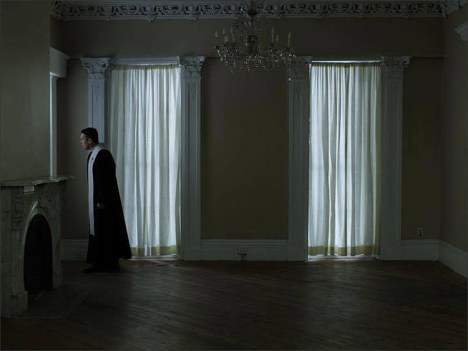
Indeed, the core premise invites comparisons to Taxi Driver, which remains the defining work in Schrader’s filmography. Schrader has been working as a writer for almost forty-five years, and as a director for forty years, but his body of work is still discussed in terms of the second script that he wrote. Although most audiences associate Taxi Driver with the creative partnership of Scorsese and DeNiro, it was a work that was very important to Schrader, articulating themes and ideas to which he would return time and time again.

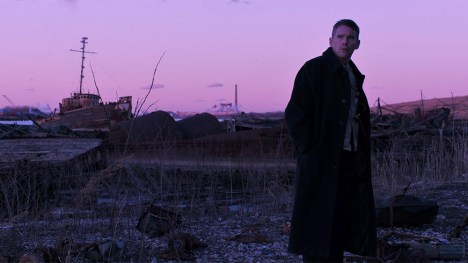
First Reformed brings Schrader back to that, with Reverend Ernst Toller feeling very much like a spiritual sibling to Travis Bickle, a man who struggles to make sense and to find meaning in a chaotic world and who decides to impose his own order upon the universe. Schrader is very much playing with his own history and iconography here, playing out a familiar story in a new setting with a slightly different emphasis. As with a lot of artists revisiting their earlier and defining, the results are frustrating. First Reformed bends and contorts in the shadow of its predecessor, never coming into its own.
Continue reading

Non-Review Review: The Breadwinner

This film was seen as part of the Audi Dublin International Film Festival 2018.

Stories enrich us, stories empower us, stories sustain us.

The Breadwinner is many things. It is a beautifully animated film from Irish studio Cartoon Saloon, a worthy successor to The Secret of Kells and Song of the Sea, and also the first time that the company have looked beyond Irish shores for one of their feature-length releases. It is a stunning adaptation of Deborah Ellis’ novel, offering a compelling glimpse into Afghanistan as controlled by the Taliban at the turn of the millennium. It is a genuinely affecting tale of a young girl surviving in a climate that seems actively hostile to her very existence.

However, The Breadwinner is also a meditation upon the power of stories. This is not a surprise, it is very much in keeping with the aesthetics and interests of Cartoon Saloon. It is a recurring theme in their work. (As a point of comparison, Pixar Studios are invested in parental anxieties, down to the inclusion of the “Pixar Babies” in the credits of every major release.) Indeed, The Breadwinner might be seen as a spiritual successor to (or the third part of a thematic trilogy with) The Secret of Kells and Song of the Sea, stories about children reconnecting with the mythic history of their countries.

Indeed, this is one of the most striking and appealing aspects of The Breadwinner is the way in which it finds something universal in its very specific setting. The Breadwinner is a story very firmly anchored in one time and place, but one that should resonate with everyone.

Continue reading

Non-Review Review: Black ’47

This film was seen as part of the Audi Dublin International Film Festival 2018.

Black ’47 is a powerful piece of pulp storytelling, a bold and daring window into an under-served chapter of Irish history.

Directed by Lance Daly, working from a story derived by a variety of writers, Black ’47 is essentially a western set against the background of the Irish Famine. Of course, the reality is much more nuanced than that simple description would suggest, but it provides a suitable starting point for discussion. Indeed, all the genre elements are in place; a soldier returns home from war to discover the horrors that have befallen his family, and decides that there shall be no justice on earth save for that which he might exact by his own hand.

Black ’47 is a very sparse and rugged film. It would be a surprise if the nominal lead character, Feeney, speaks more than one hundred words. Indeed, at one point he explicitly rejects the English language as a tool of communication. The landscape of the film is rough and cold, the audience feeling the chill that runs through the film and almost smelling the decay in the air. Black ’47 reflects its rough and wild settings, and the characters who have been shaped and moulded by those surroundings.

Black ’47 is an effective piece of storytelling.

Continue reading

New Podcast! Scannain Podcast (2018) #2!

And we’re back to doing it almost weekly!

The new and improved Scannain podcast continues. A one-stop shop to talk about the week that has been in Irish and world cinema, the Scannain podcast features a rotating pool of guests discussing the week in film – what we watched, film news, the top ten and new releases. This week we’re celebrating both the Oscar nominations and the announcement of the line-up for this year’s Audi Dublin Internation Film Festival.

I’m thrilled to be part of a panel including Phil Bagnall, Jay Coyle, Ronan Doyle and Stacy Grouden. Give it a listen below.

Non-Review Review: Berlin Syndrome

This film was seen as part of the Audi Dublin International Film Festival 2017.

Berlin Syndrome is a potentially interesting psychological drama about kidnapping and captivity that gets  lost in a CriminalMinds-style focus on the perpetrator and an awkward attempt to shoehorn near-misses into the script.

Berlin Syndrome seems to be named in allusion to Stolkholm Syndrome, the psychological label applied to the co-dependent relationship that may form between captive and captor; the geographic shift in the title is a nod to the story’s setting. Shaun Grant and Cate Shortland’s adaptation of Melanie Joosten’s novel follows a young Australian backpacker who hooks up with a stranger for a one-night stand in Berlin only to find herself locked in a creepy apartment in the abandoned quarter.

Killer one night stand.

Killer one night stand.

Berlin Syndrome works best when it stays with Clare as she finds herself locked in this city apartment and trying simply to stay alive while weighing the possibility of escape. Cate Shortland brilliantly captures Clare’s sense of anxiety and uncertainty, balancing on a knife-edge as she tries to avoid provoking her captor while also trying to figure out a way out of this trap. However, Berlin Syndrome loses tension when it allows its focus to drift away from Clare and to focus upon the life and tribulations of Andi, the kidnapper.

The result is a film that struggles to maintain a sense of tone, veering radically between the trauma and terror of Clare’s experience and the more sensationalist thrills of a conventional serial killer narrative. Berlin Syndrome cannot decide whether it is a gripping psychological thriller or heightened schlock, and suffers from that lack of definition.

"This means nothing to me... ... oh, wrong song."

“This means nothing to me…
… oh, wrong song.”

Continue reading

Non-Review Review: Lady Macbeth

This film was seen as part of the Audi Dublin International Film Festival 2017.

Lady Macbeth is a very beautiful, and very arch film. Perhaps a little too arch.

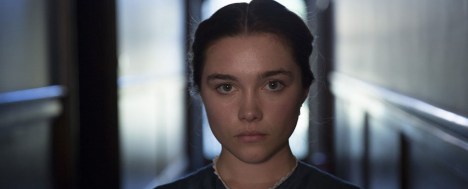
Writer Alice Birch and director William Oldroyd’s Lady Macbeth is a very loose adaptation of Lady Macbeth of the Mtsensk District by Nikolai Leskov, adapting the Russian novel to British surroundings. Ari Wegner’s cinematography is stunning, capturing the beauty of these new surroundings and meticulously framing the characters. Oldroyd films Lady Macbeth at a Kubrickian remove, keeping the camera still and often facing his characters head-on in a way that makes it seem like the cast are staring out of the film at the audience watching.

Thinly-veiled contempt.

Thinly-veiled contempt.

Birch’s script has an incredibly dark sense of humour, a wry grimace juxtaposed against the horrors that its characters inflict upon one another and the sense of bleakness that pervades the film. Indeed, the film balances on a knife-edge in terms of tone, shifting skilfully between moods from one scene to the next. At one moment, Lady Macbeth is a thoughtful character study, at another a cheeky feminist critique, then a pitch black comedy. Lady Macbeth is an impressive work in any technical sense.

However, there is a pervading coldness to the film, one reinforced by the intensity upon which the camera focuses upon characters who keep themselves at a remove. For all the polished sheen of Lady Macbeth, its characters remain heavily internalised and take their time expressing themselves through action. The result is a film that moves far too slowly, keeping its characters both opaque and inert for far too much of the runtime. Lady Macbeth is a very pretty film, but one that mistakes silence for profundity.

Return of the Mac(beth).

Return of the Mac(beth).

Continue reading

Non-Review Review: Zootropolis (aka Zootopia)

This film was seen as part of the Audi Dublin International Film Festival 2016.

Zootropolis is a solidly entertaining family film that strains under the weight of its core premise.

There is a great idea in here, a detective film set in an anthropomorphised world featuring a rabbit and fox who must team up to solve a number of mysterious disappearances. Along the way, writers Jared Bush and Phil Johnston fashion the story into an allegory rich with social commentary about race and class issues in American cities. It helps that the script is light on its feet and packed with enough fast gags that it breezes along without ever getting stuck in the same place for too long.

zootopia4

However, this becomes a problem in and of itself. There is a sense that Zootropolis struggles to do too much in the space afforded to it. The plot covers quite a lot of ground as our plucky heroes embark on their investigation, including extended (and overt) riffs on pop culture standards like The Godfather and Breaking Bad. There are points at which it feels like Zootropolis might be a much stronger film if it slowed down a bit, instead of hopping from one set-up to the next in the style of its rabbit protagonist.

Zootropolis largely works, but it never comes together in the way that the best Disney outings do. There are points at which Zootropolis feels more like a turducken than a chimera.

zootopia5

Continue reading

Non-Review Review: Hitchcock/Truffaut

This film was seen as part of the Audi Dublin International Film Festival 2016.

Hitchcock/Truffaut is incredibly light and fluffy.

In many respects, Kent Jones’ documentary about the eponymous piece of classic film literature plays like something of a late night infomercial populated with nerdiest film endorsements imaginable. Hitchcock/Truffaut is not so much interested in exploring and expanding its source text, instead settling for celebration. Wes Anderson boasts that his copy of the book is so well-used that it is held together by rubber bands; Kiyoshi Kurosawa explains that the only thing holding him back from blatantly stealing from the book is a promise to himself.

hitchcocktruffaut

There is not anything particularly wrong with this. There is something quite fun in watching film-makers get evangelical about their craft. All of the talking heads offer some insight into their own work when they expand upon what Alfred Hitchcock means to them. Martin Scorsese’s joy as he journeys shot-by-shot into Psycho is infectious, and it is clear that everybody involved with the project holds Hitchcock in the highest possible regard and embraces him as a cornerstone of modern movie-making.

Hitchcock/Truffaut‘s biggest issue is also its strongest virtue; this is a cheerful and superficial acknowledgement of its subject, one that decides particularly in-depth coverage of the auteur is secondary to rendering the material accessible to neophytes.

hitchcocktruffaut5

Continue reading

Non-Review Review: Miles Ahead

This film was seen as part of the Audi Dublin International Film Festival 2016.

Miles Ahead is a very strange film.

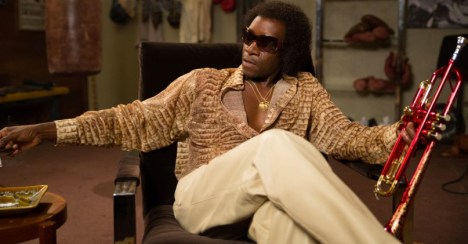
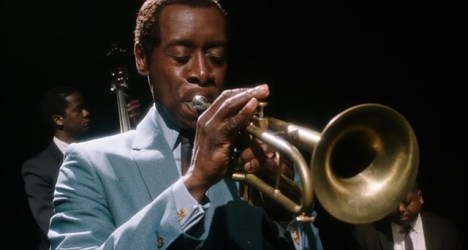
Don Cheadle stars as jazz musician Miles Davis. Not that Davis particularly cares for the descriptor. “That’s a made-up word, jazz,” he reflects during the opening credits. Asked to select a better description of his work, Davis settles on “social music.” In many ways, that awkward conversation sets the tone for the rest of the film, which weaves between a fairly conventional music biopic and a comedy musical heist adventure for no real reason beyond the fact that it really doesn’t want to be a conventional music biopic.

milesahead2

Miles Ahead feels like a passion project for Cheadle, who not only headlines the film but also directs and co-writes. Watching the movie unfold, it is clear that Cheadle cares deeply for the source material and understands the challenges the face any twenty-first century musical biography. Because Miles Ahead is adapting a life for film, it cannot avoid the familiar beats; the drug addiction, the disintegrated marriage, the wilderness years. However, Cheadle works to undercut these familiar tropes through a surreal and ambitious framing device.

Miles Ahead does not work. The film has no shortage of ambition, very clearly angling towards a free-form narrative style intended to evoke the protagonist’s unique musical sensibility. Cheadle is determined that Miles Ahead will not be lumped among the dozens of fairly nondescript musical biographies, instead tailoring something to his subject. However, Miles Ahead lacks the improvisational flourish that defines its central character, feeling more disjointed than harmonious.

milesahead3

Continue reading

Non-Review Review: Green Room

This film was seen as part of the Audi Dublin International Film Festival 2016.

Green Room is a masterful artisanally-crafted suspense thriller.

Writer and director Jeremy Saulnier crafts a loving tribute to seventies horror that feels like a truer successor to the “backwoods horror” genre than many contemporary remakes and reimaginings. Following a punk band named The Ain’t Rights that stumble into a tense stand-off with a bunch of neo-nazis in rural Oregon, Green Room is almost aggressively old-school in its horror sensibilities. It is tense and claustrophobic, paranoid and unsettling. Saulnier has a masterful understanding of the genre and its expectations, crafting a pitch perfect homage.

greenroom

Green Room is a very canny piece of work, but never in a manner that is distracting. The film is wry without being ironic, more arch than subversive. Appropriately enough, given its punk protagonists, the movie’s hints of cynicism about its genre and set-up bely a more earnest appreciation of the form. Green Room is a classic and conventional horror film about a bunch of kids who took a wrong turn, and it is utterly unapologetic about that. Instead, it commits to providing one of the most visceral traditional horror experiences in recent memory.

Green Room is a nasty piece of work. And is all the better for it.

greenroom6

Continue reading