• Following Us

  • Categories

  • Check out the Archives


  • Awards & Nominations

Non-Review Review: From Russia With Love

This post is part of James Bond January, being organised by the wonderful Paragraph Films. I will have reviews of all twenty-two official Bond films going on-line over the next month, and a treat or two every once in a while.

Dr. No demonstrated that Ian Fleming’s suave British secret agent could make it to screen. Sean Connery’s James Bond was on the pop culture map, but perhaps just short of becoming a pop culture icon – that was a sequel or two away. Of course, a second movie was pushed into development, with a rich library of Fleming’s novels to adapt – as faithfully or as loosely as the producers might like. When President Kennedy, one of the other “coolest men of the sixties”, announced that From Russia With Love was his ninth favourite novel of all time, it seemed th choice had been made. Rumour has it that Alfred Hitchcock was at one point intended to direct the film, but Terrence Young’s From Russia With Love is still a wonderfully iconic Bond film, which represents a pretty large step from “an entertaining espionage movie” to “globe-spanning spy franchise”.

Bond was already making a splash at this stage of his career...

Continue reading

Pete Postlethwaite

The quote from Spielberg about “probably the best actor in the world today” has been doing the rounds today, understandably, as well as Postlethwaite’s good-natured response (he remarked that it sounded like “a beer commercial”), but I think the below quote pretty much sums up my respect for Postlethwaite and his strength as an actor.

There are some moments that work. Pete Postlethwaite, as a big game hunter who flies onto the island with a second wave of dinosaur mercenaries, doesn’t step wrong; he plays a convincing if shallow character, even if he’s called upon to make lengthy speeches in speeding Jeeps, and to utter arty lines about “movable feasts” and having “spent enough time in the company of death.’‘ He alone among the major characters seems convinced that he is on an island with dinosaurs, and not merely in a special-effects movie about them.

Roger Ebert reviews Jurassic Park: The Lost World

It’s not his best role, nor his most notable. However, even then he managed to shine on the screen, and – when I think of him – that’s the quote that comes to mind. His career featured any number of fantastic films (The Usual Suspects, Inception), but he always brought his best – even when the movie probably didn’t deserve it. I won’t go on at length, because far more authoritative and eloquent individuals have already offered their feelings.

Rest in peace. You will be missed.

Non-Review Review: Dr. No

This post is part of James Bond January, being organised by the wonderful Paragraph Films. I will have reviews of all twenty-two official Bond films going on-line over the next month, and a treat or two every once in a while.

Sure, there’s an opening scene involving the murder of a British agent stationed in the Caribbean, but the start of the movie that everybody remembers takes place in a late-night British casino over a game of card. A beautiful young woman is losing to the suave cigarette-smoking stranger on the opposite side of the table. “I admire your luck, Mister…?” she remarks, locking eyes with the figure. He coyly lights a cigarette.

“Bond,” he introduces himself. “James Bond.”

The rest is cinematic history.

You know the name… You know the number…

Continue reading

the m0vie blog: 2010 in Review

The stats helper monkeys at WordPress.com mulled over how this blog did in 2010, and here’s a high level summary of its overall blog health:

Healthy blog!

The Blog-Health-o-Meter™ reads “Wow”.

I know that it probably sounds a bit self-congratulatory, but I am geniunely chuffed with this email I received this morning, and figured that it might be worth posting up here. I’d like to thank everybody who takes the time to stop by and does so on a regular basis. A special thanks to all the people in my life who have been patient and enthusiastic about this little side project, and for all the encouragement that I’ve received. It’s been a fun year, and here’s to 2011!

Who is Bond?

This post is part of James Bond January, being organised by the wonderful Paragraph Films. I will have reviews of all twenty-two official Bond films going on-line over the next month, and a treat or two every once in a while.

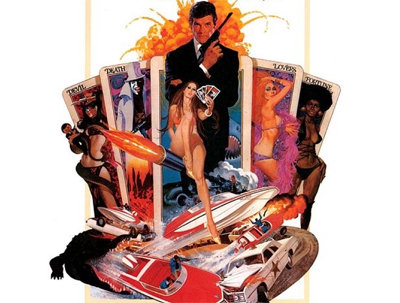
If you only count official EON productions, there have been six actors to play the role of suave British Secret Service agent James Bond, 007. However, the continuity of it all gets kind of tangled. Is Roger Moore’s clownish spy the same person as Daniel Craig’s cold-hearted assassin? Has the same agent been in operation since Dr. No (clearly taking place in the 1960s) through to Quantum of Solace (featuring all the technology of now)? There’s a popular fan theory that “James Bond” is just a cover identity, passed down from agent to agent as easily as the number “007” – so each iteration of the character is a different agent given the rank. It actually holds up surprisingly well when you watch the twenty-films in the official series.

What’s on the cards?

Continue reading

Eleven for Eleven: My Ten Most Anticipated Movies of 2011

What with listing my top ten films of the past year and all that, I thought that I’d take the opportunity to look forward rather than backwards. So here are my eleven most anticipated movies coming out in the next year or so. I picked eleven, because I’m not 100% certain about the release date of one. As ever, these are for Irish and British cinemas, so four of these will be arriving in our theatres within the next three weeks. Which, I suppose is something to look forward to. Anyway, without any further adieu, here are my eleven most anticipated films of the year ahead.

Coming soon...

Continue reading

Happy New Year…

… okay, it isn’t New Year yet, but what better way to ring it in movie-wise than a bit of nostalgia. Last year, Empire celebrated their twentieth anniversary in style by inviting a whole bunch of famous actors to come back and relive some of their iconic movie moments. I can’t agree with all the choices (Minority Report seems a little… modern for Cruise, doesn’t it?), but it was a great little project and one which felt like a celebration of twenty-years of movie-making magic. Click the images or go to Empire for bigger versions (where I could find one – they make a nice screensaver).

Continue reading

10 out of 10: The Ten Best Movies of the Year

Contrary to popular opinion, I was actually relatively impressed with 2010 as a year in cinema. It was no 2008, with a consistent string of impressive hits (both big and small). However, it wasn’t as bitterly disappointing as 2009 was, with letdown after letdown. Sure, there weren’t that many hugely successful sequels or reboots, but the vast majority of them weren’t soul-destroying wastes of film. So I’m quite happy. This year I actually had to cut several items from the list to get it down to a perfect ten.

Continue reading

10 for 10: Top Ten Movie Moments of the Year

Tomorrow, I’ll be revealing my top ten movies of the past year. It should be a fairly straightforward list, and – to be honest – there won’t be too many surprises on it. Anyway, I thought I’d put together my list of the top ten “moments” from the past year. As ever, I’m Irish – so I’ve yet to see the major crop of Oscar nominees – but it’s worth keeping in mind that there isn’t really a major overlap between this and the list of the best pictures. Some of the best movies didn’t have iconic moments, while some of the best moments were in otherwise lackluster films. Some good movies had great moments, and some great movies had simply okay moments. So, with the rules out of the way, let’s get this countdown under way!

Continue reading

Marvel Crossover Continuity

In August, I decided it would be… interesting to take a look at the event-driven storylines that Marvel was producing between 2005 and 2010. So, for sixteen weeks (and more, if you consider the occasional bonus back-up feature), I reviewed one of the many “events” Marvel produced during the period. I’ve grouped the particular strands of continuity together below for easy of browsing (also providing the original date of publication). I hoped that exploring this particular aspect of the medium might grant me some insight into why big events like this continually upset on-going stories being told by writers in individual characters’ books. It was an interesting experiment, even if I doubt I’ll be engaging with the core of the Marvel Universe so thoroughly any time soon.

Note: It is incomplete. I had planned to follow The Avengers through to Siege, but it looks like my reviewing schedule caught up with them – for the same reason I haven’t got around to The Thanos Imperitive yet. I will return to this thread in the future.

Avengers-Based Continuity
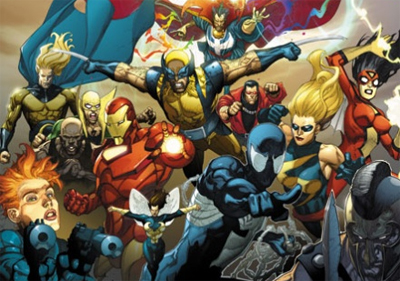
It was a good decade for The Avengers as a franchise, with Marvel consciously pushing the franchise to the forefront – not just in comics but in other media as well. If the nineties and early naughties belonged to the X-Men (with X-Men: The Animated Series on the airwaves, Bryan Singer’s X-Men in cinemas and crossovers like Age of Apocalypse in comic books), this was very clear attempt to take that back. Brian Michael Bendis was tasked with turning the Avengers into Marvel’s prime franchise and succeeded – most of the “big” comic book events of the decade revolved around them. That said it was certainly a controversial restructuring of the book, with a line-up crafted to feature more popular characters like Spider-Man and Wolverine instead of more obscure characters like Quicksilver or the Scarlet Witch.

The Avengers branched out into other media too. Iron Man demonstrated that Marvel’s “big three” could hold viewer interest in cinemas, and promised a series of crossovers on the big screen that would see The Avengers assemble under the direction of Joss Whedon. As a brand, Marvel made sure these characters were everywhere.

The stories featuring these characters over the decade form something of a larger meta-story which seems to reflect on the superhero genre as a whole. Although Bendis’ New Avengers opens with a supervillain breakout, the characters spent more time fighting each other than bad guys (Civil War, World War Hulk). When they did fight bad guys, they were more often than not corrupted mirrors of themselves, be it the Skrulls who had managed to so perfectly imitate heroes despite being villains (Secret Invasion) or government-sanctioned psychotic “Dark Avengers” (Siege). It was a story about how difficult it was to be a hero in the last few years – in the wake of the “dark age” of comic books – and a deconstruction of the effectiveness of a group of individuals like this to actually make a difference. You could even argue that this was a grim reflection of real world political and social uncertainty – particularly mistrust of authority (it’s telling how much time these heroes spend going “rogue”). Of course, this is open to interpretation, and many fans were less than pleased with the execution of this particular tale.

“Cosmic Marvel” Continuity

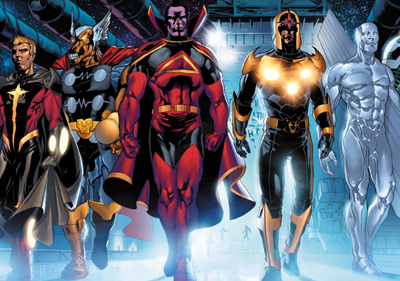
Marvel’s Cosmic Universe got a much-needed revitalisation this decade, offering perhaps a better-plotted and more straightforward avenue for Marvel’s crossover events. Although Jim Shooter had done great work with many of these characters in the nineties (with Infinity Gauntlet and so forth), they had mostly remained in relative obscurity before the relaunch.

The distinguishing aspect of these stories is the way that they are structured. Rather than a big event coinciding with countless tie-ins across countless books, most of these stories would open with a single prologue issue which would branch into a handful of miniseries running for a set number of issues, before dovetailing into a main series. This meant that every issue remotely connected with a series could be collected in a hardcover. Admittedly the titles become more entangled in continuity as they went on (with War of Kings tying in directly to Ed Brubaker’s The Rise & Fall of the Shi’ar Empire story arc in Uncanny X-Men), but by and large these series served to avoid pointless tie-ins and an exceptionally convoluted continuity (everything you needed was included in the books themselves).

They’re the best crossovers that you weren’t reading.

X-Men Continuity

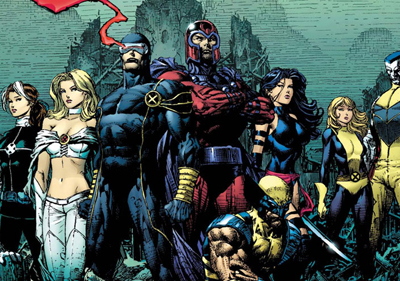
The last decade has been an interesting one for the X-Men, as both the books and the characters have found themselves looking for purpose. Grant Morrison’s New X-Men posited a world where mutants would be the dominant species with a few generations and proposed to move the “mutants as oppressed minority” metaphor firmly into the twenty-first century, where the worries weren’t (at least for the most part) about government-sponsored genocide or legal rights, but cultural and social questions about the way that mutants and humanity live together. This was clearly a step too far, as Marvel decided to essentially wipe out the mutant population, feeling there were too many mutants in the Marvel Universe. This was done with three words from a psychotic Scarlet Witch rather than a more subtle approach (like simply reducing the number of mutants featured in various books).

Suddenly the X-Men found themselves facing extinction, and this became a driving narrative force for the book. It was as if the line was actively rebelling against the editorial mandate forced upon them. Instead of granting narrative clarity, the edict had instead complicated things. It also forced the X-Men away from their widely-loved position as a civil rights metaphor and towards a more straight forward “find the cure” narrative. It also served to isolate the franchise from the rest of the Marvel Universe (except for Wolverine, of course, who is everywhere) – the X-Men were always busy doing their thing and trying not to die out rather than assisting with Civil War or Secret Invasion. The solution to this narrative thread is entirely predictable, but it does offer a clear structure to the X-Men stories from the period.

It’s interesting to note that while all the major Avengers titles from this period (New/Mighty/Dark Avengers) have been consistantly collected, the X-Men books have not been. Ed Brubaker’s run is quite difficult to collect in one consistent format, as is Matt Fraction’s – and both are writing for what should be “the flagship book” of the X-Men publishing line, Uncanny X-Men. This makes it considerably harder to follow than the Avengers franchise, for example.