• Following Us

  • Categories

  • Check out the Archives


  • Awards & Nominations

Non-Review Review: The Wolf of Wall Street

In 1987, Oliver Stone’s Wall Street was arguably too subtle in its criticisms of the Wall Street mentality – the philosophy that “greed, for lack of a better word, is good” or that enough can never really enough. After all, the film apparently inspired a whole generation of stock brokers and investment managers, with quite a few aspiring to be their generation’s Gordon Gekko – when the movie’s central point was that Gekko was hardly an idol to worship.

This would seem to explain the rationale of Scorsese’s The Wolf of Wall Street, a film that makes Stone’s brutal evisceration of Wall Street excess seem positively mild-mannered. Indeed, the film all but directly acknowledges this fact in an early scene where a “hatchet job” of an article from Forbes (the same article that would lend Belfort his sobriquet “Wolfie!”) prompts a massive upsurge in job applications for Belfort’s Stratton Oakmont.

The money shot...

The money shot…

So, understanding the need to go a bit bigger and larger, The Wolf of Wall Street introduces us to its protagonist, Jordan Belfort, snorting cocaine out of the bodily orifices of a prostitute, and yet somehow descends deeper and deeper into acts of debauchery and excess. It’s an unrelenting and energetic film, that is exhausting and exhilarating. It’s less of a structured story and more a three-hour laundry-list of depravity.

While the last hour of the film (the inevitable “it all comes tumbling down… or does it?” act) can’t maintain the forward moment that make the first two so exhilarating, The Wolf of Wall Street remains proof that Scorsese is an incredible film maker with an almost impossible vigour and enthusiasm for the medium.

Drinking it in...

Drinking it in…

Continue reading

Non-Review Review: Devil’s Due

The single biggest problem with Devil’s Due is that it’s boring.

There are a lot of other flaws. It’s really creepily xenophobic. It has little interest in the female character carrying this baby. It is completely uninterested in the “found footage” thing, but still commits to using it. It is really just a bunch of clichés that we’ve seen done much better elsewhere. Its protagonists rank incredibly low on the intelligence scale for horror movies, which sets a pretty low baseline to begin with.

However, the most frustrating flaw with this reproductive horror is the fact that it’s just deathly dull.

The belly of the beast...

The belly of the beast…

Continue reading

Star Trek: The Next Generation – Up the Long Ladder (Review)

This January and February, we’ll be finishing up our look at the second season of Star Trek: The Next Generation and moving on to the third year of the show, both recently and lovingly remastered for high definition. Check back daily for the latest review.

It’s been a while since Star Trek: The Next Generation has been openly offensive. So, just in case you’d forgotten that this was the same production staff that gave us “Riker beams down to a planet of beautiful women and screws their heads on straight” or “Troi’s womb is occupied by an alien intelligence, isn’t that cute?”, the writing staff have conspired to remind us that just because prejudice doesn’t exist in the 24th century (tell that to the Ferengi!) doesn’t mean that it can’t exist inside a late twentieth century writing room.

Begosh and begorrah! The space Oirish are coming!

"Wait, we're actually filming this?"

“Wait, we’re actually filming this?”

Continue reading

Star Trek: The Newspaper Strips – Beware the Omnimind! (aka Restructuring is Futile) (Review)

This January and February, we’ll be finishing up our look at the second season of Star Trek: The Next Generation and moving on to the third year of the show, both recently and lovingly remastered for high definition. Check back daily for the latest review.

We’ll be supplementing our coverage of the episodes with some additional materials – mainly novels and comics and films. This is one such entry.

As brilliant as the Borg were when they were introduced in Q Who?, they were hardly the most original of constructs. The cybernetic aliens went on to become one of the most iconic and recognisable pieces of Star Trek lore, featuring in the most popular Star Trek: The Next Generation feature film and all the subsequent spin-offs, but it’s tempting to give the Borg a bit more credit than they’re due.

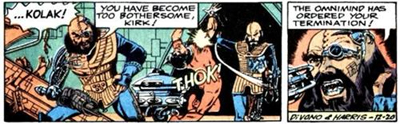
After all, cybernetic organisms were hardly cutting edge in 1989. In fact, this wasn’t even the first time that Star Trek had told this kind of story. In late 1981, the Star Trek news paper strip that had begun as a companion piece to Star Trek: The Motion Picture, featured a similar adversary for Kirk’s Enterprise.

Resistance is futile!

Resistance is futile!

Continue reading

Star Trek: The Next Generation – Samaritan Snare (Review)

This January and February, we’ll be finishing up our look at the second season of Star Trek: The Next Generation and moving on to the third year of the show, both recently and lovingly remastered for high definition. Check back daily for the latest review.

To describe Samaritan Snare as a step down from Q Who? feels like an understatement. Q Who? was Star Trek: The Next Generation realising that it needed to improve its game if it ever wanted to measure up to its predecessor, interrogating some aspects of the series that had been taken for granted, calling the crew out on their arrogance and offering an opponent that could really push the Enterprise crew for all that they are worth.

It was really the logical culmination of themes running through the second season, themes that seem to faintly echo into Samaritan Snare, another story about the arrogance and ego of the Enterprise crew. Unfortunately, while it does seem to acknowledge many of the same weaknesses and flaws that Q Who? hit upon, it can’t help but seem a little disappointing. Here, the Enterprise are not thrown against an impossible-to-defeat adversary. Instead, their arrogance turns them into interstellar marks.

His heart just isn't in it...

His heart just isn’t in it…

Continue reading

Star Trek: The Next Generation/Doctor Who – Assimilation² (Review)

This January and February, we’ll be finishing up our look at the second season of Star Trek: The Next Generation and moving on to the third year of the show, both recently and lovingly remastered for high definition. Check back daily for the latest review.

We’ll be supplementing our coverage of the episodes with some additional materials – mainly novels and comics and films. This is one such entry.

It’s amazing that Assimilation² represents the first official crossover between Star Trek and Doctor Who. After all, the nineties saw a trilogy of comics and novels in which Star Trek crossed over with Marvel’s X-Men. At the same time, though, the miniseries’ combination does seem a little odd. Pairing the Cybermen and the Borg is a bit of a no-brainer, but the Eleventh Doctor feels like a bit of a strange fit on board Picard’s Enterprise.

The Ninth or Tenth would arguably offer more of a contrast with Picard’s restrained and dignified command style. The Tenth Doctor and Donna arriving on the luxury Enterprise practically writes itself. (“Now that’s what I call a spaceship. You’ve got a box, they’ve got a Stella Liner.”) Picard and the Eleventh Doctor feels like a particularly bland pairing, if only because there’s no way they’d try each other’s patience. The Eleventh Doctor would probably work better in the context of Sisko’s Deep Space Nine or either Kirk’s Enterprise.

Still, although Assimilation² never quite takes full advantage of its central hook, it’s a diverting enough mish-mash of two science-fiction staples.

Cue Who?

Cue Who?

Continue reading

Star Trek: The Next Generation – Q Who? (Review)

This January and February, we’ll be finishing up our look at the second season of Star Trek: The Next Generation and moving on to the third year of the show, both recently and lovingly remastered for high definition. Check back daily for the latest review.

Q Who? throws down the gauntlet for Star Trek: The Next Generation. It serves as a fitting reminder that Picard and his crew are still amateurs when it comes to space exploration. They don’t even win the day – they suffer “a bloody nose” before limping away from their strange new opponents to lick their wounds. For a crew that never seemed to sweat before, who never seemed like they were under pressure, this is a shocking development.

More interestingly, it’s something unknown in a universe that has become far too familiar. Three of the four episodes leading into Q Who? ended with the crew accepting that there were some things they’d never fully understand or comprehend, and – while it’s unlikely this was intentional – it seems like a nice bit of thematic foreshadowing rather than haphazard plotting. For the first season-and-a-half of the show, it seemed like the Enterprise was always dealing with the familiar, always in control of the situation.

With Q Who?, everything is put into perspective.

Borg to death...

Borg to death…

Continue reading

Star Trek: Strange New Worlds VI – The Beginning (Review)

This January and February, we’ll be finishing up our look at the second season of Star Trek: The Next Generation and moving on to the third year of the show, both recently and lovingly remastered for high definition. Check back daily for the latest review.

We’ll be supplementing our coverage of the episodes with some additional materials – mainly novels and comics and films. This is one such entry.

The Borg are, quite possibly, the most significant addition to the Star Trek mythos since the Klingons. They are one of the few modern pieces of Star Trek lore that will be instantly recognisable to a broader audience. They have featured, in some way, in all four of the Star Trek spin-off series. They are constantly rumoured and suggested as a viable antagonist for the rebooted film series. The Borg are a pretty big deal.

And yet, like so many pop culture villains, they seem less threatening the more we know about them. One of the more frequent complaints about the use of the Borg in Star Trek: Voyager was that it made the aliens more familiar, more understandable, more relatable. Continuing to build off the premise of the Borg Queen in Star Trek: First Contact, the Borg became an alien species that Janeway would reason and negotiate with, in stark contrast to Q’s characterisation of the collective in Q Who?

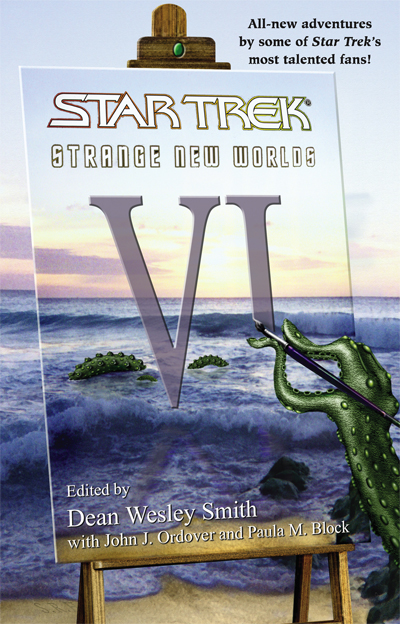
Although Star Trek: Enterprise did manage to turn the Borg’s fascination with mankind into a causal loop, televised Star Trek never managed to produce an origin story for those cybernetic monsters. Ever ready to fill in a perceived blank in the canon, the expanded Star Trek universe has actually proposed a number of origins for the Borg.

st-strangenewworlds6

Continue reading

Star Trek: The Next Generation – Pen Pals (Review)

This January and February, we’ll be finishing up our look at the second season of Star Trek: The Next Generation and moving on to the third year of the show, both recently and lovingly remastered for high definition. Check back daily for the latest review.

Pen Pals is a pretty mediocre episode of Star Trek: The Next Generation, one with a lot more potential than the episode actually delivers upon. Centring around Data’s unilateral decision to violate the Prime Directive and the consequences stemming from that decision, there’s a sense that Pen Pals might have been a lot more incisive in earlier version – a lot more willing to ask tough questions about the rules and regulations that our heroes uphold.

Sadly, Pen Pals instead ends with a massive cop out and an unwillingness to really commit to any big idea or to interrogate any of the show’s core concepts.

Everything burns...

Everything burns…

Continue reading

Star Trek: The Next Generation (DC) Annual #2 – Thin Ice (Review)

This January and February, we’ll be finishing up our look at the second season of Star Trek: The Next Generation and moving on to the third year of the show, both recently and lovingly remastered for high definition. Check back daily for the latest review.

We’ll be supplementing our coverage of the episodes with some additional materials – mainly novels and comics and films. This is one such entry.

Riker is a character caught between a rock and a hard place. According to the series bible, Riker was imagined as one of the “dual lead characters” for the show and clearly envisioned as an impulsive and brilliant Kirk to Picard’s more rational and stoic Spock. However, it didn’t quite work out that way, for a number of reasons. For one thing, the writing on the early years of Star Trek: The Next Generation tended to be a bit more sterile and bland, so Riker was never really allowed to step too far out of Picard’s shadow.

Instead, we got lots of characters talking about how ambitious Riker was, without seeing it for ourselves. It’s implied that Riker’s career led him to separate from Troi, something Peter David ran with in Imzadi. Everybody is constantly telling everybody else how Riker desperately wants to be a starship commander. And yet, when it come to the actual characterisation of Riker on the show, none of this shines through.

Due to the constraints imposed on the early years, interpersonal conflict was impossible in early Next Generation scripts, putting Riker in a paradoxical position as a character. We’re repeatedly told how ambitious and career-orientated he is, but none of that shines through.

Dead space...

Dead space…

Continue reading