












This May and June, we’re taking a trip back in time to review the fifth season of The X-Files and the second season of Millennium.
Monster continues the process of laying the groundwork for the second season of Millennium. Glen Morgan and James Wong had very consciously shaken things up with The Beginning and the End, and the first third of the second season is clearly intended to construct a solid foundation for the rest of the year. Looking at the plot points and character beats from the various episodes, they read almost like a checklist of things to address or introduce before the series can really start moving under its own power again.
Even outside of the dramatic changes wrought by The Beginning and the End, the other episodes in this stretch of the season each have their own purpose. Beware of the Dog introduces us to the Old Man, affectionately riffs on the first season format, and outlines the refactored Millennium Group. In turn, Sense and Antisense riffs on The X-Files and helps to identify areas of overlap with Millennium. A Single Blade of Grass gives Frank back his psychic powers, albeit in a more powerful and abstract form. The Curse of Frank Black is a character-driven vehicle. 19:19 and The Hand of St. Sebastian get well and truly biblical.
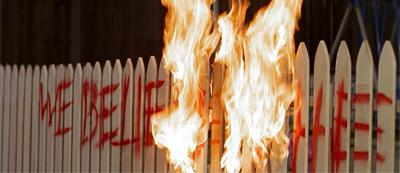
Fire and brimstone…
The most dramatic aspect of Monster is the introduction of the character of Lara Means. Means becomes a pretty vital part of the second season of Millennium, and is introduced in Monster with an eye to her inevitable role in The Time is Now. Means is a vital cog in the workings of the second season, perhaps the most important part of the mythology explicitly created by Morgan and Wong, instead of simply repurposed and reinvented. Means is a fantastic creation, wonderfully brought to life by actor Kristen Cloke and well-realised by Morgan and Wong’s scripting.
However, even outside of the important introduction of Lara Means to Millennium, Monster feels like an episode that exists to set up and outline the larger themes and ideas of the season in a way that foreshadows the larger arc. Like A Single Blade of Grass, it reiterates themes that will become a lot more important as the year goes on. Like Beware of the Dog, it uses the familiar template of a first-season Millennium episode to do this.
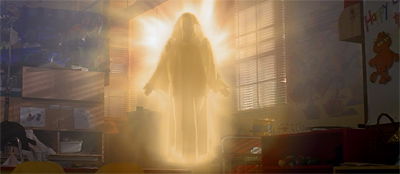
I believe in angels…
Filed under: Millennium | Tagged: Child abuse, child murder, evil, evil children, frank black, Glen Morgan, James Wong, kristen cloke, Lance Henriksen, lara means, mcmartin preschool, millennium, prophecy | Leave a comment »









Star Trek: Enterprise – The Breach (Review)
Next year, Star Trek is fifty years old. We have some special stuff planned for that, but – in the meantime – we’re reviewing all of Star Trek: Enterprise this year as something of a prequel to that anniversary. This April, we’re doing the second season. Check back daily for the latest review.
One of the more interesting aspects of a heightened franchise like Star Trek is the way that invites particular members of staff to define their own voices. On most of the Star Trek shows, it is easy to distinguish the work of particular writers from one another. Ronald D. Moore likes militarism and world-building; Brannon Braga likes time travel and classic science-fiction. There are clear voices that can be distinguished from the choir on each of the shows, for better or for worse.
Although it enjoyed a considerably shorter run than the other Star Trek spin-offs, Star Trek: Enterprise is no exception. The Breach is a script credited to writers Chris Black and John Shiban. The two had collaborated unofficially on Canamar, a script credited to Shiban alone. The two would work together again on First Flight towards the end of the season. It is certainly a partnership that had considerable potential, if not for Shiban’s departure at the end of the season.
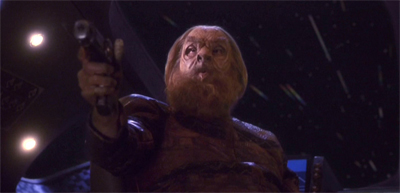
What’s up, Doc?
In many respects, The Breach feels like the product of those two voices. Xenophobia is a major theme of The Breach – as it was in Shiban’s other scripts for the season like Minefield, Dawn or Canamar. Like their last collaboration on Canamar and their future collaboration on First Flight, it seems The Breach presents a more balanced version of Archer than episodes like The Crossing or Horizon. This is a version of Archer who feels compelled to do the right thing, but without the same oppressive self-righteousness that drives his more awkward moments.
However, it seems like Chris Black provides The Breach with its very traditional and old-fashioned Star Trek aesthetic. A veteran of genre television with an understanding of the narrative conventions associated with the franchise, Black understands how Star Trek storytelling is supposed to work. The Breach is perhaps a little too formulaic and traditional in its storytelling, but it does demonstrate that – despite its best efforts – The Crossing had not completely buried a certain optimistic strain of Star Trek ethics.
Into darkness…
Continue reading →
Filed under: Enterprise | Tagged: 9/11, allegory, chris black, cycle of violence, cycles of violence, denobulans, enterprise, ethics, Guilt, hatred, john shiban, legacy, metaphore, morality, morals phlox, robert duncan macneill, social commentary, star trek: enterprise, the breach, war, xenophobia | 5 Comments »