












This July, we’re taking a trip back in time to review the sixth season of The X-Files and the third (and final) season of Millennium.
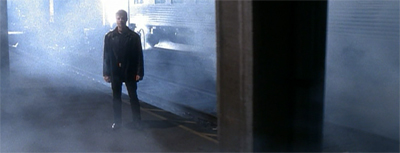
Collateral Damage continues the weird healing process at work in the third season.
After spending so much time pretending that the second season never actually happened, the third season has finally accepted that there were story developments flowing from that season that the show needs to deal with. In some respects, Collateral Damage can be seen as a process of healing and integration for the third season of Millennium, constructing a story that manages to tie together all three seasons of Millennium together into something resembling a cohesive whole.
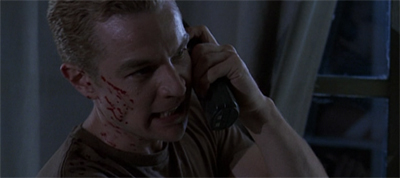
“A bloody fine mess you’ve gotten me into!”
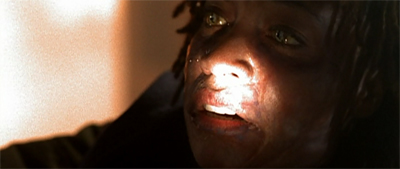
From the first season, Collateral Damage takes its introduction and basic premise. Collateral Damage begins in a manner similar to many early Millennium episodes. A sinister attacker stalks their victim and brutally strikes. We are then treated to a few extended suspense-filled sequences as the attacker’s designs become increasingly uncomfortable and nefarious. It is not too hard to imagine Collateral Damage as the kind of “serial killer of the week” episode that populated the early first season.
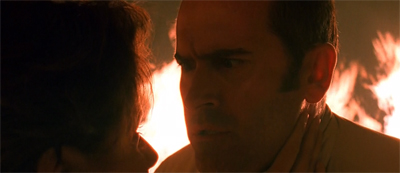
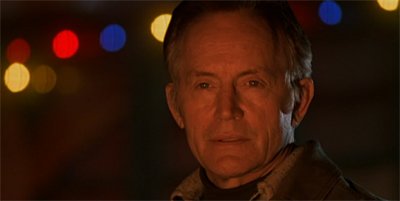
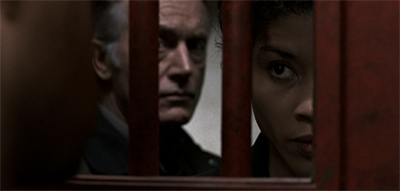
For the second season, Collateral Damage inherits its fascination with the Millennium Group and its depiction of Peter Watts. Collateral Damage marks the first point in the third season where Peter Watts feels like the character that we watched grow and evolve over the second season. This is a version of Peter who has so repressed his doubts and uncertainties that they threaten to explode if they are even acknowledged. It is a much more compelling character than the knock-off conspirator featured in episodes like Exegesis and Skull and Bones.
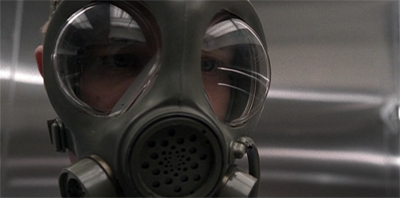
“Don’t be afraid.”
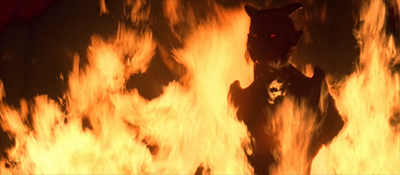
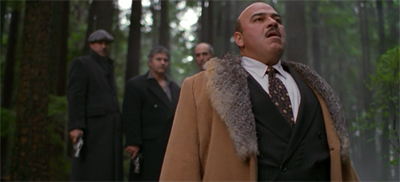
From the third season, Collateral Damage takes its fixation on the link between the Millennium Group and conspiracies involving the American government. Collateral Damage suggests that the Millennium Group is responsible for Gulf War Syndrome. It feels like a plot point from an episode of The X-Files – and arguably makes it an ideal third season element. The result is perhaps the most all-encompassing episode of the show ever produced. Collateral Damage is not the best episode of Millennium ever produced, but it is perhaps the broadest representation of the show itself.
If you were to pull back and examine Millennium from a distance, it might look a lot like Collateral Damage.
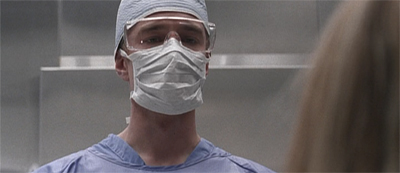
“Surgical strike.”
Filed under: Millennium | Tagged: art bell, conspiracy theories, Frank, frank black, gulf war syndrome, james marsters, michael r. perry, millennium, millennium group, peter watts, spike | Leave a comment »








 the m0vie blog
The X-Files – Dreamland II (Review)
This July, we’re taking a trip back in time to review the sixth season of The X-Files and the third (and final) season of Millennium.
Morris Fletcher is (and remains) one of the more interesting aspects of the Dreamland two-parter.
Fletcher would go on to become perhaps the most unlikely recurring character in the history of The X-Files. Michael McKean would reprise the role for a brief cameo in Three of a Kind at the end of the season. As with Kersh, he would disappear from the show’s world for the troubled seventh season, but would return the following year. He made a guest appearance in All About Yves, the finalé of The Lone Gunmen. Fletcher would then follow the Lone Gunmen back to The X-Files, appearing in Jump the Shark during the final season.
And the shippers went wild…
A large part of what makes Fletcher work is the wonderful guest performance of Michael McKean. McKean is a veteran actor with a long history of great work, dating back to his breakout role as Lenny (and Squiggy) on the sitcom Laverne and Shirley. Along with the move to Los Angeles, the sixth season of The X-Files began to drift away from Chris Carter’s initial reluctance to cast recognisable actors in significant roles. The X-Files: Fight the Future had featured guest appearances from Martin Landau, Blythe Danner, Armin Muller-Stahl and Glenne Headly.
The two-parter built around Michael McKean paves the way for appearances from Ed Asner, Lily Tomlin and Bruce Campbell. These are all superb guest performances, and consciously play into the idea that the sixth season of The X-Files has taken on a more playful or vaudevillian style. It is too much to describe these guest roles as “stunt casting” in the same way that putting Jerry Springer in The Post-Modern Prometheus or Burt Reynolds in Improbable was stunt casting, but the casting decisions are part of a broader change in the show.
Our man Morris…
On paper, Morris Fletcher could easily come off as a one-note creep. After all, he is a character who thinks nothing of using his body swap with Fox Mulder to cheat on his wife of twenty years. There is a creepy and pervy banality to his evil, one that mirrors that of Eddie Van Blundht in Small Potatoes. However, while Small Potatoes felt a little too sympathetic to pathetic Eddie Van Blundht, Dreamland strikes a better balance in its portrayal of Morris Fletcher. McKean plays Fletcher as a very human character, but one who is no less creepy for his well-practiced charm.
It goes almost without saying that Michael McKean’s guest performance is a major reason why Dreamland (mostly) works.
Not particularly reflective…
Continue reading →
Filed under: The X-Files | Tagged: commentary, deconstruction, dreamland, frank spotnitz, john shiban, kim manners, Michael McKean, morris fletcher, mulder, science fiction, scully, subversion, vince gilligan, x-files | 1 Comment »