• Following Us

  • Categories

  • Check out the Archives


  • Awards & Nominations

Non-Review Review: Guardians of the Galaxy, Vol. 2

The most appealing aspect of the original Guardians of the Galaxy was its awareness of its arrested development.

James Gunn and Nicole Perlman crafted an ode to juvenile nostalgia, anchored in a protagonist who found himself drifting away from Earth following the loss of his mother. Superhero movies work best as extended metaphors or homages, as a vehicle to render the human experience in operatic terms. Guardians of the Galaxy was the tale of a young man who had lost touch with reality in the moment that he lost his mother, and who had escaped into an acid dream of eighties space opera tropes.
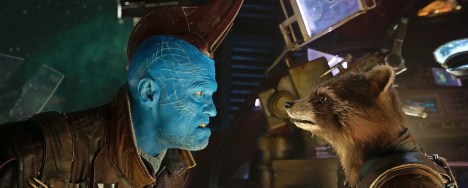
Mohawking his wears…

Guardians of the Galaxy, Vol. 2 works best when it remembers this. If the first film explored Peter’s retreat from the death of his mother, then the second explores his relationship with his absentee father. Once again, the film is saturated with eighties iconography. Early in the film, Peter confesses that he used to pretend that David Hasselhoff was his father. It is hard to tell whether he is trading up or trading down when he meets a bearded Kurt Russell.

Guardians of the Galaxy, Vol. 2 has a very straightforward set of character and thematic arcs. The movie maintains a clear throughline, focusing on the relationship between fathers and sons. The film is not subtle, even working in Cat Stevens’ Father and Son. Of course, that archetypal relationship has been explored repeatedly and thoroughly within mainstream pop culture and particularly superhero cinema. Nevertheless, it provides a clear focus to Guardians of the Galaxy, Vol. 2, a sense of momentum and direction.

Turn up the volume.

This throughline is essential, because Guardians of the Galaxy, Vol. 2 suffers from significant bloat. The second act of the film is a mess, one compounded by a number of questionable creative decisions that seem to have been made because these beats are expected from the second film in a blockbuster franchise. Guardians of the Galaxy, Vol. 2 follows the science-fiction sequel playbook just a little too well, occasionally losing sight of its characters and the chemistry between them.

Guardians of the Galaxy, Vol. 2 does not work as well as Guardians of the Galaxy. In large part, this is because it feels like a self-conscious sequel rather than an organic extension of the original film. James Gunn never forgets what worked about the original film, but he also cannot resist the urge to go larger with it.

A hole lot of trouble…

Continue reading

Doctor Who: Smile (Review)

Smile is a retro future thriller updated for the twenty-first century. It is 2001: A Space Odyssey and Logan’s Run by way of Ex Machina or The Girl With All the Gifts.

On the surface, Smile is the story of a rogue computer program seeking to enslave or destroy mankind. Popular culture is littered with that particular nightmare, a sentient AI that embarks upon patricide; Skynet from The Terminator, Alpha 60 in Alphaville. Indeed, Doctor Who has a rich history of playing with the trope; the sentient computer in The Keys of Marinus, B.O.S.S. from The Green Death, WOTON from The War Machines, P7E from Underworld. It is a classic science-fiction trope, and Smile plays with the idea of help robots becoming self-aware and murderous.

Bad bots.

Indeed, even the aesthetic of the episode consciously evokes those retro stories. Smile was filmed in Valencia’s City of Arts and Sciences, a beautiful architectural marvel defined by its smooth white surfaces and peaceful atmosphere. It feels very sterile and very clean, its minimalism evoking the set designs of those classic films and its relative lack of colour harking back to the time when Doctor Who was broadcast in black-and-white. For most of its runtime, Smile feels like a very old-fashioned piece of science-fiction.

However, around the halfway point, a shift takes place. All of a sudden, the smooth whites of the city give way to the grim industrial earth tones of the rocket. The episode seems to jump forward to gritty late seventies and early eighties science-fiction, the “used future” of Star Wars and Alien. As the episode continues, it pushes even further. Ultimately, it becomes a sly subversion of the archetypal “robot rebellion” story, instead exploring the implications of that narrative. The Vardi are transformed from renegade robots to freed slaves. It is a clever twist, albeit somewhat rushed.

Character arcs.

Continue reading

Star Trek: Deep Space Nine – Change of Heart (Review)

Change of Heart is another good episode that stops short of being a great one.

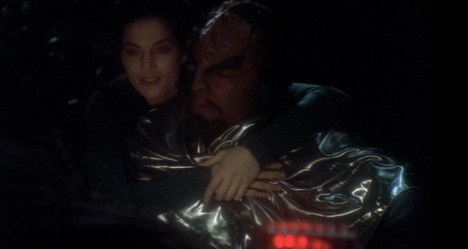
On paper, Change of Heart is a wonderful premise. Due to expedience, Worf and Jadzia are assigned on a covert mission that eventually leads to the potential recovery of a Cardassian defector. While trekking through a jungle world on their way to meet this high-value asset, a fire fight with the Jem’Hadar leaves Jadzia wounded. Without medical attention, she will bleed to death. As such, Worf finds himself caught between the oath that he swore to Starfleet and his duty to the woman that he loved. That is harrowing drama, right there.

A stain on his record.

The execution is also very solid. Ronald D. Moore is the perfect writer for a script like this, able to balance organic banter with high-stakes drama. David Livingston is a director who can certainly keep a plot moving. While Terry Farrell and Michael Dorn might not make sparks fly, they have an endearing chemistry that plays very well as a married couple. The script for Change of Heart plays to the strengths of its leading performers. It leaps through a lot of contrivances to get to that big central dilemma, but it moves quickly enough that they are not fatal flaws.

However, Change of Heart once again brushes up against the limits of what Star Trek: Deep Space Nine can do as a late nineties television series. It is an episode that suffers from the limitations imposed by the pragmatic realities of late nineties television production. Change of Heart is an episode that has very consciously learned from (and evolved beyond) the mistakes of earlier and clumsier episodes like Life Support and Rules of Engagement, but which still suffers because it cannot escape the constraints of contemporary genre television.

That’s a wrap.

Continue reading

Star Trek: Voyager – The Killing Game, Part II (Review)

In some ways, The Killing Game, Part I and The Killing Game, Part II feel like a perfect companion piece to Year of Hell, Part I and Year of Hell, Part II.

Building upon the high-concept large-scale template established by Future’s End, Part I and Future’s End, Part II during the third season, these two two-part episodes established a blockbuster template for Star Trek: Voyager going forward. They solidified Brannon Braga’s vision for the series, and effectively laid out a blueprint for his widescreen spectacle-driven reimagining of the final three seasons. Like Year of Hell, Part I and Year of Hell, Part II before them, The Killing Game, Part I and The Killing Game, Part II are blockbuster Star Trek.

Time’s up.

Star Trek: The Next Generation and Star Trek: Deep Space Nine had produced any number of two-part episodes over the course of their runs. In fact, The Best of Both Worlds, Part I and The Best of Both Worlds, Part II had helped to cement the two-part story as impressive tool in the franchise’s storytelling arsenal. On both VHS and blu ray, these two-part stories were constantly repackaged as mini-movies; Redemption, Part I and Redemption, Part II, Unification, Part I and Unification, Part II, Chain of Command, Part I and Chain of Command, Part II.

However, Voyager represented a very clear evolution in the way that the production team approached these stories. Basics, Part I and Basics, Part II were the exception that proved the rule, the last holdover of the Michael Piller era. Largely driven by Brannon Braga and Joe Menosky, the later Voyager two-parters took on a decidedly more blockbuster sensibility. They could easily be packaged as mini feature films, and might even work better in those formats than as two standalone narratives. They were bigger and bolder than earlier two-parters had been.

Holo promises.

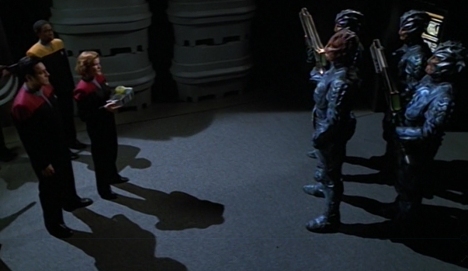
Future’s End, Part I and Future’s End, Part II provided the model for these big “event” two-parters. Scorpion, Part I and Scorpion, Part II applied to the Borg in order to offer an even bigger bang for their buck. Year of Hell, Part I and Year of Hell, Part II took the ship and crew to their limit to tell a story set over an entire year. The Killing Game, Part I and The Killing Game, Part II pushed the idea even further, with UPN opting to show both parts of the story on the same night as something like a television movie. It was a big deal.

Deep Space Nine had broadcast The Way of the Warrior as a television movie, but it was a season premiere and effectively a second (or even third) pilot. The Killing Game, Part I and The Killing Game, Part II comprised a high-concept mid-season two parter. They were arguably a stock Voyager episode, only bigger. In the years ahead, Dark Frontier, Part I and Dark Frontier, Part II would follow the same pattern. So would Flesh and Blood, Part I and Flesh and Blood, Part II. The Killing Game, Part I and The Killing Game, Part II established a trend.

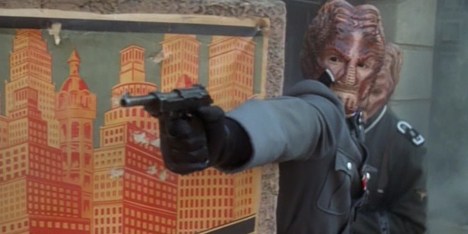
Super evil alien space Nazi.

Continue reading

Non-Review Review: The Promise

The Promise is made in earnest, even if it cannot honour all of its commitments.

The Armenian Genocide remains one of the most horrifying atrocities of the twentieth century, which is saying something. The horror of that systematic extermination is compounded by a refusal to acknowledge the violence committed by the Ottoman Empire. Modern Turkey refuses to acknowledge, or take responsibility, for those crimes. Political realities prevent other major powers from holding the government to account. It is a shameful situation, all around.

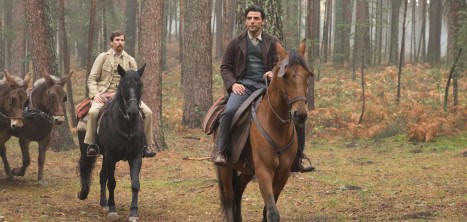
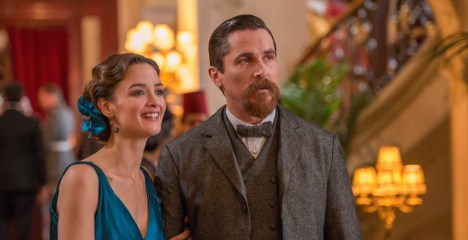
The Promise is made with the intent of shedding some light on that atrocity and bringing it to international attention. It is clearly a passion project, made with the best intentions. The film undoubtedly captures the horror of the violence inflicted upon the Armenian Christians and the systemic nature of the attempt to wipe out an entire civilisation. There are points at which The Promise plays as a travelogue into terror, a sequence of harrowing images set against a journey across Turkey during the First World War.

However, The Promise is also very much modeled on an old-school Hollywood adventure movie, complete with daring stunt work and tangled romantic subplots. The Promise evokes the feel of “classic” Hollywood, with its broad themes and its impressive scale. This sleek approach to the material jars with the horror being inflicted, the movie’s character arcs pasted over a nightmarish true story just a little too smoothly. The Promise is well-intentioned, if clumsy in execution.

Continue reading

Star Trek: Voyager – The Killing Game, Part I (Review)

In some ways, The Killing Game, Part I and The Killing Game, Part II feel like a perfect companion piece to Year of Hell, Part I and Year of Hell, Part II.

As with Future’s End, Part I and Future’s End, Part II during the third season, these two two-part episodes are very much larger-than-life archetypal Star Trek storytelling. While Future’s End, Part I and Future’s End, Part II riffed on Star Trek IV: The Voyager Home, and Year of Hell, Part I and Year of Hell, Part II borrowed liberally from Star Trek II: The Wrath of Khan, The Killing Game, Part I and The Killing Game, Part II draw from a broader pool of franchise iconography for a Star Trek: Voyager spectacular.

A cut above.

As with Future’s End, Part I and Future’s End, Part II or Year of Hell, Part I and Year of Hell, Part II, The Killing Game, Part I and The Killing Game, Part II are very much concerned with themes of memory and history. Much like Henry Starling or Annorax, the Hirogen are presented as villains waging a war upon history. They have no history or culture, usurping that of the crew and distorting it to serve their own whims and desires. Of course, The Killing Game, Part I and The Killing Game, Part II features no literal time travel, merely holographic.

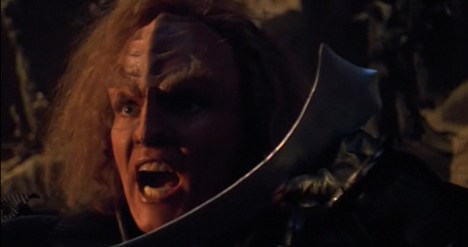
However, The Killing Game, Part I and The Killing Game, Part II is more than just archetypal Voyager. These preoccupations with memory and history are wrapped up in a whole host of broad and iconic Star Trek idea. Although the two-parter features a number of different plot threads, including the recreation of a classic Klingon conflict, the bulk of the action unfolds in a holographic simulation of the Second World War. Once again, the Star Trek franchise returns to that conflict as a formative and defining moment.

For the world is hollow and I have touched the sky.

Indeed, the two-parter even makes a point to weave the franchise’s core humanism into its sprawling epic pseudo-historical conflict. As much as The Killing Game, Part I and The Killing Game, Part II are driven by spectacle, writers Brannon Braga and Joe Menosky are careful to integrate classic Star Trek themes into the episode. While the story begins with the Voyager crew defeated and subjugated by the Hirogen, it ends with a peaceful settlement. Janeway grants the Hirogen a chance to save their people. Coexistence seems possible.

As such, The Killing Game, Part I and The Killing Game, Part II feels like an intentionally broad smorgasbord of Star Trek themes and iconography. It feels very much like the culmination of the journey that Voyager has been on since the start of the third season, with the production team aspiring to produce a show that might not have its own distinct texture or identity but which retains an archetypal “Star-Trek-ian” quality.

Evil alien space Nazis!

Continue reading

Doctor Who: The Pilot (Review)

“That’s my face?”

“You seem a bit flexible on the idea.”

“You have no idea.”

The Pilot does pretty much exactly what it says on the tin.

It is effectively a soft jumping-on point very much aimed at a back-to-basics approach to Doctor Who. It is an episode that is not particularly ambitious or original, but instead serves to lay out the groundwork for the season ahead. Like so many episodes introducing new companions, it uses the companion in question as a window into the world of the Doctor and as an opportunity to effectively redefine the show. Given the overlap between Amy and Clara with Asylum of the Daleks, this is arguably the cleanest such introduction since The Eleventh Hour.

Getting on board…

It has been almost two years since the last full season of Doctor Who. There is every possibility that The Pilot could be a young fan’s introduction to the series. By that measure, The Pilot is reasonably successful. It runs through a fairly solid checklist of things that a reintroduction to Doctor Who should do. It introduces a new status quo. It features a simple villain that is driven by an intriguing high concept. It hints at a nice long-form mystery. It establishes a sense of character and identity for the new companion.

The result is an episode that feels more like a springboard and a mission statement than a strong episode in its own right, a reminder of what to expect from Doctor Who served as something of a warm-up lap.

Time (War) out…

Continue reading

26. Ran (#137)

Man is born crying. When he has cried enough, he listens to this podcast.

Hosted by Andrew Quinn and Darren Mooney, The 250 is a fortnightly trip through some of the best (and worst) movies ever made, as voted for by Internet Movie Database Users. New episodes are released every second Saturday at 6pm GMT, with the occasional bonus episode between them.

This time, Akira Kurusawa’s Ran.

Loosely inspired by King Lear, Akira Kurusawa’s epic saga charts betrayal and disorder in feudal Japan. When an ageing warlord surrenders his lands to his children, he has no idea of the destruction that he will unleash upon his family.

At time of recording, it was ranked the 137th best movie of all time on the Internet Movie Database.

podcast-ran

Continue reading

Star Trek: Deep Space Nine – Honour Among Thieves (Review)

Honour Among Thieves is effectively Star Trek: Deep Space Nine pitching itself as a nineties crime film.

One of the luxuries of Star Trek is the sheer flexibility of the format week-in and week-out, the capacity to tell different sorts of stories depending on the tastes of the writers. The franchise can do comedy episodes like The Trouble with Tribbles or House of Quark, political thrillers like Sins of the Father or Homefront and Paradise Lost, weird science-fiction like Whispers or Threshold. The possibilities are endless, the variety incredible. It is a remarkable flexibility, to the point that the audience is never entirely sure what genre they will end up with in a given week.

To Bilby or not to Bilby…

The writers on Deep Space Nine have long been fascinated with the darker side of the Star Trek universe, the pulpy aspect of the franchise that was largely downplayed in the Rick Berman era. Episodes like Necessary Evil played with the conventions of noir storytelling, while Whispers hinted at some postmodern paranoia. The Orion Syndicate were brought back into twenty-fourth century continuity in The Ascent. Occasionally, the strands would come together, most notably in A Simple Investigation, a cyberpunk noir that blended “net girls” with bantering assassins.

Honour Among Thieves very much continues along that evolutionary line. It picks up the Orion Syndicate thread from earlier episodes like The Ascent or A Simple Investigation. However, it also positions itself very much in the context of nineties gangster cinema. This is Deep Space Nine channelling Donnie Brasco, casting O’Brien as a mob informant finding himself sympathetic to his target.

Miles ahead of the enemy.

Continue reading

Star Trek: Voyager – Retrospect (Review)

Star Trek: Voyager is a very nineties show. Sometimes that is endearing. Sometimes it is not.

Retrospect is an episode that made a great deal more sense in the context of the nineties. It was still troublesome and reactionary, structuring its central allegory in a way that was deeply problematic. However, Retrospect made a certain amount of sense when considered in light of the McMartin Preschool scandal and the satanic panic driven by regression hypnosis in the early part of the decade. Retrospect is very clearly an attempt to turn that talking point into a twenty-fourth century allegory about witch hunts and persecution.

Assimilate this…

However, there are a number of poor choices made over the course of the episode. The most obvious is build the episode around the character of Seven of Nine. There are any number of reasons why this would be written as a Seven of Nine episode, given that she is the breakout character of the fourth season. However, episodes like The Gift and The Raven have made a conscious effort to portray Seven of Nine as an abuse surviving living with genuine trauma. To put her at the centre of an episode about false allegations of abuse feels ill-judged.

Similarly, the emphasis on the subject of these accusations and his ruined life feels more than a little tone-deaf, even in the context the nineties satanic panic. Retrospect is not an episode about Seven of Nine processing abuse or even coping with distorted memories. It is ultimately the story about how the falsified accusations of abuse (from a character who is a verified abuse victim) can serve to destroy the lives of innocent men. Indeed, the emphasis on the EMH as a proxy for Seven of Nine downplays her own agency in this plot.

Memory Beta.

These aspects are troubling even in the context of an episode about the dangers of using hypnotherapy as the basis of these charges. However, the scandal has slipped from public consciousness in the years since Retrospect was initially broadcast. When the audience hears about women false accusations against men, it evokes the long-standing myth that men are frequent victims of falsified reports about sexual assault that ruin lives. This was creepy and uncomfortable subtext was obvious at time of broadcast, but has only become more pronounced in the years since.

Retrospect would have been a very clumsy and ill-judged allegory in the context of the mid-to-late-nineties. Decades removed from that original context, it seems almost reprehensible.

Blinding flash of the obvious.

Continue reading