• Following Us

  • Categories

  • Check out the Archives


  • Awards & Nominations

The X-Files (Topps) Digest #1 – Big Foot, Warm Heart (Review)

This November (and a little of December), we’re taking a trip back in time to review the third season of The X-Files and the first (and only) season of Space: Above and Beyond.

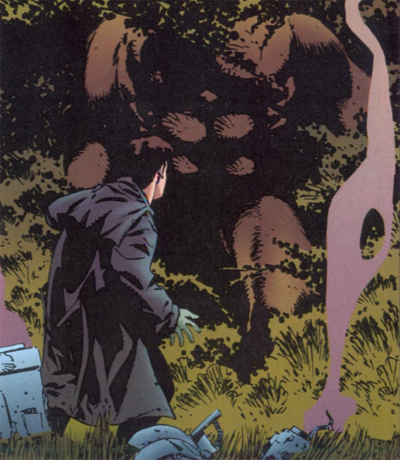
It is very odd to think that The X-Files has never done an episode about Bigfoot, perhaps America’s most recognisable and iconic mythological figure.

Perhaps there’s a reason for this. The show did a Bigfoot-type creature early in its first season, with The Jersey Devil. The fifth episode of the first season, The Jersey Devil helped to solidify the impression that The X-Files was better at abstract horrors than familiar monsters. It is not too difficult to imagine that the production team looked at The Jersey Devil and decided that Bigfoot was unlikely to be a runner.
Here there be monsters...

Here there be monsters…

Still, the show has waded into cryptozoology on occasion – with somewhat mixed results. Quagmire featured the agents hunting a mysterious reptile in a rural lake. When the show had to relaunch itself during the eighth season, Scully and Doggett bonded over their pursuit of a giant bat-like creature in Patience, the first standalone episode within that new status quo. Even Bigfoot was frequently referenced and cited. Most obviously, the final montage of Jose Chung’s “From Outer Space” suggests that Mulder treats the Roger Patterson footage as an almost holy text.

Perhaps it’s appropriate, then, that Mulder and Scully would come face to face with Bigfoot in the pages of the licensed tie-in, as part of the “digest” that Topps released at the end of their first year publishing the comic.

Eye see...

Eye see…

Continue reading

The X-Files – 731 (Review)

This November (and a little of December), we’re taking a trip back in time to review the third season of The X-Files and the first (and only) season of Space: Above and Beyond.

731 is a lot more substantial than Nisei.

This is most likely due to the episode’s production history. Frank Spotnitz had pitched the episode that would become 731 as a single standalone episode, but the production team discovered that the show was too large to fill a single forty-five minute block. So the show was extended into a two-parter. Given that Spotnitz was the credited writer on 731, it would seem that the second part retained most of the substance.

It's in the eye of the beholder...

It’s in the eye of the beholder…

This makes a great deal of sense, given that the two-parter eschews the stand format of a two-part X-Files episodes, featuring a frantic run-around in the first forty-five minutes and a tighter more intimate story in the second. Coupled with the fact that the episode is more about working through what we already know instead of heaping more information on top, and the two-parter seems a lot more substantial than most of the series’ big mythology shows.

Thoughtful, introspective, and unnerving, 731 is perhaps the highpoint of the show’s entire nine-season conspiracy arc.

Where the bodies are buried...

Where the bodies are buried…

Continue reading

The X-Files – Nisei (Review)

This November (and a little of December), we’re taking a trip back in time to review the third season of The X-Files and the first (and only) season of Space: Above and Beyond.

The most interesting aspect of Nisei and 731 is the fact that there’s very little forward movement by the end of it.

The previous multi-part conspiracy episodes typically featured big hooks and shock revelations. Duane Barry and Ascension demonstrated that the government was officially responsible for alien abductions, to the point where they could arrange Scully’s abduction. Colony and End Game featured shape-shifting aliens and confirmation that Samantha Mulder was a big part of this. Anasazi, The Blessing Way and Paper Clip revealed that Mulder’s father was part of a conspiracy involving Second World War criminals working on American soil to create an alien-human hybrid.

The only way its getting off this planet is in a bodybag...

The only way its getting off this planet is in a bodybag…

Nisei and 731 don’t contain any truly seismic revelations. The biggest moments here – the reveal that Japanese war criminals have been experimenting on Americans with the assistance of the government, and that the bodies in the box car in Anasazi were probably originally human – all build on what Paper Clip already established. There’s nothing as significant as the reveal of the Bill Mulder’s complicity in the conspiracy from Paper Clip, or the first appearance of the Black Oil in Piper Maru.

Nisei and 731 really seem to be about taking stock of what has happened so far in the show – as close to a “breather” mythology episode as the show could manage at this point. Of course, this being The X-Files, this “breather” episode still moves a break-neck pace and climaxes with a death-defying leap on to a moving train. As you do.

The doctors are in...

The doctors are in…

Continue reading

The X-Files – The Walk (Review)

This November (and a little of December), we’re taking a trip back in time to review the third season of The X-Files and the first (and only) season of Space: Above and Beyond.

The approach that The X-Files took during its third season was to hone what had worked during the first two seasons to a fine edge.

The second season had been quite playful and experimental – taking the time to figure out what did and didn’t work. Comedy episodes, like Die Hand Die Verletzt and Humbug, worked; making shows like Clyde Bruckman’s Final Repose or Jose Chung’s “From Outer Space” logical choices. Mythology-driven two-parters during sweeps had paid off, so those returned for the third season. In contrast, the heavy science-fiction of shows like Fearful Symmetry, Død Kälm or Soft Light didn’t work, and were largely forgotten.

Let some light in...

Let some light in…

The result is a third season that plays to the established strengths of The X-Files. Sure, there are still bold and experimental episodes – particularly those credited to writer Darin Morgan. However, the third season is markedly more conservative in tone than the second season – or even the fourth season. This conservatism can work very well. The third season has very few out-and-out bombs, and more than a few classics. However, it comes at a cost.

The Walk is a reasonably well-produced episode that feels a little bit overly familiar. This is the second “supernatural revenge” story that The X-Files has done in so many episodes. There’s a point where The Walk feels a lot less like a unique story than an archetypal “fill in the blanks” exercise, where a unique location and a new set of characters are caught up in an old-fashioned ghost story.

Don't worry, Stans will take good care of him...

Don’t worry, Stans will take good care of him…

Continue reading

The X-Files – 2Shy (Review)

This November (and a little of December), we’re taking a trip back in time to review the third season of The X-Files and the first (and only) season of Space: Above and Beyond.

A lot of the success of the third season of The X-Files came for learning what had worked earlier, and trying to hone that.

So, for example, the epic mythology of Colony and End Game enabled episodes like Nisei and 731 along with Piper Maru and Apocrypha. Shows like Die Hand Die Verletzt and Humbug had proven that the show could do comedy, so it wasn’t as big a risk to commit to stories like Clyde Bruckman’s Final Repose or Jose Chung’s “From Outer Space.” Even episodes like Fresh Bones had helped to define what a standard “monster of the week” should look like.

Freak like me...

Freak like me…

This approach to the third season had its drawbacks. It seemed like the first chunk of the first season was stuffed with supernatural revenge stories, to the point where it is surprisingly easy to confuse The List and The Walk on the basis of title and theme alone. However, it was a very effective way of producing television. It is very hard to fault any approach towards television production that could turn “fat-sucking vampire” into a premise that works.

The genealogy of 2Shy is quite easy to trace. It is the obvious synthesis of Tooms and Irresistible, two of the more memorable and effective monster stories of the first two seasons. 2Shy may have some very serious problems, but it does what it says on the tin.

Fresh bones...

Fresh bones…

Continue reading

The X-Files – The List (Review)

This November (and a little of December), we’re taking a trip back in time to review the third season of The X-Files and the first (and only) season of Space: Above and Beyond.

The List taps into a lot of contemporary anxieties.

As with Chris Carter’s last stand-alone script for The X-Files, there is something very timely about The List. The late second season medical conspiracy thriller F. Emasculata had aired at a point where national anxieties about Ebola and other killer diseases were at a high, with the high-profile release of Outbreak and the publication of Crisis in the Hot Zone. One of Carter’s strengths as a producer and a writer was his ability to take the national pulse, and to make The X-Files reflect whatever made nineties America uncomfortable.

A capital idea...

A capital idea…

Continue reading

The X-Files – Clyde Bruckman’s Final Repose (Review)

This November (and a little of December), we’re taking a trip back in time to review the third season of The X-Files and the first (and only) season of Space: Above and Beyond.

Clyde Bruckman’s Final Repose is a masterpiece.

It is one of the best episodes that The X-Files ever produced. It is the only episode of The X-Files to win the Emmy for Outstanding Writing in a Drama Series. It was the first episode to take home an Emmy for a performance on the show, with Peter Boyle winning the Emmy for Outstanding Guest Actor in a Drama Series. It was Boyle’s only Emmy win of ten nominations. It was the only episode of The X-Files to air on the 13th October, a symbolically important date for Carter (“1013”). It was also Friday the 13th.

No bones about it...

No bones about it…

As part of the recent resurgence in interest in The X-Files, the story has enjoyed even more focus. It was one of three episodes voted by fans to air as part of the Los Angeles Times Hero Complex Film Festival in 2013 as part of the series’ twentieth anniversary celebrations. Chris Carter himself chose it to represent The X-Files at the Austin Film Festival in 2012. It is very frequently ranked among the best the show ever produced.

And all of that praise is very well earned.

Crystal clear...

Crystal clear…

Continue reading

The X-Files – D.P.O. (Review)

This November (and a little of December), we’re taking a trip back in time to review the third season of The X-Files and the first (and only) season of Space: Above and Beyond.

What is interesting about the third season of The X-Files is the way that everything seemed to click into place. After two years of figuring out how various parts of the show worked, the series was in a place where it worked like a finely-honed machine. The conspiracy episodes hit all the right boxes. The second season had demonstrated the show could do experimental or even humourous episodes. Even the standard “monster of the week” shows were delivered with more confidence and style.

While D.P.O. may not be the strongest episode of the third season, it is an example of how comfortable the show has become. It is an episode that move incredibly well, where the vast majority of the pieces click, and one which is fondly remembered by the fan base. There’s a very serious argument to be made that writer Howard Gordon was the best author of “monster of the week” scripts working on the show at this point, and D.P.O. demonstrates how well he crafts these sorts of stories.

Cooking up a storm...

Cooking up a storm…

D.P.O. also benefits from any number of elements that make it seem memorable, even if it is “business as usual” after a massive three-part conspiracy epic. The opening sequence – featuring Ring the Bells by James – is one of the first times the show has so successfully integrated music into its action, something that would become a memorable part of later shows and even Millennium. The guest cast features Giovanni Ribisi and Jack Black. The episode also perfectly captures teen angst in an insightful manner.

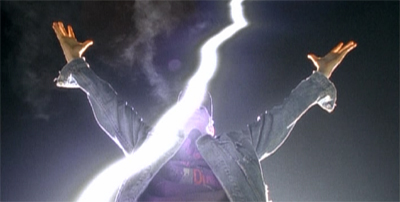
The show was apparently drawn from an index card labelled “lightning boy”, which had been on Chris Carter’s white board since the first season. It’s very hard to imagine the show pulling off something like D.P.O. during its first season. While it might have worked towards the end of the second season, the start of the third season seems the perfect place for it.

Cloudy with a chance of angst...

Cloudy with a chance of angst…

Continue reading

The X-Files – Paper Clip (Review)

This November (and a little of December), we’re taking a trip back in time to review the third season of The X-Files and the first (and only) season of Space: Above and Beyond.

And now we return to your scheduled viewing.

In many respects, Paper Clip feels like the real third season premiere. It establishes a lot of the recurring themes and ideas for the mythology of the season, from Krycek-on-the-run through to collaboration in the wake of the Second World War. It builds on the successful multi-part formula established by episodes like Ascension or End Game during the show’s second season. It moves things along in a way that The Blessing Way simply refused to. (It even resolves the cliffhanger from the last episode on screen.)

The light at the end of the tunnel...

The light at the end of the tunnel…

Paper Clip demonstrates the strengths of the third season of The X-Files. The third season was the point at which the show really pushed the mythology out, building on earlier implications that there was form to be found in the shadows. The third season also looked to the second season to determine what had worked and what had not worked. Paper Clip is very clearly modelled on the successful aspects of second parts like Ascension or End Game.

It moves. The power of Paper Clip comes from an incredible forward momentum that allows the show to maintain tension and excitement while refusing to allow the audience to catch their breath. Instead of resolving the bigger plot threads from the first episode, questions and hints are thrown out with reckless abandon as the script just drives through set pieces and emotional beats and suspenseful sequences. It is a very meticulously, very cleverly constructed piece of television.

Watching the skies...

Watching the skies…

Continue reading

The X-Files (Topps) #8-9 – Silent Cities of the Mind (Review)

This November (and a little of December), we’re taking a trip back in time to review the third season of The X-Files and the first (and only) season of Space: Above and Beyond.

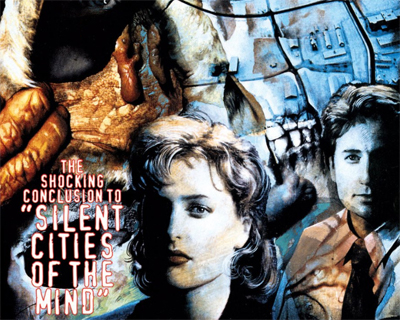
Silent Cities of the Mind is a very “comic book” story – it’s a story that might easily seem outlandish or ridiculous if committed to film, but which works very well within its medium. After all, the plot centres around a bunch of ancient Aztec priests who built an elaborate underground city that could project itself above ground as a mirage. Indeed, the story seems to accept this as a given, with Scully instead spending most of the adventure questioning whether memories can be transmitted via cannibalism.

It’s a concept that could easily seem ridiculous, and it’s a testament to writer Stefan Petrucha and artist Charles Adlard that it works as well as it does. Silent Cities of the Mind is a decidedly pulpy adventure, but that lends the story an undeniable charm. It’s a story packed to the brim with clever and fascinating ideas – from ancient aliens to ritual cannibalism to hidden cities to crystal skulls. All this is crammed tightly into two issues, meaning that everything moves so fast there’s no real time to stop and nitpick it all.

It's all in the mind...

It’s all in the mind…

Mulder is negotiating with survivalists! There are memories transferred through the act of ritual cannibalism! Mulder and Scully are shot down over Alaska! Mulder is trapped with a cannibal! There’s a hidden Aztec city buried underground! Mulder has discovered ancient Aztec mythology! There’s an army rescue team that isn’t a rescue team! There’s a macguffin that allows its wearer to commune with the gods! There’s a stand-off!

It’s all rather exhausting, but in a fun and exciting sort of way. Silent Cities of the Mind is perhaps the best example of how Petrucha and Adlard were writing The X-Files as a comic book, positioning the show’s tropes and iconography within the framework of comic book conventions.

Bonfire of the vanities...

Bonfire of the vanities…

Continue reading