• Following Us

  • Categories

  • Check out the Archives


  • Awards & Nominations

The X-Files (Topps) #13 – One Player Only (Review)

This November (and a little of December), we’re taking a trip back in time to review the third season of The X-Files and the first (and only) season of Space: Above and Beyond.

After a twelve-issue opening mega-arc of interconnected stories about conspiracies-within-conspiracies and wheels-within-wheels, author Stefan Petrucha and artist Charles Adlard step back a little bit to close out their run with a series of standalone stories. The four issues (and three stories) that make up the rest of their run on Topps’ X-Files comic stand alone. They are connected by themes and subtext, but very clearly stand apart from what came before. Indeed, they play out almost like a postscript to the main body of work, a series of smaller bite-sized chunks.

In that light, it is interesting that One Player Only feels – superficially, at least – a lot more in step with the television show. The early issues of the comic had seen Petrucha and Adlard creating their own supporting cast and their own conspiracy, so as to avoid stepping on the toes of the production company. The Cigarette-Smoking Man was largely reduced to a number of cameos, with Skinner popping up once or twice along the way.

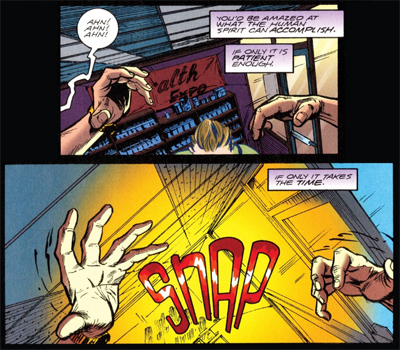
Ghosts in the machines?

Ghosts in the machines?

Not only does One Player Only feature a guest appearance from supporting characters like Mr. X or yhe Lone Gunmen, it also harks back to the structure and format of the first season of the show. On the most basic of levels, One Player Only feels like a more cyberpunk take on Ghost in the Machine, right down to the fact that Mulder is drawn into a murder at a tech company by an acquaintance from his days in the Violent Crimes Division. At one point, Mulder and Scully stumble on a ransacked house, for Mulder to deadpan, “Hm. Nothing new.”

However, if one peels back the layers, One Player Only is a fascinating piece that sets the tone for Petrucha and Adlard’s last three issues on the series, while infusing the comic with a host of fascinating cyberpunk stylings and body horror that seem to call forward to William Gibson’s future writing for the show.
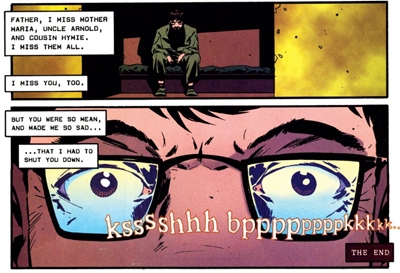
Coding out...

Coding out…

Continue reading

The X-Files – Pusher (Review)

This November (and a little of December), we’re taking a trip back in time to review the third season of The X-Files and the first (and only) season of Space: Above and Beyond.

Pusher is perhaps one of the most effective stand-alone “monster of the week” stories that the show ever did.

It is no wonder that the episode is frequently cited among the best episodes of The X-Files ever produced, but it is telling that it was identified by Slate as the perfect “gateway” episode of the show. If you want to give someone a taste of The X-Files without burdening them with continuity or back story, this is a good choice. It may not be the best episode that Vince Gilligan ever wrote, and it may not even be the best episode of the third season, but it is one the strongest demonstrations of what the show does on a weekly basis.

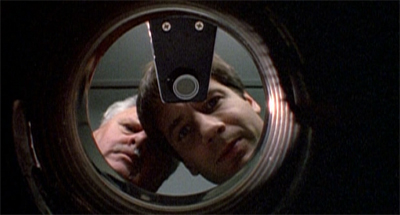
Mano a mano...

Mano a mano…

Pusher is the first episode that Vince Gilligan wrote after joining The X-Files writing staff. It is the only episode credited to Gilligan in the show’s third season. He had been offered a position on staff after turning in Soft Light at the end of the second season, but had hesitated before accepting the job. When he did accept the job, he came down with a dose of infectious mononucleosis. As a result, Gilligan only wrote one script for the third season, despite becoming one of the show’s most prolific writers.

Pusher is a pulpy delight, a spectacularly constructed standalone that perhaps points the way to Gilligan’s later work.

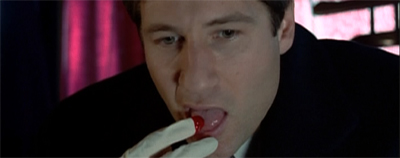
Gift of the gab...

Gift of the gab…

Continue reading

The X-Files – Piper Maru (Review)

This November (and a little of December), we’re taking a trip back in time to review the third season of The X-Files and the first (and only) season of Space: Above and Beyond.

Piper Maru and Apocrypha continue a pretty clear thematic throughline for the show’s third season mythology episodes.

As with The Blessing Way/Paper Clip and Nisei/731, Piper Maru and Apocrypha tell a story about how we relate to the past. In particular, in keeping with the rest of the third season mythology, it is a show about the legacy of the Second World War. The X-Files is a show that is sceptical of the decisions made by the American government towards the end of the Second World War, particularly as those decisions shaped and moulded the present. In many ways, The X-Files is a show about history and legacy, trauma and consequence.

A fish out of water...

A fish out of water…

Piper Maru and Apocrypha are less direct about this connection than the earlier mythology episodes. They aren’t about the war criminals given safe habour after the Second World War in return for scientific knowledge or tactical advantages. Instead, Piper Maru and Apocrypha are shows about dredging up the past and confronting the consequences of past actions. These two episodes are not only steeped in American popular history, but also in the show’s internal continuity. The majority of what happens here is driven by events we’ve seen in the show.

At the same time, Piper Maru and Apocrypha represent an attempt to boldly expand and push the mythos forward in the same way that Colony and End Game did at this point in the second season. The result is an intriguing two-parter that feels a little muddled and messy, an example of the show stumbling slightly as it tries to grow outwards. Although the mythology is still working a lot more efficiently than it would in later seasons, there is a sense of clutter beginning to filter in.

The eyes have it...

The eyes have it…

Continue reading

The X-Files – Grotesque (Review)

This November (and a little of December), we’re taking a trip back in time to review the third season of The X-Files and the first (and only) season of Space: Above and Beyond.

Grotesque is probably Howard Gordon’s strongest script for The X-Files.

F. Emasculata had demonstrated that Howard Gordon and Chris Carter worked very well together as a writing team. Carter was very good at big philosophical concepts, while Gordon was very adept at structuring a plot. Gordon knows how to build momentum and suspense, and his best scripts benefit from that particular talent. It helps that Gordon and Carter are probably the writers with the best understanding of Mulder as a character at this point in the show’s run.

Here there be monsters...

Here there be monsters…

Grotesque is an intriguing episode, particularly when examined in the context of the third season. The first and second season of The X-Files had been rather experimental in nature – the show tried to figure out what worked and what didn’t. The third season built off the successes of those earlier seasons. The idea seemed to be that the show would do more of what had worked, only better. So there were more two-part mythology episodes, more grounded stories, more comedy.

Grotesque is fascinating because it draws as much from earlier stories that didn’t work, using the lessons that the show had learned in the years since in order to make them work this time around.

Face-off...

Face-off…

Continue reading

‘Ship Shape or Ex-Files? Mulder, Scully and Paranormal Romance

This November (and a little of December), we’re taking a trip back in time to review the third season of The X-Files and the first (and only) season of Space: Above and Beyond.

It is very hard to talk about The X-Files without talking about the relationship between Mulder and Scully.

This goes without saying. After all, David Duchovny was a regular for seven years of the show, making a few appearances across the final seasons. Gillian Anderson was in the primary cast for all nine seasons. Both movies have centred around the characters. The recent comic book “Season Ten” returns to the classic Mulder and Scully dynamic. It is impossible to imagine The X-Files without Fox Mulder and Dana Scully.

xfiles-pilot8

Given how frequently the possibility of a revival comes up, one suspects that the biggest problem with potentially rebooting or relaunching the series is the fact that it would be impossible to book Duchovny and Anderson for twenty-odd episodes in a given year. Surely some enthusiastic executive has pitched a new X-Files show (“the neXt files”, perhaps?), only to have the idea shot down because it fails to consider how big a deal Mulder and Scully are to the show.

Indeed, given how important Mulder and Scully are to the show, it seems inevitable the discussion would turn towards the possibility of a romantic relationship between the two. They are two very attractive straight people of opposite genders with great chemistry. Romance seems all but assured between the two. Of course the possibility of a romance between Mulder and Scully became a fault line in X-Files fandom.

xfiles-endgame3

Continue reading

The X-Files – Syzygy (Review)

This November (and a little of December), we’re taking a trip back in time to review the third season of The X-Files and the first (and only) season of Space: Above and Beyond.

On original broadcast, Syzygy and War of the Coprophages were separated by three weeks, airing either end of January.

That probably helps to make Syzygy seem like less of a disappointing retread on initial broadcast, but it doesn’t help on modern binge re-watches. Even allowing for the three weeks between the episodes, Syzygy was always going to suffer in comparison its direct predecessor. If War of the Coprophages was Darin Morgan affectionately mimicking Chris Carter’s style, then Syzygy feels like Carter’s attempt to write a script in a voice quite close to that of Darin Morgan.

The horny beast...

The horny beast…

Structurally, the third season is constructed quite cleverly – and Syzygy is a massive part of that. The third season seems to fold in on itself, which means it makes sense for Syzygy to serve as a fun house mirror War of the Coprophages from a purely structural perspective. The problem is that this decision adds a lot to the third season of the whole while undermining Syzygy itself. It feels like an unsatisfactory decision.

However, even divorced from context, Syzygy is still a mess of an episode. Carter would go on to provide some of the show’s most comedic hours in later seasons, and Syzygy marks a starting point of that trend. It is not an auspicious beginning.

Reading the signs...

Reading the signs…

Continue reading

The X-Files (Topps) #1/2 – Tiptoe Through the Tulpa (Review)

This November (and a little of December), we’re taking a trip back in time to review the third season of The X-Files and the first (and only) season of Space: Above and Beyond.

Tiptoe Through the Tulpa is another nice “extra” from Topps’ licensing of The X-Files. The comic book was Topps’ most successful property, and the company worked very hard to promote it across various platforms. They tried to recruit potential readers from within the comic book industry and outside the comic book industry, devoting considerable time and energy to advertising the ongoing series.

Stefan Petrucha and Charles Adlard had provided promotional strips for TV Guide and for Hero Illustrated, both very clear attempts at courting potential new readers. Both strips adopted very different approaches. Aimed at as broad an audience as possible, the strip for TV GuideCircle Game – was a tight five-page story that covered a lot of ground in a very efficient manner. In contrast, the strip for Hero IllustratedTrick of the Light – was very clearly targeted at a much more niche audience, featuring in-jokes and references for fans and geeks.

He's not 1/2 the man he used to be...

Herbert’s not 1/2 the man he used to be…

Tiptoe Through the Tulpa was written as a tie-in promotion for Wizard magazine, a giveaway for people who read the comic industry’s most popular collector and insider magazine. People would buy Wizard #53, fill out a form and then send away for their copy of the seventeen-page X-Files #1/2. It was a gimmick, but it was a gimmick that was very clearly aimed at broadening the comic’s audience, convincing a few readers who wouldn’t otherwise try the book to check out a “free” sample comic.

As such, Tiptoe Through the Tulpa is written as a seventeen-page comic that could serve as a potential jumping-on point for new readers. It is rather light, rather simple, but nevertheless makes for a clean and effective X-Files one-shot.

Cue theme music...

Cue theme music…

Continue reading

The X-Files – War of the Coprophages (Review)

This November (and a little of December), we’re taking a trip back in time to review the third season of The X-Files and the first (and only) season of Space: Above and Beyond.

It is very odd to describe any Darin Morgan episode as “underrated.” And yet, despite that, War of the Coprophages feels like the underrated Darin Morgan teleplay.

Clyde Bruckman’s Final Repose had appeared towards the start of the season, featuring a powerhouse guest performance from Peter Boyle. Both Boyle and Morgan would win Emmys for their work on that episode, and Clyde Bruckman’s Final Repose is perhaps Morgan’s most conventional script for The X-Files or Millennium. In contrast, Jose Chung’s “From Outer Space” is perhaps the most adventurous and gonzo episode of The X-Files ever produced, coming at the end of the season and relentlessly (but affectionately) mocking the show’s core iconic mythology.

Down the drain...

Down the drain…

In contrast, War of the Coprophages sits in the middle, literally and figuratively. It is positioned almost precisely in the middle of the third season, with Morgan writing the screenplay in an exceptionally short period of time. It isn’t a truly exceptional example of a monster-of-the-week episode in the way that Clyde Bruckman’s Final Repose was, but it also isn’t as off-the-walls and bizarre as Jose Chung’s “From Outer Space.” It doesn’t feel like it has as much to say about death as Clyde Bruckman’s Final Repose, nor as much about life as Jose Chung’s “From Outer Space.”

And yet, in its own way, War of the Coprophages as an incisive and well-constructed commentary on The X-Files as a television show while allowing Morgan to tackle his recurring themes about society and humanity, and whether the world is what we would like to think that it is.

Bug hunt...

Bug hunt…

Continue reading

The X-Files (Topps) – The Pit (Review)

This November (and a little of December), we’re taking a trip back in time to review the third season of The X-Files and the first (and only) season of Space: Above and Beyond.

Tucked away in the Winter 1996 issue of The X-Files Magazine and republished with The Silent Sword in September 1996, The Pit is an atmospheric short story from Petrucha and Adlard, demonstrating the two work quite well together across a variety of formats. The Pit is only nine pages long, including two splash pages – and another half-page splash. There isn’t a lot of room for plot or detail. Instead, Petrucha and Adlard opt for mood and atmosphere, crafting a weird and spooky little diversion.

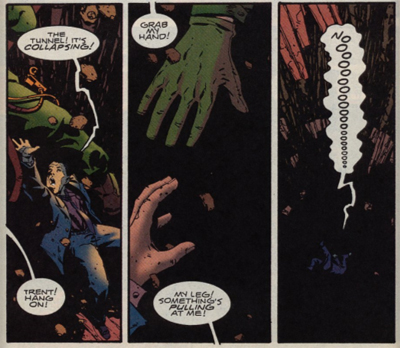
All fall down...

All fall down…

Continue reading

The X-Files – Revelations (Review)

This November (and a little of December), we’re taking a trip back in time to review the third season of The X-Files and the first (and only) season of Space: Above and Beyond.

Religion, eh?

In the mid-nineties, religion was a very difficult subject to navigate on network television. The so-called “culture wars” were in full swing at the middle of the decade, with religious values serving as a particularly brutal battleground. Religion is a very thorny and contentious subject. As recently as 2012, more than 40% of polled Americans stated they would not vote for an atheist candidate in a presidential election. Pete Stark would admit to being an atheist in 2007, becoming the first self-identified atheist in the United States Congress.

Mulder's got a taste for adventure...

Mulder’s got a taste for adventure…

As a result, it is very difficult to have a meaningful and thoughtful conversation about it. “There’s a man that I work with – a friend – and usually I’m able to discuss these things with him… but not this,” Scully confesses at the end of the episode. While undoubtedly a comment on Mulder’s stubborn refusal to engage with Scully on the topic, it also feels like a commentary on the awkwardness of any public discussion about religious beliefs or values, which was prone to become highly charged and contentious.

The conventional wisdom was that you didn’t talk about religion at the dinner table. It wasn’t much easier on television. This puts Revelations in a very awkward position.

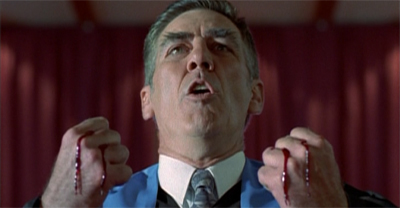
A bloody business...

A bloody business…

Continue reading