• Following Us

  • Categories

  • Check out the Archives


  • Awards & Nominations

Star Trek: Voyager – Year of Hell, Part I (Review)

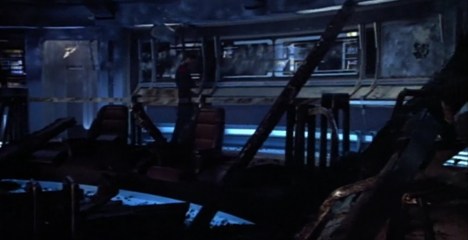
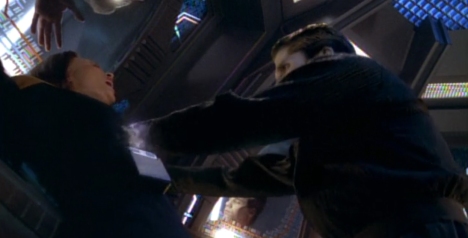
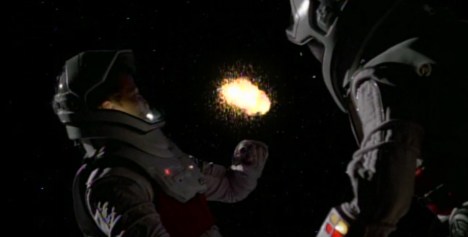
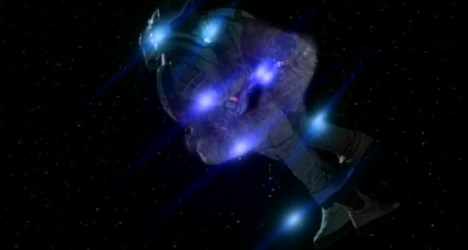
Year of Hell, Part I and Year of Hell, Part II might just be the perfect episodes of Star Trek: Voyager.

Taken together, these episodes perfectly demonstrate the raw potential and strength of the third Star Trek spin-off. They are a boldly ambitious story of a ship that finds itself in hostile territory surrounded by a hostile force with superior firepower, all while playing into the recurring themes and fascinations of the wider series. Year of Hell, Part I and Year of Hell, Part II are effectively a story that finds history itself under threat, while emphasising Brannon Braga’s interpretation of Janeway by setting her against a similarly obsessive opponent.

Things fall apart.

Things fall apart.

The result is one of the most thrilling and engaging stories of Voyager‘s seven-season run, among the most satisfying of the series’ impressive “blockbuster” two-parters. Although the show is still being broadcast in the standard nineties 4:3 aspect ratio, it feels like a widescreen story. Part of that is due to the fact that the two-parter unfolds over three quarters of an entire year, part of that is the expanded room for storytelling, part of that is the fact that history itself hangs in the balance, part of that is the fact that Voyager itself feels at stake.

Year of Hell, Part I and Year of Hell, Part II do an excellent job capturing the essence of Voyager.

The Voyager cast Christmas party took a heavier toll than usual.

The Voyager cast Christmas party took a heavier toll than usual.

Continue reading

Star Trek: Voyager – Scientific Method (Review)

Scientific Method is in many ways the flip side of the coin to episodes like Nemesis, Distant Origin or Remember.

Nemesis, Distant Origin and Remember were effective demonstrations of Jeri Taylor’s approach to Star Trek: Voyager, a conscious effort to downplay the unique premise of the show in favour of pitching a more generic sort of Star Trek. With that in mind, Nemesis, Distant Origin and Remember constructed powerful allegories to examine pressing contemporary issues through the lens of science-fiction, resulting in episodes that represented one of the most defining aspects of the franchise: the sci-fi-tinged morality play.

Built into Voyager's DNA.

Built into Voyager’s DNA.

Not every example of this approach worked as well as those three episodes. Voyager began leaning into this more archetypal and generic Star Trek storytelling at the start of its third season, and the results were quite hit-and-miss. There were certainly brilliant examples in the seasons ahead, like Living Witness or Blink of an Eye. But not every allegory worked as well. Sometimes, the episodes were too didactic, like Critical Care or Repentance. Sometimes, the episodes were too generic, like The Chute. Sometimes, they were just ill-judged, as with Retrospect.

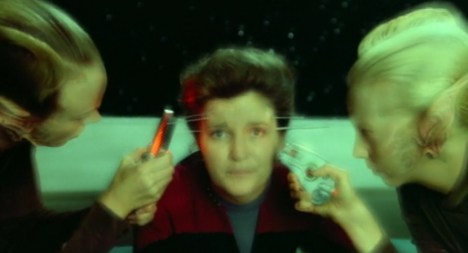
Scientific Method is a very bland and forgettable episode of Star Trek. It is not necessarily bad, but it is also not particularly memorable. In some ways, it demonstrates the limitations of the “generic Star Trek” approach to scripting for Voyager. Without a set of interesting and well-developed characters with strong dynamics in a series with a unique identity, an average episode can feel rather flat.

Give her head peace.

Give her head peace.

Continue reading

Star Trek: Voyager – The Raven (Review)

Seven of Nine is something of a mixed blessing for Star Trek: Voyager.

In some respects, the character is a transparent ratings ploy designed to refocus media attention on and attract young male viewers to a television series facing major audience attrition. The series already has enough trouble serving the under-developed members of its ensemble like Chakotay, Tuvok and Kim. The arrival of Seven of Nine only compounds this issue, with the character serving as a focal point in five of the first six episodes of the fourth season. Seven of Nine is a very cynical addition to the cast, an awkward band aid applied to a patient with a chronic condition.

Enlightening.

Enlightening.

However, there is no denying that Seven of Nine works as a character. Even is early in the fourth season, Seven of Nine is more intriguing and compelling than most of the primary cast. As early as The Gift, Jeri Ryan demonstrated that she was one of the strongest members of the ensemble. Seven of Nine might be an awkward combination of the Spock and Data archetype with blatant fan service, but she already has a stronger character and a clearer arc than the vast majority of the regular cast. The production team know what they want from Seven, which is more than can be said of Chakotay, Tuvok or Kim.

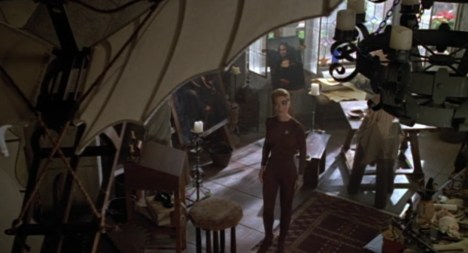
Indeed, The Raven further solidifies the character’s purpose and arc in the larger context of Voyager. Indeed, The Raven very cleverly and very literalises Seven of Nine’s character arc, doing so in a way that integrates her into the larger broader themes of Voyager. With The Raven, Seven’s journey to reclaim her lost humanity is rendered as a literal homecoming. Like everybody else on the ship, Seven is ultimately trying to find her way back home.

"I shall become a bat... er... a human."

“I shall become a bat… er… a human.”

Continue reading

Star Trek: Voyager – Revulsion (Review)

Revulsion is a solid episode elevated by a superb guest performance.

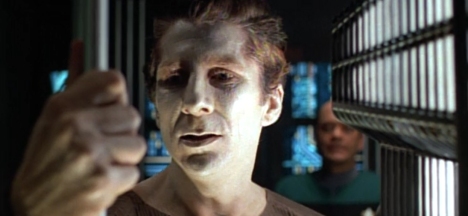
The most notable aspect of Revulsion is the guest appearance of veteran character actor Leland Orser. Orser’s screen presence is striking, making an impression with supporting role in high-profile films from The Bone Collector to se7en to Alien Resurrection to Daredevil. He has also worked reliably in television, holding down regular roles in shows like E.R. and Berlin Station, while recurring in series like 24 and Ray Donovan. To modern audiences, he is likely recognisable got his work as a fixture of the Taken franchise.

Not just holo praise.

Not just holo praise.

Even within the Star Trek franchise, Orser is very much a recurring fixture. While never a steady player like J.G. Hertzler or Jeffrey Combs, Orser made quite an impression. He played the changeling posing as Tal Shiar operative Colonel Lovok in The Die is Cast on Star Trek: Deep Space Nine, making the most of a rather minor role in one of the series’ most memorable two-part episodes. He would also do good work as the venal Loomis in the otherwise disappointing Carpenter Street during the third season of Star Trek: Enterprise.

However, his guest appearance in Revulsion on Star Trek: Voyager remains his most distinctive turn in the franchise. Playing Dejaren, a psychotic and fragmented hologram who murdered his crew, Orser singlehandedly elevates would could easily be a tired genre exercise. Revulsion is a solid episode, but one that sticks in the memory almost entirely due to the casting.

Kali Ma!

Kali Ma!

Continue reading

Star Trek: Voyager – Nemesis (Review)

Nemesis is a great example of Star Trek: Voyager pitching itself as generic Star Trek.

This is a story that is not unique or particular to this crew. In fact, the story could easily be adapted to service characters from Star Trek: The Next Generation or Star Trek: Deep Space Nine or even Star Trek: Enterprise. In some respects, Nemesis might even work better if Robert Beltran were swapped out for Jonathan Frakes or Colm Meaney or Connor Trinneer. There is very little in the script that relies on the particularities of this show or the nuances of its characters.

The Rifleman...

The Rifleman…

While this lack of a distinct identity is a problem for Voyager as a television series, it does lead to some great episodes. Many of the best episodes of Voyager could easily be ported to or from any of the other shows. It was an approach that really came to the fore during the third season, when Jeri Taylor and Brannon Braga made a conscious choice to steer the show away from its focus on a crew stranded far from home and towards a more generic Star Trek sensibility.

At its best, this leads to very strong allegorical storytelling. Episodes like Remember and Distant Origin are very much archetypal Star Trek episodes, extended science-fiction metaphors with a strong moral core that evoke the Star Trek beloved by so many of its fans. Nemesis is very much an episode constructed in that tradition, a metaphorical exploration of the dehumanisation of soldiers through combat training and conditioning. It is a powerful and thought-provoking piece of social commentary and a superb piece of Star Trek.

A hard shoot.

A hard shoot.

Continue reading

Star Trek: Voyager – Day of Honour (Review)

Day of Honour is a reminder that, while Brannon Braga is clearly the heir apparent, Jeri Taylor is still the showrunner on Star Trek: Voyager.

Day of Honour is noticeably and recognisably a Jeri Taylor episode, particularly following so sharply from Scorpion, Part I, Scorpion, Part II, and The Gift. This is a script that plays very firmly to Jeri Taylor’s idea of Star Trek, including an emphasis on the development of interpersonal relationships and also a very traditional perspective on how the franchise is supposed work. Day of Honour is a very conservative episode following the bombast of the three very ambitious stories bridging the third and fourth seasons.

"Don't worry, Janeway will never miss it."

“Don’t worry, Janeway will never miss it.”

In some ways, this is undoubtedly a good thing. Jeri Taylor is clearly more interested in developing relationships between the characters than Brannon Braga. Taylor was a very old-school television writer and producer, but her best material on Voyager suggested a genuine interest in the cast and the characters. Resolutions is an episode consciously rooted in the romantic tension between Chakotay and Janeway. Coda is a very clear elaboration on Taylor’s interpretation of Janeway.

Taylor even drafted biographies for the crew in the form of Mosaic and Pathways, suggesting a deeper interest in the characters’ inner lives than any other writer on staff. In some ways, Day of Honour is an extension of this approach. It is the culmination of Taylor’s attempts to push Paris and Torres together in third season episodes like The Swarm, Blood Fever and Displaced. That relationship became one of the nicer dynamics on Voyager, and would never have happened under the oversight of either Michael Piller or Brannon Braga.

Adrift.

Adrift.

However, there are also very serious problems with Day of Honour. In keeping with the tone of Voyager during Taylor’s tenure, it is a very conservative piece of television both in terms of style and politics. After The Gift worked so hard to generate tension between Seven of Nine and the Voyager crew, Day of Honour casually brushes that aside. And it deals with an interesting story about the legacy of Seven’s relationship to the Borg in the most trite manner possible, the plot hinging on a techno-babble solution to ensure there is no actual conflict.

More than that, Day of Honour is incredibly reactionary in its portrayal of the Caatati, a refugee race who were rendered homeless by the Borg Collective. These dispossessed aliens are presented as greed and underhanded, ready to exploit the charity of our heroes and to betray them at the first opportunity. It is an extension of the xenophobic panic of Displaced, a tale about how our privileged heroes should react with paranoia and mistrust to those who arrive by accident or in distress. It is a rather uncomfortable Star Trek theme.

Means of transport.

Means of transport.

Continue reading

Star Trek: Voyager – The Gift (Review)

The Gift belongs to a very particular subgenre of Star Trek episodes.

It is an episode that fits comfortably alongside the other second stories of the other fourth seasons, alongside Family on Star Trek: The Next Generation, The Visitor on Star Trek: Deep Space Nine and Home on Star Trek: Enterprise. It is a relatively quiet and contemplative piece, more rooted in character than plot. In fact, very little of note happens during the episode, even as it is positioned at an important point in the larger run of Star Trek: Voyager following Scorpion, Part I and Scorpion, Part II.

Things come to a head.

Things come to a head.

As with FamilyThe Visitor and HomeThe Gift is a breather episode following a more epic adventure. As with Family and Home, The Gift is explicitly about working through the consequences of earlier episodes. Family allowed Jean-Luc Picard to work through the trauma of The Best of Both Worlds, Part I and The Best of Both Worlds, Part II, while Home provided an opportunity for Jonathan Archer to make sense of everything that happened between The Expanse and Zero Hour. (Let’s not worry too much about Storm Front, Part I and Storm Front, Part II.)

The Gift is an episode of contrasts, driven by the demands of the series rather than its own distinct plot. It is very heavily serialised, playing almost as the third part of Scorpion, Part I and Scorpion, Part II; much like Family played as the third part of The Best of Both Worlds, Part I and The Best of Both Worlds, Part II. However, there is something very cynical in the use of serialisation in The Gift, as the episode rather transparently exists to transition away from where the show was at the end of Scorpion, Part II towards a more sustainable status quo.

Kes of death to an established character.

Kes of death to an established character.

The Gift is also a tale of arrivals and departures. It is an episode about introducing Seven of Nine to the cast of Voyager, establishing her character arc and setting up her journey across the rest of the series building on her separation from the Borg Collective in Scorpion, Part II. At the same time, it is an episode about the departure of Jennifer Lien from Voyager, bidding farewell to Kes as a result of her exposure to “Fluidic Space” in Scorpion, Part II. There is something quite poetic in that set-up.

However, The Gift is just as much an episode of extremes in terms of quality. The story focusing on Janeway and Seven of Nine is rivetting and compelling, but the thread focusing on Kes plays almost as an afterthought. More than that, the episode’s final act plays as a gigantic cop out, another example of Voyager retreating from some of the bolder ideas in its core concept. The result is a curate’s egg of an episode, a reminder of Voyager‘s discarded potential.

Breakout character.

Breakout character.

Continue reading

Star Trek: Voyager – Scorpion, Part II (Review)

Scorpion, Part II demonstrates the real strength of the blockbuster two-part episodes scattered across the run of Star Trek: Voyager.

Generally speaking, the two-part episodes of Star Trek: The Next Generation suffered from a sense of disharmony. The two parts seldom felt integrated, often feeling quite disconnected from one another. This was most obvious in the cliffhangers bridging the seasons, when the writing staff would take time away from the office before returning to write the second part. Michael Piller famously had no idea what he was going to do with The Best of Both Worlds, Part II when he wrote The Best of Both Worlds, Part I.

Droning on.

Droning on.

Even for the two-part episodes within a given season, there tended to be a disjointedness. Chain of Command, Part I is very much set-up for Chain of Command, Part II, with the second part feeling much stronger (and more substantial) than the first. Birthright, Part I leads into Birthright, Part II, but also features an entirely unrelated subplot that is dropped completely in the second half. Arguably, The Next Generation only really figured out how to properly balance two-parters in its final season, with Gambit, Part I, Gambit, Part II and All Good Things…

In contrast, Voyager does a much better job of balancing its two-parters so that they feel like two halves of a movie rather than an extended first act followed by a compressed second and third act. Future’s End, Part I and Future’s End, Part II established that template, but Scorpion, Part I and Scorpion, Part II demonstrates that it can applied as readily to season-bridging two-parters as to mid-season sweeps episodes. Scorpion, Part I and Scorpion, Part II integrate beautifully to form an impressive Voyager television movie.

Venting frustration.

Venting frustration.

Continue reading

Star Trek: Voyager – Season 3 (Review)

The third season of Star Trek: Voyager marks the point at which the show stops trying.

To be fair, it is not as though the opening two seasons of the show were marked by a surplus of ambition. Caretaker was a bold piece of science-fiction that promised a host of interesting ideas for the new Star Trek show, but all of those fascinating conflicts were quickly brushed aside by episodes like Parallax and Time and Again, which insisted on formulaic plotting and familiar storytelling. In many ways, the first season of the show felt like a cheaper eighth season of Star Trek: The Next Generation.

voy-fairtrade3

During the second season, the production team did attempt something a little bolder. Michael Piller returned from his work on Legend convinced that the franchise needed a dramatic shake-up and reinvention. So he attempted to introduce long-form storytelling on the series, with an arc building the Kazon as a credible threat to ship and crew. This arc failed spectacularly for a variety of reasons, with episodes like Alliances and Investigations ranking among the worst in the series’ run.

The Voyager writing staff were apparently traumatised by their experiences on that second season. Piller stepped aside at the end of the year, forced by the threat of mass resignations. Piller bid farewell to the show with Basics, Part I and Basics, Part II, effectively allowing the staff a clean slate coming into the third series of the show. Jeri Taylor stepped up into the role of showrunner, trying to steady a ship that was very clearly on troubled water. Three years into the run, how did Voyager define itself?

voy-futuresendparti13a

The third season has traditionally been a formative year for the Star Trek spin-offs. Michael Piller took charge of Star Trek: The Next Generation during its third season and established the template for the franchise heading into the nineties. Ira Steven Behr solidified the direction of Star Trek: Deep Space Nine during its third season, outlining many of the concepts and ideas that would play in the stronger fourth and fifth seasons. Even Star Trek: Enterprise came into its own in its third season, telling its own stories.

Voyager did not come into its own during this third season. Jeri Taylor’s direction for Voyager set the series on a course back to familiar territory. The third season of Voyager marks the point at which a troubled series adopts the path of least resistance, content to stop pushing itself in any direction and let itself be pulled by the gravity of the franchise around it. The third season of Voyager marks the point at which the series becomes content to be generic Star Trek.

voy-distantorigin27a

Continue reading

Star Trek: Voyager – Scorpion, Part I (Review)

In some ways, Scorpion, Part I is the perfect cap to the third season of Star Trek: Voyager.

The third season has largely seen the show retreating from ideas and concepts that would render it unique in the larger Star Trek canon. Although the first two seasons were hardly radical in terms of storytelling style or substance, Michael Piller did make a conscious effort to build off some of the premises unique to this show. The Kazon might have been a terrible idea in both concept and execution, but they were at least something new. While the second season botched its attempts at serialisation, at least it made the effort.

This is perhaps a metaphor for what Voyager is going to do to the Borg...

This is perhaps a metaphor for what Voyager is going to do to the Borg…

In the third season, the production team seem to have settled upon the idea of producing generic Star Trek, rather than telling stories unique to Voyager. This is something of a mixed blessing. While the third season features a host of forgettable episodes like Warlord and Alter Ego, it features few episodes as soul-destroying as Alliances or Investigations. More than that, episodes like Remember or Distant Origin demonstrate the appeal of producing generic Star Trek stories, ranking among the best episodes that the show has produced to date.

More than that, the production team have consciously pushed the show much closer to the model of Star Trek: The Next Generation. This is most obvious in the handling of Q as a character. While Death Wish found something novel and interesting to do with the character after All Good Things…, The Q and the Grey returns the character to his default settings for a cringe-worthy dress-up episode that owes far too much in concept and execution to Q-Pid. There are plenty of other examples.

This might also be a potent metaphor for what Voyager is about to do to the Borg...

This might also be a potent metaphor for what Voyager is about to do to the Borg…

However, Voyager‘s most overt embrace of the legacy of The Next Generation came with the introduction of the Borg. The Borg are in many ways the most iconic creation of the Berman era, perhaps the only new alien species liable to recognised alongside the Klingons or the Romulans or the Vulcans. After all, the Borg were the antagonists of Star Trek: First Contact, the theatrical release intended to celebrate the thirtieth anniversary. Their aesthetic influence can even be felt on Star Trek Beyond, the theatrical release intended to celebrate the fiftieth anniversary.

The Borg made their first appearance at the end of Blood Fever, in a postscript scene that feels like almost like a post-credits tease that arrived ten years too early. The Borg also appeared in Unity, an episode which featured Chakotay encountering the survivors from a disconnected Borg ship desperately trying to reconnect their shared link. However, neither of these episodes featured the Borg Collective, the powerful and single-minded collective consciousness that drives the hive mind.
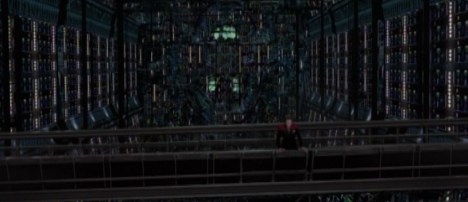
Building a bridge...

Building a bridge…

So it makes sense that the Borg Collective would appear in full force for Scorpion, Part I, the third season finale and cliffhanger bridging to the fourth season. Once again, this is a creative decision right out of the Next Generation playbook. The Next Generation really cemented its distinct cultural identity with the broadcast of The Best of Both Worlds, Part I at the end of its third season. Part of this was simply down to the fact that it had outpaced the original Star Trek, which only lasted three years. However, part of it was also that the cliffhanger was spectacular television.

Scorpion, Part I is not spectacular television. It is good television. It is a satisfying blockbuster epic, with a strong sense of momentum and some interesting ideas. However, it also smells a little bit of desperation. It feels like Voyager has completely abandoned its own sense of identity and followed the path of least resistance. Insert your own joke there.

Or, you know, don't. Whatever floats your boat.

Or, you know, don’t. Whatever floats your boat.

Continue reading