• Following Us

  • Categories

  • Check out the Archives


  • Awards & Nominations

Star Trek: Deep Space Nine – House of Quark (Review)

The September and October, we’re taking a look at the jam-packed 1994 to 1995 season of Star Trek, including Star Trek: Deep Space Nine and Star Trek: Voyager. Check back daily for the latest review.

House of Quark is a delightful episode that probably does a better job of setting the tone for the third season of Star Trek: Deep Space Nine than The Search. As much as the Dominion were introduced as “a big deal” and clearly intended to change the show’s status quo, the third season does very little with them. There are a few mentions here and there, a late-season two-parter, two scattered episodes looking at aspects of the Dominion, and a series finalé, but they don’t drive the third season as much as one might expect, or as much as they drive the fifth through seventh seasons.

In contrast, House of Quark is a decidedly irreverent look at the world of Star Trek, a decidedly cynical perspective on one of the franchise’s sacred cows – a downright subversive exploration of something that the franchise takes for granted.
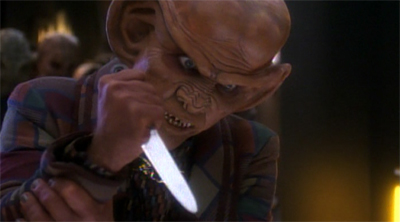
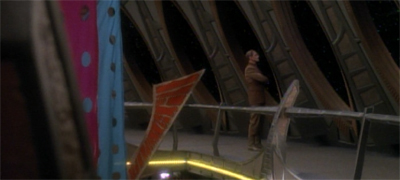
A knife story, there, Quark...

A knife story, there, Quark…

Continue reading

Star Trek: Deep Space Nine – The Search, Part II (Review)

The September and October, we’re taking a look at the jam-packed 1994 to 1995 season of Star Trek, including Star Trek: Deep Space Nine and Star Trek: Voyager. Check back daily for the latest review.

In a way, The Search feels almost like a parody of the classic Star Trek season-bridging cliffhanger. It is a story told under the same title, but with both halves of the story feeling distinct enough to stand on their own two feet. Written by two different writers and directed by two different directors, it very much feels like two very different stories linked primarily by an efficient cliffhanger.

It’s not radically dissimilar to the two-parters from Star Trek: The Next Generation. Redemption and Descent come to mind, two-part adventures that very much feel like two different stories melded together rather than one single over-arching story. This disjointedness makes a great deal of sense, given the standard operating procedure when it came to Star Trek cliffhangers, as established by Michael Piller with The Best of Both Worlds, Part I. The logic is simple: write part one; go away for a few months; return and try to write part two.

Of course, The Search very clearly isn’t a season-bridging cliffhanger. It’s a season-opening two-parter. And it’s so cleverly and consciously structured as two very different episodes that it can’t help but feel like a sly nod at the inevitable outcome of that approach to writing – playfully self-aware of how disjointed the whole experience feels as a single story.

A whole new Vorta problem...

A whole new Vorta problem…

Continue reading

Star Trek: Deep Space Nine – The Search, Part I (Review)

The September and October, we’re taking a look at the jam-packed 1994 to 1995 season of Star Trek, including Star Trek: Deep Space Nine and Star Trek: Voyager. Check back daily for the latest review.

The Search, Part I is interesting. It is an episode that, in effect, serves as something of a second pilot for the show. It’s an episode that re-conceptualises the show, while taking a great deal of trouble to ensure that any new viewers will be brought up to speed. In fact, The Search is a rather disjointed two-parter as a whole. The first part feels like a lot of set-up with a cliffhanger tacked on to the end of the episode, while the second part is very clearly its own story.

It makes sense. At this point, Star Trek: Deep Space Nine is the only Star Trek on television. It’s a period that doesn’t last, and which is really just a scheduling fluke. The show’s second season continued on past the airing of All Good Things…, the final episode of Star Trek: The Next Generation. The third season began broadcasting before the airing of Caretaker, the pilot of Star Trek: Voyager. Star Trek: Generations was released somewhere in the middle. So the stretch where Deep Space Nine was “the only Trek on television” feels largely illusory.

Still, The Search, Part I feels like a conscious attempt to welcome any wayward Star Trek fans. Including, appropriately enough, new staff writer Ronald D. Moore.

Staring into space...

Staring into space…

Continue reading

Mike W. Barr and Gordon Purcell’s Run on Star Trek: Deep Space Nine (Malibu Comics) (Review/Retrospective)

The September and October, we’re taking a look at the jam-packed 1994 to 1995 season of Star Trek, including Star Trek: Deep Space Nine and Star Trek: Voyager. Check back daily for the latest review.

The nineties comic book market was an interesting place. It enjoyed a huge boost due to the rise of speculation and collectors. The industry was massively successful in the early years of the decade, fuelled by high-profile artists, hype, and events. The industry imploded in on itself in the middle and towards the end of the decade, but it looked surprisingly profitable in the early years. Against that backdrop, Malibu Comics emerged.

Malibu had become the publisher of record for Image Comics in 1992. Image had been founded by a number of popular artists who had departed Marvel to set up their own shop and found their own company. Malibu distributed their comics for about a year, which gave Malibu access to a larger distribution platform. Although Image soon grew strong enough to publish its own comics, there was a point where Malibu had surpassed industry veteran DC Comics in the market place.

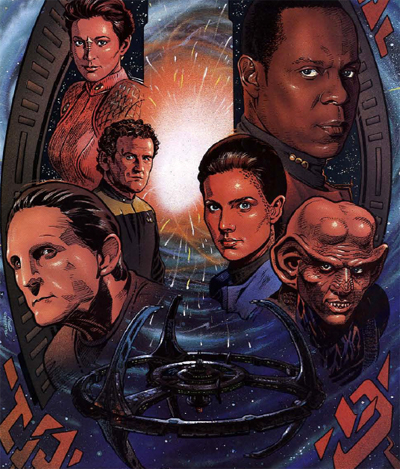
"Think of it—five months ago no one had ever heard of Bajor or Deep Space Nine. Now all our hopes rest here."

“Think of it—five months ago no one had ever heard of Bajor or Deep Space Nine. Now all our hopes rest here.”

Against this backdrop, Malibu secured the rights to publish comic books based on Star Trek: Deep Space Nine. Up until this point, DC comics had been publishing comics based on the original Star Trek and Star Trek: The Next Generation. Paramount’s decision to award the Deep Space Nine license to Malibu effectively split the comic book license up. DC Comics continued to publish comics based around the first two Star Trek shows, while Malibu had exclusive rights to the characters and world of Deep Space Nine.

As such, the decision to recruit writer Mike W. Barr and artist Gordon Purcell to write the first six issues of the comic was a pretty big deal. Barr and Purcell were incredibly associated with Star Trek comic books. The duo had done popular work on the movie-era comics, and had demonstrated an obvious and abiding affection for the franchise. Assigning these two creators to work on Deep Space Nine was a very clear message. Malibu were taking this license very seriously, indeed.

Triptych...

Triptych…

Continue reading

Star Trek – Debt of Honour (Review)

This June, we’re taking a look at some classic Star Trek movie tie-ins and other interesting objects. Check back daily for the latest reviews and retrospectives.

By all accounts, Debt of Honour should be an unqualified success.

It’s a prestige graphic novel from DC comics, produced around the twenty-fifth anniversary of Star Trek and the release of Star Trek VI: The Undiscovered Country. It is written by celebrated comic book scribe Chris Claremont, fresh off his career-defining stint on Uncanny X-Men. An avowed Star Trek fan and comic book veteran, this should be in his wheel house. The art is provided by Adam Hughes, one of the most celebrated and respected artists of his time.

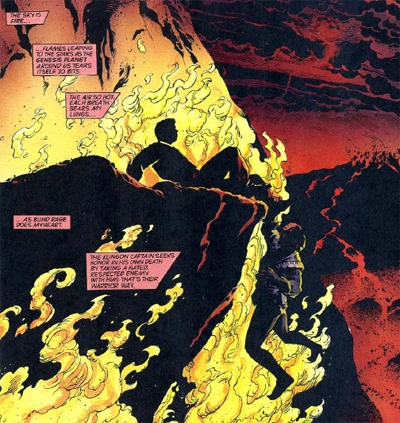
Talk about kicking off a comic...

Talk about kicking off a comic…

By any measure, Debt of Honour should count as some sort of hallmark for DC Comics’ Star Trek tie-ins. Unfortunately, that isn’t quite the case. A rather muddled storyline that is hopelessly devoted to Star Trek continuity while awkward interfacing with it,  Debt of Honour is just packed a little too tight. Charting a story from the earliest days of Kirk’s career to the aftermath of Star Trek IV: The Voyage Home, Claremont bites off more than he can chew.

Over the course of Debt of Honour, Claremont introduces a vague alien threat that has apparently been haunting Kirk for his entire career, a new arch-foe or love interest for Kirk, and even a supporting role for Kor. Along the way, he packs in cameos and shout-outs to various parts of Star Trek lore. He even explains why Klingons suddenly had ridges around the time of Star Trek: The Motion Picture. Ultimately, Debt of Honour is ambitious, but a little over-stuffed and quite over-cooked.

Warp speed ahead!

Warp speed ahead!

Continue reading

Star Trek – The 25th Anniversary (Review)

This June, we’re taking a look at some classic Star Trek movie tie-ins. Check back daily for the latest reviews and retrospectives.

Star Trek VI: The Undiscovered Country was released quite close to the twenty-fifth anniversary of Star Trek. With Star Trek: The Next Generation at the height of its popularity, the franchise was able to mark the occasion with a variety of celebrations. There were comic books and prose books celebrating the occasion. Both Spock and Scotty appeared on The Next Generation around the time of the anniversary.

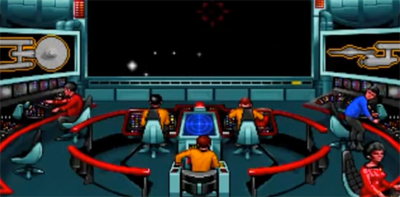
Perhaps the most obvious example was the release of Star Trek: The 25th Anniversary by Interplay. While it was not the first video game to be based on the Star Trek franchise, it was the first high profile release. It set the tone for commercial Star Trek video games, remaining one of the best-selling Star Trek video games ever produced. It paved the way for everything from Bridge Commander to A Final Unity to Elite Force.

Ship shape...

Ship shape…

Released across multiple platforms and featuring seven episodic adventures structured like episodes of the classic television show, The 25th Anniversary set a dramatic and effective precedent for Star Trek video gaming. The CD-ROM edition of the game took things even further, featuring voice recordings of the show’s primary cast to help lend a sense of continuity and credibility to events. The 25th Anniversary is littered with easter eggs and in-jokes, and it’s constructed with the utmost love and affection.

However, perhaps what is most interesting about The 25th Anniversary is the way that it plays into all these established Star Trek clichés and tropes, but with a rather sophisticated outlook. It’s a wonderful example of how the original Star Trek show never stopped reinventing itself, only really reaching a truly idealised form long after it had been off the air.

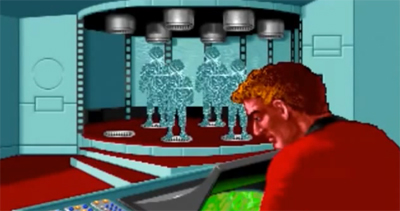
Beam me up, Kyle!

Beam me up, Kyle!

Continue reading

Star Trek (DC Comics, 1989) #35-40 – Tests of Courage/The Tabukan Syndrome (Review)

This June, we’re taking a look at some classic Star Trek movie tie-ins and other interesting objects. Check back daily for the latest reviews and retrospectives.

Captain Hikaru Sulu occupies a very special place in Star Trek lore. Given the amount of spin-off material that Sulu’s command of the Excelsior has generated, Sulu often seems like the Star Trek spin-off that never quite materialised. The idea of Sulu commanding the Excelsior has inspired novels and comics and audio books, and was even featured in Flashback, one of the episodes produced to celebrate the thirtieth anniversary of the franchise.

While Sulu’s command of the Excelsior is open-ended, it is interesting to consider the various origin stories that might apply. As with Khan Noonien Singh, there are multiple tie-in stories that cover the same ground. Published in late 2007, the novel Forged in Fire, for example, offers one account of Sulu taking command of the Excelsior – assuming command from Captain Styles during a high-pressure diplomatic crisis. However, this was not the first time that the story had been told.

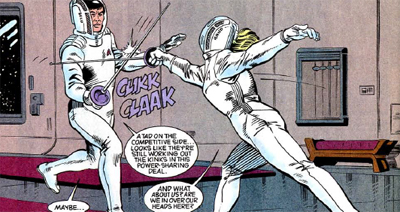
Crossing swords...

Crossing swords…

A year following the release of Star Trek VI: The Undiscovered Country, author Howard Weinstein wrote Tests of Courage. A six-issue arc set during the earliest days of Sulu’s command, Weinstein had originally hoped to collaborate with George Takei on the comic. Unfortunately, the two could not work out their schedules, forcing Weinstein to write the comic without Takei’s input. However, Takei did provide a glowing and enthusiastic foreword for the collected edition of the comic published two years later.

Tests of Courage is a fantastic piece of work, a suitably epic Star Trek comic that tells a suitably epic story – one with breadth and scope and drama and conflict that demonstrates just what a wonderful storyteller Howard Weinstein is.

Ships of the line...

Ships of the line…

Continue reading

Star Trek – The Fearful Summons by Denny Martin Flinn (Review)

This June, we’re taking a look at some classic Star Trek movie tie-ins. Check back daily for the latest reviews and retrospectives.

One of the great things about a franchise as expansive and as well-documented as Star Trek is that no idea is even completely lost to history. The franchise is sprawling enough that episodes and films inevitably end up lost to history. Scripts are written and re-written, with ideas changing dramatically from original conception through to the final released version. Even Star Trek: Phase II is well accounted for, affording fans a glimpse at how things might have gone for the franchise.

It’s interesting to imagine the possibilities that exist at given moment for the franchise – how radical things might be now had a particular event gone a different direction. Imagine Bryan Fuller and Bryan Singer bringing Star Trek back to television with Angela Bassett in the big chair. Or Spock on the grassy knoll. Or Oscar nominee Geneviève Bujold as Janeway. Or a first season of Star Trek: Enterprise set primarily on Earth during the development of the warp five drive.

So much of the franchise is discussed and analysed that ideas like this tend to bubble through. Occasionally, the franchise allows an echo of what might have been to break through. Star Trek: The Next Generation adapted two aborted scripts from Star Trek: Phase II into The Child and Devil’s Due. Harlan Ellison’s original script for The City on the Edge of Forever is being adapted into a comic book. That is to say nothing of writers like D.C. Fontana and David Gerrold working with fan productions.

However, Denny Martin Flinn’s novel, The Fearful Summons, is a particularly interesting glimpse at what might have been. It’s essentially a novel based around his original idea for Star Trek VI: The Undiscovered Country. It’s a rather bizarre and occasionally awkward glimpse at what might have been for the franchise.

tos-thefearfulsummons

Continue reading

Star Trek VI: The Undiscovered Country (DC Comics, 1992) (Review)

This June, we’re taking a look at some classic Star Trek movie tie-ins and other interesting objects. Check back daily for the latest reviews and retrospectives.

In many respects, adapting a Star Trek feature film into comic book form is very much an editorial function. With so little space available, particularly as compared to a feature film or novel, the assignment is more about whittling the script down to something that can be covered in fifty-five pages of a comic book. While those adapting the features films into novels frequently have to expand and flesh out the material to make it fit within the allocated page count and account for plot hole and logic error, the comic book adaptations just have to keep everything ticking over.

So Peter David and Gorden Purcell’s adaptation of Star Trek VI: The Undiscovered Country plays quite well as a condensed version of the narrative, covering the requisite story beats in the available space.

In space, everybody can hear you scream...

In space, everybody can hear you scream…

Continue reading

Star Trek VI: The Undiscovered Country by J.M. Dillard (Review)

This June, we’re taking a look at some classic Star Trek movie tie-ins. Check back daily for the latest reviews and retrospectives.

Reading her novelisation of Star Trek VI: The Undiscovered Country, it’s hard to shake the feeling that author J.M. Dillard really does not like this film.

It’s a very peculiar sensation, to read an adaptation clearly written by somebody who could not care less for the source material. It is not unique, of course. Diane Carey’s adaptation of Broken Bow is downright scathing in its attitude towards Star Trek: Enterprise. It just seems rather strange that J.M. Dillard’s early adaptation of Star Trek V: The Final Frontier seems a lot fonder of its source material.

st-theundiscoveredcountry-dillard

Continue reading